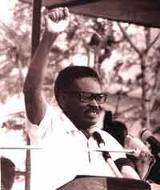
In remembrance of Agostinho Neto (Sept. 17 1922 – Sept. 10th 1979), great leader and first president of Angola, I will leave you with a poem written by the great Nigerian writer Chinua Achebe in honor of Agostinho Neto. Enjoy!!!
Agostinho, were you no more
Than the middle one favored by fortune
In children’s riddle; Kwame
Striding ahead to accost
Demons; behind you a laggard third
As yet unnamed, of twisted fingers?
No! Your secure strides
Were hard earned. Your feet
Learned their fierce balance
In violent slopes of humiliation;
Your delicate hands, patiently
Groomed for finest incisions,
Were commandeered brusquely to kill,
Your gentle voice to battle-cry.
Perhaps your family and friends
Knew a merry flash cracking the gloom
We see in pictures but I prefer
And will keep that sorrowful legend.
For I have seen how
Half a millennium of alien rape
And murder can stamp a smile
On the vacant face of the fool,
The sinister grin of Africa’s idiot-kings
Who oversee in obscene palaces of gold
The butchery of their own people.
Neto, I sing your passing, I,
Timid requisitioner of your vast
Armory’s most congenial supply.
What shall I sing? A dirge answering
The gloom? No, I will sing tearful songs
Of joy; I will celebrate
The man who rode a trinity
Of awesome fates to the cause
Of our trampled race!
Thou Healer, Soldier and Poet!
Je voulais partager avec vous ce rare bijou: une interview de la grande écrivain Maryse Condé dans laquelle elle discute de son livre Ségou, le premier roman épique africain.
——–
Dear All,
I just wanted to show you this rare jewel: an interview of the great writer Maryse Conde where she talks about her book Segu, the first epic African novel. Enjoy!
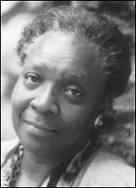
Maryse Condé is a Guadelopean/ French writer. She was married to a Guinean actor, and as such has always kept the patronym ‘Condé’ which hails from Guinea. She is a strong writer, and in my opinion, one of the best female writers of African descent. Her writing is deep, and encompasses a mixture of creole ancestry, and African culture. She has had a distinguished career as a writer and has taught at several prestigious universities in the US and France: Columbia University, University of California Berkeley, Harvard University, UCLA, University of Maryland, University of Virginia, Sorbonne, and Nanterre.
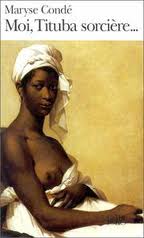
She tends to write historic fiction where she focuses on racial, gender, and cultural issues. I am an avid reader of Condé’s books. In I, Tituba: Black Witch of Salem [Moi, Tituba Sorciere] she explores slavery, and black presence during the Salem witch trials (until I read this book, it had never crossed my mind that there could be Blacks in Salem at that time).
‘Segu’ by Maryse Conde
One of the best novels ever written on an African kingdom was that of the capital of the Bambara EmpireSegu [Ségou] by Maryse Condé, which is deep and resurrects a very well-known kingdom in Mali, as well as slavery at that time, tribal warfare, the advance of islam in West Africa, the clash of cultures between muslims and animists, as well as muslims and Christians later on, and finally the presence of the white colons and the start of European imperialism in Africa. Through her novel, one finds strong historical facts, such as the battle between Fanti and Ashanti people in Ghana divided between French and English (An African version of the French-Indian war), the presence of Yoruba people in Sierra Leone, the presence of slave communities of Yoruba descent in Brazil and Jamaica, the different historic places such as the Gold coast, the Slave coast, the Grain coast, the weakening of the Bambara by the Islamic conquest which left them vulnerable to any advance by the French colonizers, etc… The depth of this book makes it one of the best African epic novel. For anybody craving for a history of Africa in the 18th/19thcentury, Segu is the best out there!
Moi, Tituba Sorciere
Asked about the meaning of her writing, Condé says: Je ne suis pas un ‘écrivain à message.’ J’écris d’abord pour moi, pour m’aider à comprendre et supporter la vie. En racontant des histoires que j’espère signifiantes, je souhaite aussi aider les autres, ceux de mon peuple en particulier, à comprendre et à la supporter à leur tour. [I am not a ‘writer of messages’. I write first for myself, to help me understand and bare life. By telling stories that I deem meaningful, I hope to help others also, particularly my people, to understand and bare life as well.]
Condé has received several awards, including the Prix Liberatur (Germany) for Segu, the Grand Prix Littéraire de la Femme for I, Tituba, Black Witch of Salem, the Prix Carbet de la Caraïbe for Desirada, the Prix Marguerite Yourcenar for Le Coeur À Rire et À Pleurer (1999, Tales from the Heart: True Stories from my Childhood), and Le Grand Prix du roman métis for En Attendant la Montée desEaux (2010). In 2001 she was ordained Commandeur dans l’Ordre des Arts et des Lettres de la France and in 2004 she was made Chevalier de la Légion d’Honneur. Please help me acclaim one of the greatest writers of African descent!!! Enjoy this interview given by Maryse Conde to Elizabeth Nunez on Grioo.com The website “ile-en-ile” provides a complete bibliography of her work. You will find a detailed biography of Condé on Kirjasto, and this interview of Maryse Conde where she discusses her book Victoire: My Mother’s Mother, about her grandmother.
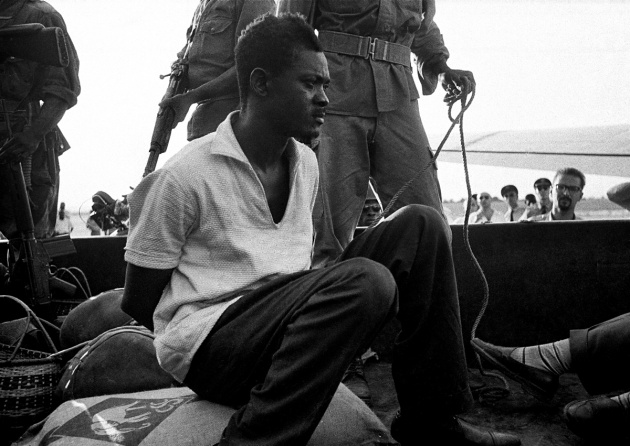
L’article qui suit vient du site 2011, Année Frantz Fanon. La similarité entre la démise de Patrice Lumumba 50 ans plutot, et celle de Laurent Gbagbo aujourd’hui pousse a se poser beaucoup de questions. Ici le grand écrivain antillais Frantz Fanon, en 1960, fait une analyse de ce qui n’a pas marché, et ce que Lumumba et les Africains en général devraient faire. Quelle pertinence! et quelle réalité!
———————————————————–
Le grand succès des ennemis de l’Afrique, c’est d’avoir corrompu les Africains eux-mêmes.
Il est vrai que ces Africains étaient directement intéressés par le meurtre de Lumumba. Chefs de gouvernements fantoches, au sein d’une indépendance fantoche, confrontés jour après jour à une opposition massive de leurs peuples, ils n’ont pas été longs à se convaincre que l’indépendance réelle du Congo les mettrait personnellement en danger. Et il y eut d’autres Africains, un peu moins fantoches, mais qui s’effraient dès qu’il est question de désengager l’Afrique de l’Occident. On dirait que ces Chefs d’État africains ont toujours peur de se trouver face à l’Afrique. Ceux-là aussi, moins activement, mais consciemment, ont contribué à la détérioration de la situation au Congo. Petit à petit, on se mettait d’accord en Occident qu’il fallait intervenir au Congo, qu’on ne pouvait laisser les choses évoluer à ce rythme.
Petit à petit, l’idée d’une intervention de l’ONU prenait corps. Alors on peut dire aujourd’hui que deux erreurs simultanées ont été commises par les Africains.
Et d’abord par Lumumba quand il sollicita l’intervention de l’ONU. Il ne fallait pas faire appel à l’ONU. L’ONU n’a jamais été capable de régler valablement un seul des problèmes posés à la conscience de l’homme par le colonialisme, et chaque fois qu’elle est intervenue, c’était pour venir concrètement au secours de la puissance colonialiste du pays oppresseur. Voyez le Cameroun. De quelle paix jouissent les sujets de M. Ahidjo tenus en respect par un corps expéditionnaire français qui, la plupart du temps, a fait ses premières armes en Algérie ? L’ONU a cependant contrôlé l’autodétermination du Cameroun et le gouvernement français y a installé un “exécutif provisoire”.
Voyez le Viet-Nam. Voyez le Laos.
Il n’est pas vrai de dire que l’ONU échoue parce que les causes sont difficiles.
En réalité l’ONU est la carte juridique qu’utilisent les intérêts impérialistes quand la carte de la force brute a échoué. Les partages, les commissions mixtes contrôlées, les mises sous tutelle sont des moyens internationaux de torturer, de briser la volonté d’expression des peuples, de cultiver l’anarchie, le banditisme et la misère.
Car enfin, avant l’arrivée de l’ONU, il n’y avait pas de massacres au Congo. Après les bruits hallucinants propagés à dessein à l’occasion du départ des Belges, on ne comptait qu’une dizaine de morts. Mais depuis l’arrivée de l’ONU, on a pris l’habitude chaque matin d’apprendre que les Congolais s’entremassacraient.
On nous dit aujourd’hui que des provocations répétées furent montées par des Belges déguisés en soldats de l’Organisation des Nations Unies. On nous révèle aujourd’hui que des fonctionnaires civils de l’ONU avaient en fait mis en place un nouveau gouvernement le troisième jour de l’investiture de Lumumba. Alors on comprend beaucoup mieux ce que l’on a appelé la violence, la rigidité, la susceptibilité de Lumumba.
Tout montre en fait que Lumumba fut anormalement calme.
Les chefs de mission de l’ONU prenaient contact avec les ennemis de Lumumba et avec eux arrêtaient des décisions qui engageaient l’État du Congo.
Comment un chef de gouvernement doit-il réagir dans ce cas ? Le but recherché et atteint est le suivant : manifester l’absence d’autorité, prouver la carence de l’État. Donc motiver la mise sous séquestre du Congo.
Le tort de Lumumba a été alors dans un premier temps de croire en l’impartialité amicale de l’ONU.
Il oubliait singulièrement que l’ONU dans l’état actuel n’est qu’une assemblée de réserve, mise sur pied par les Grands, pour continuer entre deux conflits
armés la “lutte pacifique” pour le partage du monde. Lire la suite …
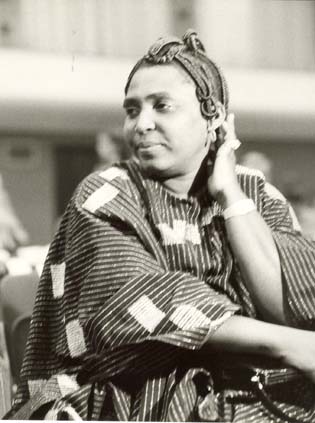
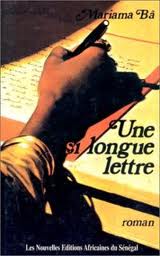
I have wanted to write about Mariama Bâ for the longest time. She is a writer from Senegal… she is the author of “Une Si Longue Lettre” [So Long a Letter], and “Chant Ecarlate” [Scarlet Song]. Her book “Une si Longue Lettre” [So Long a Letter] is considered by many as being the first truly African feminist book, as it describes the woman’s condition in an African and Muslim society. It talks about the place of the woman in society, the effect on polygamy on women and society, and the clash between modernism and traditions. It is written as a letter from a widow Ramatoulaye to her best friend Aissatou who left her husband when he decided to marry a second wife. This book really describes the feminine condition in Africa, and was truly the first to address so overtly the woman’s hurdle in African society. Six months after the publication of “Une Si Longue Lettre,” Mariama Ba passed away… and her novel “Chant Ecarlate” was published posthumously.
Une Si Longue lettre
Chant Ecarlate [Scarlet Song] also deals with feminine conditions, but addresses more the clash between two different cultures the European (of the protagonist Mireille), and the African (of Mireille’s husband), and again polygamy. I always felt deeply connected to Bâ’s first book, and always wondered what a great loss African literature suffered when she left. She will always be an inspiration for many: orphan from her mother, raised by her father and grand-parents, mother of nine children, divorcée, professor, highly educated woman, she embodied the strength and determination that can so clearly be seen in African women. Today, “Une Si Longue Lettre” is an African classic, read in all schools across the continent, and translated in numerous languages. We are forever grateful for her work… she opened the door to many bold young African female writers.
Scarlet Song
The following is an interview that Mariama Bâ gave to Alioune Toure Dia for the magazine Amina in November 1979: Interview de Mariama Bâ à Amina. Relax and enjoy!
“I have been a journalist since the age of 15. I started as an errand boy at a newspaper called Semences africaines, in the city of Yaoundé, Cameroon. Over the past 34 years, I have been arrested 126 times while carrying out my profession as a journalist. Physical and mental torture, death threats, the ransacking of my newsroom, etc., has often been my daily lot in a situation where repression and corruption, even within the press, have become the norm. Woe betide the slightest dissenting voice in this context, for it attracts all kinds of wrath, even from so-called colleagues…”
“I have never felt like a prisoner when I have been behind bars. You can be in prison without being a prisoner; the real prisoners are those who imprison journalists whose only crime is to inform or to express an opinion… ”
“… my long stay in prison above all stimulated my sense of solidarity with others, particularly the poor and the outcast… strengthened my determination to use journalism as a weapon against all kinds of abuse. For there is no better weapon than words for restoring peace and justice among people…”
“To have the privilege of writing taken away from you overnight feels like being victim of a crime…”
“During a lecture I once gave to students from a well-known university in New York, the director of the school of journalism made the following remark: “Mr. Njawe, my students and I appreciated your brilliant exposé of the situation regarding press freedom in Cameroon and in Africa in general. But I cannot help wondering one thing: either you invented all these stories to impress us, which I could understand, or everything you have told us is true and I am dying to ask you why you continue to work in the profession in the suicidal situation you describe?”
“It is indeed difficult to understand why people persist in a profession that causes them so much misery and suffering. As regards my own case, I invariably reply to everyone who wonders this, that I entered journalism the way you enter a religion; journalism is my religion.I believe in it, and a thousand trials, a thousand arrests, a thousand imprisonments and as many death threats will never make me change job. On the contrary, the harder it is, the more you have to believe in it and cling to it.”
“Even in the depths of a prison cell you can feel good about being a journalist. How many times have I not rubbed my hands in my cell, my fingers itching to once again hold a pen between them, when thinking back over my career? How many times have I smiled when recalling an editorial or an article that helped foil the most atrocious plans against Cameroon and its people? If only for consolation, one sometimes ends up saying: “They’re right to take it out on me like this, after all, I haven’t spared them in my articles…“. ”
Respecting ethical standards is of fundamental importance for anyone wishing to be a journalist. It protects you against all kinds of people who would like to teach you a lesson. When you are facing a judge who is being manipulated, it is your irreproachable professional defense that makes that judge examine his or her own conscience. It is what wins your colleagues over to your cause when you are in difficulty. Doing your job properly therefore seems to be the best advice anyone can give a journalist operating in a context of constant harassment. And doing your job properly also, and above all, means avoiding “gumbo journalism“, a practice becoming increasingly widespread in our profession, where people write what they are paid to write instead of giving real information and the truth. While journalists have the right to earn a decent living, even in emerging nations,honest journalists never need pockets in their shrouds…
Journalists perform a social function, which gives them not immunity, but the right to look critically at the way a nation is being run. While playing this crucial role, it is important for them to be protected by the law, but also by the whole of society for which they work…Every time a journalist is silenced, society loses one of its watchdogs.
Yes… I am actually talking about Ferdinand Leopold Oyono, the Cameroonian writer mostly known for his novels ‘Une Vie de Boy‘ (Houseboy), ‘Le Vieux Nègre et la Medaille‘ (The Old Man and the Medal), and ‘Chemin d’Europe‘ (Road to Europe). I must admit that I have only read the first two. I have decided to focus only on Oyono literary achievement, even though his literary career was quite short, and he also served as ambassador and minister under different presidents of Cameroon for over 40 years.
Une Vie de Boy (Houseboy)
In his novels, Oyono uses satire to denounce the colonial system, the abuse Africans suffer in the hands of the European. Oyono writes ‘Une vie de boy‘ (Houseboy) as a diary, and casts a critical view on the relations between Africans and Europeans during the colonial era. The main actor is a young boy, who leaves his family where he was mistreated, and ends up with the French missionaries, and later on works as a houseboy for the ‘Commandant’; where he quickly becomes the center of querels between the Commandant and his wife, and is frequently beaten because of what he knows. In his second novel, ‘Le vieux nègre et la medaille‘ (The Old Man and the medal), Oyono evoked the deep sense of disillusionment felt by those Africans who were committed to the west, yet rejected by their colonial masters. Meka, the main protagonist, receives a medal for his services to the French colonial administration, for donating land to the French missionary church and above all for sending his two sons to the second world war where they are killed.
The Old Man and the Medal
It is interesting that despite his short literary career, Oyono has managed to write two of the most important African novels depicting the relationship between the European colonizer, and the African colonized, a relationship made up of disillusionment, abuse, modernism, education, and cohabitation of two worlds where one is imposed on the other. The British newspaper The Guardian wrote a really good article saluting this great Cameroonian and African writer.
Le 3 Mai est la journée internationale de la liberté de presse. Pour moi, quand je grandissais à Douala, la liberté de presse avait toujours été symbolisée par Pius Njawe et son journal ‘le Messager‘. Qui au Cameroun n’a pas lu ‘le Messager’? Qui n’a pas souri sous les caricatures du ‘Messager Popoli‘? Je dévorais assidument chaque page de son journal… Au debut, quand j’étais toute petite, la rubrique ‘Takala et Muyenga‘ était la seule qui m’interessait car elle était amusante et il y avait de très belles carricatures (oui j’admets… j’aimais les dessins). Petit à petit, j’ai commencé à lire l’éditorial écrit par Pius Njawe lui-même, et puis finalement le journal tout entier. Mon père étais un abonné hors-pair, et c’est grâce à lui que le ‘Messager’ est devenu presque synonyme de ‘vraies‘ nouvelles (i.e. non contrôlée par l’etat) dans mes pensées. Pius Njawe avait un don, une passion: il aimait la vérité! Il était à la recherche de la vérité et du bien-être de la société civile. Il n’avait pas peur d’aller en prison pour avoir publier des articles poignants contre le gouvernement en place; il avait d’ailleurs été arrêté plus de 126 fois. En 2000, Njawe est nommé parmi les 50heros de la liberté de la presse des derniers 50 ans.
Le Messager
Quand je pense que Njawe avait créé ‘le Messager’ à l’age de 22 ans en 1979, sans même avoir fait d’études avancées… C’est surprenant!… non, impressionant! Il avait toujours était guidé par sa passion, et c’est certainement pour cela que ‘Le Messager’ était si différent de tous les autres journaux de la place: il était authentique, mû entièrement par la passion et la recherche de la vérité impartiale… bref par le journalisme à l’état pur! Que puis-je dire? La perte de Pius Njawe est comme la perte d’une perle precieuse, car Pius Njawe était effectivement une perle rare pour le Cameroun. Il avait résisté pendant 30 ans, et avait payé de cela par ses détentions arbitraires en prison, le saccage de ses bureaux par le gouvernement, l’exil au Benin (qui avait duré 1 an), la fausse-couche de sa femme (qui avait été battue en prison), la mort de sa femme, et ensuite lui-même. Il a payé de sa vie son amour de sa patrie, de la vérité, et du journalisme. Une chose est sûre et certaine, il a touché chacun d’entre nous, et son oeuvre continuera à jamais. Hasta la vista Pius, tu nous a ouvert les yeux à la cause de la démocratie et de la liberté. Tu resteras dans nos memoires comme étant le plus grand combattant, et opposant camerounais, car tu t’es opposé au népotisme, à la dictature, à l’injustice, et à la gabegie. Comme disait si bien Agostinho Neto: “La lutte continue et la victoire est certaine!”
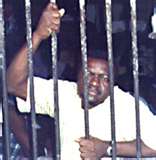
Pius Njawe in jail
May 3rd is the World Press Freedom Day. Pius Njawe and his journal ‘le Messager’ have come to symbolize this day to me. Pius Njawe’s pioneering work as the head of le ‘Messager‘ has marked me for as long as I can remember. His journal was not only the first true alternative to Cameroon Tribune (state-owned newspaper), but the real way to find news about what was truly going on in the country. In 2000, the Austria-based International Press Institute listed Mr. Njawe among its 50 world press freedom heroes of the past half-century. The institute called Mr. Njawe “Cameroon’s most beleaguered journalist and one of Africa’s most courageous fighters for press freedom.” Yes… Njawe was the quintessential freedom fighter in a country where the press was constantly controlled and held under the sword of Damocles by the regime. He was arrested over 126 times, most of the time simply for telling the truth and keeping the government under constant check. He embodied what true journalism is all about: the impartial search for truth. While resisting the regime for over 30 years, he had come to symbolize the true voice of the people, the voice of those who could not speak, those who had no one, the people of Cameroon. We salute you Pius, you were indeed a true freedom fighter, and the true representant of the people! You will sorely be missed!
Yes… that’s right! Alexander Pushkin, the father of modern Russian literature, was in reality Black. His great-grandfather was actually an African slave, Abram Petrovich Gannibal, who later became a general to “Peter the Great”. The regional origin of Gannibal is often contested as it is often said that he was born in 1696 in the village of “Logon” in modern-day Eritrea (a statue of Pushkin was erected in Asmara in 2009), while others claim that he was from the Logone-Birni area in Cameroon (possibly from the Kotoko kingdom or the Kanem-Bornu Empire). Today, most agree that he was actually from Cameroon. Interestingly enough, Alexander himself was very proud of his African ancestry.
Alexander Pushkin
Just to give you a time frame, Pushkin lived from 1799 to 1837 in Russia, and even wrote a book about his great-grandfather entitled “Peter the Great’s Negro,” also known as “Blackamoor of Peter the Great.” He is considered to be the greatest Russian poet and pioneered the use of vernacular speech in his poems, plays, mixing both drama and romance. Alexander Pushkin introduced Russia to all the European literary genres. He brought natural speech and foreign influences to create modern poetic Russian. Even though he lived a short life, he left examples of nearly every literary genre of his day: lyric poetry, narrative poetry, the novel, the short story, the drama, the critical essay, and even the personal letter. He lived a life entirely based on his favorite quote: “Live by the pen, die by the sword.” He lived a very provocative life, and was a real playboy. He died in a duel.
Pushkin’s monument in St Petersburg
Monuments have been erected in Russia, in St Petersburg, Moscow, and schools do carry his name. PBS did a piece on Frontline, entitled Pushkin Genealogy. It is said that Leo Tolstoy‘s book’s character Anna Karenina is based on Pushkin’s daughter (Maria Gartung), whom Tolstoy described as being extremely beautiful and intelligent. Check out some of his books on Amazon: Eugene Onegin, The Queen of Spades, Boris Godunov, and others… Check out Wikipedia to learn more about the father of modern Russian literature.
Ngugi wa Thiong’o is a world-acclaimed Kenyan writer cut from the same cloth as African veteran Chinua Achebe. Ngugi is the author of several novels, plays, short stories, critical pieces, and children books. Ngugi reached fame writing in English, and then decided to write in Gikuyu, his mother-tongue. Today, his books are written in Gikuyu, and then translated into English. His first books Weep not child (1964) followed by The river between (1965) were on the secondary school syllabus in Cameroon, and a friend of mine used to love reading The river between.
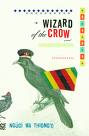
The wizard of crow
When Ngugi first started writing in Gikuyu, he was threatened by the Kenyan government, and in the late 70’s, the political overtone of his play I will marry when I want, got him arrested by the then vice-president Daniel Arap Moi (who later became president, and ruled Kenya for 22 years). After his release from jail, Ngugi spent two decades in exile, and tried returning to Kenya in 2004 under the new government, but was viciously attacked in his hotel and his wife was sexually assaulted… after that he returned to the USA where is a professor at New York University. His latest novel, The wizard of crow which is 1000-pages long, and which I own, discusses a dictatorship in an imaginary country in Africa.















 African Heritage