This really good article by the Kenyan writer Binyavanga Wainaina on ‘How to Write about Africa‘ was recently shared with me. It was published by Granta magazine. One will be surprised to see that this is exactly the way Africa is depicted in Western televisions, magazines, news, and books. Such an interesting read, very satirical, and yes very thought-provoking. This is not the Africa I know, but this is the Africa sold on Western media. The entire article can be found on Granta.com.
==========
Always use the word ‘Africa’ or ‘Darkness’ or ‘Safari’ in your title. Subtitles may include the words ‘Zanzibar’, ‘Masai’, ‘Zulu’, ‘Zambezi’, ‘Congo’, ‘Nile’, ‘Big’, ‘Sky’, ‘Shadow’, ‘Drum’, ‘Sun’ or ‘Bygone’. Also useful are words such as ‘Guerrillas’, ‘Timeless’, ‘Primordial’ and ‘Tribal’. …
Never have a picture of a well-adjusted African on the cover of your book, or in it, unless that African has won the Nobel Prize. An AK-47, prominent ribs, naked breasts: use these. If you must include an African, make sure you get one in Masai or Zulu or Dogon dress.
Africa
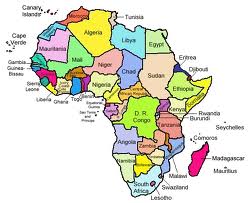
In your text, treat Africa as if it were one country. It is hot and dusty with rolling grasslands and huge herds of animals and tall, thin people who are starving. Or it is hot and steamy with very short people who eat primates. Don’t get bogged down with precise descriptions. Africa is big: fifty-four countries, 900 million people who are too busy starving and dying and warring and emigrating to read your book. The continent is full of deserts, jungles, highlands, savannahs and many other things, but your reader doesn’t care about all that, so keep your descriptions romantic and evocative and unparticular. […] Continue reading “How to Write about Africa, by Binyavanga Wainaina”→
In the past I have always wished that we, Africans, could be patriotic. I came across this beautiful poem ‘Love poem for my country‘ by South African writer Sandile Dikeni. I really enjoy the way the author describes his country, the valleys, the birds, the ancient rivers, and its beauty. He feels the peace, the wealth, and the health his country brings. He is one with hiscountry.He is at home! His country is not just words or food, or friends, or family, it is more, it is his essence! That is true patriotism, the bond that links us to the bone to our motherland. Enjoy!
My country is for love so say its valleys where ancient rivers flow the full circle of life under the proud eye of birds adorning the sky.
My country is for peace so says the veld where reptiles caress its surface with elegant motions glittering in their pride
My country is for joy so talk the mountains with baboons hopping from boulder to boulder in the majestic delight of cliffs and peaks
My country is for health and wealth see the blue of the sea and beneath the jewels of fish deep under the bowels of soil hear the golden voice of a miner’s praise for my country
My country is for unity feel the millions see their passion their hands are joined together there is hope in their eyes
Anton-Wilhelm Amo was a respected Ghanaian German philosopher who taught at the Universities of Halle and Jena in Germany in the 1730s… That’s right… you read it well, 1730! This man is said to be the first African to be awarded a doctorate degree from a European university, and to later teach there. Who was Anton-Wilhelm Amo?
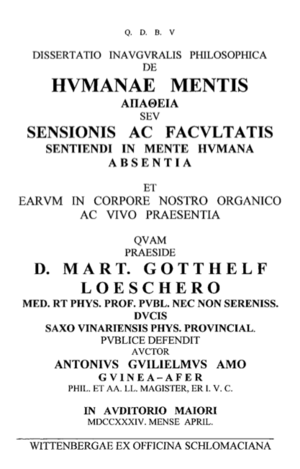
Anton-Wilhelm Amo was born in 1703 in Awukena near the town of Axim in Ghana. At the young age of 4, he was taken to Amsterdam; some accounts say that he was taken into slavery, others that he was sent to Amsterdam by a missionary based in Ghana. Either way, he was given as a present to the Duke of Brunswick-Wolfenbüttel. Amo was raised as a member of the family, and attended the Wolfenbüttel Ritter-Akademie from 1717 to1721, and then the University of Helmstedt from 1721 to 1727. He also met with the great German mathematician and philosopher Gottfried Leibniz who was a frequent visitor of the Wolfenbüttel palace. He then attended the Law school at the University of Halle in 1727, and finished his preliminary studies in two years at the end of which he wrote a dissertation thesis titled “The Rights of Moors in Europe.” He went on to further study philosophy and earn a doctorate degree in philosophy from the University of Wittenberg in 1734. Amo was a learned man, and a true polyglot as he mastered six languages: French, English, German, Dutch, Latin and Greek.
He was appointed professor of philosophy at the University of Halle in 1736, and went by his preferred name Antonius Guilelmus Amo, Afer of Axim. He taught psychology, ‘natural law‘, and the decimal system. He then published his second major work: ‘Treatise on the Art of Philosophing Soberly and Accurately (Tractatus de Arte Sobrie et Accurate Philosophandi). In 1740, he joined the University of Jena in Jena, central Germany. During the early years of the reign of Frederick II of Prussia, Amo was invited to the court in Berlin as a government councilor. Amo was also elected a member of the Dutch Academy of Flushing.
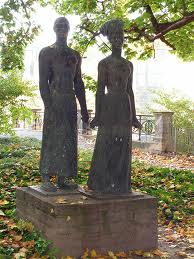
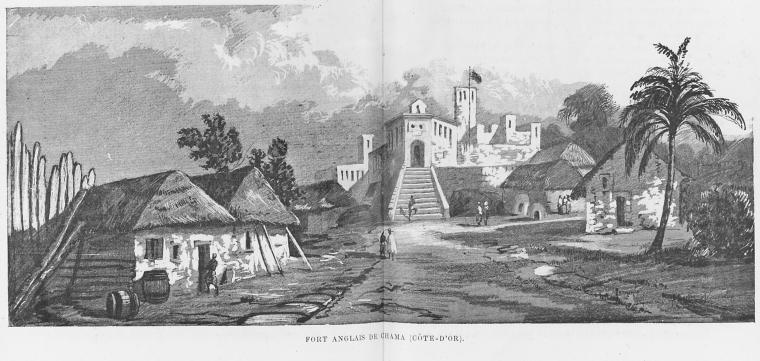
There were lots of social changes in Germany in the 1740s, and people were becoming less liberal, xenophobe, racist, and Amo himself was subject to public threats from his ennemies. Eventually, Amo returned to his land of birth, Ghana, and settled back in Axim where he was honored as a traditional doctor and worked as a goldsmith (by some accounts). He was laid to rest in Fort San Sebastian in Shama, Ghana, in 1759. Today, the University of Halle-Wittenberg annually awards the Anton-Wilhelm Amo prize to deserving students. There is also a statue in Halle in his honor. This man was at the time thought to be among the most prominent German thinkers of his times.
Fort San Sebastian or Fort Shama in Ghana, Henri Frey 1890
For more on this great man, please check out Anton Wilhelm Amo by Marilyn Sephocle (Journal of Black Studies Vol. 23, No. 2, Special Issue: The Image of Africa in German Society (Dec., 1992), pp. 182-187), Anton-Wilhelm Amo from SUNY Buffalo, The Life and Times of Wilhelm Anton Amo by W. Abraham, Transactions of the Historical Society of Ghana 7 (1964) P. 60-81, Anton Wilhelm Rudolph Amo, Anton-Wilhelm Amo, a Ghanaia Philosopher in 18th Century Germany on the blog of Justin E. H. Smith, and lastly Black History Month in Europe 2007: Amo’s Ghost where the blog’s author asks very poignant questions about the life of Amo. Everytime you think of Africa as the dark continent, or think that Africans were illiterate people, or had no ‘light’, think about Anton-Wilhelm Amo the great Ghanaian-German philosopher of the 1700s who taught great minds in Europe, and was among the most prominent German philosphers of his time.
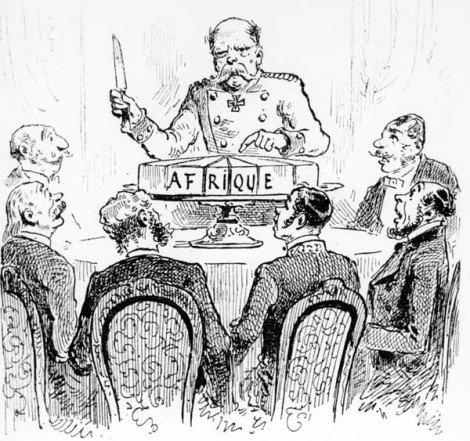
Le partage de l'Afrique à la Conférence de Berlin de 1884
As we talk about neo-colonialism, and the new conquest of Africa, I thought about sharing this poem ‘They Came‘ by the Cameroonian writer François Sengat-Kuo published in Fleurs de Latérite, Heures Rouges Éditions Clé, 1971. In the poem, he talks about colonization and how Africans were fooled by European missionaries who were always preceding European explorers and armies. I particularly like the sentence: “they came, … bible on hand, guns behind.” How true! In the days of colonization, Europeans claimed to be bringing civilization and christianity to pagans across the globe. Today, they bring development, globalization, and democracy… same ol’ thing → submission and slavery of the people. Enjoy!
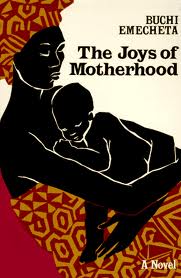
Today I would like to talk about a strong woman… a determined woman… an independent African female writer: Buchi Emecheta. Dr.Buchi Emechetais an established Nigerian author who has published over 20 books. She wrote such books asSlave Girl, The Joys of Motherhood, Second Class Citizen, The Bride Price, and more recentlyKehinde. Her themes have always revolved around motherhood, child slavery, and women independence. Buchi got married at the tender age of 16, and by the age of 22 was the mother of five children (they had moved to London after the birth of the first child for her husband to pursue higher education). Her marriage was unhappy and oftentimes violent. She used writing as an escape, to keep her sanity.The day her husband burnt her first manuscript marked Buchi’s rebirth. As she watched him burn her novel, she said ‘I am going to leave this marriage‘ and the man replied ‘what for? that stupid book?‘, and she told him, ‘I just feel you just burn my child.‘ (Source:Buchi Emecheta BBC). That was really her turning point. At the age of 22, she left her husband, raised her 5 children by herself, got a degree in sociology studying at night, andwrote 4 novels in the space of 5 years. She would often rise at dawn to pursue her dream of becoming a writer. She wore several hats: mother, student, writer, and worker.
'The Joys of Motherhood' by Buchi Emecheta
Like her Nigerian ancestors, she uses storytelling to teach morals, to entertain and to instruct. She brings to her writing the Igbo qualities of vividness, economy and directness. She speaks for the marginalized woman. Some of her first novels, such asIn the DitchandSecond Class Citizen, were quite autobiographical. She views her writing as the “release for all my anger, all my bitterness, my disappointments, my questions and my joy.”Please help me acclaim Buchi Emecheta, a powerful woman, a powerful writer, and a proud daughter of Africa. In her own words, Buchi advises ‘whatever you want to do with your life. “Just keep trying and trying. If you have the determination and commitment you will succeed.”‘(Source: ‘Just’ an Igbo Woman Interview by Julie Holmes in The Voice July 9, 1996.) Check out some of Buchi’s quotes on GoodReads.com.
Cheikh Anta Diop was a great Senegalese historian, anthropologist, philosopher, physicist and politician. He should be considered as one of the greatest scientists after Darwin, as he demonstrated that Africa was the cradle of humanity; that everything started in Africa, and that Egypt and modern day Africans descended from the same ancestors, in other words, were the same people. Before Cheikh Anta Diop, the world, and Africans in particular, had been taught that Africa was nothing, and that Egypt and Egyptians were not Africans… that the great Egyptian civilization which gave so much to the world, could not have come from the dark brown Africans. Europeans refused to admit that although in Africa, Egyptians could be Africans i.e. Black, or rather believed that Blacks were so backwards that their ancestors could not have possibly made the great pyramids of Giza or the great sphinx. Well Cheikh Anta Diop proved them all wrong!
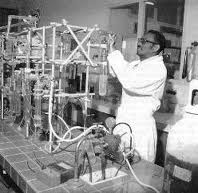
Cheikh Anta Diop in the laboratory
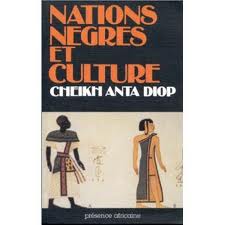
As a physicist, I was amazed to learn that Cheikh Anta Diop was a PhD student of Frédéric Joliot-Curie, the 1935 physics nobel laureate, and Marie Curie‘s son-in-law (first woman to receive a Nobel in Physics, and first to have two nobel prizes). So Diop’s pedigree, in physics terms, was quite impressive! Moreover, he had earned two PhDs: one in history and the other in nuclear physics. He was also the only African student of his generation to have received a training in egyptology. He was well-versed in prehistoric archaeology, and linguistics. It took him almost a decade to have his doctorate degree granted: he submitted a thesis in 1951 which was based on the premise that the Egypt of the great pharaohs and pyramids was an African civilization– it was rejected. He then published it in 1955, as Nations Nègres et Culture, and received world-wide acclaim. Two additional attempts at submitting it were rejected, until 1960 when he finally managed to convince a room full of physicists, sociologists, anthropologists, egyptologists, and historians. Having gone through the hurdle of submitting and defending a doctoral dissertation, I truly raise my hat to someone like Diop who had so much stamina and endurance, and could endure a decade of rejection like that; he was truly destined for greatness!
'Nations Negres et Culture' de Cheikh Anta Diop
In 1974, Diop managed to prove beyond a shadow of a doubt, that Egyptians were Black people. He obtained pigment from Egyptian mummies and tested for their melanin content. He was able to determine their melanin content accurately, and later published his technique and methodology for the melanin dosage test in scholarly journals. This technique is used today by Forensic investigators around the world, to determine the “racial identity” of badly burnt accident victims.
'The African Origin of Civilization' by Cheikh Anta Diop
Please watch one of the greatest African thinkers of the 20th century, and above all one of Africa’s greatest sons (… and renowned physicist). I salute this great soul who made us proud of being Africans, who re-define history or rather wrote History the way it should have been, with Africa in its right place, as the origin of civilization. If there was an African Pantheon for great minds, Cheikh Anta Diop’s remains should be in it!
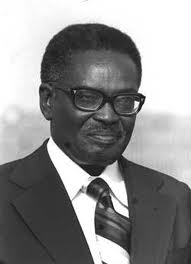
Agostinho Neto was the a medical doctor, a poet, and most importantly the first president of Angola. Today, I would like you to sit back and enjoy a poem written by this great African leader
Dear All, I was so surprised when I learned that Alexandre Dumas, yes… the writer of the “Three Musketeers” was just recently (2002) inducted into the Pantheon of Paris, you know… the place where the remains of the most famous/distinguished French citizens are buried. I wondered why?… because the Three Musketeers is the most acclaimed French book adapted to screen, movies, and theater. I wondered why?… because The Three Musketeers and The Count of Monte Cristo are among the most read books by a French author in the world… why only in 2002, 132 years after his death? when Victor Hugo had been indicted in 1885? why since Rousseau, Voltaire, Emile Zola, had all been indicted, while the most read French author, Alexandre Dumas’ remains were not? Well… you’ve guessed it right: Alexandre Dumas was Black! Yes… the great French writer was just like the Russian Father of modern literature Alexander Pushkin: Black! Yes… you can paint it all you want… he was of African descent: he was Black! Just look at his hair! He was actually Haitian, the grandson of a French nobleman and a Haitian slave. See… they hide this to you in the classroom.
The Three Musketeers, by Alexandre Dumas
Alexandre Dumas was born in 1802 in Picardy, France. His paternal grandparents were Marquis Alexandre-Antoine Davy de la Pailleterie, a French nobleman and Général commissaire in the Artillery in the colony of Saint Domingue (Haiti), and Marie-Cesette Dumas, an Afro-Carribean creole of mixed African and French ancestry. His father Thomas-Alexandre Dumas served in Napoleon’s army as general, and later fell out of favor. By the time Alexandre was born, his family was very poor. His being of mixed race affected him all his life. He once said to someone who had insulted his mixed-race background: “My father was a mulatto, my grandfather was a Negro, and my great-grandfather a monkey. You see, Sir, my family starts where yours ends.”
The Count of Monte Cristo, by Alexandre Dumas
In 2002, then French president Jacques Chirac had him exhumed from his original burial place and transported to the Pantheon of Paris. Chirac said: “With you, we were D’Artagnan, Monte Cristo, or Balsamo, riding along the roads of France, touring battlefields, visiting palaces and castles—with you, we dream.” Chirac acknowledged the racism and injustice that had been done to one of the greatest French writers of all time. Imagine that, Dumas’ works have been translated into over 100 languages, and have inspired over 200 motion pictures.
Alexandre Dumas
Please check out some of these websites which give a detailed biography of Alexandre Dumas: the Alexandre Dumas pere website, and The Literature Network. In 2005, a lost novel by Dumas was found: it is titled The Chevalier de Sainte Hermine (The Knight of Sainte Hermine), was first serialized by Dumas in a French newspaper in 1869 but was never finished by the time of his passing a year later. Imagine if I had known in high school that Alexandre Dumas, the author of the Three Musketeers was black… Imagine how I would have delved further into his writings! Goodness Gracious… Goodness Gracious! As Dumas would say himself, “One for all, all for one!“
This poem by David Mandessi Diop was my favorite. By the time I was 9 years old, I knew it by heart… I loved it so much! It symbolizes so much about Africa, and the love we, all African children, should have for her. Oh how I wish David Diop had lived longer to see the effect of his ‘ode to Africa‘ on other generations. Enjoy!!!
Afrique mon Afrique Afrique des fiers guerriers dans les savanes ancestrales Afrique que me chantait ma grand-mère Au bord de son fleuve lointain Je ne t’ai jamais connue Mais mon regard est plein de ton sang Ton beau sang noir à travers les champs répandu Le sang de ta sueur La sueur de ton travail Le travail de l’esclavage L’esclavage de tes enfants Afrique dis-moi Afrique Est-ce donc toi ce dos qui se courbe Et se couche sous le poids de l’humilité Ce dos tremblant à zébrures rouges
Qui dit oui au fouet sur les routes de midi Alors gravement une voix me répondit Fils impétueux cet arbre robuste et jeune Cet arbre là -bas Splendidement seul au milieu de fleurs blanches et fanées C’est l’Afrique ton Afrique qui repousse Qui repousse patiemment obstinément Et dont les fruits ont peu à peu L’amère saveur de la liberté.
Africa my Africa Africa of proud warriors in ancestral savannahs Africa of whom my grandmother sings On the banks of the distant river I have never known you But your blood flows in my veins Your beautiful black blood that irrigates the fields The blood of your sweat The sweat of your work The work of your slavery The slavery of your children
Africa, tell me Africa Is this your back that is unbent This back that never breaks under the weight of humiliation This back trembling with red scars And saying no to the whip under the midday sun But a grave voice answers me Impetuous child that tree, young and strong That tree over there Splendidly alone amidst white and faded flowers That is your Africa springing up anew Springing up patiently, obstinately Whose fruit bit by bit acquires The bitter taste of liberty.
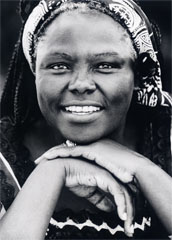
I once took a class in environmental and social changes, where I studied the work of Dr. Wangari Maathai. Her boldness and her stand for truth made her a great role model for many African women, and Africans in general. She was bold! “Wangari Maathai was known to speak truth to power,” said John Githongo, an anticorruption campaigner in Kenya who was forced into exile for years for his own outspoken views. “She blazed a trail in whatever she did, whether it was in the environment, politics, whatever.” Indeed, Wangari Maathai was one of the most widely respected women on the continent, where she played many roles: environmentalist, politician, feminist, professor, human rights advocate, and head of the Green Belt Movement which she started in 1977. She was scoffed at by the Kenyan Forestry department who thought that uneducated women could not fight the desert. She told them ‘We need millions of trees and you foresters are too few, you’ll never produce them. So you need to make everyone foresters.’ I call the women of the Green Belt Movement foresters without diplomas.”
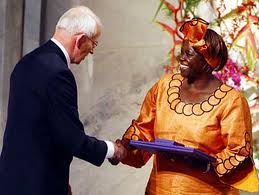
Wangari Maathai receiving the Nobel Peace Prize
As a star student after high school, she won a scholarship to study biology in Kansas (US), and went on for a Masters of Science at the University of Pittsburgh, and later a doctorate degree in veterinary anatomy at the University of Nairobi where she later taught and became chair of the department in the 1970s. Wangari’s work started with the Green Belt Movement with the mission of planting trees across Kenya to fight erosion, stop desertification, create firewood for fuel, provide jobs for women, and empower the women of Kenya. According to the United Nations’ data, her organization has planted over 45 million trees in Kenya, helped 900,000 women, and inspired similar projects in other African countries. “Wangari Maathai was a force of nature,” said Achim Steiner, the executive director of the United Nations’ environmental program. He likened her to Africa’s ubiquitous acacia trees, “strong in character and able to survive sometimes the harshest of conditions.”
Maathai planting a tree
Her work was illustrated in one of my secondary school English textbook. The government of Arap Moi was trying to build a skyscraper in one of Nairobi’s only parks, and she brought women who protested until the government abandoned the project. She was beaten by police until she fainted. Wangari was not one to back down from her beliefs. She would go to jail for what she believed in. For instance, her husband divorced her because he said she was too strong-minded for a woman. When she lost her case in court, she criticized the judge and told him her mind, and was thus thrown to jail.
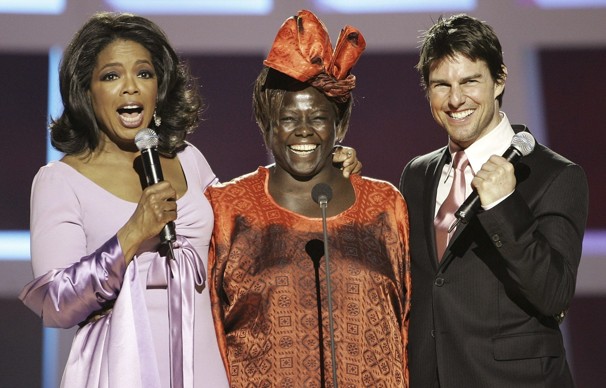
Oprah Winfrey and Tom Cruise congratulating Wangari Maathai on her Nobel Peace Prize
In presenting her with the Peace Prize, the Nobel committee hailed her for taking “a holistic approach to sustainable development that embraces democracy, human rights and women’s rights in particular” and for serving “as inspiration for many in the fight for democratic rights.” Wangari Maathai has received many honorary degrees, including an honorary doctorate from the University of Pittsburg, her alma mater. Check out articles by the BBC, CNN, her Interview on NPR, and the Huffington Post whose article is entitled “Wangari Maathai and the Real Work of Hope .” Don’t forget to click also on the The Green Belt Movement website, and the movie “Taking Root: The Vision of Wangari Maathai.” She once said that ‘we should all be hummingbirds‘: doers, and not spectators, even in the face of great challenges; do the best you can. Goodbye Wangari, your work is not over, for Africa has been blessed with millions of Wangari Maathais who will continue your outstanding work.
















 African Heritage