I really enjoyed last week’s The Guardian’s Photojournal on vanilla trade in Madagascar. I did not know that so much was involved in getting that marvelous spice that I often add to my cakes. As a flashback, the process of pollination of vanilla was invented by a 12 years old Black slave from the island of Bourbon (Réunion): Edmond Albius. His technique allowed for the pollinating of the vanilla orchids quickly and profitably. Albius’s technique revolutionized the cultivation of vanilla and made it possible to profitably grow vanilla beans away from their native Mexico. Today, vanilla is the world’s most popular flavor, and surging demand has recently made the spice more expensive than silver; its aroma finds its way into cakes, perfumes, and all delicacies around the globe.
Bottle of Vanilla
This Guardian’s photojournal focuses on the people working the plantations of vanilla and hustling it in Sambava, Madagascar, dubbed the Vanilla Capital of the world. Today, three quarters of the global vanilla crop is produced in this region, with 2,000 tons being exported from there. The photojournal shows the vanilla hustlers like never before. Despite the expense, vanilla is highly valued for its flavor. So, as you enjoy your vanilla ice cream, or add its delectable aroma into your cakes, or enjoy it in perfumes or aromatherapy, remember the island of Madagascar, and its vanilla hustlers. Enjoy The Guardian’s Photojournal on vanilla trade!
I really enjoyed Godfrey Nzamujo‘s TEDx talk. Nzamujo is the founder of the Songhai Center in Benin and has been implementing, for over 30 years now, sustainable agriculture to address Africa’s food problems, and also to fight against rural exodus which forces youths to leave their villages to go to the city. One of his center’s aim is promotes entrepreneurship in agriculture aimed at making the poor producers, actors and managers of their own future. His main goal is to erect green rural towns where nothing is wasted. His approach is fully 100% re-use, recycle agriculture, zero-waste emission! Watch, listen, share, and enjoy!
Imagine an organic farm where nothing is wasted: from the crops, the chicken, everything is generated in house, even the energy for the farm is generated with the bio-gas from the animal waste. I recently came across the Songhai Center, and loved the idea that Godfrey Nzamujo has implemented in Porto-Novo, Benin. Created in 1985 by Godfrey Nzamujo, a Dominican priest with doctorate degrees in electronics, development science and microbiology, the Songhai Center is an NGO which promotes entrepreneurship in agriculture aimed at making the poor producers, actors and managers of their own future. His main goal is to erect green rural towns where nothing is wasted. Have rural people be proud of staying and enriching their villages / towns. Songhai has found recognition beyond Benin. The UNDP (2008) regards its approach as successful in the promotion of agricultural entrepreneurship and the creation of decent jobs in rural areas.
A farm
His farm is centered around agriculture, animal husbandry, and core production. The waste from one sector becomes an input in another sector. The waste from the animal production is used to produce maggots that feed the fish, and the wastewater from fish ponds is used to irrigate the crops where vegetables and grains are produced, and the waste from the crops are used for bio-gas or to feed the animals (grains for the animals), and the droppings from the animals are used for compost. And the products, meat, eggs, fruits, etc, are eaten by men. Everything is bio: fertilizers are from compost, no chemicals are used! Natural fertilizers are used. No pesticides are used: pest management is implemented using plants themselves via inter-cropping or integrated pest management. The pure clean water used for drinking comes from a deep well; the water from the rain is also harvested, and water from sewage is purified using plants and various organisms to be used in the agriculture and plants. Part of the electricity comes from the bio-gas, some from the diesel, and some from the national grid. Even the plastic bottles containers for the juices produced in-house are made from plastic waste used at the center, while the machinery for the farm is built in-house as well! Watch, Enjoy, and get Inspired!
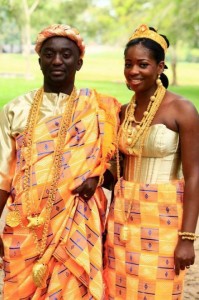
Traditional Ghanaian wedding (Source: Nairaland.com)
A few years back, I was privy to a traditional wedding ceremony where the groom and bride families came together and the groom paid the bride price. This is considered symbolic, and marks the union of the two families.
Before the arrival of Europeans and their church (white wedding), the bride price was the way to go, to get married. This is a practice as old as the world. It is a custom widely practiced across Africa. It plays a very important role in our traditions and cultures. It marks the coming together of two families. I loved the comment one of my friends made: “I found giving bride price to my wife’s family an enriching experience. Going to work and saving money gave me a sense of how precious she was to me. The contention I often hear against bride price often cite the greedy few who have spoken the loudest. There are millions who still respect the practice.” Yes… many still respect and value the practice.
It is a cultural practice which makes for stronger family relationships, and do help with arranging conflicts when they arise in marriage.
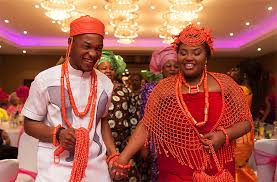
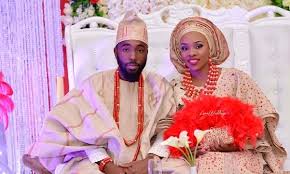
Traditional Nigerian wedding (Source: VozAfrica)
The bride price also known as bride token, is an amount of money or property which is paid by a groom and his family to the family of the bride. In many parts of Africa,the bride price confirms the validity of a traditional marriage and conditions the permission to marry in church or in a civil ceremony. Its power supersedes all other sorts of marriages. The marriage is considered invalid if the bride price has not been paid, and this actually affects the marriage, and the offspring from that couple as it is then considered that the groom and his family have despised and dishonored the bride’s family. The children from that union do not belong to the husband’s family, but rather to the woman’s, as he never paid the bride price, and thus has no right over them.
Last year, a friend of mine returned the bride price which had been paid for his sister’s hand to the groom’s family, as he (the groom) had dishonored the wife, almost beaten her to death, and cheated. In this instance, this was to mark a divorce. Now what will happen if the woman wanted the divorce and could not afford to reimburse the bride price? What if rupture was the only way out of this marriage, what should she do? Divorce is still highly frowned upon in African societies, and the stigma of it affects the woman deeply.
Although the bride price is a symbolic token, it has been described in many African countries as a license to own a family or to purchase a wife from a family often leading the man to receiving the “permission” to exercise economic control over his wife. It has also been criticized for being an “enrichment scheme” for the bride’s family. There are two serious questions that have arisen with the evolution of the bride price: has it truly become a source of income for families and does it have a negative impact on women?Does the practice of the bride price hinder the work of women’s rights and empowerment activists? Does the bride price create more bad than good by leaving newlywed couples with unfortunate financial problems which strip them of the joys of being newly married?Has the bride price truly become a source of enrichment for families and demeaning to women?
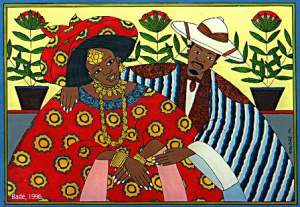
Senegalese Wedding (Source: Bade, 1996)
This is a tradition truly African which should be upheld… and it varies from country to country, and maybe should be checked to avoid excesses from the bride’s families… and to stop the groom’s families from depriving the bride of her rights once in the marriage.
Below are comments by African BBC correspondents about Bride Price practices across Africa. For the full article, check Bride price practices in Africa:
==========
Pumza Fihlani, South Africa:
A bride price here is known as “lobola“, where the groom’s family presents either money or cows or both to the bride’s family as a gesture of his willingness to marry her.
The payment of lobola is a sign of the man’s commitment to take care of his wife and is seen as asymbolic act and a necessary part of upholding culture, rather than a purchase.
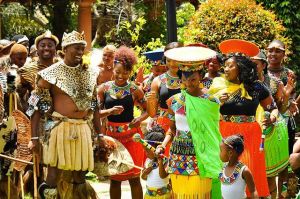
Traditional South African wedding (Source: Wikimedia)
Kim Chakanetsa, Zimbabwe:
The term “lobola” is also used in southern Zimbabwe, but in Shona communities it is known as “roora” and while the tradition is to give cattle, this is now often replaced by cash – the amount is subject to negotiation.
There are several stages to the tradition andit is seen as a way of thanking the bride’s family for bringing her up, but there is no sense that the bride is being bought.
Abdourahmane Dia, Senegal:
The payment of bride price iscustomary in Senegal but largely symbolic.
A small amount of money and a kola nut is given to the bride’s family at the mosque, after that the sum handed over can be anywhere from less than $100 to tens of thousands.
Angela Ngendo, Kenya:
The Kenyan constitution outlaws the obligation to pay a bride price but it is widely understood that it will be paid.
Pastoral communities insist that it is paid in cattle and it has been cited as a cause of cattle rustling, whereas families in other communities will accept cash.
There is a sense that a transaction has taken place over the bride.
African Wedding – Nigerian (Source: Naija.nj)
Leone Ouedraogo, Burkina Faso:
The bride price is commonly paid in Burkinabe culture and is largely a symbolic act.
There is no set amount and a little money is given, but it is mainly in goods such as Kola nuts, drinks, cigarettes – and some ethnic groups may give a goat.
However, a bride’s family is not normally too demanding.
Aichatou Moussa, Niger:
In Niger, there is an official maximum rate for a bride price of 50,000 CFA francs ($83, £54) but many pay much more than this.
The price is agreed between the families, but it is seen as asymbolic act rather than about buying the wifeas Nigeriens say not matter how much is paid you cannot buy a human being.
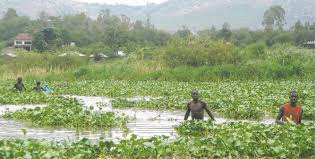
Fishermen wade through water hyacinth in Lake Victoria (Source: Lilian Ochieng, The East African)
Ever heard of the Water hyacinth (Jacinthe des eaux)? that plant that has been suffocating rivers around the globe? That plant can be seen as one drives on the Wouri River bridge in Douala, and in major cities in Africa as it proliferates in the local rivers. Often, one can see fishermen in boats trying to uproot the plant? Years ago, Lake Victoria (Africa’s largest body of fresh water) was luscious, today the water hyacinth has had negative effects on its ecosystem, not only depriving the lake of its oxygen thus reducing nutrients for fishes, blocking water ways, and breeding all sorts of new diseases. This plant is not native of Africa. Achenyo Idachaba has turned a major problem for the local fishermen and villages as their source of livelihood was being extinguished by this plant, into a source of revenue while getting rid of the plant and developing arts and crafts. Enjoy her TED talk.
Introducing to you Choco-Togo, a brand of chocolate made in Togo by Togolese students. This is an organic brand of chocolate made in Togo, by Togolese, with Togolese as the main consumers! Their chocolates are without additives, and chemical products; they are 80% cocoa with natural ingredients. Check out their website, Choco-Togo.
I really liked this Pambazuka article on the brief history of the passport. For those of us coming from ‘third-world’ countries, the act of applying for visas is both quite expensive and time-consuming. I always wondered why citizens of the ‘developed’ world could enter most countries in the world free of charge, while citizens of underdeveloped countries needed visas. The logic always seemed twisted to me, especially given that the converse was not true. For instance, a South African citizen needs a visa to enter the USA for tourism/business, but an American citizen does not need a visa to enter South Africa for the same reasons, and the list goes on. The article below goes over it. For the full article go to: Pambazuka . Here are some excerpts.
=========
Fatou Diome
[…] In spring 2015, Senegalese author Fatou Diome, whose works include The Belly of the Atlantic, caused a stir during the French talk show Ce soir ou jamais!. Only a month earlier, over 1,000 had drowned in one week in the Mediterranean Sea after their boat had capsized en route from the Tunisian coast to Italy. Diome vented her anger about the current European perspective and discourse on migration. And she expressed her belief that there is an underlying global problem that is rooted in the privileged treatment of a small percentage of the world’s population that depends on a document:
“Europeans see Africans arriving, ok. This migratory movement of populations is tracked and visible. But you don’t see the migratory movement of Europeans going to other countries. This is the migratory movement of those with power, with money. Those who have the right kind of passport. You go to Senegal, you go to Mali, you go to any country in the world, to Canada, to the U.S. Everywhere I go […], I meet French people, German people and Dutch people. I run into them everywhere on this planet because they have the right kind of passport.” (translated from French) (Diome 2015)
‘The Belly of the Atlantic’ by Fatou Diome
Apart from unmasking a very selective European perception and use of the word ‘migration’, Diome addressed an apparent inequality. There is a structural force which privileged nationals can ignore while the unprivileged are confronted with it every day, namely the power of a passport. Clearly, this inequality is not a natural development, but has evolved over time, as a look at the history of this small document shows.
[…] The focus here will be on the international passport. This document is used to control the departure from the home country, entering a foreign country and returning to the home country. All those who have crossed a national border know the process of handing his or her passport to a border official behind a glass panel. This guard checks you and your passport very thoroughly and sometimes asks questions about your purpose of travelling.
Nonetheless, a German passport allows the holder to enter 172 of the Earth’s 192 countries without a visa. Reversely, people from only 81 countries can enter Germany without a visa – an imbalance that quantifies a passport’s power. The development of a passport hierarchy is an advanced process, which has only been taking place for some decades. It leaves citizens from countries such as Somalia, Eritrea, Sudan, South-Sudan, Ethiopia, Congo or Liberia at the bottom of this hierarchy and enforces a restrictive and often arbitrary system of visa issuance on them. This system allows economically and politically powerful nations to use people’s mobility as a bargaining resource and reinforces their dominance. An example of this mechanism is the 2014 FIFA world cup in Brazil: European countries had a keen interest in granting their football-mad citizens free access to the host country. Brazil managed to secure liberalized visa regulations for its own citizens traveling to Europe in return. In this instance, the cultural event gave Brazil negotiating power and that in turn increased its economic and political power. When states lack these material and symbolic resources, they are less able to give their populations access to international networks, exchanges, education and jobs.
World map (Wikipedia)
Alternatives become possible when we start deconstructing the perceived ‘naturalness’ of the status quo. A growing number of intellectuals, scholars, artists and political activists are pointing to the historical development of borders and making us aware of their violence and their arbitrariness. They argue in favor of social and economic advantages that non-existent borders might yield…a world in which we can claim that the passport was just an episode that lasted for little more than a century. It would be a world in which Diome’s statement would ring true for everyone:
“We live in a globalized world in which an Indian might live and make a living in Dakar, someone from Dakar in New York, someone from Gabon might live and make a living in Paris. Whether you like it or not, this is an irreversible fact. So let’s find a collective solution, or move away from Europe, because I intend to stay.” (translated from French) (Diome 2015)
Ghanaian social entrepreneur Mabel Suglo is the co-founder of the Eco-ShoesProject, an initiative that assists artisans with disabilities to create marketable shoes from used tires and recycled African fabric. Started in 2013, the company currently employs 13 people. Her company is based in Kumasi, Ghana. It employs local able as well as artisans with disabilities to make shoes, bags, and accessories.
“There are millions of discarded car tyre stockpiles and waste materials in Ghana which pose an environmental and health hazard,” explains Suglo. “Eco-Shoes rescues some of the millions of tyres and other materialwaste creating an environmental nuisance, to make fashionable and comfortable shoes.” She, and two of her friends were inspired to start the business to challenge local perceptions of disabled people as burdens to society.
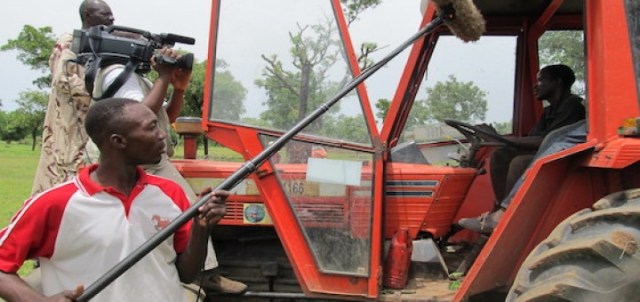
Yes… we are talking about the very first WebTV for mobile phones developed in Francophone Africa. This is an innovative project launched by Inoussa Maïga of Burkina Faso. Maïga’s specialty is in the agricultural sector, talking to farmers and addressing the problems of the land workers. This is an amazing idea, which can have impact in all sectors of their lives. Many countries in Africa are not poor, they actually have a lot of food, however, they lack the infrastructures (poor roads) to bring in their products in due time and in good quality to the city, or the best markets. So imagine, if one used the WebTV to inform said farmers about the latest roadblocks from one city to another; imagine if one used WebTV to tell breeders about ways to vaccinate their cattle, or the next time there will be a veterinary in town to vaccinate or take care of their herds. Maïga’s project will start with journalists based in 4 countries: Burkina Faso, Côte d’Ivoire, Cameroon and Benin.There are so many ways indeed. Enjoy the full article on Samsa.fr. Don’t forget to visit his blog at GoogolFarmer.
At work, interviewing a farmer in Africa (Source: GoogolFarmer)
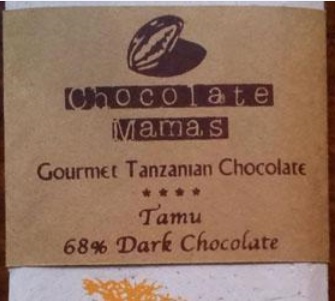
A chocolate bar from Chocolate Mamas (chocolatemamas.com)
Today, I would like to introduce you to Chocolate Mamas, Tanzania‘s first and only indigenous Chocolate company and producer of gourmet chocolates. It was co-founded by Jaki Kweka, when she quit her job as a practicing attorney to launch Chocolate Mamas and become a full-time chocolatier. All of their products are local: cocoa beans, milk, etc, which is quite rare for chocolate making on the African continent (some others across the continent use local beans, but import milk powder and sugar).
Flag of Tanzania
Even the packaging, made with corn husk, is produced by a local NGO for disabled persons. They serve organic chocolate, containing no emulsifiers, fat additives, gluten, or other chemicals. After opening stores in Dar es Salaam, Arusha, and Zanzibarin the country, Jaki Kweka, the director of Chocolate Mamas, is now looking to expand to other countries in East Africa, and maybe one day to the entire continent and the world. Enjoy a beautiful, pure, organic chocolate bar from Tanzania!








 I really liked this

 Nonetheless,






 African Heritage