Namibia Rightfully Rejects 10 million Euros Compensation for Genocide

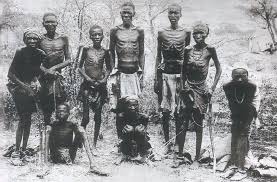
Survivors of the Herero genocide (Wikimedia)

The guts of these people sometimes! How can Germany after killing, and exterminating the Herero and San people of Namibia, thus perpetrating the First Genocide of the 20th Century, dare offer 10 million Euros for compensation to the Namibian government? Such an insult! Germany must really think that Namibians, Africans, are nobodies, below sub-humans… because it is quite unbelievable! They have almost eradicated an entire race, and to this day, Namibia is struggling because of this. And they give 10 million Euros? 10 millions Euros for torturing, killing, raping, destroying, displacing for years? Do you think they could have dared to make such an offer if the Namibians were Jews? This money is not even what they give as compensations to victims (and sometimes only one) during lawsuits against big companies. I clap for the Namibian government, and hope that they stand their ground; the rest of Africa is watching them! Excerpts below are from an article on the Guardian.

====

Flag of Namibia

Namibia has rejected a German offer of compensation for the mass murder of tens of thousands of indigenous people more than a century ago.

German occupiers in Namibia almost destroyed the Herero and Nama peoples between 1904 and 1908 as they consolidated their rule in the new colony in south-west Africa. Some historians have described the bloodshed as the first genocide of the 20th century.

The two countries have been discussing an agreement on an official apology from Germany and an increase in development aid, but the talks appear now to be running out of momentum.

Namibia’s president, Hage Geingob, said on Tuesday that the most recent offer “for reparations made by the German government … is not acceptable” and needed to be “revised”.
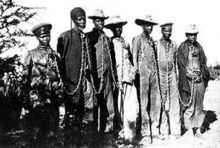
Chained (by German forces) Herero men

No details were provided on Berlin’s proposal, but unconfirmed media reports have referred to a sum of €10m.

…. Other countries in Africa are watching the negotiations between Namibia and Germany closely as they consider launching their own efforts to gain compensation for the violence and theft of decades of European rule.

The Power of Women in the Ancient Kongo Kingdom

Queen Nzingha of Angola

Below is a description of the power of women in the ancient Kongo Kingdom. Remember that a lot of African cultures are matriarchal. The description below is from 1704, and shows that there were women kings in Kongo, and also that the Kongo Empire had vassal kings who reported all to the one King of Kongo. There were also great queens like Queen Nzingha: Great Queen of Angola in neighboring kingdoms, to whom other kings reported. The text below has been translated to English by Dr. Y., Afrolegends.com.

=====

The power of women in the Ancient Kongo Kingdom

In the evening I received the visit from a matron who was chief of her locality [Tubii] and other villages of the Sogno [Soyo] principality. She does not recognize any other authority above her but that of the King of Kongo. These villages are always governed by women.

Lorenzo da Lucca, 7th relation, Soyo, 31 January 1704 in Jean Cuvelier

Les Africains Vol.9, Editions J.A, C.-A. Julien, P. 58, (1977)

Beatrice of Congo : A Physical Portrait in 1710

Beatriz Kimpa Vita
Beatriz Kimpa Vita

Today we will talk about Beatrice of Congo, also known as Kimpa Vita, who was an African priestess and prophet who held a lot of power. Born into a noble clan, the Mwana Kongo clan, she was baptized in her youth, and later created her own religious movement which used Christian symbols but revitalized traditional Kongo cultural roots. She is seen as a strong antislavery figure; think about this for a moment, the catholic priests preaching christianity, yet silently participating in the slavery of the Kongolese. Didn’t it make total sense for her to turn away from catholicism and create a true Kongo religion? Her movement which is among some of the best documented in Kongo’s history is seen a precursor to modern African democracy movements. Below is the physical portrait of Beatrice of Congo by a contemporary Father Bernardo da Gallo in 1710 (Translated to English by Dr. Y., Afrolegends.com).

======

Kongo Kingdom map
Kongo Kingdom map

This young woman was about twenty two years old. She was fairly tall and with fine features. On the exterior, she seemed very devout. She spoke with gravity, seeming to weigh all her words.  She predicted “the future and announced among other things that the judgment was near.”

She walked on tiptoes (toes), almost without touching the ground with the rest of her feet; she moved her flanks and whole body, like a snake, even though her body was tense, as if deprived of spirit, and with bulging eyes; spoke frantically with delirium.

Rapport du Père Bernardo da Gallo, Rome, 17 Decembre 1710, publié par Louis Jadin

Les Africains Vol.9, Editions J.A, C.-A. Julien, P. 58, (1977)

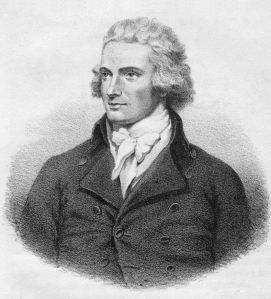
Mungo Park describes Ségou in 1795

Mungo Park
Portrait of the Scottish explorer Mungo Park

Below is a description of the great city of Ségou (pronounce Segu) in Mali by the Scottish explorer Mungo Park in 1795. Here he describes the city’s population density, dynamism, architecture, and even their ways of life. He amply describes the roominess and surprised sturdiness of Ségou’s canoes which could host 4 horses. Mungo Park is simply astounded by the greatness of the civilization he encounters there, and concludes, “the crowded population and the cultivated state of the surrounding country, formed altogether a prospect of civilization and magnificence, which I little expected to find in the bosom of Africa.” Note that the city is surrounded by high mud walls probably similar to the Tata of Sikasso: an African Fortifying Wall.

=====

Mali_Ségou_La Mosquée (AOF)
The Mosque in Segou at the beginning of the 20th century

Sego, the capital of Bambarra, at which I had now arrived, consists, properly speaking, of four distinct towns ; two on the northern bank of the Niger, called Sego Korro, and Sego Boo and two on the southern bank, called Sego Soo Korro and Sego See Korro. They are all surrounded with high mud walls ; the houses are built of clay, of a square form, with flat roofs ; some of them have two storeys, and many of them are whitewashed.

Mali_Segou_Palais d'Ahmadou Tall
Entrance to Ahmadu’s palace in Segou-Sikoro published in the 1868 edition of the book by Eugene Mage Voyage dans le Soudan occidental (Sénégambie-Niger), Paris: Hachette

Besides these buildings, Moorish mosques are seen in every quarter ; and the streets, though narrow, are broad enough for every useful purpose, in a country where wheel-carriages are entirely unknown. From the best enquiries I could make, I have reason to believe that Sego contains altogether about thirty thousand inhabitants. The king of Bambarra constantly resides at Sego See Korro ; he employs a great many slaves in conveying people over the river, and the money they receive (though the fare is only ten cowrie shells for each individual) furnishes a considerable revenue to the king in the course of a year. The canoes are of a singular construction, each of them being formed of the trunks of two large trees, rendered concave, and joined together, not side by side, but end ways ; the junction being exactly across the middle of the canoe ; they are therefore very long and disproportionably narrow, and have neither decks nor masts ; they are, however, very roomy ; for I observed in one of them four horses, and several people crossing over the river. When we arrived at this ferry, with a view to pass over to that part of the town in which the king resides, we found a great number waiting for a passage ; they looked at me with silent wonder, and I distinguished, with concern, many Moors among them. There were three different places of embarkation, and the ferrymen were very diligent and expeditious ; but, from the crowd of people, I could not immediately obtain a passage ; and sat down upon the bank of the river, to wait for a more favourable opportunity The view of this extensive city ; the numerous canoes upon the river ; the crowded population and the cultivated state of the surrounding country, formed altogether a prospect of civilization and magnificence, which I little expected to find in the bosom of Africa.


Mungo Park, Travels in the Interior Districts of Africa: Performed Under the Direction and Patronage of the African Association, in the Years 1795, 1796, and 1797.

Sego = Ségou

Bambarra = Bambara

Sego Boo = Ségou-Bou

Sego Korro = Ségou-Koro

Sego See-Korro = Ségou-Sikoro

*The four cities mentioned here are actually on the southern shore, but there are on the northern shore some neighborhoods to which Mungo Park attributed excessive importance.

Mory Kante : So long to an Electrifying Griot

Mory Kante_2
Mory Kante with his kora (Source: RadioKing.com)

I remember dancing to the tunes of “Yé ké yé ké” as a child… I also have fond memories of seeing Mory Kante play his kora, and being amazed by his dexterity, finesse, and charisma. Every note transported me to different horizons. It did not matter that I did not understand his language, I could feel the emotions he conveyed with his voice and kora… it was like magic: one could travel all the way to Guinea and back within the confines of one’s room.

On May 22, 2020, an honorable member of the Griot (Djeli) family, Mory Kante, moved to the land of his ancestors. In reality, he just changed dimensions, and left us with the electricity of his music. Born in 1950 in a small town near Kissidougou in Guinea, Mory Kante came from a long family tradition of griots (Djeli). Both of his parents were griots, his father was from Guinea and his mother from Mali  Mory absorbed the singing of his parents and as a child learned to play the balafon. As a child, his family sent him to Mali to study the kora and other griot traditions. 

Mory Kante_3
Mory Kante with some of the instruments he played including the balafon, kora, and djembe (Source: Express.co.uk)

Mory Kante is often known as the “electronic griot” because he modernized local traditional instruments such as his kora which he electrified, and fused African music with styles and instruments from Western pop. Kante’s 1987 single “Ye Ke Ye Ke” was a hit, first in Africa and then across Europe. It became the first African single to sell more than a million copies and has been licensed frequently for commercials and film soundtracks. It has even been reworked by other musicians into German techno, Bollywood film music and Chinese Cantopop.

If you ever come across a kora, or listen to Ye Ke Ye Ke remember this great man who modernized the ancient ways to share with us his love of the music of his forefathers. His music has inspired countless singers from the new generation. The New York Times , BBC, and Guardian have written articles about this great man.

The Lost Libraries of Timbuktu

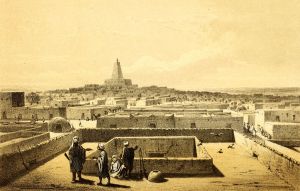
Mali_Timbuktu from a terrace by Heinrich Barth 1858
View of Timbuktu in 1858 by explorer Heinrich Barth 

As you all know Timbuktu was a great center of knowledge in search for  for many centuries starting at least in the 12th century. It was visited by people from around the world, in search of knowledge.

Timbuktu was one of the world’s first and oldest thriving universities! Students came from all over the world to study at Timbuktu. Imagine that, students from the middle east, and Europe coming to study in Africa! There are over 700,000 manuscripts at the great Sankore University in Timbuktu, and many more at other libraries including the  Ahmed Baba Institute, Al-Wangari Library, and others.

Enjoy this documentary about the lost libraries of Timbuktu commented by the Scottish/Sierra Leonean writer Aminatta Forna. Enjoy, and discover with me the treasures of Africa.

Egypt’s Tamed Crocodiles – in pictures

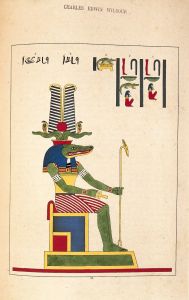
Egypt_Crocodile god Sobek
Sovk (Suchus, Cronos, Satrune); by Jean-François Champollion; 1823–25; Brooklyn Museum (New York City)

I really enjoyed this photojournal on The Guardian‘s website about crocodiles and the ancient art of crocodile raising in Nubia. Taming crocodiles was a part of the culture of ancient Nubia; and it is still done today in Nubia (northern Sudan /part of Southern Egypt). One of the deities of ancient Egypt was Sobek, who was represented with a human body and a crocodile head. He was associated with the Nile crocodile or the West African crocodile. Sobek was also associated with pharaonic power, fertility, and military prowess, but served additionally as a protective deity with apotropaic qualities, invoked particularly for protection against the dangers presented by the Nile, or intended to turn away harm or evil influences.

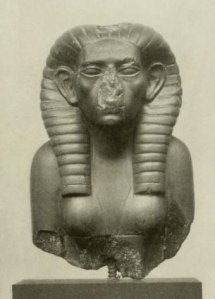
Sobekneferu_1
Head of ruling Pharaoh Sobekneferu

The strength and speed of the crocodile was thought to be symbolic of the power of the Pharaoh, and the word “sovereign” was written with the hieroglyph of a crocodile. It was thought that Sobek could protect the Pharaoh from dark magic. Coincidentally, when the cult of Sobek took off during the Twelfth and Thirteenth Dynasties, a number of rulers incorporated him in their coronation names, including the first fully attested female pharaoh – Sobekneferu. To learn more about Sobek and other deities of ancient Egypt, check out Wilkinson, Richard H., The Complete Gods and Goddesses of Ancient Egypt. (2003).

In ancient times, tamed crocodiles were kept in a sacred pool and hand fed choice cuts of meat and honey cakes and adorned with precious jewels. The pratique has not changed much over the centuries as you will see in the photojournal on The Guardian‘s website. Enjoy!

Crocodile_1
Nile Crocodile

Description of King Behanzin’s Army on 13 March 1890

Behanzin, king of Dahomey

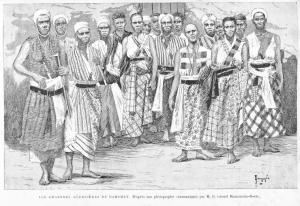
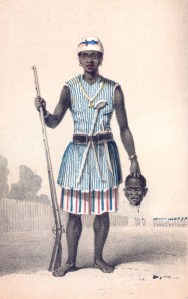
Below is a description of the army of King Béhanzin by a French prisoner made on 13 March 1890. This Frenchman is stunned by the number of warriors in Behanzin’s army, by their discipline, strength and muscular stature. More importantly, he also describes the Dahomey Amazons (locally known as Mino), the Fon all-female military regiment of the Kingdom of Dahomey (in present-day Republic of Benin) who formed the king’s special bodyguard unit, and his secret weapon! Remember that in Behanzin’s Farewell Speech in Dahomey, the king had sung praises of his beloved Mino. Here the narriator is amazed by their sight and confirms, “Old or young, ugly or beautiful, they are wonderful to contemplate. Just as muscular as the Black warriors, their attitude is just as disciplined and correct, …”  Translated to English by Dr. Y. Afrolegends.com.

====

Dahomey_Amazones a 1890
Dahomey Amazons ca 1890

We are right in the Dahomean camp!

At least 15000 men are in front of us, arranged in order of battle in front of their tents made up of palm leaves, immobile, in such a deep silence that at 100 meters from our prison, in the same courtyard, separated by a simple wall, we could not have imagined their existence.

It is really a painting of a sublime horror and which painfully squeezes our heart. Fifteen thousand men, armed with guns and machetes! There is nothing to say, they are beautiful robust and muscular warriors under their white loincloths, which brings out the ebony of their stature even more. Not a cry, not a single movement, not a noise.

Quiet ourselves and deeply moved, we cross the hay that they form, lined up like the long rows of ears on a wheat field. Black and human harvest of which the one who is there can freely pick or mow heads.

Seh-Dong Hong-Beh, leader of Dahomey Amazons (painted by Frederick Forbes in 1851)

The main officers of the army came to surround us. Our group starts to walk, it takes us more than a quarter of an hour to cross the first rows, given that their battle ranks are so deep. Then we cross an empty space, on the other side of which the Black army continues. Here it is no longer just warriors. The second line, in fact, consists of amazons in three tight ranks, surrounding in a huge circle the very throne of the king whom we cannot yet see.

They are there the four thousand female warriors, the four thousand Black virgins of Dahomey, bodyguards of the monarch, immobile under their war shirts, gun and knife in the fist, ready to pounce on a signal from the master.

Old or young, ugly or beautiful, they are wonderful to contemplate. Just as muscular as the Black warriors, their attitude is just as disciplined and correct, lined up like them in ranks.

An Amazon warrior ca 1890

The chiefs are in rows, at the head of the columns, recognizable by the richness of their shirts, by their proud and resolute air. Such are the amazons at rest with their arms. There is a long way from this discipline, this order, to the savage and barbaric hordes that we imagine. His Majesty Behanzin can be calm, these viragos will not let him be taken away easily. The triple circle that they form is immense, without a void, gap, or hole.

E. Chaudoin, extract from the Illustration of 26 July 1890, Les Africains Tome X, Editions J.A., 1978, P. 250


Experts crack mystery of ancient Egypt’s sacred bird mummies

Ibis
Ibises near a lake on the African continent

Did you know that ancient Egyptians did not only mummify humans, but animals also? Animals such as cats, crocodiles, mongooses, and ibises have been found in Egyptian pyramids. In ancient Egypt, the ibis was a special bird who represented the god Thoth, god of wisdom, magic,  writing, hieroglyphs, science, art, judgment, and the dead. For the longest times, scientists could not understand where millions of ibises which had been mummified came from. Now, they seemingly have cracked this mystery.

Excerpts below are from the The Guardian.

=====

DNA analysis helps work out origin of nearly 6 million mummified ibises

An ancient Egyptian mystery has been solved, according to researchers, who say they have cracked the conundrum of where millions of mummified birds came from.

Pharaohs and members of the nobility were often mummified, but the practice was not reserved for humans – cats, crocodiles, mice and mongooses are among the mummified animals that have been found.

While some have been discovered alongside human burials, others – most notably the sacred ibis bird – were mummified as part of rituals designed to curry favour with the gods.

More than 4 million sacred ibis mummies have been found in the catacombs of Tuna el-Gebel and 1.75 million have been discovered in the ancient burial ground of Saqqara. The vast majority were votive offerings to the god Thoth, a practice that had its heyday between 450BC and 250BC.

The ibis was considered [to represent] the god Thoth, the god of wisdom, the god of magic, the god of judgment, writing all sorts of things,” said Sally Wasef, a research fellow at Griffith University in Australia and first author of the research.

If you had a boss that annoys you and you don’t feel like you are getting a good judgment from him or you want fairness and justice, you go and ask Thoth to interfere and in return you promise to offer him an ibis, a mummified ibis, in his annual feast.

But the sheer quantity of mummified ibises left experts scratching their heads – where did all these birds come from?

One suggestion is that they were reared on an industrial scale in hatcheries. That idea appears to have some support in ancient texts, such as the writings of Hor of Sebennytos, a priest and scribe in the second century BC, who wrote about feeding tens of thousands of sacred ibis with bread and clover.

Ibis_The god Thoth
The god Thoth

To explore the possibility, Wasef and colleagues analysed DNA from 14 mummified sacred ibises found in ancient Egypt and 26 modern samples from across Africa.

… The results, published in the journal Plos One, reveal the level of diversity in the mitochondrial DNA among the ancient birds is similar to that among modern wild birds, and have similar levels of potentially harmful mutations. However, the team says if the ancient Egyptians farmed sacred ibises, the genetic diversity in ancient birds would probably be lower due to high levels of inbreeding.

Wasef said this suggested that, rather than being bred in a mass-farming situation, sacred ibises were tempted to local areas and kept in a natural habitat – or perhaps captured and kept in farms for a short time, ready for sacrifice.
[The most likely thing is ] next to each temple there was like a lake or a wetland – it is a natural habitat for the ibis to live in and if you are giving them food they will keep coming,” she said. Indeed, she notes, there was a swamp near Tuna el-Gebel and the Lake of the Pharaoh near Saqqara. …

Understanding Sahara’s Climate shift from Savannah to Desert through Fish ?

Sahara_ancient sea creatures
Some of the sea creatures that lived underwater in the location where the Sahara desert is today. (Source: American Museum of Natural History 2019)

In October, we talked about how the Sahara had been home to world’s largest sea creatures. Given that Africa is the cradle of humanity, it totally makes sense that it would also be the place where some the world’s largest sea creatures hail from. Now, scientists have charted the climate of the Sahara desert thousands years ago based on the diet of the people there, identifying it as a place which was plentiful with fish: a lot of catfish and tilapia (or rather ancestors of these!). Enjoy excerpts from this The Guardian article.

=====

Sahara desert from space
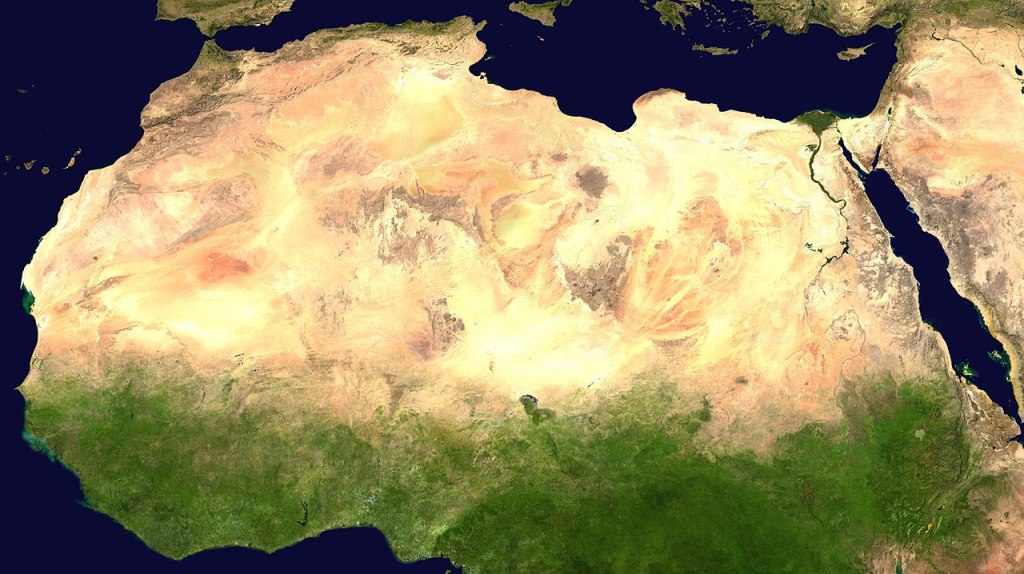
View of the Sahara desert from space

The Sahara’s shift from savannah with abundant lakes to a largely arid expanse has been traced in the remains of fish eaten thousands of years ago.

Researchers analysing material found in a rock shelter in the Acacus mountains in south-west Libya say they have found more than 17,500 animal remains dating from between 10,200 and 4,650 years ago, 80% of which are fish. About two-thirds of the fish were catfish and the rest were tilapia. The team say telltale marks on the bones reveal the fish were eaten by humans who used the shelter.

It is not the first time fish remains have been found in what are now dry regions of the desert, but the team say it is the first time the ancient climate of the region has been traced through animal remains.

All the other finds are surface finds, [from] just one layer, one period, one event. Whereas what we have here is a 5,000-year sequence with a lot of bones – so that makes it special,” said Dr Wim van Neer from the Royal Belgian Institute of Natural Sciences, a co-author of the study.

The discovery is the latest in a string of finds from the large Takarkori rock shelter, a site, about 50-60 metres long and 30 metres high, that is thought to have been first used by hunter gatherers more than 10,000 years ago.

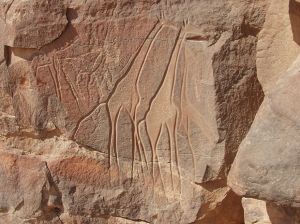
Sahara petroglyph in the Fezzan giraffes
Rock art in the Sahara desert (Source: Wikipedia) 

Prof Savino di Lernia, a co-author of the study from Sapienza University of Rome, said previous finds at the shelter included evidence of rock art, the earliest signs in Africa of wild cereals being cultivated and their seeds stored, and evidence from pottery shards of dairy practices in Africa dating back nearly 7,000 years ago.

… Writing in the journal Plos One, Van Neer and colleagues report that fish account for about 80% of the animal remains discovered at the site during the 5,000-year period it was used by humans, with mammals making up just over 19%. Birds molluscs and other animals such as turtles account for the rest.

The team found the predominance of fish was not steady but fell from about 90% in the earliest layers to about 48% in those from the most recent period of its occupation.

The amount of fish is decreasing through time and the contribution of mammals increases, showing that people at Takarkori focussed gradually more on hunting and livestock keeping,” the authors write. But, they add: “It is unclear if this was an intentional process or if this shift could be related to increasing aridity, which made the environment less favourable for fishes.” …