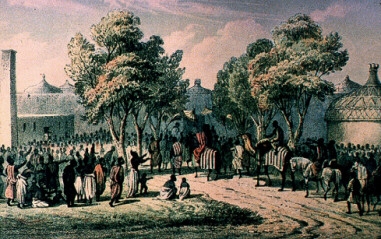
An illustration from Jules Verne’s book “Découverte de la terre” (“Discovery of the Earth”) drawn by Léon Benett. Ibn Battuta (1304-68/69) was a Moroccan Berber scholar and traveler
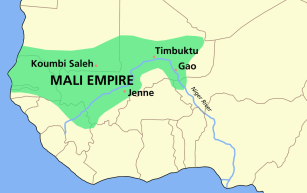
The Berber scholar and historian Abu Abdullah Ibn Battuta (commonly known in English as Ibn Battuta) is known as the most prolific and famous traveler of the middle ages. Born in Morocco in 1304, descending from a family of Islamic legal scholars (qadis) in Tangier, Ibn Battuta covered over 73,000 miles in 3 decades spanning 3 continents, Africa, Europe, and Asia. On one such travel, he visited the great Empire of Mali, and through his notes, we know what an audience with the Emperor Mansa Sulayman of Mali looked like. Travel to 1351 and enjoy a day in the court of the Emperor of one of the greatest empires in Africa, the Mali Empire, through the eyes of Ibn Battuta!
=====
Mali Empire (Wikipedia)
On certain days the sultan holds audiences in the palace yard, where there is a platform under a tree, with three steps; this they call the “pempi.” It is carpeted with silk and has cushions placed on it. [Over it] is raised the umbrella, which is a sort of pavilion made of silk, surmounted by a bird in gold, about the size of a falcon. The sultan comes out of a door in a corner of the palace, carrying a bow in his hand and a quiver on his back. On his head he has a golden skull-cap, bound with a gold band which has narrow ends shaped like knives, more than a span in length. His usual dress is a velvety red tunic, made of the European fabrics called “mut’anfas.” The sultan is preceded by his musicians, who carry gold and silver guimbris[two-stringed guitars], and behind him come three hundred armed slaves [possibly servants]. He walks in a leisurely fashion, affecting a very slow movement, and even stops from time to time. On reaching the pempihe stops and looks round the assembly, then ascends it in the sedate manner of a preacher ascending a mosque-pulpit. As he takes his seat the drums, trumpets, and bugles are sounded. Three slaves go out at a run to summon the sovereign’s deputy and the military commanders, who enter and sit down. Two saddled and bridled horses are brought, along with two goats, which they hold to serve as a protection against the evil eye. Dugha stands at the gate and the rest of the people remain in the street, under the trees.
Sometimes one of them stands up before him and recalls his deeds in the sultan’s service, saying, “I did so-and-so on such a day,” or, “I killed so-and-so on such a day.” Those who have knowledge of this confirm his words, which they do by plucking the cord of the bow and releasing it [with a twang], just as an archer does when shooting an arrow. If the sultan says, “Truly spoken,” or thanks him, he removes his clothes and “dusts.” That is their idea of good manners.
The painted wooden coffins were found intact in burial shafts and contained mummies, amulets and wooden boxes. Photograph: Khaled Desouki/AFP/Getty Images
To be an archaeologist in Egypt is probably one of the highest wishes of any archaeologist out there: everyday there are new findings, and more importantly new insights into one of the world’s most ancient civilizations which happens to be African. The ancient Egyptian civilization has inspired many, and shed new light on life thousands of years ago in that area of the African continent. Few days ago, hundreds of Ancient Egyptians coffins were found at a cemetery in Saqqara; among the coffins was found a headless statue of Imhotep, Chief architect of Pharaoh Djoser‘s step pyramid, and possibly one of history’s first documented physician, and author of several wisdom texts. The mission found 250 colored wooden sarcophagi with well-preserved mummies, wooden statues and masks dating from 500 BC, as well as a cache of bronze mirrors, bracelets, necklaces, earrings, and more dating from the 15th century BC. Below are excerpts from an article on the Guardian. Enjoy!
====
Archaeologists working near Cairo have uncovered hundreds of ancient Egyptian coffins and bronze statues of deities.
The discovery at a cemetery in Saqqara contained statues of the gods Anubis, Amun, Min, Osiris, Isis, Nefertum, Bastet and Hathor along with a headless statue of the architect Imhotep, who built the Saqqara pyramid, according to Egypt’s ministry of tourism and antiquities.
The 250 coffins, 150 bronze statues and other objects dated to the late period, about 500BC, the ministry said.
They were accompanied by a musical instrument known as a sistrum and a collection of bronze vessels used in rituals for the worship of the goddess Isis.
The painted wooden coffins were found intact in burial shafts and contained mummies, amulets and wooden boxes. Wooden statues of Nephthys and Isis from an earlier period were also found, both with gilded faces.
Have you ever stood in front of an African mask and wondered about the artist who made it: what was his name, origin, and life like? A few weeks ago, I had an argument with a European friend who specializes in art history, who tried to convince me, a child of mother Africa, that African art does not have authorship. He claimed that while looking at African masks, they were all cloaked with anonymity, and that probably African art traditions prized anonymity. I had to tell him that he needed to stop looking at African art through his tainted European lenses, but rather try it through African tunnel vision. First of all, African art’s function is not similar to that used by Europeans as decorative art. African art actually has functions that go beyond decorative; the art work has meaning, and a real place in society.
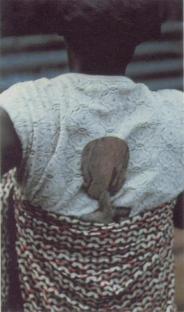
An Akua’ba tucked into the wrapper of an Asante woman. Photograph by Herbert M. Cole, Ghana, 1972 (RandAfricanArt.com)
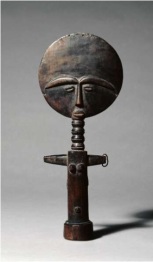
For instance, in the Asante (Ashanti) culture of Ghana, the Akua’ba (Akua’s child) figurines which are among some of the best well-known African wooden figures recognizable by their small disc head lodged on a cylindrical torso with or without arms, were used as legend says by Akua who could not have children; she ordered a figurine which she tied to her back and cared for as instructed by an African traditional priest, eventually being able to conceive; since then, many women desiring children have ordered Akua’ba figurines from artists and gotten them consecrated at shrines, and cared for in hope of conceiving. Also, some of the statues, like fertility statues, serve a particular purpose as the name states.
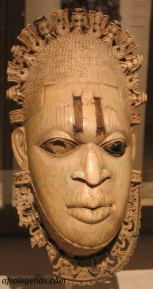
Pendant Ivory mask representing Queen Idia, Iyoba of Benin City (16th Century), exposed at the MET
Anonymity in African art is only a myth invented by Europeans as they came in contact with a foreign culture which they tried to explain via their own tainted cultural glasses. In the case of the Yoruba people of West Africa, as we saw earlier in the naming ceremonies [African Naming Tradition], names given at birth are not just used to differentiate individuals, but also serve to identify the essence of one’s personality and destiny called ori inu (inner spiritual head), which in Yoruba religious belief, determines a person’s success or failure in this world and directs his or her actions. The name also gives information about the person’s family, beliefs, history, origin, and environment. It is sacred! With every naming celebration, there begins a corresponding oriki (citation poetry), which grows with an individual’s accomplishments. Leaders, warriors, diviners, and other important persons, including artists are easily identified by their oriki, which chronicles their achievements [The Griot, the Preserver of African Traditions]. In Yoruba culture, there are different kinds of oriki: oriki Olurun (oriki for God), oriki orisa (oriki for gods/goddesses), oriki Oba ati Ijoye (oriki for monarchs and chiefs), oriki Akinkanju (oriki for warriors), oriki idile (oriki for families), to name just a few.
Below is the part of the oriki of Olowe, one of the greatest traditional Yoruba sculptors of the twentieth century; it was collected by John Pemberton III in 1988 from Oluju-ifun, one of Olowe’s surviving wives, and has been found to be instrumental in reconstructing his life and work. Outstanding Yoruba artists like Olowe whose works have been collected and studied by researchers have been identified in scholarly literature only by their nicknames or bynames such as, Olowe Ise (meaning Olowe from the town of Ise); Ologan Uselu (Ologan from Uselu quarters in Owo); and Baba Roti (father of Rotimi). This was done to protect the artist as he could become a vulnerable target to malevolent forces because of his standing in society or closeness to the king’s court, etc; in that case the artist never revealed his full name to strangers. However, when a person’s oriki is recited, it is assumed that anyone who listens carefully and understands it will know enough about the subject’s identity, name, lineage, occupation, achievements, and other qualities so that stating the person’s given name becomes superfluous. This is found on P. 11 – 12 of A History of Art in Africa, Monica Blackmun Visona, Harry N. Abrams (2001). Thus, authorship in African art is not veiled in anonymity, but rather the way authorship is conceived of is different. Enjoy!
Olowe, oko mi kare o
Aseri Agbaliju
Elemoso
Ajuru Agada
O sun on tegbetegbe
Elegbe bi oni sa
O p’uroko bi oni p’ugba
O m’eo roko daun se…
Ma a sin Olowe
Olowe ke e p’uroko
Olowe ke e sona
O lo ule Ogoga
Odum merin lo se libe
O sono un
Ku o ba ti de’le Ogoga
Ku o ba ti d’Owo
Use oko mi e e libe
Ku o ba ti de’kare
Use oko mi i libe
Ku o ba ti d’Igede
Use oko mi e e libe
Ku o ba ti de Ukiti
Use oko mi i libe
Ku o li Olowe l’Ogbagi
L’Use
Use oko mi i libe
Ule Deji
Oko mi suse libe l’Akure
Olowe suse l’Ogotun
Ikinniun
Kon gbelo silu Oyibo
Owo e o lo mu se
Olowe, my excellent husband
Outstanding in war.
Elemoso (Emissary of the king),
One with a mighty sword
Handsome among his friends.
Outstanding among his peers.
One who carves the hard wood of the iroko tree as though it were as soft as a calabash
One who achieves fame with the proceeds of his carving …
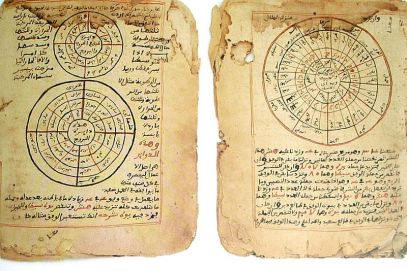
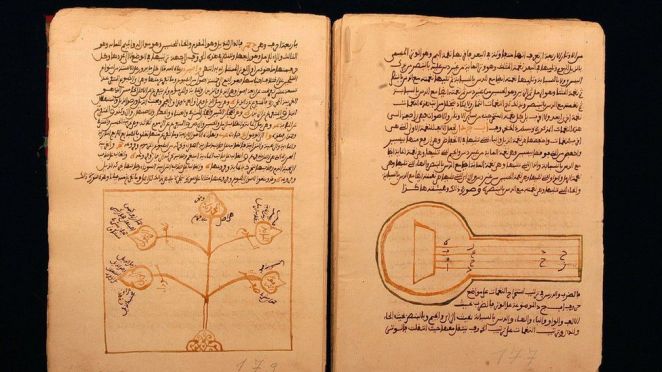
Manuscripts a Tombouctou (Mali) montrant de l’astronomie et mathematique
I am happy to announce that the Timbuktu manuscripts are now available online. Can you imagine that? Treasures of our ancestors, writings, judgments, mathematical concepts, architectural findings, from those great scribes of ancient times. Up to 40,000 pages will now be available online, covering wide topics from biology to music to religion.
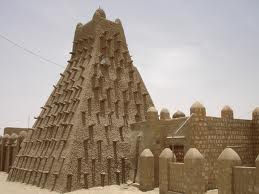
Sankore Mosque in Timbuktu
With the Islamic attacks on Mali, Timbuktu has been under occupation since 2012 (Tensions Escalating in Mali). As you all know Timbuktu was a great center of knowledge in search for many centuries starting at least in the 12th century. It was visited by people from around the world, in search of knowledge. There were over 700,000 manuscripts at the great Sankore University in Timbuktu, and many more at other public and private libraries including the Ahmed Baba Institute, Al-Wangari Library, and others (Lost Libraries of Timbuktu, Timbuktu under Attacks: Arise to save African Treasures). Many families smuggled the manuscripts to safety from Timbuktu to the capital of Bamako. The manuscripts contain centuries of African knowledge and scholarship on topics ranging from mathematics to astrological charts, biology, geography, laws, etc. They were written on various materials ranging from ancient paper, goat, sheep and even fish skins. Some were written in verse, poetic meter, while others in narrative styles using dialogues, stories of kings, scribes, noblemen, fables, anecdotes. They were renowned in the world for their physical beauty and outstanding wisdom.
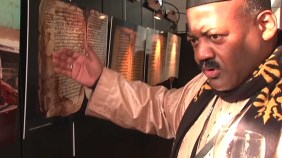
Dr Abdel Kader Haidara talking about the manuscripts of Timbuktu
In 2014, Dr Abdel Kader Haidara known for his work on the protection and preservation of the Timbuktu manuscripts and who smuggled over 350,000 manuscripts out of the city away from the jihadists, called on Google and invited the company to visit Mali and see the renowned manuscripts and join in the digitization of these treasures. Thus the collection Mali Magic was born as a collaboration between Google, local, and international partners. It took several years of combined efforts from Mali’s traditional leaders, historians, and digital archaeologists to digitize these ancient manuscripts, some dating back to the 11th century.
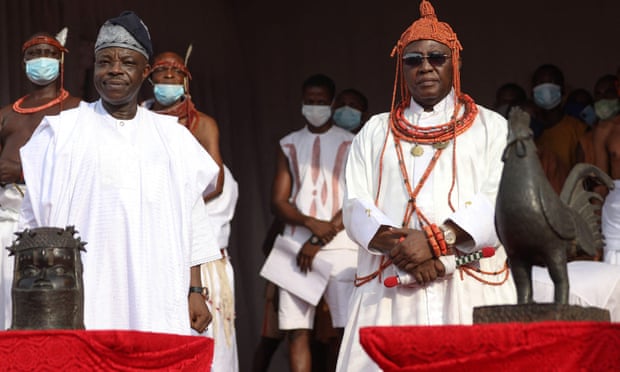
Return of cockerel sculpture and head of an Oba raises hopes that thousands more artefacts could be returned to their ancestral home. Photograph: Kola Sulaimon/AFP/Getty Images – The Guardian
It has been104 yearssinceBenin City: the Majestic City the British burnt to the groundwas looted and destroyed. Now, a century later, two of the numerous Bronze statues that were taken at the time, are being returned. Some may ask, who cares about 2 Bronze statues? These statues are not just a symbol of the craftsmanship of the Benin people, but they also symbolize the essence of the people. Back in those days, the statues were not used like they are by Europeans, to be placarded in museums, they had a symbolic, and some even had a spiritual or energetic importance. Below are excerpts from the article on the Guardian’s website.
=====
Two Benin bronzes were returned on Saturday [19 February 2022] to a traditional palace in Nigeria, more than a century after they were pillaged by British troops, raising hopes that thousands more artefacts could finally be returned to their ancestral home.
The artefacts, mostly in Europe, were stolen by explorers and colonisers from the once-mighty Benin Kingdom, now [part of] south-western Nigeria, and are among Africa’s most significant heritage objects. They were created as early as the 16th century onwards, according to the British Museum.
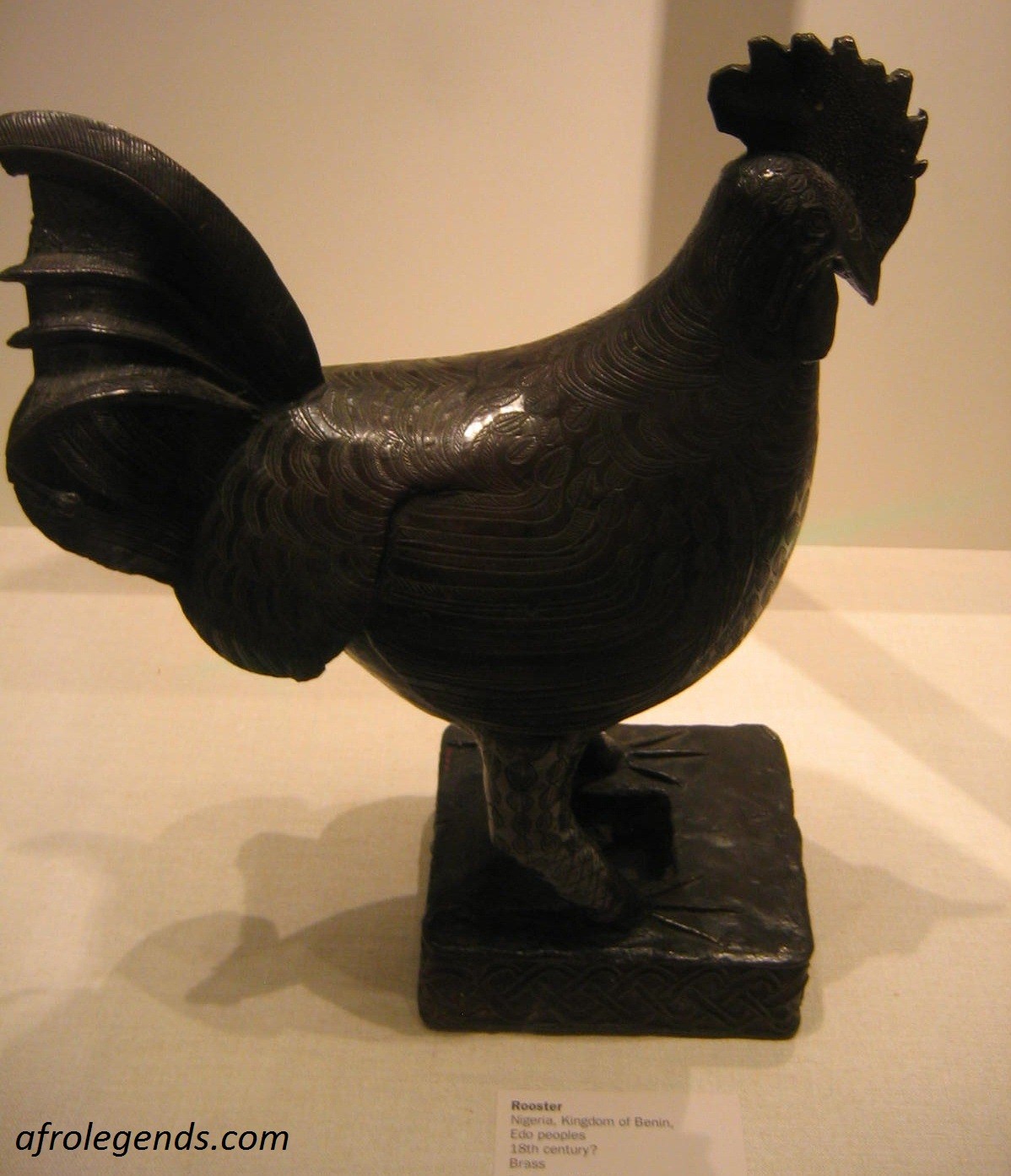
At a colourful ceremony to mark the return of a cockerel sculpture and head of an Oba or king, spokesperson Charles Edosonmwan for the Oba palace in Benin City noted that some of the bronzes were kept as far away as New Zealand, the United States and Japan.
Rooster from Benin Kingdom (18th century), exposed at the MET
The two artefacts were handed over to the Nigerian High Commission in October by the University of Aberdeen and Cambridge University’s Jesus College but had yet to return to their ancestral home.
“They are not just art but they are things that underline the significance of our spirituality,” Edosonmwan said in an interview on the sidelines of a ceremony attended by traditional leaders.
… About 90% of Africa’s cultural heritage is believed to be in Europe, French art historians estimate. Musée du quai Branly – Jacques Chirac in Paris alone holds about 70,000 African objects and London’s British Museumtens of thousands more.
Queen Nefertari and Pharaoh Ramses II at the Queen’s temple at Abu Simbel
Love songs and poems are a part of every culture in the world… Love is a universal language. It does not have any barrier, race, class, and even time! It is Love… simple, overflowing, and boundless… Some of the world’s oldest love poems were found in Egypt written several millenia ago. Amazing how timeless they are! I chose the picture of Pharaoh Ramses II and Queen Nefertari as it is well-known that Ramses II deeply loved her and had a temple built in her honor at Abu Simbel .
For this Valentine Day, enjoy this Love poem from Ancient Egypt, found in Deir el-Medina, dated about 1300 BC. It is part of the Chester Beatty Papyri I. As you read it, savor it slowly, and stop for a moment to ponder as the lover sings of his sweetheart as the fairest of all, her skin as bright as a star, her hair as precious as the lapis lazuli stone, stone highly valued in antiquity, her arms surpassing gold, her legs parading her beauty, and when she steps outside she is as the sun so beautiful she catches everyone’s attention. I have placed two of the most popular translations next to each other. Enjoy!
Sister Without Peer My one, my soul without peer,
Most beautiful of all!
Rising like the morning star
At the start of happy year.
Shining bright, fair of skin,
Lovely the look of her eyes,
Sweet the speech of her lips,
She has not a word too much.
Upright neck, shining breast,
Hair true lapis lazuli;
Arms surpassing gold,
Fingers like lotus buds.
Heavy thighs, narrow waist,
Her legs parade her beauty;
With graceful steps
she treads the ground,
Captures my heart by her movements.
She causes all men’s necks
To turn about to see her;
Joy has he whom she embraces,
He is like the first of men!
When she steps outside
She seems like the Sun!
“She has no rival, there is no one like her.
She is the fairest of all.
She is like a star goddess arising
… at the beginning of a new year;
brilliantly white, shining skin;
Such beautiful eyes when she stares,
and sweet lips when she speaks;
she has not one phrase too many.
With a long neck and shining body
her hair of genuine lapis lazuli;
her arm more brilliant than gold;
Her fingers like lotus flowers,
ample behind, tight waist,
her thighs extend her beauty,
Shapely in stride
when she steps on the earth.
She has stolen my heart with her embrace,
She has made the neck of every man
turn round at the sight of her.
Whoever embraces her is happy,
he is like the head of lovers,
And she is seen going outside
like That Goddess, the One Goddess.”
As we saw from the description of a Bornu Maï (King) in the 17th century, the Bornu Empire was a prosperous empire with great kings.
Below is another description, this time of the Bornu Empire in 1582. Immediately, we notice the impressive size of the capital city most likely Ngazargamu, the respect given to the kings, who were treated just like the kings of Timbuktu. It is also good to note the level of education of these kings, as well as their relations with Libya and beyond, Turkey. Lastly, slaves were not traded here, but rather leather. Was this the source of the great Libyan leather?
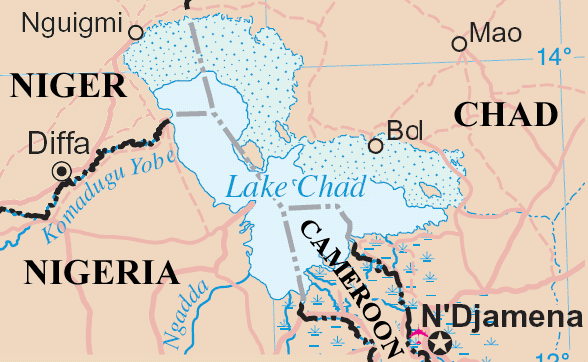
Then there is Borno on the edge of the Negro river (where there is a large lake formed by the said river [this is most likely the Yobe River also known as Komadugu Yobé River which flows into Lake Chad]). It is an immense city with a lot of traffic, having its own king who is treated with the same ceremonies, both by foreigners and by his own vassals, as those in use among the king of Tungubuto (Timbuktu). We kneel down on our knees, throwing sand on anyone’s head. He is served with great zeal by eunuchs and young girls whom they render sterile with certain potions.
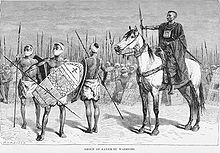
Group of Kanem-Bu warriors in the 1800s
In his correspondence, writing to foreign princes, he uses the Arabic language, as Giovanni di Vesti tells me, a very honorable person, and who was a slave to the son of a great count among the Turks. He himself saw a letter that the king of Borno wrote to the Pasha of Tripoli with great eloquence and art. This prince is so powerful that several times he has raised an army of hundred thousand men against the king of Cabi (Kebbi [in modern day Nigeria]). The blacks, it is said, regard him as an emperor, so great is his power. He owns a multitude of horses which Arabs bring from their country, and they make a great profit by selling them for at least a thousand or seven hundred crowns each. These horses do not stay alive for long, because when the sun enters the sign of Leo, many of them die every year from the extreme heat. Today many Turks arrive, seeking adventure, and many Moors from Barbary, who are their scholars. They are very well paid, because they are few in number, as it happens with all those blacks who are Muslims. And many merchants depart from there every year, carrying so much excellent quality leather that it seems extraordinary in Fizzan (Fezzan [in Libya]). Then they return with big quantities of horses, accompanying the caravans of black merchants.
Edition critique par Dierk Lange
Les Africains, vol. 3, Editions J.A., 1977, p. 57. Translated to English by Dr. Y., Afrolegends.com
We can retain without great risk of anachronism the detailed description that a Frenchman – probably a surgeon by the name of Girard held in slavery for a few years in Tripoli – gives in 1685 of the sovereign according to the testimonies he collected in this city.
It is in this case the grandson and fourth successor of Idris Alooma, designated under the name of “Mahi-Hagi-Hali”, that is Mai (Hajj) Ali b. Umar b. Idris, who had reigned, according to D. Lange, from 1639 to 1677.
Idris Alooma
“Those who have seen this prince agree that he is nice looking well-built, and of rich stature, but he is black : his ordinary clothes are a robe of white or blue linen, with long sleeves, very fine and untied : he wears the white turban like the Turks, and his face is always more than half covered, because the Bornu people are ashamed (take shame) to show their mouths, and which covers their face from the tip of the nose to the bottom of the chin.”
Chronology of the Bornu Kings from 1512 to 1671. – Extract from manuscript number 12220 (Nouvelles acquisitions. Bibliothèque Nationale, Paris) – Reproduced by le Bulletin de la Société de Géographie de Paris, 1849
It is good to note that, two centuries later, the European travelers who visited Bornu described the robe of the king in identical terms. Such permanence clearly indicates that this is not an occasional outfit, but one of the ritual and traditional insignia of power.
Les Africains, vol. 3, Editions J.A., 1977, p. 53. Translated to English by Dr. Y.,Afrolegends.com
The calabash tree (Le calebassier) under the African sun
Have you ever eaten out of a calabash? It seems the food has a particular taste, and that eating out of the calabash adds an extra ‘mmph‘ to the food. In the old days, and even to this day we used homemade utensils such as calabash, especially when eating fufu (yummy)… Well, I recently stumbled upon the tree from which the calabash bowl is made out of, and found the fruits hanging down from the tree. The tree is cultivated not only for its fruits but also for the utensils, and for making amazing musical instruments. I love the idea that everything is used and nothing is thrown out: from the fruit, the meat inside the fruit, and its shell. The calabashes are hollowed-out and dried, and used to cook, carry water, and food. The smaller sized ones are used as bowls to drink palm wine: the white wine made in Africa (Le Vin de Palme: Vin Blanc Made in Africa).
The calabash fruit
Calabashes are used in making the West African kora (a harp-lute), xalam/ngoni (a lute) and the goje (a traditional fiddle). They also serve as resonators underneath the balafon (West African marimba). The calabash is also used in making the shekere / shegureh (a Sierra Leonean women’s rattle) and balangi (a Sierra Leonean type of balafon) musical instruments. Sometimes, large calabashes are simply hollowed out, dried, and used as percussion instruments, especially by Fulani, Songhai, Gur-speaking and Hausa peoples. In Nigeria, the calabash has been used to meet a law requiring the wearing of a helmet on a motorcycle. In South Africa, it is commonly used as a drinking vessel and a vessel for carrying food by all people across the continent. In Ethiopia, children from the Erbore tribe wear hats made from calabashes to protect themselves from the sun.
The calabash all dried up… almost ready to be made into a bowl
Is there a child on this planet who has gone to high school and not been taught the Pythagorean Theorem in some shape or form? I am not sure that many African children know that the so-called Pythagorean Theorem was written by their ancestors over 1000 years before Pythagoras was born, and on African soil. You heard me right: Pythagorean Theorem was written on the Berlin Papyrus or Berlin Papyrus 6619, a papyrus from ancient Egypt from the Middle Kingdom. This papyrus dates back from the second half of the 12th (c. 1990–1800 BC) or 13th Dynasty (c. 1800 BC – 1649 BC).
The papyrus is one of the primary sources of ancient Egyptian mathematical and medical knowledge, including the first known documentation concerning pregnancy test procedures. See our ancestors were already trying to test pregnancy! Amazing!
The first problem found on the Berlin Papyrus states, “You are told the area of a square of 100 square cubits is equal to that of two smaller squares. The side of one is ½ + ¼ the side of the other. What are the sides of the two unknown squares.” In modern terms, we would express this as x2 + y2 = 100 and x = (3/4)y, yielding to y = 8, and x = 6. Although the papyrus shows a solution using Egyptian multiplication and a somewhat different way of solving it today, it is understood that they most likely had a good knowledge of the Pythagorean Theorem. It is written in Hieratic script.
Next time you visit the Egyptian Museum Berlin, don’t just look at the bust of Queen Nefertiti which is next to the Berlin Papyrus and dwarfs it, but check it out also.