The Swede abolitionist and explorer Carl Bernhard Wadström (Charles Berns Wadström) once described his travels in West Africa from October 1787-1788 with fellow Swede Anders Sparrman and Carl Axel Arrhenius. They were sent by King Gustav III of Sweden, with the official goal of making new discoveries in natural sciences, history, and of course the non-official goal to help with the king’s colonial ambitions. The scientific expedition was quickly aborted when they were in Senegal, where they then witnessed diverse aspects of the transatlantic slave trade. As we saw earlier, Wadström was later called in 1790, to testify in front of the British Government Select Committee; published in a report entitled “Minutes of the evidence taken before a Committee of the House of Commons, being a Select Committee, appointed to take the Examination of Witnesses respecting the African Slave Trade.” Wadström described the advanced industries found in that part of Africa, ranging from textile, indigo, soap, leather, and gold… he even noted that he had never seen such advanced work in Europe! Accompanied by his doctor friend Sparrman and chemist Arrhenius, they were dumbfounded to realize that Africans had a large materia medica which listed over 3000 plants.
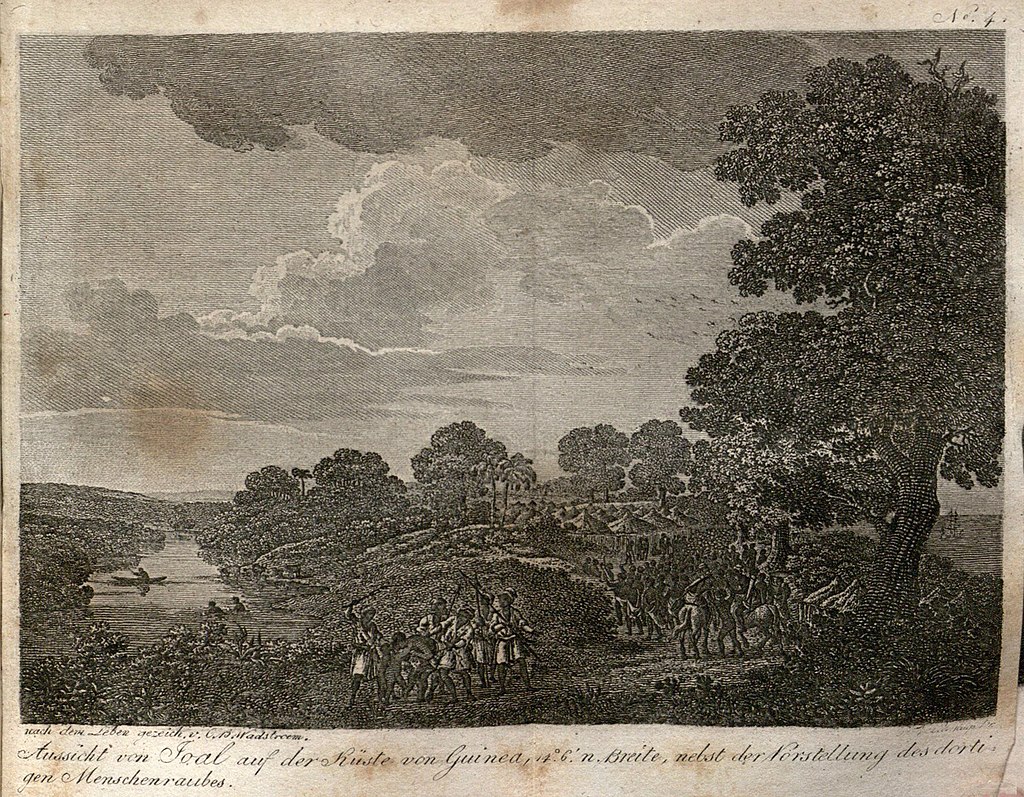
View from Joal on the coast of Guinea, 14° and an idea of the kidnapping of slaves there
The Select Committee on the Slave Trade was keen to know about the quality of culture in that part of Africa. They asked Wadström: “Have they any manufactures amongst them?”
Mr Wadström’s reply was most edifying: “I have been surprised to see with what industrythey manufacturetheir cottons, their indigo, and other dying articles, as well as several sorts of manufacture in wood; they make soap; they tan leather, and work it exceedingly well, and even with good taste … they work bar iron … into several articles, as for instance,lances, instruments for tillage, poniards, &c.; they work in goldvery ingeniously, and so well, that I never have seen better made articles of that kind in Europe; a great number of articles for ornaments of gold, silver, brass, leather, &c.”
Wadström further stated that: “Their clothand their leatherthey manufacturewith uncommon neatness; and I have samples with me to shew [sic] in case it should be desired.”
As we saw earlier, the king who was called Dalmanny was a well educated man; he had held the position of Grand Marabout before becoming King. His subjects were very honest and hospitableand showed Wadström “all civility and kindness.” In addition, they had “an extraordinary genius for commerce.” Interestingly, they also had a “Materia Medica” of “about 2,000 or nearer 3,000” plants.
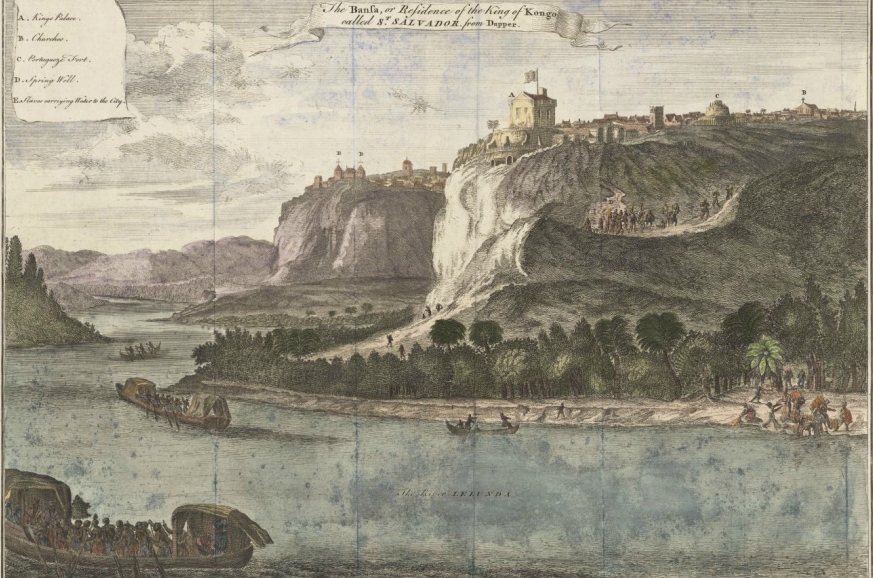
Mbanza Kongo, capital of the Kingdom of Kongo, in 1745
History repeats itself! It is extremely important to know our history. We have already shown that the narrative that states that African kings sold “their” own into slavery was very flawed and was made up to shift the blame of slavery from the European merchants and their powers (kings and queens, the Catholic church with the papal bull, and much more) to the Africans themselves (the victims). How many times in modern day have we seen how the blame is placed on the victim rather than the aggressor? As we read here another account of an African king who hated slavery, it is important to note the similitude with modern days: the king did not want slavery, therefore attempts were made on his life; does it not remind you of Patrice Lumumba, Sylvanus Olympio, Amilcar Cabral, Ruben Um Nyobé, and so many… when African leaders opposed the narrative being played, they were eliminated! And this behavior spans centuries! Below is the account of an attempt made on King Afonso I [King Nzinga Mbemba] on his life; this is the same Kongo king who wrote to the King of Portugal against Slavery.
“The hatred devoted by Affonso I [King Nzinga Mbemba] to the overseas slave trade and the vigilance he maintained so as not to see his authority erode earned him the animosity of some of the Portuguese merchants living in the capital. On Easter Sunday 1540, eight of them tried to make an attempt on his life while he was attending mass. He escaped, a bullet having simply passed through the fringe of his royal tunic, but one of the nobles of his court was killed and two others wounded.“
Asante ceremonial cap worn by courtiers at coronations is among the items that will be loaned back to Ghana (Source: British Museum / BBC)
The news is everywhere, Asante gold artifacts are returning home after 150 years … on loan from the UK to Ghana. Let’s repeat that, Ghanaian artifacts looted 150 years by British forces in modern-day Ghana, are now being returned to Ghana on a loan from the UK. What the heck? So someone comes to your house, steals from you, and then years later, after you have begged, says “I am returning some of the stuff I stole from you on loan only!” How does that make sense? People say, “it is a step forward, we need to acknowledge it, and be grateful for progress.” Grateful? Grateful for what? Because the British are loaning things they stole from the Asante kingdom of Ghana, back to Ghana? Some of these loaned items are like the crown jewels of the kingdom, and have high spiritual values as well. And this comes after Ghanaians have negotiated for very long … can you imagine? … a loan!
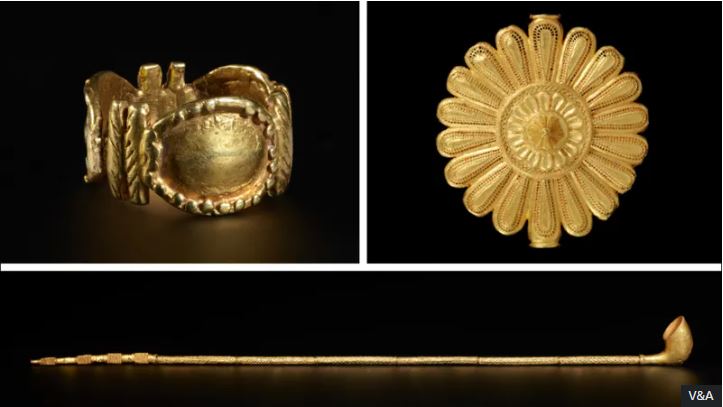
The V&A is lending 17 items including an Asante gold ring (top left), a gold badge worn by the king’s “soul washer” and a ceremonial pipe (Source: V&A Museum / BBC)
The UK is sending some of Ghana’s “crown jewels” back home, 150 years after looting them from the court of the Asante king.
A gold peace pipe is among 32 items returning under long-term loan deals, the BBC can reveal.
The Victoria & Albert Museum (V&A) is lending 17 pieces and 15 are from the British Museum.
Ghana’s chief negotiator said he hoped for “a new sense of cultural co-operation” after generations of anger.
Some national museums in the UK – including the V&A and the British Museum – are banned by law from permanently giving back contested items in their collections [somehow, they are not banned by law from taking stolen goods], and loan deals such as this are seen as a way to allow objects to return to their countries of origin .
But some countries laying claim to disputed artefacts fear that loans may be used to imply they accept the UK’s ownership. Tristram Hunt, director of the V&A, told the BBC that the gold items of court regalia are the equivalent of “our Crown Jewels“.
The items to be loaned, most of which were taken during 19th-Century wars between the British and the Asante [known as the Anglo-Ashanti wars, series of conflict wars which lasted from 1824 to 1900], include a sword of state and gold badges worn by officials charged with cleansing the soul of the king.
British troops ransacking Fomena Palace en route to Kumasi in 1874
Mr Hunt said when museums hold “objects with origins in war and looting in military campaigns, we have a responsibility to the countries of origin to think about how we can share those more fairly today. It doesn’t seem to me that all of our museums will fall down if we build up these kind of partnerships and exchanges.” [that’s why they only loan a minuscule number at a time … so their museums don’t fall apart].
However, Mr Hunt insisted the new cultural partnership “is not restitution by the back door” – meaning it is not a way to return permanent ownership back to Ghana. [The UK are still the owners of these Ghanaian artifacts stolen from Ghana].
The three-year loan agreements, with an option to extend for a further three years, are not with the Ghanaian government but with Otumfo Osei Tutu II – the current Asante king known as the Asantehene – who attended the Coronation of King Charles last year. [Did the negotiation include attending the British King’s coronation, as a condition for loaning?]
… The items will go on display at the Manhyia Palace Museum in Kumasi, the capital of the Asante region, to celebrate the Asantehene’s silver jubilee.
The Asante gold artefacts are the ultimate symbol of the Asante royal government and are believed to be invested with the spirits of former Asante kings.
They have an importance to Ghana comparable to the Benin Bronzes – thousands of sculptures and plaques looted by Britain from the palace of the Kingdom of Benin (Benin City: the Majestic City the British burnt to the ground), in modern-day southern Nigeria. Nigeria has been calling for their return for decades.
Nana Oforiatta Ayim, special adviser to Ghana’s culture minister, told the BBC: “They’re not just objects, they have spiritual importance as well. They are part of the soul of the nation. It’s pieces of ourselves returning.” She said the loan was “a good starting point” on the anniversary of the looting and “a sign of some kind of healing and commemoration for the violence that happened“.
UK museums hold many more items taken from Ghana, including a gold trophy head that is among the most famous pieces of Asante regalia. The Asante built what was once one of the most powerful and formidable states in west Africa, trading in, among others, gold, textiles and enslaved people. The kingdom was famed for its military might and wealth. …
Burning of Kumasi by British troops in 1874
Europeans were attracted to what they later named the Gold Coast by the stories of African wealth and Britain fought repeated battles with the Asante in the 19th Century. In 1874 after an Asante attack, British troops launched a “punitive expedition”, in the colonial language of the time, ransacking Kumasi and taking many of the palace treasures.
[The items on loan] include three heavy cast-gold items known as soul washers’ badges (Akrafokonmu), which were worn around the necks of high ranking officials at court who were responsible for cleansing the soul of the king. …
The British Museum is also returning on loan a total of 15 items, some of them looted during a later conflict in 1895-96, including a sword of state known as the Mpomponsuo.
When Emperor Tewodros II was crowned King, the British Consul Walter Plowden who knew well the political events of Ethiopia during the 1850s and had foretold the rising star of Kassa, the Emperor’s birth name, the freelance warrior from Qwara, described him as such:
“The King Theodorus is young in years, vigorous in all manly exercises, of a striking countenance, peculiarly polite and engaging when pleased, and mostly displaying great tact and delicacy. He is persuaded that he is destined to restore the glories of the Ethiopian Empire and to achieve great conquests: of untiring energy, both mental and bodily, his personal and moral daring is boundless… When aroused his wrath is terrible, and all tremble; but at all moments he possesses a perfect self-control. Indefatigable in business, he takes little repose night or day: his ideas and language are clear and precise; hesitation is not known to him; and has no counsellors or go-between. He is fond of splendour, and received in state even on a campaign. He is unsparing in punishment — necessary in a wilderness as Abyssinia (at that time). He salutes his meanest (poor) subjects with courtesy, is sincerely though often mistakenly religious, and will acknowledge a fault committed to his poorest follower in a moment of compassion with sincerity and grace. He is generous to excess, and free from all cupidity, regarding nothing with pleasure or desire but munitions of war for his soldiers. He has exercised the utmost clemency towards the vanquished, treating them more like friends than enemies. His faith is signal: without Christ I am nothing.”
Prince Alemayehu, son of Emperor Tewodros II, as photographed in 1868 by Julia Cameron
This is a heartbreaking news. Last week, Buckingham Palace, and the UK government refused to return the remains of Prince Alemayehu, son of Emperor Tewodros II, to Ethiopia. Prince Alemayehu’s remains are still in Great Britain 150 years after his death. How preposterous is this! Few years ago, when the Ethiopian government asked, the British said that they could not identify his bones (Ethiopians urge Britain to return bones of ‘stolen’ prince after 150 years). Today, Ethiopians thought that now that there is a new occupant in Buckingham Palace, King Charles III, Prince Alemayehu’s remains will finally return home. However, Buckingham Palace said that returning his remains will not be possible, as it will disturb the resting place of several others in the vicinity. From not being able to identify his bones a few years ago (when in this day and age the remains of King Richard III of England have been identified 500 years after his death), to disturbing others buried there, it makes us wonder if they ever even took the time to look. These are the same people who only returned the hair of Emperor Tewodros II only in 2019. It is so painful to hear… it feels like part of Emperor Tewodros II is still stuck in England. As one looks at pictures of the young orphaned prince who arrived in the UK at the age of 7, and who died at the age of 18, there is so much pain in his face.
Below are snippets of the article; for the full version, go to the BBC.
=====
Emperor Tewodros II
Buckingham Palace has declined a request to return the remains of an Ethiopian prince who came to be buried at Windsor Castle in the 19th Century.
Prince Alemayehu was taken to the UK aged just seven and arrived an orphan after his mother died on the journey. Queen Victoria then took an interest in him and arranged for his education – and ultimately his burial when he died aged just 18.
But his family wants his remains to be sent back to Ethiopia. “We want his remains back as a family and as Ethiopians because that is not the country he was born in,” one of the royal descendants Fasil Minas told the BBC. “It was not right” for him to be buried in the UK, he added.
… in a statement sent to the BBC, a Buckingham Palace spokesperson said removing his remains could affect others buried in the catacombs of St George’s Chapel in Windsor Castle. “It is very unlikely that it would be possible to exhume the remains without disturbing the resting place of a substantial number of others in the vicinity,” the palace said. The statement added that the authorities at the chapel were sensitive to the need to honour Prince Alemayehu’s memory, but that they also had “the responsibility to preserve the dignity of the departed“.
How Prince Alemayehu ended up in the UK at such a young age was the result of imperial action and the failure of diplomacy. In 1862, in an effort to strengthen his empire, the prince’s father Emperor Tewodros II sought an alliance with the UK, but his letters making his case did not get a response from Queen Victoria. Angered by the silence and taking matters into his own hands, the emperor held some Europeans, among them the British consul, hostage. This precipitated a huge military expedition, involving some 13,000 British and Indian troops, to rescue them [no diplomacy, always force and violence].
British Camp at Zoola, Abyssinia expedition 1868-9 (Source: Victoria and Albert Museum, London)
The force also included an official from the British Museum. In April 1868 they laid siege to Tewodros’ mountain fortress at Maqdala in northern Ethiopia, and in a matter of hours overwhelmed the defences. The emperor decided he would rather take his own life than be a prisoner of the British, an action that turned him into a heroic figure among his people.
Departure of the British expeditionary forces from Maqdala with the loot – Illustrated London News 1868
After the battle, the British plundered thousands of cultural and religious artefacts. These included gold crowns, manuscripts, necklaces and dresses. Historians say dozens of elephants and hundreds of mules were needed to cart away the treasures, which are today scattered across European museums and libraries, as well as in private collections. [In the case ofMaqdalain1868, it is said that15 elephants and 200 mules were needed to cart away all the loot from Maqdala.British forces looted the place with no restrain].
The British also took away Prince Alemayehu and his mother, Empress Tiruwork Wube. [The loot was not enough… the young prince and the Empress too].
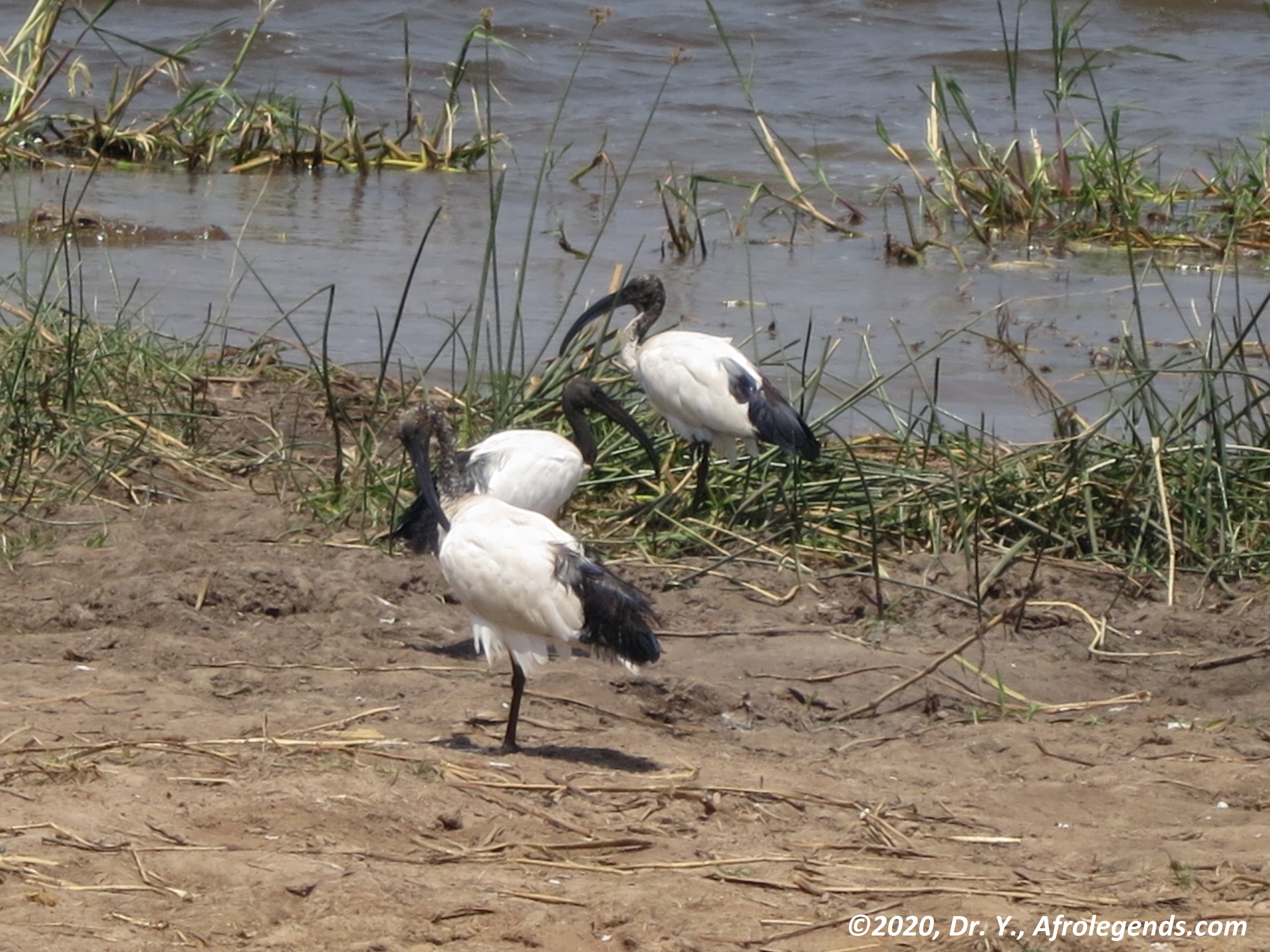
It is no secret that the ibis was highly regarded in Ancient Egypt. It was seen as a sacred bird, and the embodiment of Djehuty or Thoth, the god of wisdom, the scribe of the gods and inventor of writing and Egyptian hieroglyphs; he was depicted with the head of an ibis. The bird has been painted on murals, and often been found mummified in tombs. However, the Sacred Ibis has been extinct in Egypt for over a hundred years and can now be found throughout the Ethiopian region, in marshes, swamps, pasture lands, and more (Experts crack mystery of ancient Egypt’s sacred bird mummies). Apart from Thoth being a scribe to the gods in Egyptian mythology, he was also represented as a baboon, Aani, the god of equilibrium, in
Djehuty or Thoth in his form as an ibis-headed man
the underworld, Duat, who reported when the scales weighing the deceased’s heart against the feather, representing the principle of Maat, was exactly even. As Thoth, he is credited with making the calculations for the establishment of the heavens, stars, Earth, and everything in them. For ancient Egyptians, he is attributed as the author of all works of science, religion, philosophy, and magic; while ancient Greeks further credited him as the author of every work of every branch of knowledge, human and divine. The Sacred Ibis, from its scientific name Threskiornis aethiopica has white plumage and dark feathers on its lower back; at 30inches long, it is a striking bird found near marshes, swamps, pasture land, and flood plains in the Ethiopian region.
Ibises and a crocodile
The Hadada Ibis, also known by its scientific name as Bostrychia hagedash is common in East Africa where it can be found in marshes, swamps, edges of lakes, and pasture land. They are often seen in villages and towns, and the bird is quite tamed. Often heard at daybreak and sunset, its entire plumage is olive-brown, with pale underparts, while the head and neck often have a metallic green sheen. It is a sociable bird, but unlike other ibises, it is a solitary nester.
There are many more species of ibises around the world, but today the focus is on the African species, and particularly the Sacred Ibis. Just to think of how much that bird was venerated in Ancient Egypt makes us wonder about its magnificence. It would not be a surprise if the hotel brand Ibis was inspired by this magnificent bird and all it encompassed in the Ancient world of Egyptians.
Church pillars on Sai Island (Source: Atlas Obscura)
Our hearts go out to our brothers and sisters in Sudan whose country is going through unrest again. This unrest is part of the New Scramble for Africa, and to a greater extent the great global war between the West and the East which as always plays on other continents.
Today, we will continue our exploration of Saï Island, an island in Sudan which contains ruins spanning thousands of years and several empires. It is the largest island on the Nile river, about 12 kmlong and 5.5 kmwide. Although Sudan is today an Islamic country, Saï was once occupied by Egyptians during the New Kingdom, and later was the site of the ancient medieval Christian Nubian Empire known as Makuria which flourished in Sudan between the 7th and 14thcenturies. Later, during the 16thcentury, the Ottomans founded a fortress on the island. Saï Island has always been Nubian, and over the centuries has seen different cultures, religions, and much more.
Ruins on Sai Island (Source: Lendi Travel)
Many Empires have prevailed on the island. The presence of the Egyptian town and temple which dates back to 1500 BC is a good example of the strong imprint of the Pharaonic Egypt, with among many other things a spolia bearing the cartouche of Amenhotep IV, amongst other 18th Dynasty rulers: the fort was founded by Pharaoh Ahmose and then overbuilt by Amenhotep I and his successors. Saï Island was also an important royal site during the Meroitic period as testified by the discovery of pillars/columns with the names of the Queen Amanitore and King Natakamani of Nubia. It is clear today that Saï Island was the seat of a Nubian Bishop as indicated by the remains of a Medieval Christian cruciform church, identified as a cathedral, the largest in Nubia; while the Ottoman presence is noted by the remains of a fort built in the 2nd half of the 16th century AD. The place is full of pottery dating several centuries, if not millenia. However, part of the island, the northern part, was flooded when Lake Nasser was created in 1971 (most monuments that were destroyed were on the Nubian/Sudan side of the dam, while a lot on the Egyptian side were recovered and moved to higher ground – don’t get me wrong, Abu Simbel is amazing and worthy to have been saved, but wasn’t the fortress at Buhen just as important?).
Chert pebble with ochre residue from Sai Island, Sudan. (Source: Illustration by Van Peer, et al. (2004))
Saï Island is an exceptional testimony to early human occupation in this part of Africa, notably the Homo-erectus and the Homo-Sapiens. It provided early attested evidence for the use of color in the world with rare finds of ochre and ways to manipulate it (Saï Island in Sudan – Earliest Site with Evidence of Ochre Use by Modern humans). It is one of the key sites in Sudan (which was not flooded) which shows the prime influence of Egyptian culture in Nubia during the 2nd millennium BC, and the evolution and fusion of both cultures with mutual influences from Nubia and Pharaonic Egypt across centuries. All these attributes qualify Saï Island as unique with an outstanding Universal Value.
Chert pebble with ochre residue from Sai Island, Sudan. (Source: Illustration by Van Peer, et al. (2004))
Saï Island, in Sudan, is located in the Nubian region of the Nile River, and is the very earliest site with evidence of ochre use by modern humans. It is the largest island on the Nile River, and was occupied intermittently by people throughout the Paleolithic. The island is rich in history, and today we will focus on the color impact of Saï island in the history of the world.
Found on the island, there are several archaeological layers dating from about 180,000 to 200,000 years ago. Excavation there has yielded large quantities of red and yellow ochre. While red is almost always the dominant color at early human sites, the inhabitants of Saï Island seem to have preferred yellow pigment. The significant use of yellow ochre there indicates strong cultural choices and the use of new manipulation techniques to change colors, call it chemistry, which could have been heating or something else. Thus, Saï Island is known for being the site of the earliest ochre-processing kit in the world; on the site were found sandstone mortars, a rectangular sandstone slab with a depression carefully hollowed out in its center. The slab appears to have been a grinding stone, with evidence of ochre powder within the depression. Two small pieces of chert stone with fragments of ochre still attached were found nearby. The pieces of chert were used to crush the ochre into a fine powder on the slab, like an early mortar and pestle. These were dated to about ca 180,000 years ago. This makes Saï island an important site to understand the initial emergence of modern human behavior in the world, and thus the start of colors, and new techniques of manipulations of ochre.
To learn more, check out Van Peer et al. J. of Human Evolution 45, 187 (2003) and Fulcher et al., J. of Archaeological Sci. Rep. 33, 102550 (2020).
King Mandume ya Ndemufayo, portrait extracted from a photograph of the King with British representatives in South Africa
I found this Kwanyama poem written in honor of King Mandume. It is simple, and rich in culture. It emphasizes the Kwanyama culture: how can one cowardly abandon his king? the only son of his mother? A mother’s only son is everything, so he needs to be protected by those around. It also shows the respect given to the king, as to him were extended leather carpets. From this poem, it is clear that Mandume was a very good rider, a fearless knight, and a fine gunman. The term soba, is the term for king in Kwanyama (Cuanhama in Angola) culture. The reference to the “ragged brother” is based upon the fact that from Kwanyama accounts, Mandume used to “disguise himself in poor clothing and walk about the country to listen to what the people were saying, to see if they were satisfied by his laws” (Loeb, 1962:35), given that he had made significant positive changes to laws; while the Portuguese account on the other hand, state that Mandume used to dress in rags to trick those who would not recognize him as the king, “picking quarrels and exacting cruel vengeance to those who responded to his provocations with crude insults” (Estermann, 1960: 221). When living in the desert, water is crucial to survival; thus, water finds its way into this poem: why would anyone share the little they have with an enemy who has been trying to crush them and force them off their land? Enjoy the poem, translated to English by Dr. Y., Afrolegends.com. To learn more, read “Lyrical Nationalism in Post-Apartheid Namibia” by W. A. Haugh, Lexington Books (2014).
A great light has joined the stars. His Majesty, Jean Paul Yitamben, King of the Batcheu people, in Cameroon, has changed dimensions, and now graduated to be an ancestor to guide our paths. A great Economist, Teacher, Historian, Father, Brother, Husband, Friend, has moved on. Like Behanzin, before and many other kings, he devoted his life to the service of his community and his people. The fight has changed! Local kings are no longer deported, but kingdoms and cultures are still fragmented, crushed under the load of ‘fake’ modernism assisted by “administrations” (excrescence of colonialism) which are at the service of foreign forces to continue the work of the annihilation and/or spoliation of the African identity.
Descendant of great kings before him, Jean Paul Yitamben was an avid historian and a perfectionist who tirelessly sought perfection in everything he did. Meticulous to a letter, he did not tolerate half-done work. With his wife, world-renowned social entrepreneur, Gisele Yitamben, he worked tirelessly to empower women in micro-finance, less-privileged youth to find jobs in our tough local economies, and more importantly he affected the lives of countless others outside of his own village, community, city, and beyond. The aborted Kugwe village Palm oil and indigenous development project in the North West Region of Cameroon is a clear example.
Le soleil / The sun
Yitamben was very methodical. He had so many great projects! He worked to bring solar power to his village, sent local village women to be trained in India on how to become solar engineers at a time when it was not yet common. He sent others to Australia and Denmark, and was the first in the area to organize the ‘quinzaine’: two weeks of sports competitions to encourage local pride, and distribute prizes to the winners, encouraging children to strive in education; awarding scholarships to youths, and prizes to mothers and grandmothers. He was ahead of his time, in sub-Saharan Africa where millions of people have low access to electricity, firewood and charcoal are the main source of energy for cooking meals, representing three quarters of total energy demand; Yitamben brought in improved households (foyers améliorés) which are more efficient and better for environmental protection. He brought in international collaborators because he sought a great place for his village and his people. Let us build on Yitamben’s strength!
Libya, the Prey of the West
His biggest fight was that of his village. See, colonization did not stop in 1884, or in 1960 with the advent of pseudo-independences, it is well and alive and waxing on even stronger than before. The fight is not open, but like in Libya in 2011 or Mali today, the goal is still to fragment, to divide and conquer; to break into thousand pieces and loot local wealth while crushing the spirits of the indigenous populations. The overall objective is still the destruction of local initiatives to take the land and resources; it has not changed.
The fight at the level of King Yitamben’s village is an ample microcosm of what happens at the national or continental level in Africa: when a land is rich, or when the enemy covets the area, he promotes in-fighting among brothers (Ethiopia – Eritrea, Sudan – South Sudan), division over boundaries (Cameroon – Nigeria over Bakassi, Tanzania – Malawi over Lake Nyasa/Malawi), and division over resources (DRC – Rwanda).
Behanzin, king of Dahomey
Remember that in the time of Behanzin, after his deportation, the tactic used was to install Agoli-Agbo as a puppet King; one who was not chosen by the traditions of the land, but by Europeans to help in weakening and eradicating traditions, and promoting divisions (Côte d’Ivoire where Alassane Ouattara was installed by French war tanks in 2011).
Flash news…
The fights that occurred over 100 years ago in Dahomey kingdom, or other parts of Africa, are still ongoing, albeit on a smaller scale (and big scale as well). Villages are divided, fragmented, and local institutions weakened. The governments which, in most African countries do not serve the locals but foreign forces, are complicit in the destruction of African traditions and institutions. Yitamben believed that it was possible to change the tides of time, by at least awakening his own people against division. He fought tirelessly for unity, and against division; adamantly refusing the fragmentation orchestrated by some of his people helped by a complicit administration with colonial instincts. He could not understand how his people could let themselves be used to destroy their very own land. He was a force to reckon with. He had a titanic strength; but it is a difficult fight.
Proud warrior, you have placed the bricks on its foundation, and the task will be completed. You tirelessly gave yourself for it. The fight continues. O great warrior! Your legacy lives on!
When we have lost a leader, we need to look forward, and build for future generations.Yitamben had a strong presence, was so confident, and so generous in sharing his time, resources, and knowledge.
So long brother, father, husband, friend, … May your seeds bear lots of fruits. I will remember your laughter, your big smile, your intelligence, your fight for perfection, and above all your teachings. I feel so privileged to have had you in my life, and received your teachings. You showed us the way. Now we have to carry on your light.