This week, I will be talking about the great civilization of the Solomonic era in Ethiopia and particularly Lake Tana. Butwhat does a lake have to do with civilization? Well, lake Tana is Ethiopia’s largest lake and is also the source of the Blue Nile. There are several islands on the lake: the Portuguese missionary Manuel de Almeida in the 17th century counted about 21 of which 8 had monasteries on them; today some count 45 of which 19 have monasteries dated from the 14th and 17th centuries on them. So what does it have to do with civilization?
Well, the sepulchers and remains of many emperors (14th-17th centuries), treasures of the Ethiopian church, as well as ancient manuscripts are kept on some of the most isolated islands of Lake Tana (Ura Kidane Mehret, Narga Selassie, Kebran Gabriel, Daga Estifanos, Medhane Alem of Rema, Kota Maryam, Mertola Maryam, etc)! It is being said that Frumentius, who introduced Christianity to Ethiopia, is buried on Tana Cherqos. The body of Yekuno Amlak rests in the monastery of St. Stephen on Daga island. Emperors Dawit I, Zara Yaqob, Za Dengel and Fasilides, also lay on Daga island.
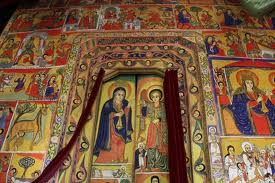
Mural at Uda Kidane Mihret
Lake Tana was already known by Ptolemee in the 2nd century BC, which he called Pseboe or ‘hollow swamps‘ (marais creux en francais). It was very important in the 14th through the 17th centuries, as it played a key role in maintaining the Christian faith, and the rise of the Solomonic dynasty and the Christian Abyssinian empire. During the Solomonic dynasty, building churches and monasteries was emphasized, just like building pyramids in Egypt was emphasized by pharaohs. Many crown jewels, treasures and precious manuscripts were stored on islands on Lake Tana. The oldest of these forty churches from the Solomonic era was built in the 14th century. The architecture reflects its era: the use of round shapes in the building technique. Each monastery/church consists of three main rooms or areas: the inner sanctuary, the inner ambulatory, and the outer ambulatory. The outside walls of the sanctuary are covered with magnificent colorful paintings reflecting that era. Seven of these churches (and the most accessible) have been chosen by the UNESCO campaign for renovation.
Around the 16th century, lake Tana became an important trade center for travellers who were coming to the famous market of Bahir Dar by foot or tankwa (reed boats made out of papyrus). Lake Tana was an important stop linking the north to the south of Ethiopia.
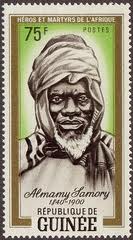
One of the great kings, and fighters of African freedom was the great Samori Touré. Over 100 years ago, Samori Touré was captured by the French and deported to Gabon where he died of pneumonia.
But who was Samori Touré?
Well, Samori Touré was born in 1830 in Manyambaladugu (some texts mentionSanankoro instead), a village southeast of Kankan in present-day Guinea. Samori was a great warrior who fought imperialism in the 19th century such as many leaders today. He refused to submit to French colonization and thus chose the path of confrontation using warfare and diplomacy.
Until the age of 20, Samori was a trader. After his mother was captured in a slave raid by the king Sori Birama, he offered to serve in his army and excelled by his military prowess and skills.
Samori Touré had a vision of unity for the Malinké people, and thus started organizing his empire using traditional and innovative methods. He effectively organized Malinké chiefdoms into a single state under his authority, at the core of which was the army. He managed to increase loyalty to the state in the Malinké people who now thought as one united people… this intensified their allegiance to him. His state was well-organized and efficient. Samori’s army was powerful, disciplined, professional, and trained in modern day warfare. They were equipped with European guns. The army was divided into two flanks, the infantry or sofa, with 30,000 to 35,000 men, and the cavalry or sere of 3,000 men. Each wind was further subdivided into permanent units, fostering camaraderie among members and loyalty to both the local leaders and Samori himself. Talk about African organization and discipline… this was really a strong army! His empire reached his apogee between 1883 and 1887, and he took the title of Almami or religious leader of a Muslim empire.
"L'Almami Samori Toure" de Khalil Fofana
Samori Touré created the Mandinka empire (the Wassoulou empire) between 1852 and 1882. His empire extended to the east as far as Sikasso (present-day Mali), to the west up to the Fouta Djallon empire (middle of modern day Guinea), to the north from Kankan to Bamako (in Mali); to the south, down to the borders of present-day Sierra Leone, Liberia, and Cote d’Ivoire. His capital was Bisandugu, in present day Gambia.
In the 1850s, slavery being abolished, European powers decided to establish colonies in Africa, and could not tolerate strong states like the Mandinka empire, and strong leaders like Samori Touré. These African leaders had to be crushed!
In 1882, at the height of the Mandinka empire, the French accused Samori Touré of refusing to comply to their order to withdraw from an important market center, Kenyeran (his army had blockaded the market). They thus started war on him. This was an excuse to start war! From 1882 to 1885, Samori fought the French and had to sign infamous treaties in 1886 and then 1887. In 1888, he took up arms again when the French reneged on the treaty by attempting to foster rebellion within his empire. He defeated the French several time between 1885 and 1889. After several confrontations, he concluded several treaties with the French in 1889.
Stamp from the Republic of Guinea
In 1890, he reorganized his army, and signed a treaty with the British in Sierra Leone, where he obtained modern weapons. He re-organized his army so as to stress defense, and employed guerilla tactics.
In December 1891, French forces overran the major cities of the Mandinka empire, leaving death and desolation in their wake (sounds familiar? Côted’Ivoire April 2011). These incursions into Touré’s empire led to exodus of the entire nation eastward. In 1893, Samori moved his capital east from Bisandugu to Dabakala. In 1894, the French assembled all their troops in western sudan (Senegal, Mali, Niger, etc…) to fight Samori.
Capture of Samori
Between 1893 and 1898, Samori’s army retreated eastward, toward the Bandama and Como (in modern day Cote d’Ivoire), conquering huge territories in the northern part of modern-day Cote d’ivoire. He led the scorched earth tactic, destroying every piece of land he evacuated. Although that tactic cut him from his new source of weapons in Liberia, he still managed to delay the French. He formed a second empire, and moved his capital to Kong, in upper Cote d’Ivoire. On May 1, 1898, the French seized the town of Sikasso and his army took up positions in the Liberian forests to resist a second invasion. This time Samori’s army fought valiantly but was no match to the power of the French arsenal. Samori forced to fight a total war against a foreign invader, and fighting against all odds, was captured on September 29, 1898, in his camp in Gué(lé)mou in present-day Côte d’Ivoire. He was exiled to Gabon where he died two years later on June 2, 1900.
Samori Touré was a warrior, a fighter, an empire builder, and one of the greatest African military leaders ever seen… he fought and won against the French army several times before his capture.
Interestingly enough, over 50 years later, the grandson of Samori, Sekou Touré, was the only one to say ‘NO’ to France, and to General De Gaulle: they preferred freedom over slavery under the European master… that was in Guinea!
Samori’s empire
Please check out the work of Pr. Yves Person on WebMande.net who wrote a book on Samori Touré, BlackHistoryPages, and this article published by the New York Times in 1898 about the Capture of Samori Toure by the French. According to the New York Times, Samori, “for nearly 13 years, was the most dangerous antagonists Europeans had had to deal with“. I could not find a good map of Samori’s empire anywhere… so I made my own based on all the boundaries and main cities conquered and his capitals: Bisandougou, Kankan, Bamako, Sikasso, Kong, Dabakala, Guelemou, etc… some of the cities may not be the same today (or even exist after 100 years), particularly the city of Dabadugu: Samori Toure defeated the French at Dabadugu, was it the city of Dabadugu near Kankan, or was it the city of Dabadugu near Nzerekore? I used Google map and made my own, respecting all the information found in all the different books and atlases I read. This is the entire kingdom, without taking into account the first and second empires. If you have further information, I will be happy to hear more.
As a physicist, I could not pass on the opportunity to talk about the fellow South African astrophysicist Thebe Medupe ‘s work on Cosmic Africa. Cosmic Africa is a project/documentary about astronomy in African cultures, exploring astronomy among two of the oldest African tribes: the Namib (or Bushmen or San) of Namibia, and the Dogon people of Mali. I heard this documentary one evening on PRI. It felt so great hearing an elder from the Dogon tribe talking about their use of the moon, stars, etc, for their harvest. People still study the sky and the stars to guide them during the hunting season; astronomy is an integral part of their daily lives, dances, and ceremonies. This knowledge of the sky was passed on from generation to generations for the past 500 years.
Thebe Medupe
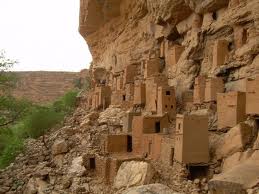
The Dogon people knew certain celestial bodies that were just discovered/identified properly by Western science in the 50s and 60s. They used the stars in spirituality and devised a divination system as discussed in the movie. One of their great treasures is the knowledge of the star Sirius which Dogon elders confided about its existence to French anthropologists in the 1940s. The Dogon elders said that Sirius had a companion star that was invisible to the human eye.
Dogon village
“They also stated that the star moved in a 50-year elliptical orbit around Sirius, that it was small and incredibly heavy, and that it rotated on its axis. All these things happen to be true. What makes this so remarkable is that the companion star of Sirius, called Sirius B, was first photographed in 1970. While people began to suspect its existence around 1844, it was not seen through a telescope until 1862 — and even then its great density was not known or understood until the early decades of the twentieth century. The Dogon beliefs, on the other hand, were supposedly thousands of years old.” To read the full account, check out: The Sirius Mystery and the The Dogon Website.
San (Basarwa/Bushmen) hunters
The Bushmen of Namibia are the oldest people in Africa, as well as in the world. They have lived in the Southern area of Africa for the past 20,000 years, and their celestial stories are just as old. In the documentary, I love the way their celestial stories, and their story of creation was centered around the lion. Isn’t it interesting? The lion, which is the king of the jungle,…purely African! I simply loved it. The sky is interpreted in African terms: giraffes, lions, and zebras are seen among the stars where other people see bears and horses. From the documentary, one sees that the Namib (Bushmen or San) healers welcome the bright evening star, the planet Venus, with a special dance…. The elders observe the shadows cast by the Sun and still count the days by the phases of the Moon, orient themselves, decide when to hunt, harvest, etc… with the sky. They call the Milky Way the Spine of the Night and observe its three different positions during the night: it tells them about time and the changing seasons. Read more about the Khoisan people of Botswana and their fight for survival amidst government/Corporation’s menace.
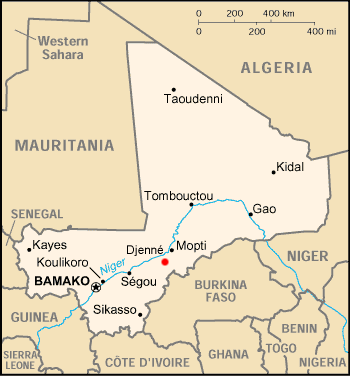
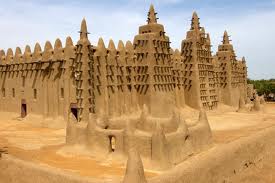
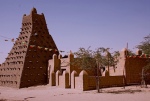
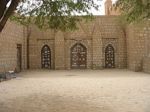
Djenné is a city of Mali whose history is closely linked to that of Timbuktu. It is well-renowned for its mud brick architecture, and today most of the city is considered a UNESCO World Heritage Site. In no place in the world do you have a civilization entirely built on mud! Maybe that is why Malians are so renowned for their work on mudcloth a.k.a. bogolan! The Djennenké say that nowhere in the world would you find people who can build in mud like Djenné’s masons: their work with mud is pure magic, as illustrated by the beautiful Great Mosque of Djenné. The masons’ family lines stretch back half a millenium! They mix the clay from the surrounding plains with the water from the Bani river, and bring to life an architecture purely from Djenné rising with splendor.
Great Mosque of Djenné
Djenné has fallen victim of time, erosion, and particularly rain which deteriorates the mud structure. Recently, as part of protecting this UNESCO world heritage, restoration started. For this process, Djenné masons divide up the work according to whose ancestors originally built the houses, the families that inhabit them, and themselves: dirt from old brick is reused only within the dwelling which it came from, since it is believed to carry a blessing which cannot be transferred; this is a practice whose roots date back to 250B.C.. Before the arrival of the French in 1900s, Djenné’s masons built using the technique of Djennefere or the art of building with cylindrical bricks, as opposed to rectangular bricks introduced by the French. Recently, a Malian-American team of archaeologists found in the base of wall fragments, from about A.D. 1400, of a type of bowl Djennenké still place in foundations for protection; another fragments with Arabic inscriptions dating back to A.D.
Entrance
1118. This is important, since before Djenné, there was Jenné-Jeno (before 200 B.C.), the “city without a citadel” which had no royal palace or ruler with an army, but was made up of different tribes or clans with different specialties which formed a sort of democracy where they came together to trade and decide community affairs. After 1100, Jenné-Jeno shrank, and by the 14th century, it felt and a new city, Djenné, grew from the trans-saharan trade in salt and gold. Djenné was later on invaded by Arab traders who introduced islam to the city. Later, Djenné was part of the great Mali Empire, the Songhai empire, the Ségou Kingdom, the Macina Empire, and the Toucouleur Empire. In essence, in Djenné, the old and the new merged, the mud from the earth grew, and the learning was passed on from generations to generations, making Djenné, the city built on mud rising from the splendors and knowledge of the past!
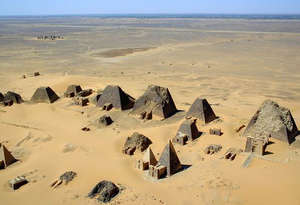
The general public is familiar with Egypt and the pharaohs, but is not so aware that there was a highly important, sophisticated, and independent ancient civilization in Nubia, which is south of Egypt in present-day Sudan. For over a century, Nubian pharaohs dominated Egypt, and their kingdom extended from Lake Chad and well into the middle east. The conquest of Egypt started with Pharaoh Piye of Nubia, and continued with Taharqa who launched the most audacious building campaign of any pharaoh since the New Kingdom (around 1500 B.C.). Under Taharqa, the capitals were Napata and Thebes, and Jebel Barkal the holy mountain.
Black Pharaohs of Nubia
Nubia is a kingdom with 3 times as many pyramids as Egypt. Their language still needs to be decoded, and archaeologists are searching for a Rosetta stone similar to that discovered by Champollion which allowed the translation of Egyptian hieroglyphs. The Nubians were well known for their military genius, and Egyptian pharaohs will sometime hire Nubian mercenaries to fight their battles. Theirs was a civilization of strong queens such as Amanishaket, and Amanitore. One of these queens Candace Amanirenas defeated the roman army of Augustus Caesar.
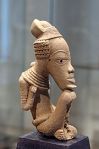
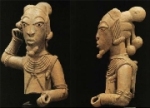
Nok Sculpture from the Louvre museumMap of Nok area
Ever since I saw an image of a Nok figurine on the cover of my history textbook in 6eme (grade 5), I have been fascinated by this civilization. These neighbors of ours, had a civilization which flourished in the Jos plateau in the northern part of modern-day Nigeria between 800 BC and 600AD. The Nok civilization is considered the oldest African terracotta civilization. They were very advanced, and many people have mentioned similarities to the Egyptians. Their work shows great mastery of the firing process as emphasized in their sumptuous sculptures and artistry.
Nok soldier, dating 800 BC
Nok art work is unique and detailed. Most sculptures found so far represent kings, queens, dignitaries, wizards, animals, etc. One thing that stands out the most when looking at the Nok sculpture of a woman is the hairstyle. It makes me feel so proud to see that 800 years BC, Nok women wore elaborate braids, cornrows, etc… the same way we African, no Black women wear our hair today. Imagine going back 2800 years ago and meeting beautiful Nok women with hazelnut eyes looking at you with the same hair-do as yourself!
Nok sculpture of a woman
Nok sculptures vary in size and can reach up to 1,20m. How were the Nok able to make such life-size terracotta statues without having them explode or shatter into pieces during the firing process? Well… they used branches from trees and trunks as the central core of the sculptures.The website Memoire d’Afrique has a detailed account on the Nok Civilization ingenuity. Check it out: http://www.memoiredafrique.com/en/nok/geographie.php and wikipedia: http://en.wikipedia.org/wiki/Nok_culture
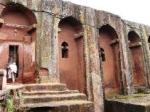
The Church of St GeorgeLalibela, Church of Saint George
When I was younger, there was a cartoon on television in which they always mentioned the churches of Lalibela, and somehow I used to think that it was not actually real,… you know like these made-up places in cartoons! Isn’t it interesting that the name Lalibela always made me think of honey bees (abeille in french)… Imagine my surprise when I found out that it is said that at birth a swarm of bees descended on the baby king’s head, and his Mother named him Lalibela, meaning “the bees have recognized him as king!”
Lalibela, Bet Gebriel Rafael church
Carved straight from red volcanic stone, and actually from a single stone, Lalibela is the place of pilgrimage of thousands of christians every year, and is one of Ethiopia’s holiest places. It was intended to be the New Jerusalem, in response to the capture of Jerusalem by Muslims. The architecture of Lalibela was revealed to KingGebrel Mesqel Lalibela one night in his dreams (he is said to have seen Jerusalem in his dreams) by God; he was instructed to build churches never seen before. Lalibela is actually made up of 11 medieval churches rock-hewn. Many of its names come from Jerusalem, like the Yordannos (Jordan) river, the church of Mary, etc. The most well-known is the Church of Saint George (or Bet Giyorgis in Amharic) which was probably the last one built around the 13th century and has the shape of a cross and has been referred by some as the 8th wonder of the world. It is about 30 m deep, and is simply stunningly beautiful! Talk about a church built on stone!
Lalibela, Bet Medhane Alem
Lalibela is now regarded as one of the greatest Ethiopian architectural wonders and is ranked the eighth most incredible historical site in the world by UNESCO. It entered the UNESCO world heritage in 1978. Ethiopians themselves love to tour their own country and treasures, and about 1/3 of the tourists at popular Ethiopian sites are Ethiopians.
Oh wow… I always knew Timbuktu (Tombouctou in Mali) because of the story of the great emperor of the kingdom of Mali, Mansa Kankan Musa. I knew it was the center of his empire, but it is only lately that I realized that it was one of the world’s first and oldest thriving university! Students came from all over the world to study at Timbuktu. Imagine that, students from the middle east, and Europe coming to Africa to study! oooohhhh … Goodness Gracious, that sight only would make me proud! Well, to those who say Africa only has an oral tradition, go and check out the 700,000 manuscripts at the great Sankore University in Timbuktu, and tell me what you think! Oh la la…
In one documentary, the speaker mentions that they translated one of the manuscript on Algebra from Arabic to
Sankore University in Timbuktu
French, and sent it to France to be evaluated educationally; well, that manuscript revealed that the mathematics it contained was currently studied in 2nd year of university in France, and the speaker then says “and that was taught at universities in Timbuktu before the 16th century“! Wow… my Goodness!
Timbuktu also houses some of the world’s oldest mud mosques, and every year the people of the city unite to re-do the walls of the mosque. It was added to the UNESCO world’s heritage list in 1988 (http://whc.unesco.org/en/list/119/).
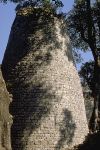
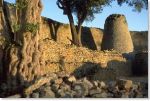
Have you ever felt tired of people telling you that there was no great Black civilization? that there was nothing in “sub-saharan” Africa? Well,… I have heard of a great African kingdom in the southernmost part of Africa: Great Zimbabwe which stands for “great house of stone” in the Shona language! Houses upon houses made of stone, and today some of them still stand tall in Zimbabwe. When a German geologist ‘stumbled’ (you know what I mean… like christopher Columbus discovered America at a time when it was already full of people) upon it, he was convinced that it could not be the work of Africans! Well, then… let me present to you Great Zimbabwe, a kingdom located between the Zambezi and Limpopo rivers! It is a civilization which flourished from the 11-15th centuries. Just like the Maya, Aztec, incas, we also have our own!
There are great documentaries about Great Zimbabwe, but I decided to choose a short doc made by school children (please don’t be distracted by the masks shown in these video which are not from southern Africa but from West and Central Africa), since all the others mostly focused on the European researchers rather than Great Zimbabwe itself. If you are curious, feel free to go check all the other documentaries on youtube or dailymotion (such as Zimbabwe’s Ancient Ruins Part 1-3, http://www.youtube.com/watch?v=8Kdhyj2kc6c).



















 African Heritage