Pharaonic Princess’ Tomb found in Egypt

Three statues recently discovered in the tomb of the princess (Source: artdaily.org)

Archaeologists have unearthed the 4,500 year old tomb of a pharaonic princess, just south of Cairo.  This discovery may lead to the discovery of other ancient tombs from before 2,500BC.  Princess Shert Nebti‘s burial site is surrounded by the tombs of four high officials from the Fifth Dynasty dating to around 2,500 BC in the Abusir complex near the famed step pyramid of Saqqara.  Inscriptions on the four limestone pillars of the Princess’ tomb indicate that she is the daughter of King Men Salbo.  Only her tomb has been unearthed; her father, the king, or her mother, are yet to be found.  The antechamber to the princess’ tomb includes four limestone columns and hieroglyphic inscriptions.  The current excavation has also unearthed an antechamber containing the sarcophagi of the four officials and statues of men, women, and a child.

Azougui: First Capital of the Almoravid Dynasty

Azougui
Azougui
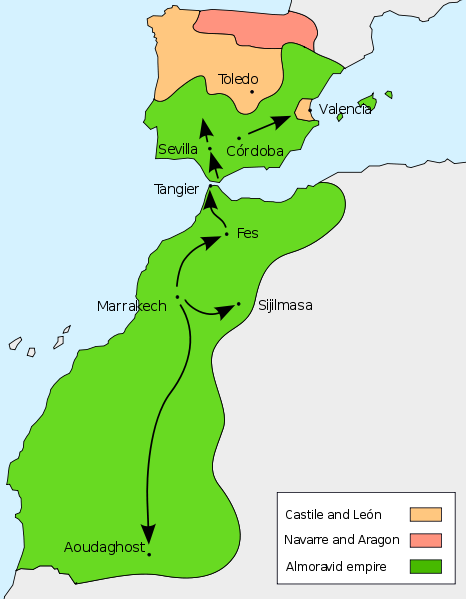
Map of Almoravid Empire

Azougui was a town in the northwestern part of Mauritania, lying on the Adrar Plateau, north west of Atar, 450 km north of Nouakchott.  In the 11th century, it was a base for the Almoravid dynasty (this will be the subject of another post), who conquered a territory stretching from the Ghana Empire to Morocco and the Iberian peninsula.  The chronicler Al-Zuhri, writing in the 1150s, called Azougui the “capital of the Almoravids.”

Azougui was an important transit place for the trans-Saharan trade route from Morocco and Ghana.  The birth/ apparition of the oasis is strongly linked to the creation of Azougui.  Today, this palm grove is the site for over 20,000 palm trees.  The archeological site was added to the UNESCO World Heritage tentative list on June 14, 2001.

Archaelogical Site of Azougui
An Almoravid Soldier

Azougui, as the first capital of the Almoravids, was a stone fortress with a wall and several concessions.  This fortress was enlarged with time, which explains the urbanization inside the enclosure on an area expanding over several kilometers.  The site was reported in 1068 by Al Bakri, and mentioned by several Arabic chroniclers such as Ibn Said, El Kalakshandy, and Ibn Khaldun.  The Almoravid movement was a political formation at its origin, which was born in the midst of Sanhaja tribe of Lamtuna (or Lemtouna), and Gudala (Guedala) in Adrar, under the authority of a spiritual leader of extraordinary religious rigor, Abdallah ibn Yasin.  This movement was able to unify west Africa, the Maghreb, and the Iberian peninsula for several centuries, after investing the Empire of Ghana, the Idrissides, and the kingdom of Barghawata (or Berghouata).  The site’s excavation started in 1979, and continues until today.  Its excavation has shed light on the importance of Azougui in the trans-Saharan trade.

Kouroukan Fouga, la Constitution de l’Empire du Mali – la plus vieille constitution republicaine au monde?

Soundiata Keita a l'Assemblée constitutive de l'empire du Mandé avec les chefs de guerre (Source: Wikipedia.fr)
Soundiata Keita a l’Assemblée constitutive de l’empire du Mandé avec les chefs de guerre (Source: Wikipedia.fr)

Le Kouroukan Fouga fut la constitution de l’Empire du Mali (1235 – 1645), et officiellement la plus vieille constitution républicaine en Afrique, et au monde.  Le Kouroukan Fouga réuni officiellement la fédération des clans Mandingues sous un seul et unique gouvernement.  Cette constitution régit la vie de l’empire à travers des lois auxquelles tout le monde doit obéir.  Mansa (Empereur) Soundiata Keïta présenta ce document en 1236 après la célèbre bataille de Kirina, dans l’actuel cercle de Kangaba, et dès lors cette constitution a été léguée de générations en générations par les griots ou djeli. Les griots ont conservé une grande partie de l’histoire de l’empire du Mali, y compris ses rois, les batailles, et le système gouvernemental.  Decouvrez avec moi la première constitution républicaine mondiale, et appréciez le génie de nos ancêtres. Si seulement nous, africains, pouvions tous adaptés celle-ci, et non perdre le temps avec ces constitutions importées de l’occident. (For English, click here).

Article 1er : La Société du grand Mandé est divisée en seize (16) porteurs de carquois, cinq (5) classes de marabouts, quatre (4) classes de Nyamakalas (1) une classe de serfs (esclaves) (Mofé molu)

Chacun de ces groupes a une activité et un rôle spécifiques

Article 2 : Les Nyamakalas se doivent de dire la vérité aux chefs, d’être leurs conseillers et de défendre par le verbe les règles établies et l’ordre sur l’ensemble du royaume.

Article 3 : Les Morikandas lolu (les cinq classes de marabouts) sont nos maîtres et nos éducateurs en islam. Tout le monde leur doit respect et considération.

Article 4 : La société est divisée en classe d’âge. A la tête de chacune d’elles est élu un chef. Font de la classe d’âge les personnes (Hommes ou Femmes) nées au cours d’une période de trois années consécutives.

Les Kangbès (Classe internationale entre les jeunes et les vieux) doivent être conviés pour participer à la prise des grandes décisions concernant la société.

Assemblée constitutive de l'empire du Mandé (Source: Wikipedia.fr)
Assemblée constitutive de l’empire du Mandé lors de la charte du Kouroukan Fouga (Source: Wikipedia.fr)

Article 5 : Chacun a le droit à la vie et à la préservation de son intégrité physique. En conséquence, tout tentation d’enlever la vie à son prochain est punie de la peine de mort.

Article 6 : Pour gagner la bataille de la prospérité, il est institué le Kongbèn Wölö (un mode de surveillance) pour lutter contre la paresse et l’oisiveté.

Article 7 : Il est institué entre les Mandenkas, le Sanankuya (cousinage à plaisanterie) et le tanamanyoya (forme de totémisme. En conséquence, aucun différent né entre ces groupes ne doit dégénérer, le respect de l’autre étant la règle.

Entre Beaux-frères et Belle-sœur, entre grands parents et petits, tolérance et le Chahut doivent être le principe.

Article 8 : La Famille est désigné famille régnante sur l’empire

Article 9 : L’éducation des enfants incombe à l’ensemble de la société. Continue reading “Kouroukan Fouga, la Constitution de l’Empire du Mali – la plus vieille constitution republicaine au monde?”

5000 years old Artefacts uncovered in Senegal

Artefacts found in Dakar, Senegal (Source: AFP)

The current floods in Senegal, particularly in Dakar, have unearthed 5000 years old artefacts: pieces of jewelry, pottery, iron tools dating back thousands of years.  The discovery was made at a construction site in the capital Dakar.  The objects could date back between 2000 to 5000 BC.  Proper carbon dating will probably give us more accurate information, and would certainly yield information about the rich history of Dakar, of Senegal, and that part of Africa.  Could this new discovery be related to the Senegambian Stone Circles (3rd century BC to 16th century AD)?  or be from ancestors of these structures?  Could these be related to the lost Atlantis the island which sank into the ocean in a single day?  or could it be simply coming from a different civilization which flourished by its work of iron and pottery?  Time will tell… in the meantime, enjoy this article on BBC.

Benin City: the Majestic City the British burnt to the ground

Pendant Ivory mask representing Queen Idia, Iyoba of Benin City (16th Century)
Ivory mask representing Queen Idia, Iyoba of Benin City (16th Century)

Today, I would like to tell you about Benin City, the great city at the heart of the Benin Kingdom.  The city, not at all related to the present-day country of Benin, was burnt to the ground by the British who were amazed by its beauty and wealth (just like many ancient kingdoms in the Americas were burnt to the ground by Europeans).   I would like to tell you about this ancient beautiful city whose art still marvels millions of people everyday in worldwide museums: Benin City.

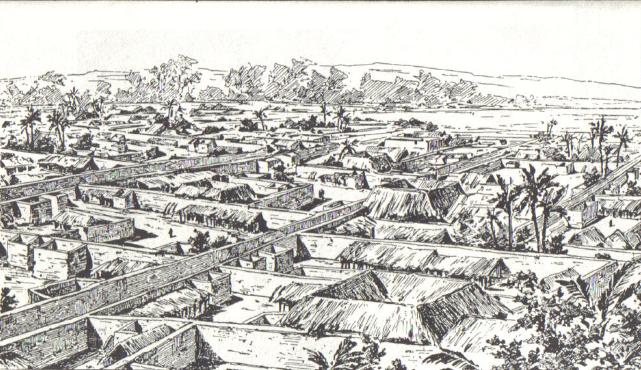
Benin City around 1600

Benin city was the capital of the kingdom of Benin (in present day Nigeria) which was founded in the 13th century by the Edo people, and flourished between the 14th and 17th centuries.  Its early name was Ubinu, which later was turned into Bini, and then Portuguese called it Benin.  The kingdom was ruled by an Oba or king, in a very well-structured hierarchy.  Starting in the late 15thcentury, Benin traded with Europeans items such as ivory, pepper, palm oil, and cloth.  From history books, it is said that the city was laid out in a sophisticated system of huge straight streets, very wide, long, and well-maintained.  Houses were built in rows along the streets.  These houses had covered porches to protect people from the sun or rain, as they sat outside.

Benin City in 1897
Benin City in 1897

The Oba governed over the entire region.  Oba Ewuare, the first gold age Oba, is credited with turning Benin City into a military fortress protected by moats and walls known as the Walls of Benin.  It was from this bastion that he launched his military campaigns and began the expansion of the kingdom from the Edo-speaking heartlands.  At its peak, the empire extended from Onitsha in the east, through the forested southwestern region of Nigeria and into the present-day nation of Ghana.

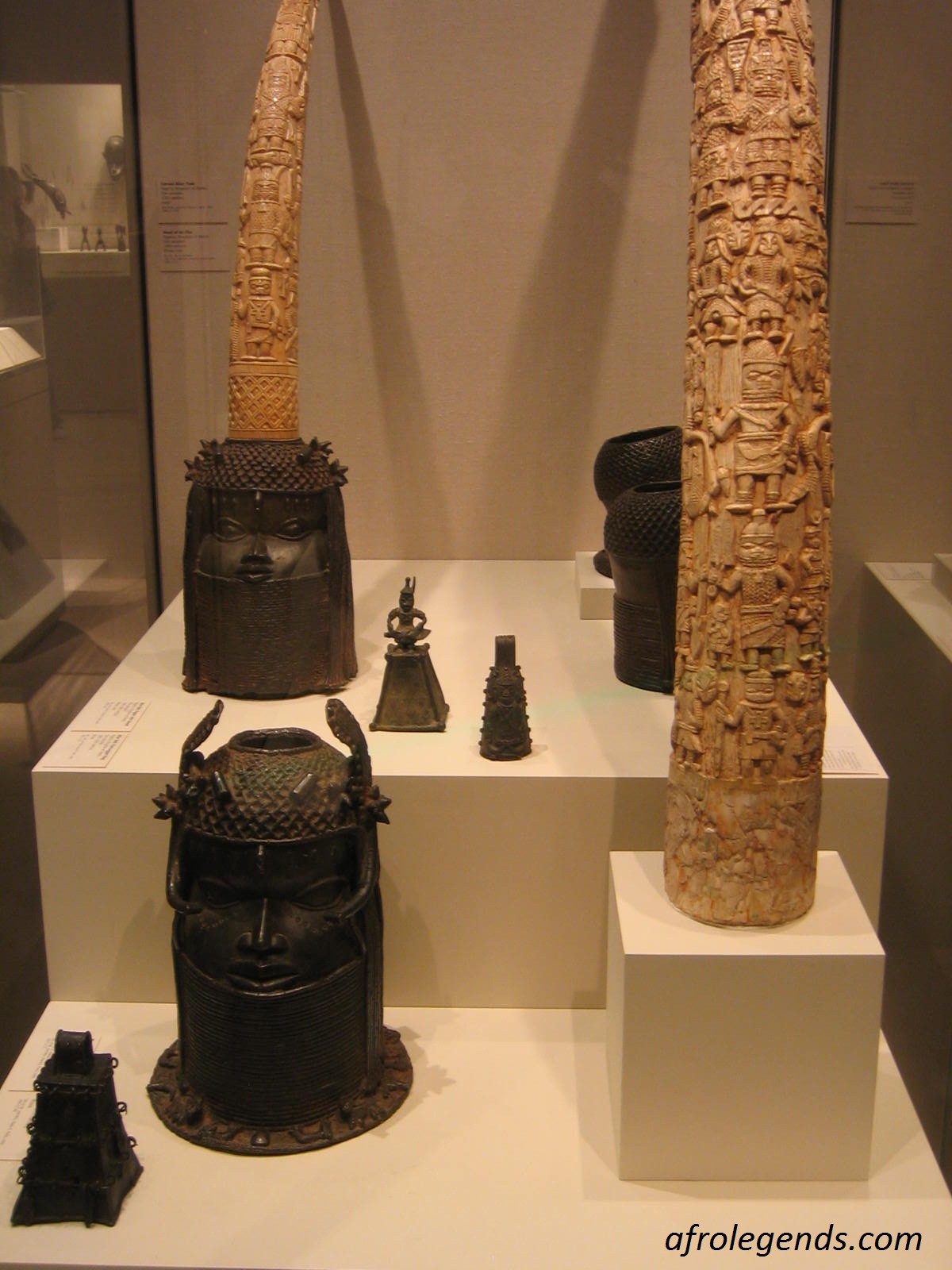
The state developed an advanced artistic culture especially in its famous artifacts of bronze, iron and ivory.  The Benin artists mastered the art of bronze, iron, and sculpture. The most well-known artifact based on Queen Idia, popularly called the FESTAC mask, currently resides at the Metropolitan Museum of Art (MET) in New York City.

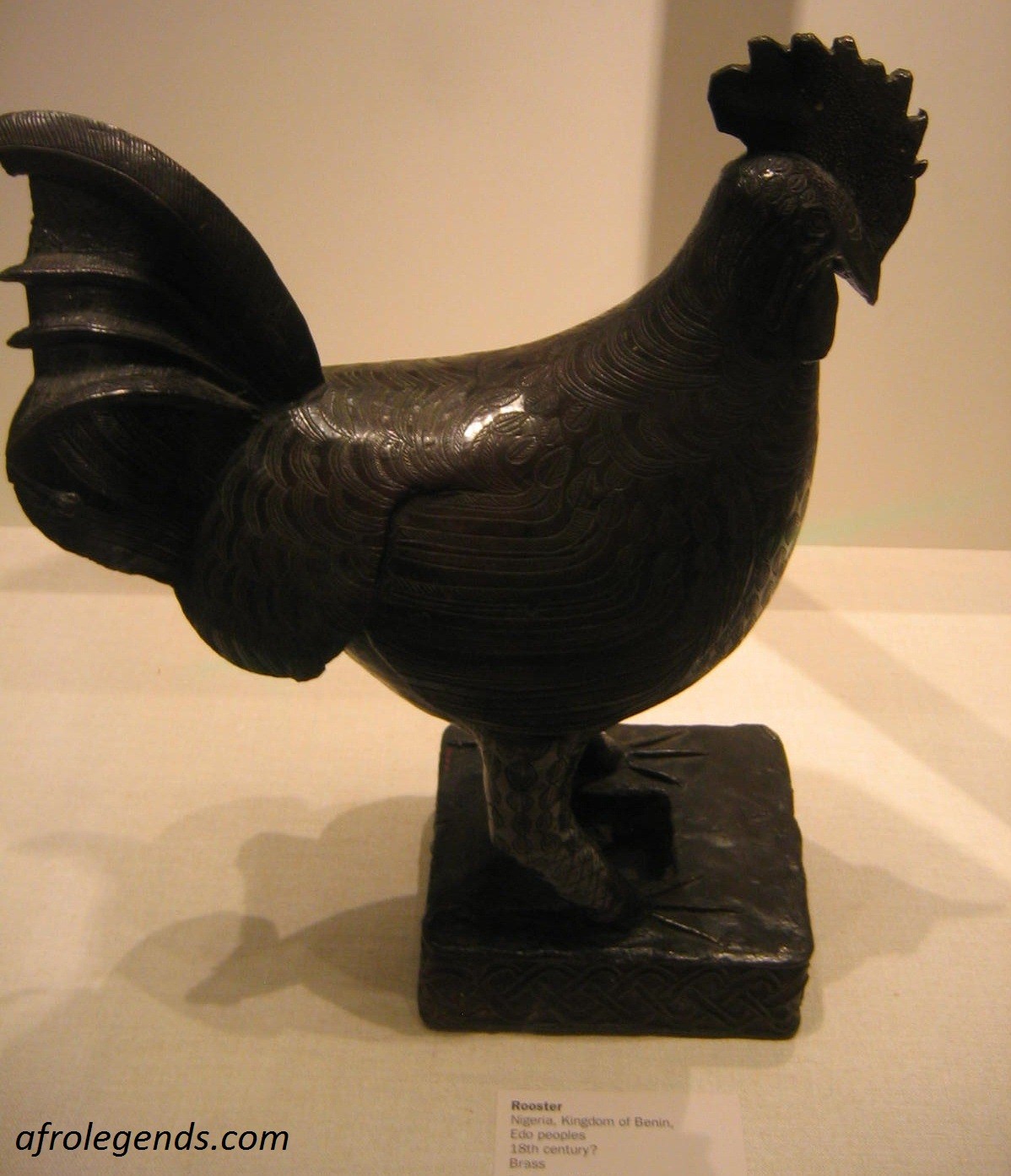
Rooster from Benin Kingdom (18th century)
Brass rooster from Benin Kingdom (18th century)

The Punitive expedition of 1897 was a military excursion by a British force of 1,200 under Admiral Sir Harry Rawson that captured, burned, and looted the city of Benin, bringing to an end the West African Kingdom of Benin.  During the conquering and burning of the city, most of the country’s treasured art, over 3,000 pieces of art work, including the Benin Bronzes, was either destroyed, looted or dispersed.  The British used one of their favorite tactics to burn the city to the ground: deception – they claimed that the Omo n’Oba Ovonramwen had breached a treaty (they wanted to annex Benin Kingdom as a British protectorate, and the Oba refused to sign).  When the Oba realized that the treaty presented to him was a deceptive ploy to conquer his people, he issued an edict barring all British officials and traders from entering Benin territories.  Since the consul general of the Oil River Protectorate authorities considered the ‘treaty’ legal and binding, he deemed this a violation of the treaty and a hostile act.  Repeated attempts by the British to invade the Benin Kingdom followed, but without success.  In 1896, the major Phillip tried to attack and seize the city of Benin without approval from his superiors.

Art from Benin kingdom (18th century)

However, the Benin noblesmen decided to send a strike force to destroy the invaders (just normal, if an invader comes to burn and loot your place, you strike to defend yourself).  Only two British soldiers survived.  This came to be known as the ‘Benin massacre’ in the British press (In the eyes of the British crown, this was the perfect excuse to attack the Benin kingdom).  On January 12, 1897, Rear-Admiral Harry Rawson, commanding the squadron at the Cape of Good Hope was sent by his high commandment to capture the Oba of Benin and destroy Benin City.  The operation was named ‘Benin Punitive Expedition.’  The invasion of Benin kingdom was launched on February 9, 1897.  The field commanders were instructed by their commander-in-chief to burn down all Benin kingdom’s towns and villages, and hang the king once captured.

Queen from Benin kingdom

On February 17, 1897, Benin City fell to the British.  On that fateful day in history, the city of Benin lost its independence, its sovereignty, its Oba (king), its beauty, and its control of trade.  The city was looted and burnt to the groundThe ivory at the palace was seized.  Nearly 3000 of the famous Benin Bronzes and other valuable works of art, including the magnificently carved palace doors, were carried back to Europe.  The Oba was exiled to Calabar with his two wives, and subsequently died there.  Today, every museum in Europe possesses art treasures from Benin.

To read a detailed account of the destruction of Benin city, check out the Benin Massacre page. Edoworld.net tells about the Benin Kingdom and its magnificence, as well as its destruction. The art pieces shown on this page are all exposed at the MET, and pictures were taken during my visit to the MET. Watch and enjoy a quick history of Benin City.

Timbuktu under Attacks: Arise to save African Treasures

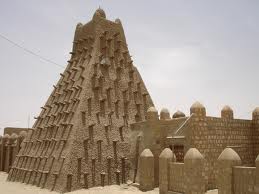
Sankore Mosque in Timbuktu

It is with horror that I watched and read about Timbuktu‘s desecration these past weeks, and I could not /would not stay silent as African treasures are being ransacked and destroyed.  Why would somebody destroy such a rich historical city?  Why would someone want to erase history?  Then I read the articles on BBC,  and they say that the destruction was conducted by muslim fundamentalists.  Seriously who do these media think we are?  Stupid?  Muslim fundamentalists?  Isn’t Timbuktu’s history linked to Islam?  Why on earth would somebody who loves and respects Islam destroy a place dear to his life?  It’s like saying that a catholic fanatic would want to destroy the Vatican or Jerusalem… really?  then they say these Muslim fundamentalists are from Northern Mali and are Touareg groups working to divide Mali.  See, again, BBC must really think that we are stupid or newborns.  How could a Malian, a Northerner, a Touareg, destroy his own home?  unless this group is not from Northern Mali…  unless this group is from somewhere else.  Remember Libya? there were foreigners attacking, and NATO, which destroyed the beautiful Libyan historic places: Sabratha and Leptis Magna … Remember that remains of Babylon were almost destroyed during the attacks of 2003?  Where are these stolen treasures today?  Please watch this video on Timbuktu and learn why any son of Africa should fight for its preservation.  There is over 10 centuries of history in Timbuktu, and it is our duty to save this place.  There are over 700,000 manuscripts saved in public libraries and private collections.  Check out this photojournal on BBC.  Enjoy and share!

Amanishakheto, Warrior Queen of Nubia

Candace Amanishakheto on a mural

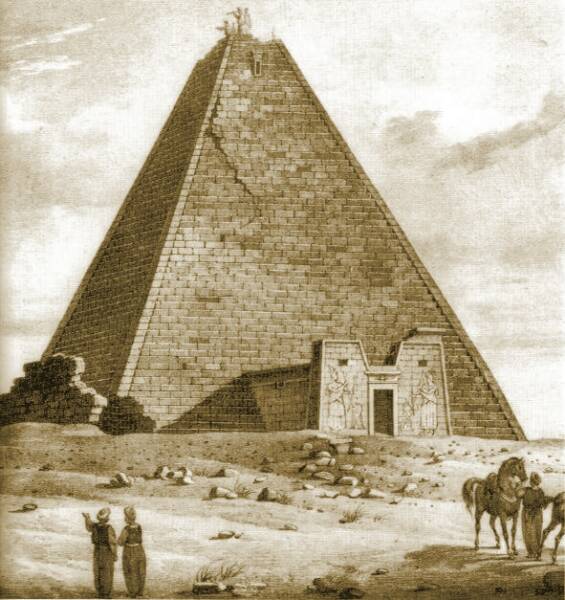
Great women are often left out of history.  Rarely do we hear or read about African queens.  It is already hard enough to read about great African men and leaders in history books, but as for African women… it is more like impossible.  How many have heard of the great warrior queen of Nubia, Amanishakheto, who defeated a Roman army?  Who has heard of this great queen whose pyramid/tomb was leveled to the ground by an Italian treasure hunter, Giuseppe Ferlini, in 1832? Who has heard of this woman who led her people with a strong arm, and built pyramids in Meroë?  Who has heard of this great candace, whose daughter Amanitore, also queen of Nubia, is mentioned in the Bible (Acts 8:27) … yeah the Queen of Sheba is not the only African queen mentioned in the Bible!

Pyramid N6 of Amanishakheto in Meroe, before its destruction

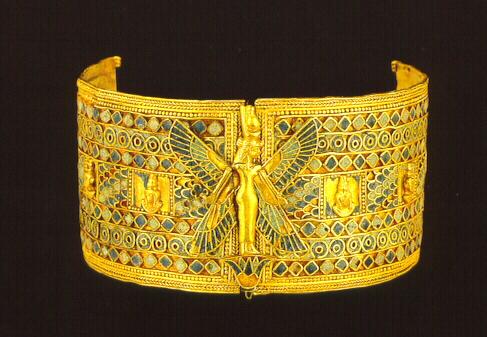
Well, let me tell you about the great Candace (Kandake or queen) of Nubia (present day Sudan), Amanishaketo (also written Amanishaket, or Amanikasheto or Mniskhte in meroitic hieroglyphs) who reigned from around 10 BC to 1 ADCandace Amanishaket was an extremely wealthy and powerful queen.  She succeeded to Candace Amanirenas who was also a great warrior queen (and will be the subject of another post).  She built considerable pyramids and temples at Wad Ban Naqa, where she was buried with great treasures.  Her residence and several temples were based there.  Her palace is one of the largest treasures identified at Wad ban Naqa.  It was 61 m long, and covered an area of  3700 m2 with the ground floor made up of over 60 rooms.  The palace originally had a second floor as indicated by the remains of columns found on the ground floor, and may have contained an atrium or other structure.  Inside Amanishakheto’s grave, the Italian treasure hunter Ferlini discovered an amazing quantity of golden artifacts such as armlets, necklaces.  The treasure found (or what has been recovered) contained ten bracelets, nine shield rings, sixty seven signet rings, two armbands, and an extraordinary number of loose amulets and necklaces, especially made for queen Amanishakheto created by Nubian artists from her kingdom.  Some of her treasures (stolen by Ferlini) are now on display at the Egyptian Museum of Berlin, and at the Egyptian Museum of Munich.

Bracelet of Amanishakheto from the Egyptian Museum of Berlin

Amanishakheto defeated a Roman Army sent by the first emperor of the Roman empire, Augustus, (who broke a peace treaty) to conquer Nubia.  She was a strong, and powerful woman, and a great pyramid builder.  Her tomb at Meroë was one of the largest ever built.  She is often depicted on pyramid murals as a massive, powerful woman, covered with jewels, elaborate fringed, tasseled robes, and carrying weapons in one hand, preparing to lead her army against others. Enjoy the video below on Amanishakheto, the great warrior queen of Nubia, and do not forget to check out The Treasures of Queen Amanishakheto.

La Charte du Mandé: Première déclaration de droits de l’Homme au Monde?

L'Empire du Mali a son apogee (1230 - 1545)
L’Empire du Mali à son apogée (1230 – 1545)

J’ai été admirablement surprise de lire la charte du Manden (Mandé), qui semble être la première déclaration des droits de l’homme au monde.  Elle fut prononcée lors de l’intronisation de Soundiata Keïta comme empereur du Mali en 1222.  Imaginez-vous ma joie: première declaration des droits de l’homme au monde, érigée en Afrique? en 1222? plusieurs siècles (7 siècles) avant la fameuse déclaration des droits de l’homme de l’ONU? Waou…! Et après on vous dira qu’il n’ya jamais rien eu en Afrique. Lisez, et rejouissez-vous, car au Mali, du temps de l’empereur Soundiata Keïta, il y avait le concept du droit de l’homme et l’amour de l’être humain.

===========

La Charte du Manden (Mandé)

Soundiata Keita a l'Assemblée constitutive de l'empire du Mandé avec les chefs de guerre (Source: Wikipedia.fr)
Soundiata Keïta a l’Assemblée constitutive de l’empire du Mandé avec les chefs de guerre (Source: Wikipedia.fr)

1. Les chasseurs déclarent :

Toute vie (humaine) est une vie.

Il est vrai qu’une vie apparaît à l’existence avant une autre vie,

Mais une vie n’est pas plus “ancienne“, plus respectable qu’une autre vie,

De même qu’une vie n’est pas supérieure à une autre vie.

2. Les chasseurs déclarent :

Toute vie étant une vie,

Tout tort causé à une vie exige réparation.

Par conséquent,

Que nul ne s’en prenne gratuitement à son voisin,

Que nul ne cause du tort à son prochain,

Que nul ne martyrise son semblable.

Assemblée constitutive de l'empire du Mandé (Source: Wikipedia)
Assemblée constitutive de l’empire du Mandé (Source: Wikipedia)

3. Les chasseurs déclarent :

Que chacun veille sur son prochain,

Que chacun vénère ses géniteurs,

Que chacun éduque comme il se doit ses enfants,

Que chacun “entretienne”, pourvoie aux besoins des membres de sa famille.

4. Les chasseurs déclarent :

Que chacun veille sur le pays de ses pères.

Par pays ou patrie, faso,

Il faut entendre aussi et surtout les hommes ;

Car “tout pays, toute terre qui verrait les hommes disparaître de sa surface

Deviendrait aussitôt nostalgique.”

Assemblée constitutive de l'empire du Mandé (Source: Wikipedia.fr)
Assemblée constitutive de l’empire du Mandé (Source: Wikipedia.fr)

5. Les chasseurs déclarent :

La faim n’est pas une bonne chose,

L’esclavage n’est pas non plus une bonne chose ;

Il n’y a pas pire calamité que ces choses-là,

Dans ce bas monde.

Tant que nous détiendrons le carquois et l’arc,

La faim ne tuera plus personne au Manden,

Si d’aventure la famine venait à sévir ;

La guerre ne détruira plus jamais de village

Pour y prélever des esclaves ;

C’est dire que nul ne placera désormais le mors dans la bouche de son semblable

Pour allez le vendre ;

Personne ne sera non plus battu,

A fortiori mis à mort,

Parce qu’il est fils d’esclave.

le Manding, berceau de l'empire du Mali (photo: Olivier Epron)
le Manding, berceau de l’empire du Mali (photo: Olivier Epron)

6. Les chasseurs déclarent :

L’essence de l’esclavage est éteinte ce jour,

“D’un mur à l’autre”, d’une frontière à l’autre du Manden ;

La razzia est bannie à compter de ce jour au Manden ;

Les tourments nés de ces horreurs sont finis à partir de ce jour au Manden.

Quelle épreuve que le tourment !

Surtout lorsque l’opprimé ne dispose d’aucun recours.

L’esclave ne jouit d’aucune considération,

Nulle part dans le monde.

Manuscripts a Tombouctou (Mali) montrant de l'astronomie et mathematique
Manuscripts à Tombouctou (Mali) montrant de l’astronomie et mathématique

7. Les gens d’autrefois nous disent :

“L’homme en tant qu’individu

Fait d’os et de chair,

De moelle et de nerfs,

De peau recouverte de poils et de cheveux,

Se nourrit d’aliments et de boissons ;

Mais son “âme”, son esprit vit de trois choses :

Voir qui il a envie de voir,

Dire ce qu’il a envie de dire

Et faire ce qu’il a envie de faire ;

Si une seule de ces choses venait à manquer à l’âme humaine,

Elle en souffrirait

Et s’étiolerait sûrement.”

La grande mosquee de Djenne (Mali - heritage du grand empire du Mali)
La grande mosquée de Djenné (Mali – héritage du grand empire du Mali)

En conséquence, les chasseurs déclarent :

Chacun dispose désormais de sa personne,

Chacun est libre de ses actes,

Chacun dispose désormais des fruits de son travail.

Tel est le serment du Manden

A l’adresse des oreilles du monde tout entier.

Youssouf Tata Cissé

Texte réécrit par Youssouf Tata Cissé dans “Soundjata, la Gloire du Mali”, éd. Karthala, ARSAN, 1991

Béhanzin, King of Dahomey, one of the last African Resistant to French Colonization

Behanzin, king of Dahomey

Béhanzin (Gbêhanzin) Hossu Bowelle or the ‘King Shark‘ was one the most powerful kings in West Africa at the turn of the 19th century.  He was the eleventh king of Dahomey, and the last independent ruler of Abomey before French colonization.  Who was really Béhanzin?

Born in 1844 in Abomey, Béhanzin was the eleventh king of Dahomey from 1889 to 1894.  His name, Kondo, was changed to Béhanzin after he succeeded to his father GlèlèHis personal symbols were the shark, the egg, and two coconut palm trees, while those of his father were the lion and the ritual knife of Gu.  His name actually meant ‘the egg of the world or the son of the shark‘.  His great love for the freedom of his country, culture, and people led him to courageously and fiercely defend the land of his ancestors.  He led the resistance and fight for the Dahomey’s freedom.

Seh-Dong Hong-Beh, leader of Dahomey Amazons (painted by Frederick Forbes in 1851)
Seh-Dong Hong-Beh, leader of Dahomey Amazons (by Frederick Forbes in 1851)

Dahomey was one of most powerful kingdoms of West Africa, deriving its power from trade and its superior army.  Dahomey’s army was one of the strongest and best-organized armies in West Africa and was comprised of both men and women, including the Amazons, a superior and dreaded fighting force of female warriors.  At the time, Béhanzin masterfully led an army of 15000 men and 5000 amazon women.  One of the Amazon leaders was Seh-Dong Hong-Beh (which means “God speaks true“) who led an army of 6000 amazons against the Egba fortress in Abeokuta in 1851.

In 1882, France declared a protectorate over Porto Novo, a vassal state of Abomey, without consulting with the indigenous people, as was (and still is) the practice with Europeans colons.  By 1885, the French occupied the entire coastal strip West of Porto Novo.  In 1889, King Glèlè and his son Béhanzin, who considered these coastal areas to be part of the kingdom of Dahomey, declared that the Fon people could no longer tolerate France’s actions.

Combat de Dogba au Dahomey le 19 Septembre 1892
Combat de Dogba au Dahomey, 19 September 1892

In February 1890, the French occupied Cotonou; Béhanzin, now king after Glèlè’s sudden death, prepared for war.  Béhanzin’s army, with rifles supplied by the Germans, were getting too strong for neighboring French colonies.  Béhanzin’s forces attacked the French simultaneously on two fronts—militarily at Cotonou and economically by destroying the palm plantations at Porto Novo.  The latter precipitated an early end to the hostilities.  A treaty was signed, with the French continuing to occupy Cotonou, for which Béhanzin exacted an annuity; he made France pay for the use of Cotonou portThe peace lasted for two years.  However, France was determined to annex Dahomey before the British or Germans did.  Béhanzin, knowing that he would have to defend his sovereignty, continued upgrading his army in preparation for renewed war.

le general Alfred-Amedee Dodds
General Alfred-Amedee Dodds on the cover of ‘L’Illustration’ 20 May 1893

He declared a treaty made with France by his father, Glèlè, in 1868 null and void, from this war began.  In 1894, Béhanzin was defeated by Colonel Alfred-Amédée Dodds, a Senegalese mulatto, who was sent to fight against him with powerful French armed forces.  Béhanzin, not wanting his people to be massacred, surrendered his person to Dodds, without signing any instrument of national surrender or treaty.  Béhanzin thought that he will get a chance to talk to the French president and find a way or sign a conciliation agreement for his country, unfortunately, the French tricked him and instead of going to France, Behanzin was exiled to Martinique.  With Béhanzin and his immediate family adamantly refusing to sign a treaty making Dahomey a French protectorate, the French installed their choice, Agoli-Agbo, as king; Agoli Agbo, the puppet, did not last more than 6 years (when he asked for more freedom to rule, he was deported to Gabon).  Dahomey was then placed under France’s protection and it eventually became a French colony.  Béhanzin died in 1906 in Algeria.  In 1928, his son, Ouanilo (who was also France’s first African attorney in 1920) had his body moved to Dahomey. Ouanilo’s remains will be restituted to Benin almost 80 years after his death.

King Behanzin in exile in Algeria

Béhanzin once said: «Vous pouvez arracher l’homme de son pays, mais vous ne pouvez arracher son pays du cœur de l’homme, ni arracher un grand homme de l’histoire.» [You can remove a man from his country, but you can never remove his country from a man’s heart, or erase a great man from history].  Béhanzin truly loved his people, and when he saw that his army was being massacred by the French, he cried for his beautiful and strong amazons, and pronounced the most beautiful ode to them [Où sont maintenant les ardentes amazones qu’enflammait une sainte colère? … Qui chantera leurs splendides sacrifices? Qui dira leur générosité? … comment accepterais-je sans eux une quelconque abdication? Comment oserais-je me présenter devant vous, braves guerriers, si je signais le papier du Général? pour la survie de mon peuple, [j’accepte] de rencontrer dans son pays, selon sa promesse, le président des Français.

Behanzin, the Last King of independent Dahomey

Where are now the ardent amazons who were inflamed by a mighty anger? … Who will praise their splendid sacrifices? … Who will tell about their generosity? … How could I accept any sort of abdication without them? How could I dare presenting myself to you, brave warriors, if I signed the general’s paper?… for the survival of my people, [I agree] to meet in his country, according to his promise, the president of the French].  Please watch this great documentary about the life of Béhanzin, the last king of the Dahomey (part 1 – 4), and one of the last resistant to French colonization.  Why was he defeated?  He said himself: «malgré la justesse de notre cause, notre vaillance et notre détermination, ils n’ont pu l’emporter et s’accaparer de la terre de nos aïeux que par la force de leur science» [despite the legitimacy of our cause, our courage, and determination, they could only win and take the land of our forefathers because of the force of their science].  Check out the website djime.com entirely dedicated to Béhanzin and his heritage.  To learn more about Dahomey’s Amazons, check out the Smithsonian blog.  This facebook page provides details about the organization of the amazons in the army.  Don’t forget to offer your support to the Agongointo Musée du passé vivant dedicated to the kingdom of Dahomey.

Senegal/Gambian Ancient Civilization: the Senegambian Stone Circles

Senegambia Stone Circles at Sine Ngayene (source: Les Cercles Megalithiques)
Senegambian stone circles at Sine Ngayène - Senegal (source: Les Cercles Megalithiques)

Today I would like to talk about a national treasure of Senegal and Gambia: the Senegambian stone circles. The Stone Circles of Senegambia are the largest group of megalithic complexes yet recorded in any region of the world… yes… that’s right: forget Stonehenge (no offense to the Brits)… Senegambia has the largest!  There are 1,053 Stone circles and a total of 28,931 monoliths. Their quality suggests sophisticated stone working traditions.  These stones lie in The Gambia, north of the town of Janjanbureh (previously known as Georgetown), and central Senegal.  The site consists of four large groups of stone circles that represent an extraordinary concentration of over 1,000 monuments in a band 100 km wide along some 350 km of the River Gambia. The four groups, Sine Ngayène Kaolack (Senegal), Wanar Kaolack (Senegal), Wassu (Gambia) and Kerbatch (Gambia), cover 93 stone circles and numerous burial mounds, some of which were recently excavated to reveal material that suggest dates between 3rd century BC and 16th century AD. Together the stone circles of laterite pillars and their associated burial mounds present a vast sacred landscape created over more than 1,500 years.

Senegambian Stone Circles at Wassu - Gambia
Senegambian stone circles at Wassu - Gambia

Each stone circle contains about 10 to 24 standing stones.  All the stones in any given circle are usually the same height, and size, varying between 60 cm and 245 cm high and weighing up to 10 tons.  The largest stones, located at N’Jai Kunda, may weigh at least 10 tons.  These stones were all made up of laterite (soil rich in iron and aluminum), whose particular property is to harden upon exposure to air, and before exposure, they are quite easy to quarry; they were fashioned with a great degree of sophistication using iron tools.  One such stone circle has a ‘V’ shape.  According to local historians, the circles were built around mounds of kings, chiefs, and later religious muslim leaders, following royal burial traditions from the ancient empire of Ghana.  In Europe, these kinds of megalithic stones served a calendrical purpose; however in Senegambia, nothing suggests an astronomical function.  The late Islamic scholar Alhaji Kemoring Jaiteh suggests that these were burial sites where the circle represents harmony, the absolute and perfection; the circle implies heaven and eternityThis reflects a prosperous, highly organized and lasting society.

50 dalasi note, with the Senegambian stone circles on the verso
50 dalasis note, with the Senegambian stone circles on the verso

The area around Wassu and Djalloumbéré sees many visitors as it has the densest concentration of more than thousand stones erected in nearly fifty stone circles.  Check out the website Les Cercles Megalithiques which provide very good details about the stone circles of Senegambia, as well as beautiful pictures of the different sites. In 2006, the Senegambian Stone Circles were finally inscribed in the UNESCO World Heritage list.  These should be in all African history textbooks, and all African children should learn about these megalithic circles, the largest concentration in the world, and a show of their ancestors’ mastery and greatness.