The Ishango Bone: Craddle of Ancient Mathematics

Ishango Bones
Ishango Bones

Today, I would like to talk about the Ishango bone, or rather the first evidence of a calculator in the world.  Named after the place where it was found in the Democratic Republic of Congo (DRC), the Ishango bone is what is called a bone tool or the craddle of mathematics.  Dating as far back as 22000 years ago, in the Upper Paleolitic era, the Ishango bone is a dark brown bone which happens to be the fibula of a baboon, with a sharp piece of quartz affixed to one end for engraving It is the oldest attestation of the practice of arithmetic in human history. 

The Belgian geologist Jean de Heinzelin de Braucourt uncovered the bone buried in layers of volcanic ashes on the shores of Lake Edward in the Ishango region in DRC, near the border with Uganda.  The Ishango bones are actually two (2) bones of baboon, 10 to 14 cm long, with several incisions on each faces.  The smallest of the two bones was the first to be exposed at the Royal Belgian Institute of Natural Sciences in Brussels; it carries several incisions organized in groups of three columns.

The location of Ishango

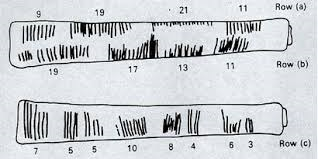
The left column can be divided in 4 groups, with each group possessing 19, 17, 13, and 11 notches.  The sum of these being 60.  Those are the 4 successive prime numbers between 10 and 20.  This constitutes a quad of prime numbers.

The central column is divided in groups of 8.  By an approximate count, one can find (in the parenthesis, is the maximum number): 7 (8), 5 (7), 5 (9), 10, 8 (14), 4 (6), 6, 3.  The minimal sum is 48, while the maximal sum is 63.

The right column is divided into 4 groups, where each group has 9, 19, 21, and 11 notches.  The sum of these 4 numbers is 60.

The second bone has not been well-studied.  However, we know that it is composed of 6 groups of 20, 6, 18, 6, 20, and 8 notches.

The Ishango bones with their notches and the numbers

The first bone has been subject to a lot of interpretation.  At first, it was thought to be just a tally stick with a series of tally marks, but scientists have demonstrated that the groupings of notches on the bone are indicative of a mathematical understanding which goes beyond simple counting.  In fact, many believe that the notches follow a mathematical succession. The notches have been interpreted as a prehistoric calculator, or a lunar calendar, or a prehistoric barcode.

Jean de Heinzellin was the first to consider the bone as a vestige of interest in the history of mathematics.  For instance, he noted that the numbers in the left column were compatible with a numeration system based on 10, since he saw that: 21 = 20 + 1, 19 = 20 – 1, 11 = 10 +1, and 9 = 10 -1.  These numbers are also prime numbers between 10 and 20: 11, 13, 17, 19.

The Ishango bones
The Ishango bones with the notches

Some other scientists such as the Belgian physical engineer proposed that the bones were probably a slide rule. While Alexander Marshack has indicated that the bones could refer to the oldest lunar calendar on earthClaudia Zaslavsky thinks that the author of the Ishango bone must have been a woman following the lunar phases to calculate her menstrual cycle.  However, the second bone completely rules out the lunar calendar theory, and favors more the numeration system.

All said, it is amazing to realize that there were mathematicians 20,000 years ago on the African continent.  It is so great to realize that my ancestors, on the shores of Lake Edouard, were actually brilliant scientists playing with prime numbers.  Whether it was a woman calculating her menstrual cycle, or some brilliant tribe astronomer, it feels so good to know that the paleo-mathematicians of Ishango already knew prime numbers.  They were a great civilization long before the pharaohs of Egypt. Thus, in reality, the Ishango bone is the oldest table of prime numbers in the world. To read more, check out Mathematicians of the African Diaspora,, the Prime Glossary, and Wolfram Mathworld.

The African Origin of Extradition

Ramesses II
Pharaoh Ramesses II

I just learned today that the first ever written extradition agreement – and peace treaty- was written in Egypt centuries ago by Pharaoh Ramesses II (The Great) between the Egyptians and the neighboring Hittites in 1259 BC.  It is the world’s oldest and first extradition treaty.  Mostly known as the Treaty of Kadesh, after the battle of Kadesh fought 16 years earlier, the agreement bound both sides to repatriate criminals and political refugees from the other side.  It was concluded between Egyptian Pharaoh Ramesses II, and Hittite King Hattusili III.  The purpose of the treaty was to establish and maintain peaceful relations between the parties.

The Treaty of Kadesh (the Hittite version) engraved on baked plates and currently housed in Istanbul

In Egypt it was inscribed on the walls of temples in hieroglyphics, while in the Hittite capital of Hattusa (in present day Turkey) it was preserved on baked clay tablets.  Archaeological excavations at the Hittite royal palace uncovered it among the palace’s sizable archives.  The Egyptian version of the peace treaty was engraved on the walls of Pharaoh Ramesses II’s mortuary temple in Thebes.  Translation of the text revealed that this engraving was originally translated from the silver tablet given to Ramesses II, but had since been lost to contemporary historians. The scribes who engraved the Egyptian version of the treaty included descriptions of the figures and seals that were on the tablet that the Hittites delivered.  A complete version of the Hittite text is currently housed within Istanbul‘s Ancient Orient section of its Archaeological Museums.

Think about it, our ancestors the Egyptians were quite ahead of time… they even thought of extradition.  As the likes of Julian Assange or Edward Snowden run around the world in search of a place with no extradition, it is good to know that ancient Egyptians were men of honor, and light who had thought about such a law centuries ago.


The Siddis: Africans of India

Siddi girl
Siddi girl

The BBC recently had a photojournal article on the lost Africans of India, and I thought it wise to talk about our brothers from the Indian subcontinent.  The Sidi or Siddi, or Sheedi, or Habshi, are said to have first arrived on the Indian subcontinent around 628 AD at the Baruch port.  Several others followed; most Siddis are believed to be descendants of traders, sailors, soldiers, servants, and merchants of East Africa.  The biggest wave of migration is said to have lasted between the 12th and 19th centuries.  Most Siddis are Bantu descendants from southeast Africa.  In the 13th and 14th centuries, most slaves were mainly drawn from countries in the Nile region: lower Egypt, Ethiopia, Somalia, and Sudan.  Due to their fighting prowess, many became soldiers in the armies of conquerors and sultans all over India’s princely states.  They were wanted mostly because of their loyalty and strength, and received grants of land in return for their valorous services.  With the arrival of the Europeans, especially the Portuguese, into the slavery scene in the 16th century, Siddis were now drawn from the inner continent in regions such as the Congo, and as far down the East African coast as Mozambique, Malawi, and Tanzania.

The origin of the word Siddi is very controversial.  Some believe that it was a term of respect in North Africa similar to the word sahib used in India; others believe that it derived from the title borne by the captains (known as sayyib) of the Arab vessels that first brought Siddi settlers to India; while others believe that the word habshi (another term for siddi) is derived from the common name for the captains of the Ethiopian/Abyssinian ships that also first delivered Siddi slaves to the subcontinent.

Siddi dancers of Goma music

Today, many Siddis reside in the Western states of Karnataka, Gujarat and Maharashtra, with some in the city of Hyderabad in India and Makran and Karachi in Pakistan.  India counts about 20,000 to 50,000 Siddis.  Their communities are very poor, and many have kept together, and do not marry outside.  Siddis are mostly muslims, but some are christians; with few adopting Hindu as they could not fit appropriately in the Hindu caste society.  Today, the Siddis are called a ‘scheduled caste‘, or ‘scheduled tribe‘, which simply gives them access to reserved quotas of government jobs, quotas in state schools, bursaries and subsidized housing.  As is the case with the descendants of black slaves in the Americas, most of the Siddis of India do not know where their ancestors came from in Africa, but, amazingly, they have somehow preserved some of the musical and dance traditions of their long-lost forefathers (again, similar to Africans in the Western Hemisphere).  Their African-derived music is known as the Goma and is clearly African in origin.

Siddi man from Karnataka

Many of the well-known Siddis in Indian history were war generals.  One of them was Jamal-ud-Din Yaqut who rose to prominence in the Delhi Sultanate period prior to the rise of the Mughals of India, as a close confidant of Razia Sultana (12051240 CE); it has been speculated that he was her lover.  Many of the kingdom’s noblemen resented the relationship between Razia Sultana and Yaqut, first since she was the first female ruler of the Delhi sultanate, but also because she elevated him to the great title rank of Amir of Amirs.  Other important Siddis have been Yakut Khan, a naval admiral and administrator of Janjira fort who served under the reign of the Mughal Emperor Aurangzeb; and Malik Ambar who created an army of over 1500 men on his own; and general Hoshu Sheedi, who was a Supreme Commander of Sindh‘s Talpur army, who fought with valor against the British in the Battle of Dabbo and laid down his life in defense of his country.

Lastly, it is good to note that Africans have influenced civilizations around the world, and continue to influence them to this day: many great cities and empires were built thanks to them.  Imagine that some of the great generals and confidants of the Mughal empire were of African descent… doesn’t that make you proud?  To learn more about the Siddis of India, don’t forget to check out BBC’s photojournal.  Please read the article on The Lost Indians on NigerianMasterweb.com, India’s Sidis on The East African journal, as well as the article in the International Business Times.


History of African Fabrics and Textiles

Wax Hollandais
Wax Hollandais

Very often, Africans are depicted on old pictures as naked people, walking around without any clothing.  This seems to be quite at odd with the fact that the Dutch textile company VLISCO has been installed in Africa, more precisely in Togo, since 1846.  So how could pictures from the 1800s and early 1900s only show naked Africans?  The BBC recently ran a story on VLISCO and African textile tradition actually being European.  The New York Times claimed that Africa’s fabric was entirely Dutch.  I find this quite appalling, and I call this a falsification of history.

For starters, before VLISCO, Africa had a very rich textile industry as noted by Kankan Moussa‘s entire delegation being clothed from cotton woven with golden threads in 1300s during his pilgrimage to the Mecca (this will be a story for another day), or the Kanembu clothing tradition which dates as far back as the 800s.  It is misleading to believe that the Wax hollandais is the only fabric worn by Africans, when we know that the Bogolan rises from a long tradition of weavers in Mali, or the Kente cloth of Ghana.

A piece of Bogolan cloth

So what is the history of African fabric?  Is there an African history of textile?

As pointed earlier, the African fabric industry is very old, and dates as far back as 5,000BC when ancient Egyptians began cultivating flax and weaving it into linen.  An ancient pottery found at Badari shows an ancient depiction of a loom dating back to this period, while a 12th dynasty image from the tomb of Khnumhotep shows weavers using a horizontal loom (ca 2400 BC).  Moreover, pyramids, sculptures, and hieroglyphs clearly show all Egyptians clothed.
Even their neighbors to the south, the Nubians, had a flourishing textile industry, as can be seen on images on pyramids at Meroë, and images of the great queen Amanishakheto, as well as those of pharaoh Piye.
Later on, as several civilizations flourished throughout Africa, cotton became a more commonly used fabric.  The explorer Ibn Battuta does mention the presence of weavers in the Mali empire, and in Timbuktu, in the 1300s.  As Islam was introduced in West Africa, many began wearing today’s version of the boubou.
Kente cloth
Kente cloth

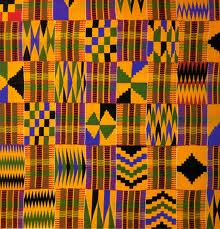
Today, one can find a full tradition of textile flourishing throughout Africa.  The Bogolan or ‘mud cloth’ is  hand-woven fabric hailing from Mali.  Kente cloth, is Ghana’s national fabric, with the most expensive ones made with golden threads for kings only (in the olden days).  It is said that the British explorers were amazed by the beauty of the Ashanti king’s attire.  Cameroon has a long history of cloth made from the bark of trees, with some fabric particularly made from the obom.  Fibers from the raffia are still commonly used to make bags, and clothing.  Moreover, in West Cameroon, Kings are dressed with finely woven clothing made by the best weavers of the kingdom embellished with beads.  The Pygmies use bark cloth made from tropical fig trees, while people from Chad and the Central African Republic weave cotton strips on horizontal looms; they use a variety of natural dyes.

Ndebele woman
Ndebele woman

The Kuba people of the Democratic Republic of Congo, use raffia and make some of the most beautiful hand-woven blankets, clothing, and sculptures.  The Ndebele of South Africa and Zimbabwe have a rich tradition of gorgeous colorful quilts and blankets entirely hand-made.  Many would envy the elegance, color, and presentation of well-dressed Ndebele women.

So why are the New York Times and the BBC trying to falsify history?
Even VLISCO patterns are not Europeans, as they are inspired by Africans, and made to address the needs of the African population.  Yes, Africans wear have worn VLISCO textiles and many Nana Benz have prospered from it, but that doesn’t mean that they do not have their own rich tradition of textile.   Africans have their textile industry which dates back millennia, and has probably inspired many in the world.  So today as you wear a wax hollandais, remember that there are Kente cloth, Bogolan, and many other beautiful garments made by local artists well-deserving of praise.
I am leaving you with a documentary video on Kente cloth weaving.  Enjoy!

The Boubou: A Traditional African Garment

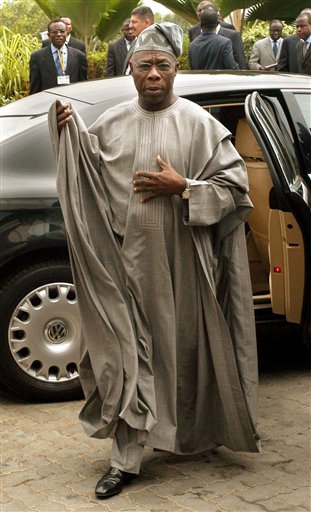
President Olusegun Obasanjo of Nigeria, famous for his boubous
President Olusegun Obasanjo of Nigeria, famous for his grand boubous

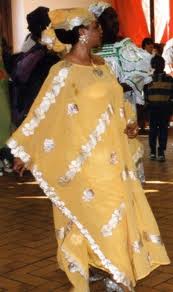
Yesterday I wore my green boubou with intricate gold embroidery in the front for a special African celebration.  To say that I looked like royalty is simply an understatement.  I looked majestic!  So, for starters, you might ask me what is a boubou?  Well, a boubou (or bubu, or grand boubou, or grand bubu) is an African garment worn by men and women in much of West Africa, and parts of Central Africa.  The boubou generally consists of up to three pieces: a long-sleeved shirt, a pair of tie-up trousers that narrow at the ankles, and an open-stitched overflowing wide sleeveless gown worn over these two; all three are usually the same color, and were historically made from silk, but nowadays are made up of cotton or sometimes synthetic fabric made to resemble silk.  The whole will be incomplete without a hat or chechia of any color.  A woman’s boubou would differ from a man’s boubou by the fact that it will consists of two pieces: a wrapper at the bottom, and a large overflowing gown to top it all off, and of course an intricate headscarf.  Its name comes from the wolof ‘mbubb’, which made it into French, as boubou.  In Yoruba, it is known as agbada; in Hausa, it is babban riga, while in Tuareg, it is k’sa grand boubou.

Woman wearing a boubou

The tradition of the boubou is old, and can be traced back to as far as the 8th century.  Its origin lies with the clothing worn by the Islamized Tukulor (Toucouleur), Mandé, and Songhai peoples of the great Takrur and Ghana empires, and 13th century Mali and Songhai empires.  In West Africa, the nobles of the different people were already wearing a garment more or less similar to the actual boubou.  The different patterns in the embroidery already had precise meanings which varied for different ethnic groups and regions.  The rest of the population, in majority craftsmen and farmers, wore garments similar to tunics for the upper body, and a wrapper or baggy trousers for the lower body.

In the past, in West Africa and Central Africa, only Islamized peoples used to wear the boubou: Fulani, Toucouleur, etc. … the other ethnic groups all had their own traditional garments of more or less similar genre.  With trade among the peoples, the fashion industry, many African stylists (such as Alphadi) have specialized into the boubou and it has now gained international exposure.

The video below is short and simple, and addresses the boubou.  It is a small documentary from Arte. Enjoy!

Queen Nzingha: Great Queen of Angola

Queen Nzingha of Angola

Today, I will be talking about another great queen of Africa: the Queen Nzingha of Angola, who defended her kingdom against the Portuguese for 40 years and defeated them.  Yes! DEFEATED THE PORTUGUESE IN THE 1600s!  See… another gap in our textbooks: anybody heard of this great queen and of her military and diplomatic genius?

Well, the great Queen Nzingha was born in Angola at the end of the 1500s, just over 100 years after the Portuguese started slavery ports across Africa.  She was born to Ndambi Kiluanji, Ngola (king) of the Mbundu and Ndongo people and his second wife Kangela, in 1582.  At her birth, a wise woman predicted that she will one day become queen, which was unheard of since there were no women rulers in those days.

In her youth, Nzingha was strongly favored by her father, who allowed her to witness as he governed his kingdom, and who carried her with him to war.  She participated in all the intense training for warriors. Nzingha grew up in a world normally suited for males.  She was educated in the fields of hunting and archery, and in diplomay and trade.  Nzingha was a true politician, and showed true military and intellectual genius.  She also had two sisters Kifunji and Mukambu, and a brother Mbandi.

Queen Nzingha sitting on the back of her servant
Queen Nzingha sitting on the back of her servant, during her audience with the Portuguese governor

Nzingha was special in the sense that she was well-educated and spoke and wrote fluent Portuguese.  As the Portuguese were setting a slave port in Luanda (present-day capital of Angola), and capturing the people for slavery, Ngola Kiluanji tried to work diplomatically with the Portuguese to keep the Mbundu people safe, but many were captured and taken into slavery.  At the death of her father in 1617, Nzingha’s brother, Mbandi, took over the throne as required by tradition.  In 1622, Nzingha went to Luanda working for Mbandi as a special emissary to negociate peace treaties with the Portuguese.  When she met with the Portuguese governor of Luanda, João Correia de Sousa, she was refused a seat.  As a mark of power, she sat on the back of one of her male servants and made him a human bench, to show the governor that she would not negociate with him from an inferior footing.  This was a woman ahead of her time, and who would not be made inferior!  There she succeeded in negociating a peace treatment.

After her return to Kabasa (the capital of the Mbundu kingdom), Mbandi committed suicide.  The Portuguese profited from this moment of weakness to attack Kabasa and burnt it to the ground.  Nzingha fleed with her people, and moved her people to the mountains where she formed an army to fight against the Portuguese.  She was named Ngola of the Mbundu people in 1624, with two of her war leaders and closest advisors being her sisters Kifunji and Mukambu.  In 1626, after the Portuguese betrayed yet another treaty, she was led to move her people further west and establish a kingdom in Matamba.  There, she organized several alliances with neighboring people such as the Imbangala people, and developed a new form of military organization known as kilombo, in which youths moved away from their families, and were raised communally in militias.  Nzingha also made alliances with the Dutch to fight the Portuguese, but to realize later that they were all the same as the Portuguese: treacherous, and only there to enslave the Mbundu people.  From 1630 to her death in 1663, Nzingha, Queen General of Matamba, launched a formidable opposition to the Portuguese regime from the rocky slopes of Matamba.  The Portuguese came to respect her for her strength, dignity, pride, shrewdness, and her intransigence.  She was their strongest enemy in Angola.  Nzingha ruled for almost 40 years in both Ndongo and Matamba.

Nzingha's Kingdom
Nzingha’s Kingdom

Nzingha died in 1663, at the age of 82. She was succeeded on the throne by her sister Mukambu (also known as Barbara).  Mukambu gave Nzingha a burial befitting of the greatest Ngolas: Nzingha was laid to rest in her leopard skins and with her bow over her shoulder and arrows in her hand.  This was the first time in history that the Mbundu people had been led by a woman, and everyone remembered Nzingha as an outstanding, impressive, female warrior, ruler and field commander.  For the Mbundu people, she is remembered for her love of her people, her strength, charisma, and her fight for their sovereignty and freedom.  No wonder, her influence was felt centuries later, when African slaves in Brazil organized themselves in Quilombo to fight their white masters and retain their freedom.

Pedras Negras mountains of Pungo Andongo
Pedras Negras mountains of Pungo Andongo (once the capital of Ndongo kingdom)

It took me 3 christmas and new year holidays to finally realize this video of Queen Nzingha de Mbande of Angola.  It took me this long not only because I only worked on it a few days of the year, but also because the time and references had to be right.  I am so glad to be able to present to you this great video which talks about another great queen of Africa, one who defended, and defeated the Portuguese for over 40 years.  See… another thing that is not written in African history books; we tend to think that our leaders were all weaklings, but we had real kings and real leaders like Samori Toure, Behanzin, Ranavalona I, Amanishakheto, Beatrice of Congo, and Nzingha who fought the foreign invaders for the freedom of their people.  Enjoy learning about Queen Nzingha of Angola. You can also read Nzingha: Warrior Queen of Matamba, Angola by Patricia McKissack, as well as Black Women of Antiquity by Ivan van Sertima; don’t forget to check out this piece on Metropolitan Museum‘s website.

Did you know about Nzingha? How do you feel, now that you know that there was a great queen like her?

France returns smuggled Nok artefacts to Nigeria

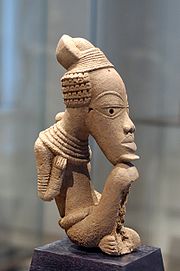
Nok Sculpture from the Louvre museum

France has returned today to Nigeria five ancient terracotta sculptures which had been smuggled out of the country in 2010.  Experts say Nok art is the earliest attempt at portraiture yet discovered in Nigeria.  Over the past 100 years, Nok art has been discoverd in a large area near the Jos plateau in northern Nigeria.  The Nok culture shows that African societies were quite versatile in iron works, and terracotta.  I had posted an article earlier on the Nok culture.  I am just glad to see that sometimes the French, with the pressure from the country from which it was stolen, can return stolen artefacts.  There are so many of our artefacts, manuscripts which have been stolen and are still kept in museums in France.  Applauds to the Nigerian government which kept demanding the return of their artefacts.  These should all be returned. I fear that very soon, we will also find Timbuktu’s manuscripts at the Louvre.

Enjoy the article from BBC, and my article on the Nok civilization.

Le Discours d’Adieu du Roi Behanzin

Statue of Behanzin in Abomey, Benin

Je viens de me rendre compte que le site djime.com qui était entièrement dedié au roi Béhanzin, n’est plus actif. J’ai donc decidé de poster ici, la version francaise, l’originale du discours d’adieu du roi Behanzin. J’avais deja traduit dans son intégralité ce discours du roi Behanzin en anglais. The English version here.

=============

« Compagnons d’infortune, derniers amis fidèles, vous savez dans quelles circonstances, lorsque les Français voulurent accaparer la terre de nos aïeux, nous avons décidé de lutter.

Nous avions alors la certitude de conduire notre armée à la victoire. Quand mes guerriers se levèrent par millier pour défendre le Danhomè et son roi, j’ai reconnu avec fierté la même bravoure que manifestaient ceux d’Agadja, de Tegbessou, de Ghézo et de Glélé. Dans toutes les batailles j’étais à leurs côtés.

Malgré la justesse de notre cause, et notre vaillance, nos troupes compactes furent décimées en un instant. Elles n’ont pu défaire les ennemis blancs dont nous louons aussi le courage et la discipline. Et déjà ma voix éplorée n’éveille plus d’écho.

An Amazon warrior ca 1890

Où sont maintenant les ardentes amazones qu’enflammait une sainte colère ? Où, leurs chefs indomptables : Goudémè, Yéwê, Kétungan ? Où, leurs robustes capitaines : Godogbé, Chachabloukou, Godjila ? Qui chantera leurs splendides sacrifices ? Qui dira leur générosité ?

Puisqu’ils ont scellé de leur sang le pacte de la suprême fidélité, comment accepterais-je sans eux une quelconque abdication ? Comment oserais-je me présenter devant vous, braves guerriers, si je signais le papier du Général ?

Non ! A mon destin je ne tournerai plus le dos. Je ferai face et je marcherai. Car la plus belle victoire ne se remporte pas sur une armée ennemie ou des adversaires condamnés au silence du cachot. Est vraiment victorieux, l’homme resté seul et qui continue de lutter dans son cœur. Je ne veux pas qu’aux portes du pays des morts le douanier trouve des souillures à mes pieds. Quand je vous reverrai, je veux que mon ventre s’ouvre à la joie. Maintenant advienne de moi ce qui plaira à Dieu ! Qui suis-je pour que ma disparition soit une lacune sur la terre ?

Partez vous aussi, derniers compagnons vivants. Rejoignez Abomey où les nouveaux maîtres promettent une douce alliance, la vie sauve et, paraît-il, la liberté. Là-bas, on dit que déjà renaît la joie. Là-bas, il paraît que les Blancs vous seront aussi favorables que la pluie qui drape les flamboyants de velours rouge ou le soleil qui dore la barbe soyeuse des épis.
Compagnons disparus, héros inconnus d’une tragique épopée, voici l’offrande du souvenir : un peu d’huile, un peu de farine et du sang de taureau. Voici le pacte renouvelé avant le grand départ.
Adieu, soldats, adieu !…

Behanzin, the Last King of independent Dahomey

Guédébé… reste debout, comme moi, comme un homme libre. Puisque le sang des soldats tués garantit la résurrection du Danhomè, il ne faut plus que coule le sang. Les ancêtres n’ont plus que faire de nos sacrifices. Ils goûteront mieux le pur hommage de ces cœurs fidèles unis pour la grandeur de la patrie. C’est pour quoi j’accepte de m’engager dans la longue nuit de la patience où germent des clartés d’aurore. Guédébé, comme le messager de la paix, va à Ghoho où campe le général Dodds. Va dire au conquérant qu’il n’a pas harponner le requin. Va lui dire que demain, dès la venue du jour, de mon plein gré, je me rends au village de Yégo. Va lui dire que j’accepte, pour la survie de mon peuple, de rencontrer dans son pays, selon sa promesse, le président des Français. »

extrait de – Kondo le requin – Jean PLYA – Ed. CLE

Electricity in Africa… 5000 years ago

Very often, we, Africans, have been misinformed about our true place in advancing humanity.  Very often, we have been told that we were a dark continent, an ignorant race, or rather a non-scientific class?  Well…  I have news for those nay-sayers.  Ancient Africans, Ancient Egyptians used electricity: ancient pyramids were lighted via electricity… yes… you heard me well… not only did they show some of the greatest scientific fits by designing pyramids, but they also had electricity (thousands of years before Nikola Tesla or Alessandro Volta).  Just like the great Library of Alexandria, or the University of Timbuktu … we, Africa, also had electricity.  Enjoy… and Applaud … and above all be proud of the ingenuity of our ancestors.

Queen Ranavalona I: Defending Madagascar against European Invasion

Queen Ranavalona I
Queen Ranavalona I

Today I will be talking about a great queen of Madagascar, Queen Ranavalona I who fought against French and British expansionism in Madagascar, and strongly believed in autarky (self-sufficiency).

Born by the name of Mavo (or Ramavo) around 1788, Ranavalona I will later be named Rabodonandrianampoinimerina (which means the smart grand-daughter of Andrianampoinimerina) in reverence to her uncle, the King Andrianampoinimerina.  She became Queen of Madagascar after the death of her husband Radama I and was coronated on 12 August 1829.  She was also designated by the title Ranavalo-Manjaka I (« Reigning Ranavalona »).  She reigned over the Kingdom of Madagascar from 1828 to 1861.

Ranavalona I followed in the footsteps of her predecessors, with the territorial expansion of her kingdom, and led several expeditions to pacify conquered territories such as the meridional Menabe, the Boina, and the north-east regions of the island (Madagascar).  Fervent nationalist, she fought against foreign influence, including that of Christian missionaries.  During her reign, the power of some castes increased, like that of the andriana or the royal family, or that of the military chiefs, the hova.

Madagascar
Madagascar

Ranavalona’s 33-year reign was distinguished by an ongoing struggle to preserve the political and cultural sovereignty of Madagascar in the face of increasing European influence and competing French and English bids for domination over the island.  In the beginning of her reign, Ranavalona I tried to continue the work of modernization started by her predecessor.  Very soon, she faced the hostility of the French, who in 1829, attacked different points on the oriental coast of the island.  This unexpected aggression sharpened the queen’s distrust of European ambitions; especially since the British missionaries installed at the heart of the island since 1820 were converting many.  Fearing the loss of the independence of her country, she denounced the anglo-malagasy treaty of 1820, and asked the British to give up on the religious extension in her country, and to focus only on the educational works she wanted for her people.  However, the British refused, and in 1835, she had them expelled from the island.  To counter-balance the European influence on the island, the monarchy created contacts between the ports of Majunga, and Zanzibar.

Manjakamiadana, the Royal compound built for Queen Ranavalona I
Manjakamiadana,encased in stone under the orders of Ranavalona II

Ranavalona I then hired the services of Jean Laborde who accomplished quite a lot of modern upgrades, the most important of these will be providing Madagascar with a metallurgic and chemical industry.  He also built the queen a new residence known as the Manjakamiadana, which became the largest structure on the Rova grounds, the royal compound in Antananarivo.  The residence was made entirely from wood and bore features of a traditional andriana home, including a central pillar (andry) to support the roof.  The palace would eventually be encased in stone in 1867 by James Cameron of the London Missionary Society during the reign of Ranavalona II. The original wooden palace of Ranavalona I and virtually all other structures of the historic Rova compound were destroyed in a 1995 fire, leaving only the stone shell to mark where her palace had once stood.  Renovation is on the way.

Royal Crown of Madagascar as worn by King Radama II, Ranavalona I's successor (ca 1862)
Royal Crown of Madagascar as worn by King Radama II, Ranavalona I’s successor (ca 1862)

Ranavalona pursued a policy of autarky (self-sufficiency) and isolationism, diminishing economic and political ties with European powers, repelling a French attack on the coastal town of Foulpointe, and taking vigorous measures to eradicate the small but growing Malagasy Christian movement initiated under Radama I by members of the London Missionary Society.  She made heavy use of the traditional practice of fanompoana (forced labor in lieu of tax payments in money or goods) to complete public works projects and build a standing army of between 20,000 and 30,000 Merina soldiers, whom she deployed to pacify outlying regions of the island and further expand her realm.

Subsequently, to try to eradicate Christianity among her subjects, as she believed (and rightfully so) that this was a means of infiltration of the colonial ambitions of Europeans on the island, she had converts (considered as traitors) run off.  As she declared in 1849: « Miala amiko ka mba ialako, mahafoy ahy ka mba foiko ! » (« they [christians] have denied me [ as a living symbol of their homeland], therefore I deny them as well; they have rejected me, I reject them! »).

Ranavalona I on the throne

She said in a letter addressed to the Europeans: “To all Europeans, British and French, in recognition for the good you have done to my country by teaching European wisdom and knowledge, I would like to express my thanks.  … You can keep following your customs. Have no fear for I have no intention of modifying your habits.  But if I see some of my subjects trying to change the rules established by the twelve great kings, my ancestors, I will not possibly consent: because I will not allow men to come and change anything to all the ideas I have received from my ancestors, which I had accepted without shame or fear.  You are free to teach my people science and wisdom, but when it comes to touching our ancestors’ customs, it is a vain work, which I will fully oppose….”

Ranavalona I continued the works of Andrianampoinimerina and Radama I.  In her country, she is seen as a great sovereign, true symbol of patriotic and national pride.  However for Europeans, she has been described as a tyrant… but like her so many great African kings and queens defending their country against foreign invasion/colonization have been portrayed as cruel, and ignorant.  Faced with the contempt of Christian converts, she proudly stated: ”ny fomban-drazako tsy mba mahamenatra ahy na mampatahotra ahy!” (“I do not feel any shame or fear about my ancestors’ customs”).  Enjoy this great video, and honor one of Africa’s earlier nationalist and independentist: Queen Ranavalona I.