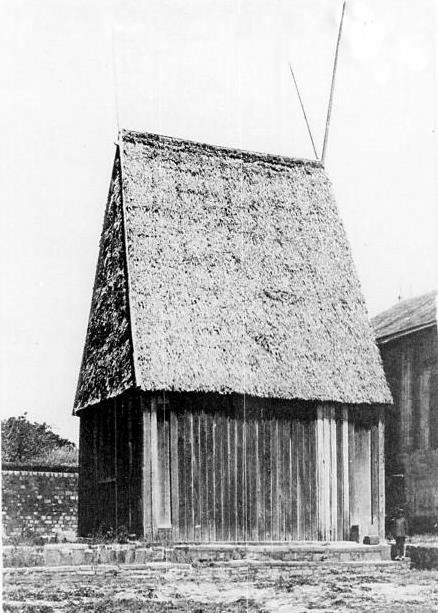
Tchaman (Atchan) Kings and dignitaries in front of the Djidji Ajokwe talking drum (Source: Afrikmonde.com)
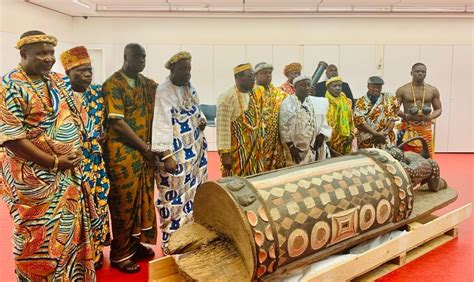
On this day, France has returned a sacred drum looted from Côte d’Ivoire after 110 years. It was taken from the Tchaman (Atchan, Ebriés) people by the French people. The sacred, talking drum, is known as the Djidji Ayôkwé and was exposed at the Musée du Quai Branly. The drum is 4 m (13 ft) long and 430 kg (948 lbs) heavy. This is the first object returned by France to Côte d’Ivoire, the first of 148 artifacts.
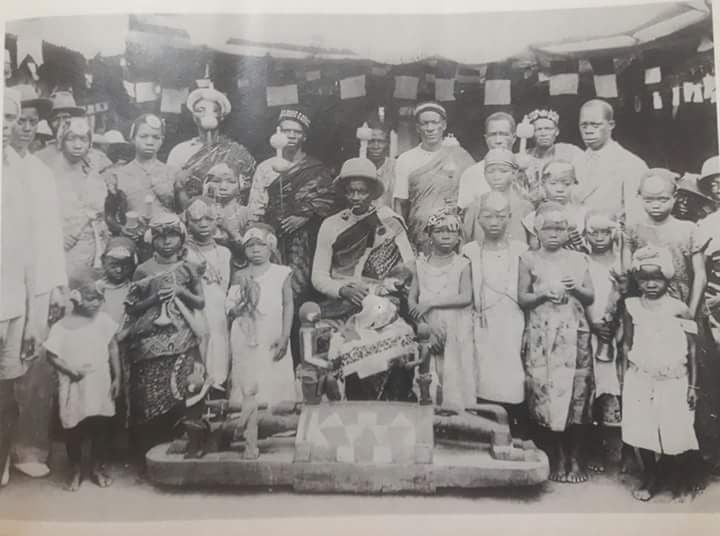
Tchaman (Ebrié) King, Nandjui Abrogoua and his court (1848 – 1938) – Foreground : “DJIDJI AYOKWE” the sacred talking drum of the Tchamans (Ebriés) of Goto Bidjan. (Source: Photo/IT / TheAfricanDream.net)
France returned a sacred drum that was taken from the Ivory Coast during colonial rule at a ceremony in Abidjan on Friday, marking the first official restitution of a cultural artefact from France to the West African country.
The Djidji Ayôkwé, described as the “talking drum,” is a massive carved wooden drum once used by the Atchan people of the Abidjan region to communicate between villages. It landed in the economic capital early Friday morning.
… It is expected to go on display in April at the newly renovated Museum of Civilizations in Abidjan.
“Your return is a message for our young people who have decided to take ownership of their history, for the communities that are rediscovering their Djidji Ayôkwé, a symbol of social cohesion, peace and dialogue,” Ivory Coast’s culture minister, Françoise Remarck, said during the ceremony.
Seized by French colonial authorities in 1916, the Djidji Ayôkwé had been among 148 objects formally requested by the Ivory Coast from France in 2018.
“This drum has been gone for centuries, so today, as a young man, I am overjoyed to receive it and to see it,” said Serge Akmel, who came to watch the arrival.
“When this drum was taken, it was difficult for us; they took something heavy from us. Today, we received the drum.”
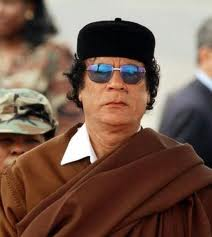
I would like to share some points about life in Libya under the Guide of the Libyan Revolution Muammar Gaddafi, from an African perspective, not the trash published by the Western media. Western Media Lies in Libya, NATO’s debacle in Libya, Truth Dispatch: Update on Libya. He was not a saint, but he loved his country deeply and Africa as a whole, and was fighting for our freedom and dignity as human beings!
Libya had significant reserves of crude oil and the discovery of oil changed its socio-economic landscape. Before Gaddafi, Libya had less control on the oil industry as most of the companies involved in oil exploration activities were foreign, but a few years after Gaddafi took control of the government of Libya, his administration nationalized the oil Industry which had a marked impact on the economy and development. Under Gaddafi’s leadership, Libyans enjoyed an exceptional standard of living, financed by oil revenues that were equitably redistributed.
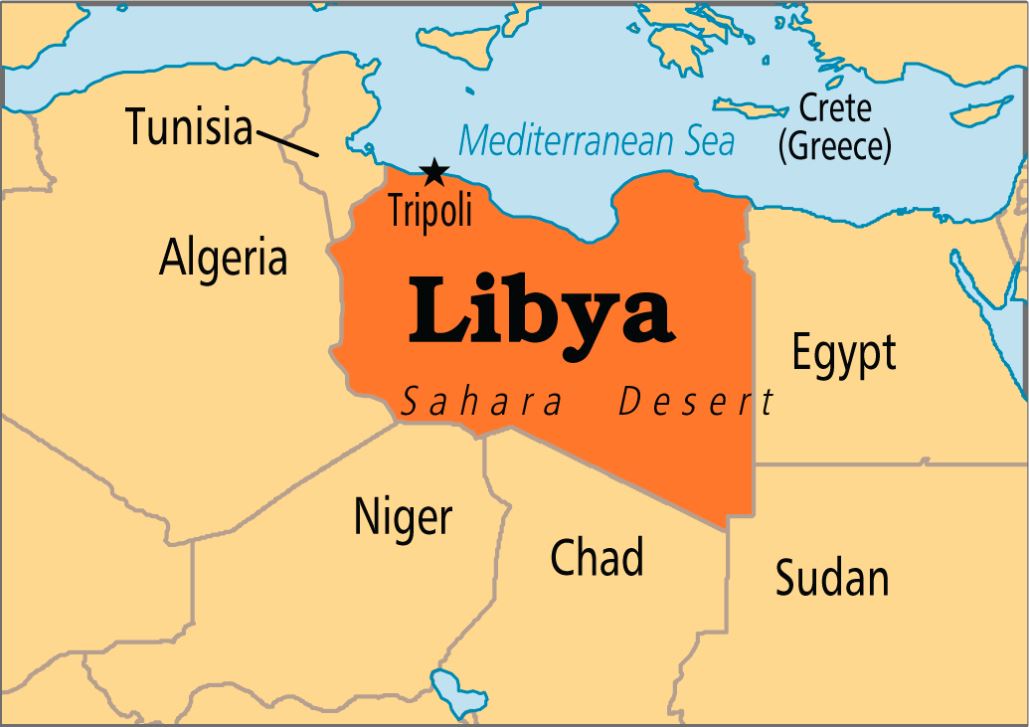
Map of Libya
Thanks to a bold management of oil wealth, Gaddafi transformed his desert country into a model of social and economic development, offering its citizens unparalleled benefits on the continent, and in the world (Norway is now applying his doctrines – just under a different name). While the West often portrays him as a dictator, we want to tell you about the life of Libyans under Gaddafi, and the benefits to the whole of Africa.
Below are the main benefits enjoyed by citizens (source Eurafrica, translated by Dr.Y, Afrolegends.com):
Free education for all: Access to education, from primary school to university, was entirely free. Before Gaddafi, only 20% of Libyans were literate; under his rule, this rate rose to 83%. A quarter of the population held a university degree, a record in Africa.
Free medical care: Hospitals provided free care, and the number of doctors quadrupled in a decade. Diseases like malaria were eradicated, and tuberculosis declined sharply.
Affordable electricity: Although sometimes described as free, electricity was so heavily subsidized that its cost was negligible for households.
Housing, a fundamental right: Gaddafi considered housing an inalienable human right. Massive programs were implemented to build affordable housing, and citizens could obtain interest-free loans to buy their homes. No homelessness like in the streets of some of American and European capitals!
Support for young couples: Newlyweds received financial assistance of approximately $50,000 to acquire a home and start their family life.
Support for mothers: Every woman giving birth received a bonus of $5,000 to support her family.
Car subsidies: The state covered 50% of the price of cars, making mobility accessible to all. Gasoline at a ridiculously low price: With a liter of gasoline costing only $0.14, Libyans enjoyed some of the cheapest fuel in the world.
Affordable basic necessities: Essential goods were subsidized to ensure access for all.
Support for agriculture: Aspiring farmers received land, equipment, seeds, and livestock free of charge to start their farms.
Assistance for unemployed graduates: Unemployed young graduates received an allowance equivalent to the average salary for their profession until they found a job.
Education and healthcare abroad: If local infrastructure was insufficient, the state financed studies or medical treatment abroad, providing a monthly allowance of $2,300 for housing and transportation.
Oil revenue redistribution: A portion of oil revenues was reinvested in social programs, ensuring rare economic stability.
Libya was a debt-free economy and Gaddafi had a pan-African vision. With reserves of $150 billion and no external debt, Gaddafi’s Libya was an anomaly: an African country free from the clutches of international financial institutions like the IMF. This economic independence allowed Gaddafi to dream big. His ambitious project, the Great Man-Made River, transported millions of cubic meters of water across the desert, transforming arid lands into fertile fields. Nicknamed the “eighth wonder of the world,” this irrigation network symbolized his ambition to make Libya self-sufficient.
Gaddafi went even further: he wanted to unite Africa. By proposing a gold dinar to replace the dollar in African trade, he sought to free the continent from Western powers. This project, combined with his support for the African Union, made him a threat to the global order.
We have talked so many times about the numerous puppet regimes installed throughout Africa, but we have not talked about how these regimes came to be. It is no secret that these puppet governments, particularly in francophone Africa, are inherited from colonial era, and before that from slavery times. They just morphed over time. The authorities of kings of different African kingdoms and empires were slowly reduced to those of couriers or delivery boys, totally disconnected from their original power rooted in their ancestral traditions. Those who rebelled were simply killed or deposed, or forced to bow down like Behanzin, Prempeh I, Samori Toure, and more. Once we understand this, it is now clear why today we often see African presidents run abroad to France or wherever to take their orders: when they win elections, when new rules need to be established, or their currency devalued, etc.
Pr. Bwemba Bong explains it so well in his book “Quand l’Africain était l’or noir de l’Europe. L’Afrique: Actrice ou Victime de la Traite des Noirs? – Démontage des mensonges et de la falsification de l’histoire de l’hydre des razzias négrières transatlantiques” (When the African was the black gold of Europe. Africa: Actress or Victim of the Slave Trade ? – Dismantling the lies and falsification of the hydra history of the transatlantic Slave Raids),” MedouNeter 2022, p. 170 (translated to English by Dr. Y, Afrolegends.com). In his section titled “The transformation of the administrators of the so-called French-speaking colonial Black Africa into anti-African, ethnic ogres and terrorists”, he explains :
In the political sphere, traditional African institutions were completely destroyed to make way for the establishment of the slave system, for which the disappearance of African kingdoms and empires was a sine qua non prerequisite. When European and African criminals had not simply seized their thrones, African kings and emperors were now placed under the subordination of European slave traders. This violent intrusion, through the dismantling of legitimate powers replaced by subservient structures whose survival is today represented by African “chieftaincies,” but above all by the so-called African state, has created new, artificial, and illegal territorial structures. From now on, the authority of African “rulers” had and has its source only in the wicked European law and no longer in the institutions of their ancestors.
The act of recognition by the slave-owning power now constituting the sole legal basis for the exercise of power, any structure not expressly approved because it was established by the European invading authority—which alone granted and still grants today the title of “king,” “chief,” or “president” (depending on the appropriate tactic)—was and is automatically guilty of the crime of usurpation of title, and was and is irremediably subject to deposition, or even execution, through the system of coups d’état so prevalent today in Sub-Saharan Africa.
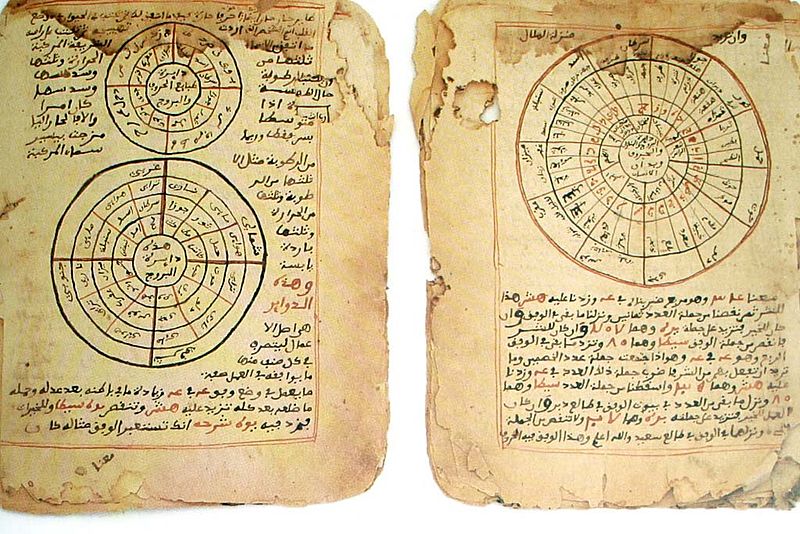
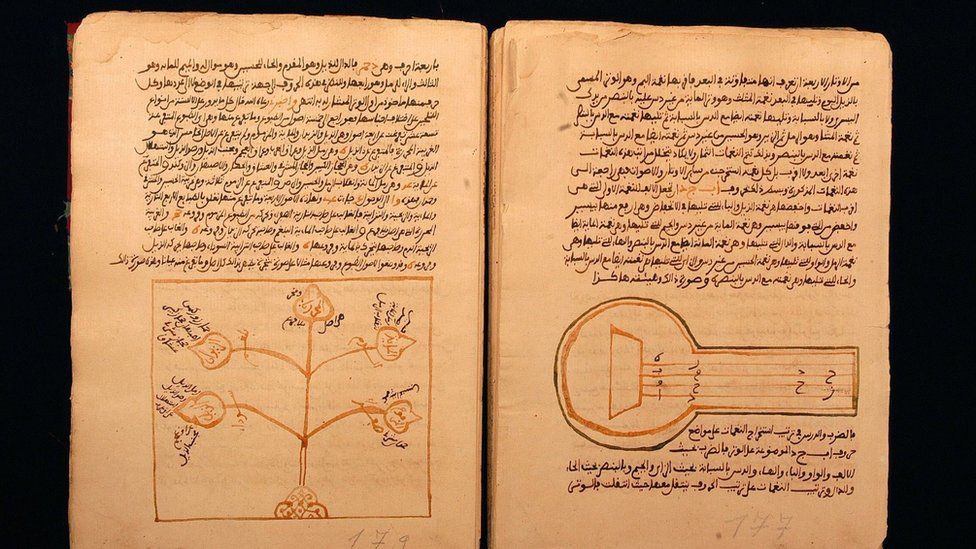
Manuscripts a Tombouctou (Mali) montrant de l’astronomie et mathematique
The Timbuktu’s Manuscripts are Returning Home to their rightful owners, after over 10 years away. It is so beautiful that the families who own these multi-centennial parts of African history get to have them back as it is not only part of their heritage, but ours also, and we are thankful for them to have protected throughout the centuries.
At the Ahmed Baba Institute in Bamako, people have been actively working on digitalizing all the manuscripts for humanity’s sake. These challenge the eurocentric views that “Africans have not entered enough in history” as the former French president Sarkozy said, even though many scholars from around the world used to travel to Timbuktu to find the best teachers. Through these manuscripts, we discover brilliant scholars, doctors, lawmakers, astronomers, mathematicians, geologists, and much more. After all, Timbuktu, was one of the world’s first and oldest university.
… Among the manuscripts are medical texts, legal rulings, letters, astronomical notes and chronicles of West African empires.
In some pages, scholars debate whether smoking tobacco was moral or forbidden.
In others, officials urge reducing dowries so poorer men could marry.
Marginal notes record earthquakes and local events long forgotten elsewhere.
Sane Chirfi Alpha is the founding member of SAVAMA DCI, which is a local nonprofit organisation dedicated to the safeguarding, preservation, and promotion of the ancient Timbuktu manuscripts. He says the collection reveals a depth of scholarship that challenges assumptions about the region’s past.
“According to old documents, there were doctors here in Timbuktu who performed surgery to treat cataracts. The same manuscript also says that a doctor from Timbuktu saved the French throne. The crown prince was sick, and French doctors could not cure him. It was the doctor from Timbuktu who cured him.”
… One important tradition still documented in many manuscripts is the chain of teaching, where scholars recorded who taught whom through generations.
Dr Mohamed Diagayaté, general director of the Ahmed Baba Institute says: “When a student finishes studying with a scholar, that scholar gives him a certificate saying he has taught him a subject, which the student has mastered. The certificate also says that the student learned it from a certain scholar, and that this scholar learned it from another scholar, going right back to the person who wrote the original document.”
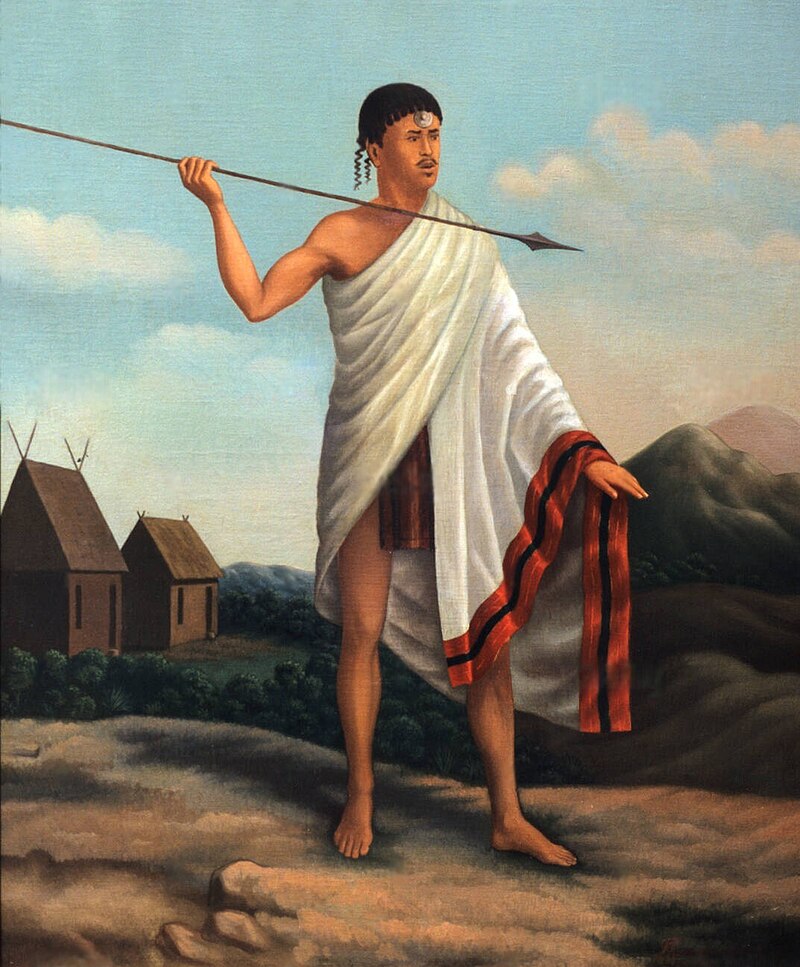
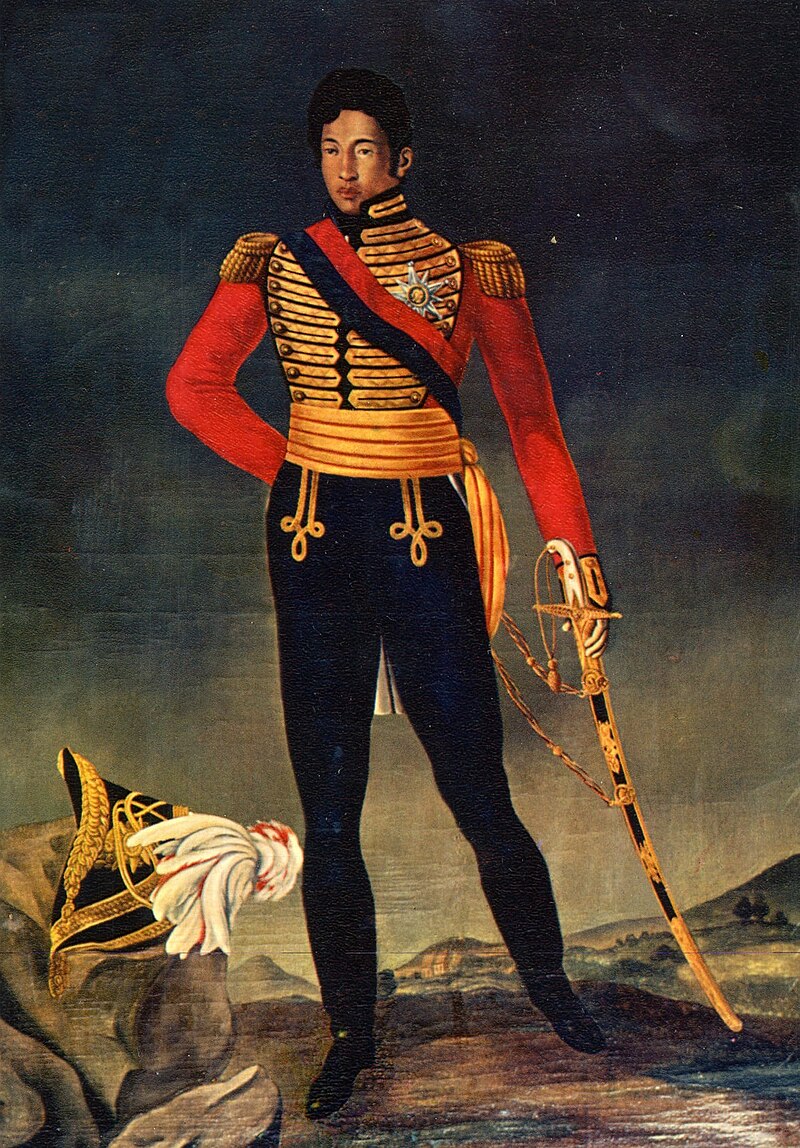
Andrianampoinimerina, portrait painted around 1905 by Ramanankirahina
As we learned, Andrianampoinimerina is known as the first Ruler of the Kingdom of Imerina in Madagascar, the one who unified the Merina people of Central Madagascar. His reign was marked by the reunification of the Imerina after 77 years of civil war, and he also led the subsequent expansion of his kingdom to nearby territories, thereby initiating the unification of Madagascar under Merina rule. His legacy was followed by his son Radama I who successfully continued it, unifying 2/3 of the great island under his rule.
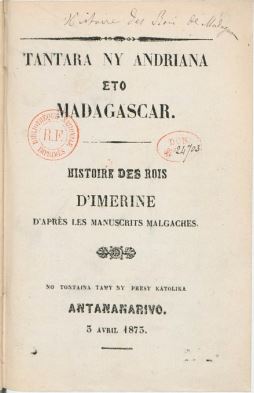
Tantara ny Andriana
Below is an excerpt of Andrianampoinimerina’s speech, taken from the Tantára ny Andriána, edition 1968. It is an immense collection of the oral traditions of Madagascar collected by R.P. Callet, a Jesuit priest from 1868 to 1881. The book is in Malagasy. A French translation was published in 4 volumes by the Malagasy Academy from 1935 to 1958. The numbers at the head of each excerpt indicate the page numbers of the original.
=====
One of King Andrianampoinimerina’s residences within the Rova of Antananarivo, Madagascar
Excerpts from Andrianampoinimerina’s Speech
708.« I see the different castes: all belong to me and all have my affection, he said, and I will unite you; I will make of Imerina a guinea fowl of a single color.»
728.« This is what I will tell you, O Merina: the country and the kingdom are mine; I will share the land with you… to allow you to live… I will give a rice field to each man; I will see to it that all the Ambaniandros1 have the same belly. »
731.« Here is the forest: I make it the great undivided heritage, the means of subsistence for orphans, for single women, for all the unfortunate… whoever goes there, do not prevent them: all will be able to take and act as they please. »
757.« The men guilty of these crimes, even if they were great figures, even if they were caste leaders, even if they were my relatives…, I will put them to death; I will reduce their women and children to slavery and I will confiscate their property… The Merina, my subjects, are like a lámba without inside or back, like the circular and uniform edges of a pot. »
Radama I (c. 1810 – 1828)
802.« There is no other enemy to my kingdom than famine, because one cannot, when hungry, think of the State: the great, then, seek to devour the small, and the small to steal… If there are people who do not work, I invite you, oh my subjects, to cultivate their lands… you will take the harvests, but will give them back their land when they are determined to work it. »
1054.(Excerpt from his recommendations before his death) « O my friends, let Radama be for you a young gosling to whom you will bring what you have conquered… Do not present him with unfaithful reports, do not deceive him. For the King has no parents; he has no brothers; those who obey his instructions and who trust in his laws are his parents… »
1056.« … and I declare to you too, O Radama, that Imerina is now unified and that the sea will be the limit of your rice field. »
Africa has inherited arbitrary boundaries delineating countries from the colonial era, and even water supplies! This is the case for the Nile River, the world’s longest river, which flows through several countries in North and East Africa, including Egypt, Sudan, South Sudan, and Ethiopia. Nobody presents the Nile River anymore, as it is a River which has been part of this planet’s history since time immemorial with its critical place in one of the greatest civilizations of the world, that of Ancient Egypt and its pharaohs, and in the Bible, the most read book in the world.
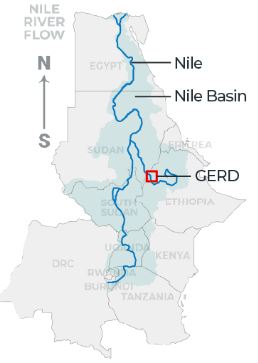
Map of the Nile River flow and the location of Grand Ethiopian Renaissance Dam (GERD) in Africa
Yesterday marked the inauguration and official opening of the Grand Ethiopian Renaissance Dam (GERD). This is Africa’s largest hydro-electric dam, measuring 1.8 km (1.1 miles) wide and 145 m (0.1 mile) tall, and is located on the Blue Nile in Western Ethiopia near the border with Sudan. It is expected to generate 5,100 MW of power, and more than double Ethiopia’s current capacity. It is designed to supply power to Ethiopia, but also to neighboring countries.
The dam’s location on a Nile tributary has sparked tensions between Ethiopia and Egypt, which relies heavily on Nile waters. The Nile River has long been governed by a series of historical treaties, many of which were shaped during colonial times and have sparked ongoing disputes—especially between Egypt, Sudan, and Ethiopia. The 1929 Anglo-Egyptian Treaty gave Egypt veto power over upstream projects, and allocated the majority of the Nile waters to Egypt and Sudan, excluding upstream countries like Ethiopia. Later, the 1959 Nile Waters agreement between Egypt and Sudan divided the Nile’s flow between Egypt and Sudan, not including Ethiopia and other upstream nations in the deal. This last deal remains the primary legal framework used by Egypt to assert its water rights! Picture this? A river flows through your country and others, and the others share the river’s flow among themselves and forget you in the equation, like you did not exist, or like the river never flowed through your country, and was also a source of existence for your people. What the …? Such injustice!
Flag of Egypt
No wonder there are issues! Egypt relies on the Nile for over 90% of its freshwater. Any disruption in the flow could threaten agriculture, drinking water, and industry. Egypt fears that the GERD would reduce water availability, especially during droughts. It has since then reduced the area cultivated for certain crops like rice which are water greedy.
Ethiopia feels that it has the right to use its own water resources, and rightfully so. Ethiopia today is a growing nation, and one of Africa’s strongest economies. The GERD is seen as a great symbol of national unity. It is a national development project, which will double Ethiopia’s electricity output, provide power to millions, and boost regional exports.
For Ethiopians, the GERD is seen as a victory: victory against all preconceived ideas that they could not seat at the table, or even design such amazing engineering feats. Because of the tensions, Egypt (which has always been the partners of all these foreign colonial powers in the region) had lobbied the world bank and other world funding organizations against financing the dam; thus the dam has been almost entirely domestically funded through bonds and donations. The GERD has also united citizens across ethnic and political divides.
After 14 years of continuous work, the GERD was officially launched by Prime Minister Abiy Ahmed who called it “the greatest achievement in the history of the Black race.” I would not go as far, but I agree that this is a great historical achievement indeed!
Last week, the Malian government started returning the famous Timbuktu’s manuscripts home to Timbuktu after over 10 years away. As you remember, we prayed for the manuscripts to be kept safe, as Timbuktu was under Attacks by ‘Muslim fundamentalists’, Timbuktu Manuscripts now Available Online. You know the AES is working hard, when it is safe for the Timbuktu manuscripts to return home after over 10 years away! This is a testimony to the hard work of the Malian troops, its people, and its government. The Malian people have shown that an African country can protect itself, recover its territory, and free its own people. Yes… there has been strong collaborations with Russia, and their neighboring brothers of Burkina Faso and Niger, and the formation of the Alliance of the Etats du Sahel (AES). Mali did what France and all its allies could not do with their multiple operations, operation Barkhane, Operation Serval, Task Force Takuba, etc, … wait they were not really there to free the country from terrorism, but rather to finance/protect terrorism, divide the country, so as to be free to do their business. We are proud of Mali, and pray that these manuscripts remain safe as they have been for centuries, in the hands of their very own people.
Manuscripts a Tombouctou (Mali) montrant de l’astronomie et mathematique
The Malian military government on Monday started returning home the historic manuscripts of Timbuktu, which were spirited out of their fabled northern city when it was occupied by al-Qaida-linked militants more than a decade ago.
Islamic radicals destroyed more than 4,000 manuscripts, some dating back to the 13th century, after they seized Timbuktu in 2012, according to the findings of a United Nations expert mission. They also destroyed nine mausoleums and a mosque’s door — all but one of the buildings on the UNESCO World Heritage list.
The majority of the documents dating back to the 13th century — more than 27,000 — were saved by the devotion of the Timbuktu library’s Malian custodians, who carried them out of the occupied city in rice sacks, on donkey carts, by motorcycle, by boat and four-wheel drive vehicles.
Manuscript of Timbuktu (Google Arts and Culture)
… About 706 kilometers (439 miles) from Bamako, Timbuktu sits on the edge of the Sahara desert and has a dry climate. For years, the local municipal and religious authorities have asked for the return of the manuscripts. Diahara Touré, Timbuktu’s deputy mayor, said the famous documents are important to the local people as they “reflect our civilization and spiritual and intellectual heritage.”
… In February, the military government made a commitment to return the manuscripts, according to Bouréma Kansaye, the Malian Minister of Higher Education. He described them as as a “legacy that bears witness to the intellectual greatness and crossroads of civilization” of the city of Timbuktu — “a bridge between the past and the future.”
“We now have a responsibility to protect, digitize, study, and promote these treasures so that they continue to enlighten Mali, Africa, and the world,” Kansaye said during Monday’s return ceremony.
In 1954, Agostinho Neto, Angola’s first president (before he became president) wrote a chez d’oeuvre titled Bamako, after the capital of the country of Mali. The poem appeared in his collection Sagrada Esperança (Sacred Hope), in 1974. The poem is an ode to African unity, resilience, and rebirth, all based on the rich history of the great Empire of Mali, and the continent as a whole. Neto refers to Africa’s tallest mountain, Mt Kilimanjaro. In his poem, he weaves in the great rivers of the continent, Niger and Congo, particularly focusing on the soil’s fertility from the abundant flow of the river Niger, and the tantalizing immensity of the river Congo. Above all, he highlights the warmth of its people, their friendship, their resilience (‘strong roots’), and their kindness. He builds on the pain of slavery and centuries of hurt to offer hope, the living fruit of Africa’s future; in Bamako, he says, we will conquer death! Why Bamako, one may ask? Bamako is special as it was part of the great Empire of Mali, where the oldest constitution in the world saw the light (Kouroukan Fouga, la Constitution de l’Empire du Mali – la plus vieille constitution republicaine au monde?), and is also known as the crossroad of West Africa, where germinated centuries’ old history of great West African kingdoms in Mali, and its rich traditions.
Below is Bamako! by Agostinho Neto, published in Sagrada Esperança, in 1974. You can find it on AgostinhoNeto.org
======
Bamako by Agostinho Neto
Bamako!
ali onde a verdade gotejante sobre o brilho da folha
se une à frescura dos homens
como as raízes fortes sob a tépida superfície do solo
e onde crescem amor e futuro
fertilizados na generosidade do Níger
sombreados na imensidão do Congo
ao sabor da aragem africana dos corações
Bamako!
ali nasce a vida e cresce
e desenvolve em nós fogueiras impacientes de bondade
Bamako!
ali estão os nossos braços
ali soam as nossas vozes
ali o brilho esperança dos nossos olhos
se transforma imenso numa força irrepreensível da amizade
secas as lágrimas choradas nos séculos
na África escrava de outros dias
vivificado o sumo nutritivo do fruto
o aroma da terra
em que o sol desencanta kilimanjaros gigantes
sob o céu azul da paz.
Bamako!
fruto vivo da África de futuro
germinado nas artérias vivas de África
Ali a esperança se tornou árvore
e rio
e fera
e terra
ali a esperança se vitoria amizade
na elegância da palmeira
e na pele negra dos homens
Bamako!
ali vencemos a morte
e o fruto cresce – cresce em nós
na força irresistível do natural e da vida
connosco viva em Bamako.
Bamako!
There, where the dripping truth on the leaf’s shine
unites with the freshness of men
like strong roots beneath the warm surface of the soil
and where love and future grow
fertilized in the generosity of the Niger
shaded in the immensity of the Congo
to the taste of the African breeze of hearts
Bamako!
there life is born and grows
and develops within us impatient fires of kindness
Bamako!
There are our arms
There our voices sound
There the hopeful glow of our eyes
Immensely transforms into an irrepressible force of friendship
Pendant Ivory mask representing Queen Idia, Iyoba of Benin City (16th Century), exposed at the MET
Just like Cheikh Anta Diop, Leo Frobenius, the German ethnologist and archaeologist who visited Africa in the 1900s saw fetishism as a creation of Europe, made to dehumanize Africans to justify and normalize slavery of the Black man [Dum Diversas or The Vatican’s Authorization of Slavery]. In all his travels throughout Africa, he had never seen natives worship fetishes!
“The new country of America needed slaves and Africa offered them: hundreds, thousands, full shiploads of slaves. “However, the slave trade was never a matter of peace; it required its justification ; so the Negro was made into a half-animal, a commodity. And this is how the notion of the fetish was invented (Portuguese : feticeiro) as a symbol of an African religion. European trademark. As for me, I have not seen in any part of black Africa the natives worship fetishes.
The idea of the “barbarian Negro” is a European invention which, as a consequence, dominated Europe until the beginning of this century.”
Leo Frobenius, La Civilisation africaine, Le Rocher, Paris, “Civilisation et Traditions”, Jean-Paul Bertrand Editeur, p. 16-17 (1984). Translated to English by Dr. Y, Afrolegends.com.
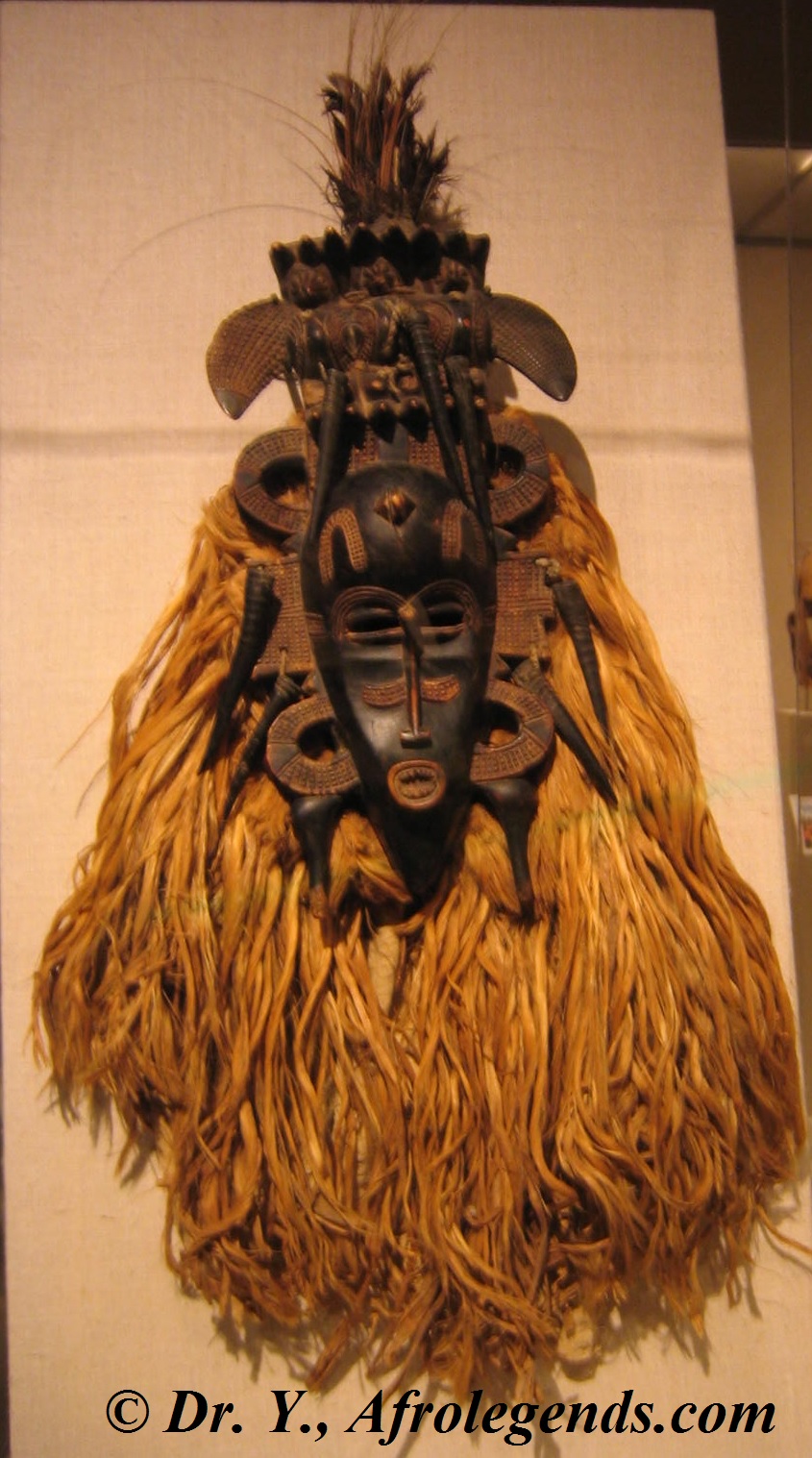
In Africa, there is the concept of fetishism which has been prevalent as a description of African beliefs. Thus, a fetish is an object which holds spiritual power or supernatural significance. Given that African statues hold deep cultural, spiritual, and symbolic significance [Authorship in African Art: The Case of Yoruba Art], the term fetishism has been historically associated to them. Early European anthropologists have linked African religions and statues to fetishism. However, we are learning that this was a technique designed by Europeans to denigrate and dehumanize the African person so as to justify slavery [Dum Diversas or The Vatican’s Authorization of Slavery] early on, and colonialism later on.
Cheikh Anta Diop, the great Senegalese historian, anthropologist, philosopher, physicist, and politician, showed in his book, Nations Nègres et Culture: de l’Antiquite nègre égyptienne aux problèmes culturels de l’Afrique noire d’aujourd’hui, that fetishism in Africa is not an inherent school of thought, but rather arose from the disconnection of modern Africans to their original religions due to violent exposure to centuries of attacks (slavery) from the West. Thus, he said,
Cheikh Anta Diop
“From one end of Black Africa to the other, passing through Egypt, the statues were originally intended to be the support of the immortal “double” of the ancestor after his earthly death. Placed in a sacred place, the statue was the object of offerings and libations: this fact, misinterpreted by Westerners, created the false idea of fetishism. In reality, there is a tendency towards fetishism, that is, idolatry, only where the meaning of the cult has been forgotten through a break in tradition.”
Cheikh Anta Diop, Nations Nègres et Culture, Présence Africaine, Paris p. 339 (1954). Translated to English by Dr. Y, Afrolegends.com.













 African Heritage