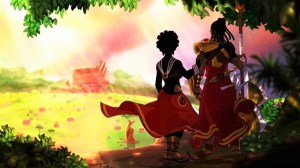
A game scene from ‘AURION: Legacy of Kori-Odan’ (source: kickstarter.com)
Video game players, and in particular African video game players will be excited by the latest, the first Gaming studio to see the light in Central Africa, and particularly in Cameroon. The games produced by this company embody African myths and culture. According to its founder, Olivier Madiba, the content of their games combine African characters and folklore. Kiro’o Games, Central Africa’s first video studio, latest project Aurion: Legacy of the Kori-Odan is an action-RPG (Role Playing Game) with which the studio intends to unify and transmit African culture by combining various myths, tales and traditional values into the gaming experience.
A game scene from AURION: Legacy of Kori-Odan (source: kickstarter.com)
“The history of our continent is rich … we took inspiration from local Cameroonian traditions, like the Ngondo Festival celebrated by the Sawa people, and we also incorporated symbolism adapted from that of the Akan people of Ghana, specifically the Adinkra writing style,” said Olivier. Aurion: Legacy of the Kori-Odan is set in a world of elemental energies and ancestral powers, where players assume the role of a traditional ruler, Enzo Kori-Odan, rightful ruler of the Zama kingdom, who uses the Aurion power granted him by his ancestors to regain control of his kingdom. To learn more, go to VenturesAfrica and TheNewAfrica. Kudos to Olivier Madiba and his team, all the best in their endeavor! Africa needs more of you.
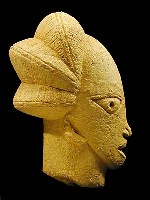
Have you ever looked at sculptures of women from the Nok civilization? Then you have probably noticed that Nok women wore their hair braided similar to the Fulani women of today, in beautiful goddess braids, and amazing styles. Ever looked at images of Queen Nzingha? She wore her hair in Afro, fully out.
Queen Nzingha of Angola
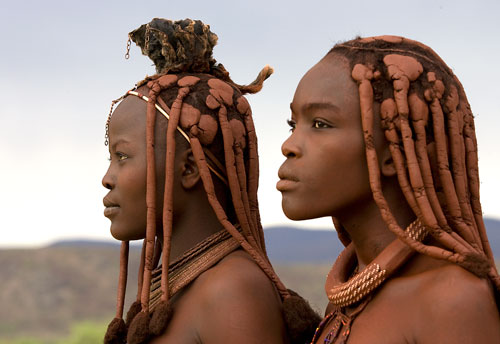
What about the great Amanishakheto of Nubia, well, hieroglyphs at Meroë, show her sporting a gorgeous ‘Fro. And the fierce amazons of King Behanzin wore either braids, or shaved their heads, or sported afros. Today the tradition persists: the Himba women of Namibia and Angola wear dreadlocks decorated with red ochre, while Maasaiwomen shave their heads and Maasai men sport dreadlocks. For their wedding, the Wodaabe women wear amazing braids decorated with cauris, and jewelry. In our culture, there were intricate hairstyles for different occasions: passage of a girl into womanhood, courting, weddings, funerals, etc.
Himba women (absoluteafrica.com)
Isn’t it amazing how our crown jewel, our hair, can be worn in so many different ways? Isn’t it amazing that one could change hairstyle every two-three weeks, or even
Fulani woman (Wodaabe)
every month? After all, nature gifted the African race with a lion’s mane, which can be dressed a thousand ways, why not take advantage of it? Nigerian photographer J.D. Okhai Ojeikerecaptured some of these different hairstyles from women in the 1960-70s. Many African women from the 1960s-70s can be seen wearing tresses; and if you ever dig up pictures of your parents, you will see your mothers wearing those as well. His collections and books are amazing. Enjoy!
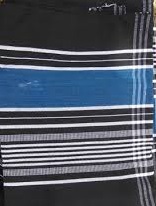
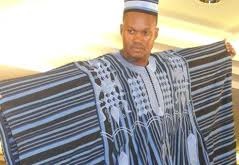
Today we will be talking about the Faso Dan Fani, known as Burkina Faso‘s national cloth. For starters, the Faso Dan Fanimeans “woven cloth of the homeland” (pagne tissé de la patrie). All the words are Dioula: Fani = cloth/wrapper(pagne), Dan = woven(tissé), Faso = homeland (patrie). It is known locally as FDF. As you have probably guessed, the Faso Dan Fani is a handwoven cotton cloth. The weaving style and patterns differ depending on the ethnic group. As you all know, weaving cotton is an ancient African tradition (African textiles): in the old days, the spinning was done by women, while the men were left with weaving the cotton threads into cloth. With time, women took over the weaving business as well.
Thomas Sankara a Ouagadougou
In 1986, the President of the Faso, Thomas Sankara, declared that it was important to “produce and consume Burkinabé“. Thus, he declared “In all the villages of Burkina Faso, we know how to grow cotton. In all villages, women know how to spin cotton, men know how to weave it into cloth, and other men know how to sew those threads into clothes... [Dans tous les villages du Burkina Faso, l’on sait cultiver le coton. Dans tous les villages, des femmes savent filer le coton, des hommes savent tisser ce fil en pagnes et d’autres hommes savent coudre les pagnes en vêtements …]” and further “We should not be slave of what others produce[Nous ne devons pas être esclave de ce que les autres produisent].” For the president, “wearing the Faso Dan Fani is an economic act, cultural, and political to challenge imperialism[porter le Faso Dan Fani est un acte économique, culturel, et politique de défi à l’impérialisme].”
Faso Dan Fani
Thus under Thomas Sankara’s revolution, the traditional attire was imposed in work places. … Many were not pleased with it, to the extent that some had nicknamed the FDF, “Sankara is coming“ [Sankara arrive] since the PF was known to do impromptu visit of his ministries. Under him, the FDF had become the signature of Burkinabé outside the country. Sankara even made a speech at the United Nations where all the members of his delegation and himself were dressed with the Faso Dan Fani entirely made by local Burkinabé artists to be consumed by Burkinabe.
My wish for you today dear friend is to have a colorful day! What do I mean by colorful? The colors on the petals of this flower remind me often of what a good day is, and what a colorful day is: full of joy, of empathy, difference, surprises, full of unexpected good events and simple. Yes… it is the simple things that most make us happy by their simplicity and subtleness. So today, enjoy the subtle things, and let color filter into your life.
Image of a young woman’s face (agnautacouture.com)
These days, many of my fellow African brothers and sisters sport tattoos of some European or foreign symbols on their skins. These symbols are usually alien to our cultures, traditions, thinking, and history. So I thought about talking about scarification, which could be called an “ancient” African culture of tattoos.
For starters, Africa has a rich culture of scarification. Many cite HIV, and ugliness as being the reason why they would not do scarification and why the practice has been abandoned. I neither agree nor disagree with them, but I would like to give a history of scarification and why, this is something to be cherished as part of our history, even if it is no longer practiced and/or needed today.
Sculpture of a Mangbetu person, in Congo (exposed at the MET)
In the past, a woman or man would have scarification marks that will distinguish her/him from anyone else, tell her/his rank in society, family, clan, and tribe, and symbolize her beauty or strength. In some African tribes, it was like wearing your identity card on your face. True, some may hate that, but this was a mark of pride, not shame. In most African cultures, it was a major aesthetic and cultural componentas can be seen on sculptures in museums around the world. Scarification patterns on sculptures are not only marks of beauty, but marks of one’s lineage as well, and in some cases protection against evil spirits. Lastly, in Africa like in Polynesia, scarification is more visible on darker skinned people than say, tattoos.
Diamond and Rectangular patterns on the forehead and temples of a Tikar mask from Cameroon (exposed at the MET)
What is scarification? Scarification is the practice of incising the skin with a sharp instrument such as a knife, glass, stone, or coconut shell, in such a way as to control the shape of the scar tissue on various parts of the body. Cicatrisation is a special form of scarification where a gash is made in the skin with a sharp instrument, and irritation of the skin caused by applying caustic plant juices forms permanent blisters. Dark pigments such as ground charcoal are sometimes rubbed into the wound for emphasis. These cuts, when healed, form raised scars, known as keloids. The most complicated cicatrisation was probably found in the Congo Basin and neighboring regions, and among the Akan people of West Africa.
Pendant Ivory mask representing Queen Idia, Iyoba of Benin City (16th Century)
Scarification is a long and painful process, and a permanent modification of the body, transmitting complex messages about identity and social status. Permanent body markings emphasize social, political, and religious roles.Beautiful and complex designs depend on the artist’s skills but also on a person’s tolerance to pain. Facial scarification in West Africa was used for identification of ethnic groups, families, individuals but also to express beauty; scars were thought to beautify the body. It was also performed on girls to mark stages of life: puberty, marriage, etc. These marks assisted in making women more attractive to men, as the scars were regarded as appealing to touch as well as to look at, but also as testimony that women could withstand the pain of childbirth. Princesses in many places, including West Cameroon, used to sport amazingly beautiful and intricate marks. The sculpted face of Queen Idia of Benin Kingdom sports two marks on her forehead. For the Karo people of Ethiopia, men scar their chests to represent killing enemies from other tribes; women with scarred torsos and chests are considered particularly sensual and attractive.
Intricate patterns on a Dogon mask from Mali (exposed at the MET)
Today, the art of scarification is changing in Africa, and can mostly be spotted on elders. Mostly because of fears of HIV transmission via blades, and also because of the shame encountered. It is a culture which was once loved and is now despised. Ironically, people in western societies go under the knife to perfect their bodies; they prefer to hide their scars (it is also not on their faces)! Moreover, with the advent of identification cards, the need for scarification has also reduced.
I just wanted us to cherish and not frown upon an ancient culture which had its purpose, and was an integral part of our society, history, and traditions. For more on scarification in African cultures, check out Ezakwantu.com and RandAfricanArt which have amazing images of scarification in Africa, and these articles on the Huffington Post, National Geographic, and Lars Krutak‘s article on the Bétamarribé people of Benin.
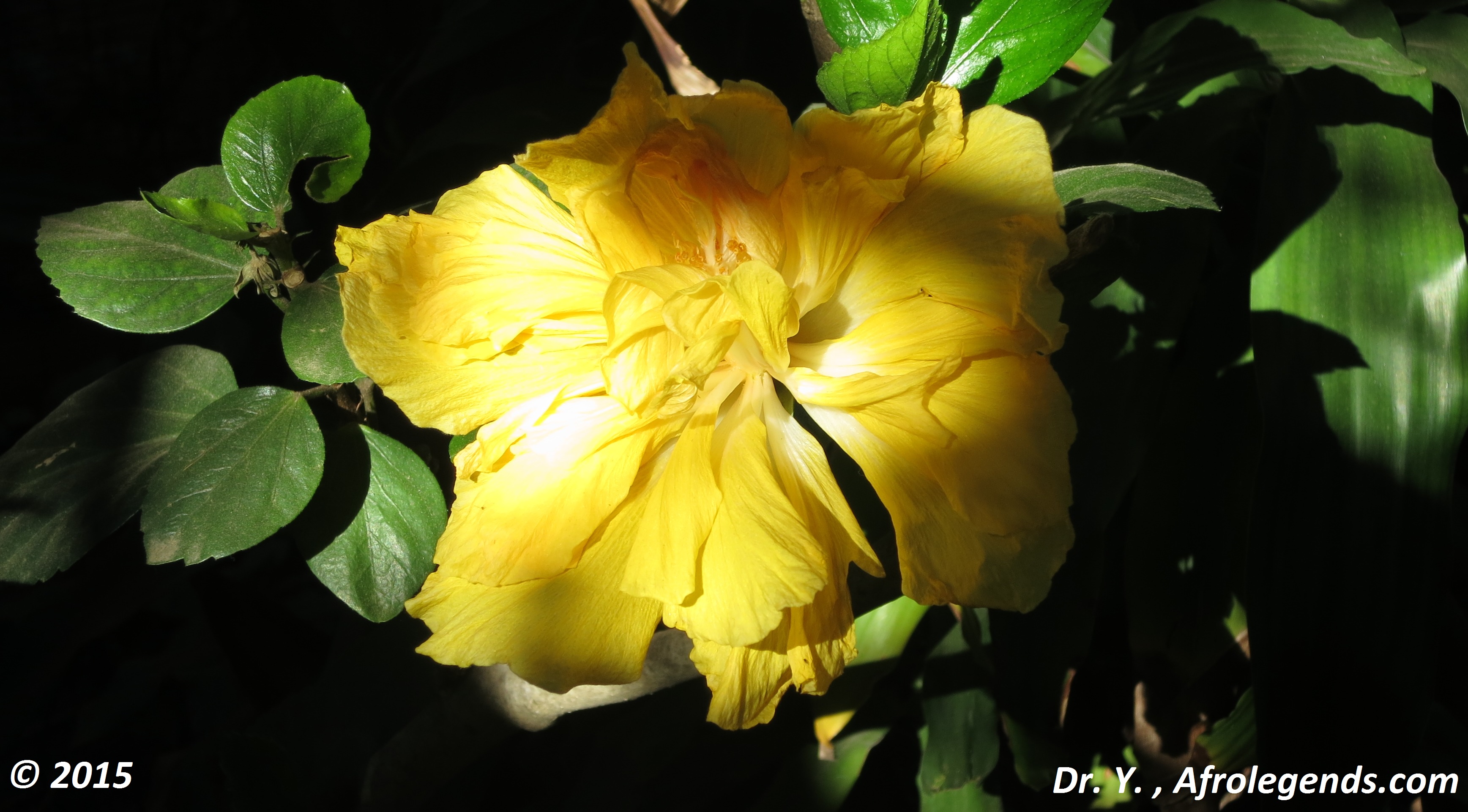
Are there days when you feel quite down? Days when you feel surrounded by darkness? It could be bright daylight, and hot outside, but you feel all alone, and surrounded by obscurity? Well, I saw this yellow hibiscus flower, and the way the sun rays fell on it caught my attention. It was as if the flower was emerging from darkness and into the light. What more, it seemed that the flower had never been touched by the darkness, its beauty was always there, and it just needed a ray of light to be rediscovered. It is the same for you: there is no darkness. Your beauty, intelligence, and being remain intact no matter what your mood might be, and all you need is a ray of light for your grace to be revealed… so let go of the obscurity, the past, the heaviness, and just shine, be revealed. May you emerge from darkness into the light just like this yellow hibiscus flower. Enjoy!
Not too long ago, I took a picture of a white hibiscus flower. It reminded me so much of the concept of purity, and peace. Like the white doves often sent away to symbolize peace, I wanted to send you this white hibiscus as a reminder to have a peaceful day. This made me wonder about the many time the word ‘peace’ is used in languages around the world, like the Arabic greeting As-salamu alaykumwhich means peace be upon you. Or the name of the Tanzanian city Dar es Salaam which means ‘the abode of peace’or ‘the house of peace’. To all of you out there, I send you my dove of peace, in the form of a white hibiscus flower. May your day be peaceful!
I had to share the trailer of the documentary “Capitaine Thomas Sankara” by Christophe Cupelin, which was shown this year at the FESPACO 2015 in Ouagadougou, Burkina Faso. This is the first time a movie about Thomas Sankara, the African Che, could be shown at the FESPACO in 27 years since Compaore‘s coup. Enjoy!
FESPACO2015ended last week, and ran from February 28th until March 7th. The festival’s glamour was not at its usual, since the overthrowing of Blaise Compaoré, but it still took place in Ouagadougou, Burkina Faso, and brought in some great African films and documentaries.
“FIEVRES” by Hicham Ayouch
This year’s festival featured, for the first time, films from the African diaspora. 720 films competed, and 134 were selected in the 5 categories. The winner of this year’s Golden Stallion of Yennenga was “Fievres” by the French-Moroccan filmmaker, Hicham Ayouch. The film tells the story of a 13 year old boy, displaced and prone to violence who learns that he has a father after his mother is sent to jail, and is sent to live with his father in a Parisian suburb. The beauty of “Fievres” is its focus on telling the tale between a father and son who have to learn to be father-son, and also the cultural identity among immigrants, and practicing Muslims in France.
“Fadhma N’Soumer” by Belkacem Hadjadj
The Silver Stallion was awarded to Algerian director Belkacem Hadjadj for his film on “Fadhma N’Soumer“, a stunning biopic on the life of the Algerian resistance leader who fought against the French colonial forces in Kabyle. I was so happy to see this movie made, and winning the second prize, as I had written about Lalla Fadhma N’Soumer a while ago, and wanted her praises to be sung. This is truly Africans telling their own stories, and honoring their greatest heroes and heroines. Applauses to director Belkacem Hadjadj for telling our history.
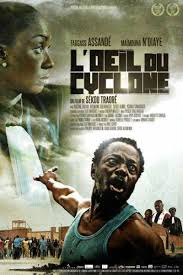
“L’Oeil du Cyclone” (The Eye of the Cyclone) by Sekou Traore
The Bronze Stallion was awarded to Burkinabé director Sekou Traoré “L’Oeil du Cyclone” (The Eye of the Cyclone), which is a political drama set in an unnamed African country plagued by civil war. The film follows an idealistic young lawyer committed to defending a former child soldier charged with war crimes. The movie shows two faces of Africa: the young, idealistic and futuristic, vs. the broken and consumed with the past. The movie also won the festival awards for Best Actress (Maimouna N’Diaye – who is clearly a rising star of African cinema), and Best Actor (Fargass Assandé).
“Capitaine Thomas Sankara” by Christophe Cupelin
The Burkinabé public finally had the chance to see the documentary “Capitaine Thomas Sankara” by Christophe Cupelin, which would have never been allowed at FESPACO under Blaise Compaore’s tenure (Thomas Sankara‘s murderer, best friend, and coup-formenter). It was a time to celebrate the life of Burkina Faso’s greatest hero. To read more about this year’s FESPACO, check out The Guardian, and the FESPACO homepage.
Pendant Ivory mask representing Queen Idia, Iyoba of Benin City (16th Century)
A British man recently decided to return looted art that his grandfather had taken (stolen?) away during the 1897 Benin City Massacre. The article about the art returning is on BBC. I do salute the man for doing it; and I wish the British museums and museums around the world will return art looted by Europeans in African countries and countries around the world. True, the man excuses his grandfather’s acts by saying: “We are taught from a very young age that the killing of enemy combatants under the umbrella of statehood is a regrettable necessity of life.” And excuses the art looting by saying, “To him [his grandfather], it was probably no more than picking up stuff that’s washed up on the beach, because people had fled and nobody owned them any longer.” But he is happy they are now back in Benin City. “These objects are part of the cultural heritage of another people… to the people of Benin City, these objects are priceless.”
I also decided to link back to the story I wrote a while ago about the Benin City Massacre.


















 African Heritage