This is another all-time favorite… The second-most popular post on Afrolegends.com: the history of Adinkra symbols and the Rich Akan culture of the Akan people of Ghana and Côte d’Ivoire. Enjoy!
As we revisit this favorite, please let us know if there are other things you would like to learn on the topic, and we will try to add more.
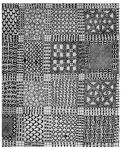
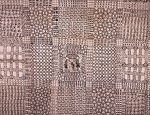
The Adinkra symbols are believed to originate in Gyaman, a former kingdom in modern day Côte d’Ivoire. According to an Ashanti (Asante) legend, Adinkra was the name of a king of the Gyaman kingdom, Nana Kofi Adinkra. King Adinkra was defeated and captured in a battle. According to the legend, Nana Adinkra wore patterned cloth, which was interpreted as a way of expressing his sorrow on being taken to Kumasi, the capital of Asante. He was finally killed and his territory was annexed to the kingdom of Asante. The Asante people, around the 19th century, took to painting of traditional symbols of the Gyamans onto cloth, a tradition which has remained to this day.
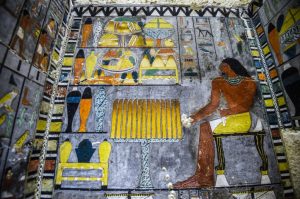
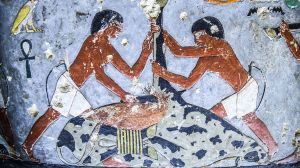
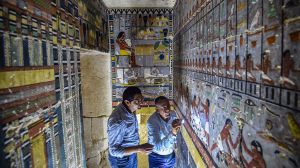
This picture taken on April 13, 2019 shows a view inside the newly-dicovered tomb of the ancient Egyptian nobleman “Khewi” dating back to the 5th dynasty (24942345 BC), at the Saqqara necropolis, about 35 kilometres south of the capital Cairo. (Photo credit should read MOHAMED EL-SHAHED/AFP/Getty Images)
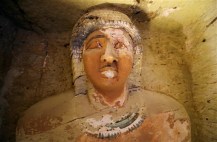
As I read the article about the discovery of this 4,300 years-old Egyptian tomb bursting with colors, I was stunned to see that NO article stated the obvious conclusion: Ancient Egyptians were Black! NO articles stated it: they wonder who the nobleman, Khewi, in whose tomb this was found is, what his link to the Pharaoh is, … they ask a thousand other questions, instead of addressing the reality! This reinstate what we already knew and what the great Cheikh Anta Diop always said, that Ancient Egyptians were black and that their descendants are today’s Subsaharan Africans! One of the statues found inside the tomb beautifully shows its very broad nose, clear symbol of its Black-ness/African-ness, and of course its skin color. Enjoy! Below are excerpts; for the full article, please go to Fox News.
=====
A view inside the newly discovered tomb of the ancient Egyptian nobleman “Khewi” dating back to the 5th dynasty at the Saqqara necropolis, about 35 kilometers south of Cairo. (Photo by Mohamed el-Shahed / AFP)
Egyptianofficials announced astunning discoveryover the weekend: a 4,000-year-old tomb of a dignitary bedazzled in colorful paintings and inscriptions.
Egypt’s Ministry of Antiquitiesunveiled Saturdaythe ancient resting place of the senior official named “Khuwy, [Khewi in other sources]” noting that he served during the reign of King Djedkare, a pharaoh who ruled Egypt during the Fifth Dynasty — from the late 25th century to early 24th century BC. The next day, the Egyptian government released footage that showcased what it called “exceptionally painted” limestone walls.
“The remarkable well-preserved colours on the inscriptions are considered royal colours,” the ministry said in an originalvideo posted online.
Mohamed Mujahid, head of the Egyptian mission that discovered the tomb of the ancient Egyptian nobleman “Khewi,” inspects the tomb’s walls inside the Saqqara necropolis on April 13. (Photo by Mohamed el-Shahed / AFP)
[…] “The L-shaped Khuwy tomb starts with a small corridor heading downwards into an antechamber and from there a larger chamber with painted reliefs depicting the tomb owner seated at an offerings table,” Mohamed Megahed, who led a team of archaeologists in digging up the tomb,told the Egyptian newspaper.
Every inch of the tomb is covered in markings, which archaeologists are carefully studying. So far, the inscriptions have raised questions about Khuwy’s impact on the ancient community as well as his specific relationship with the pharaoh — whose elaborate tomb sits just “a stone’s throw away,” per the ministry.
[…] Mostafa Waziri, secretary general of the Supreme Council of Antiquities, called the burial “one of a kind in the last decades.”
Statue inside the tomb. (Photo by Mohamed el-Shahed / AFP)
“The color is almost intact even though the tomb is almost4,400 years old,” Waziri said in a statement at the time.
“Les lignes de nos mains sont des lignes de Vie, de Destin, de Coeur, d’Amour. De douces chaînes qui nous lient les uns aux autres, Les vivants aux morts.”
“The lines of our hands Are life lines Destiny lines, Heart lines, Love lines. Soft chains Which bind us One to the other, The living to the dead.”
Bernard Dadié in ‘Les lignes de nos mains’ published in La Ronde des Jours, Edition Pierre Seghers, 1956. The English translation is by Dr. Y., Afrolegends.com. [Note: punctuation was added to write in one line the first sentence].
It is with great sadness that I learned of the passing of the great Ivorian writer Bernard Binlin Dadié. Bernard Dadié was a Baobab of African literature, and he was 103 years of age at the time of his passing. On his 100th-year birthday, he had complained of not being able to write as much anymore, given that he still had so much to say! Dadié was a literary virtuoso who brilliantly explored many genres from poetry, to fiction, to theater.
Many have wondered what was the secret of his longevity, and “his children always thought that Dadié was able to surmount all those obstacles and live so long because he was deeply in love with his wife,” said Serge Bilé [« Ses enfants ont toujours pensé qu’il a pu traverser toutes ces épreuves et vivre si longtemps car il était amoureux de sa femme » Jeune Afrique] writer, journalist, and whose mother was a cousin of Assamala Dadié (Dadié’s wife).
Dadié was born in Assinie, Côte d’Ivoire, and attended the local Catholic school in Grand Bassam and then the Ecole William Ponty. He worked for the French government in Dakar, Senegal. Upon returning to his homeland in 1947, he became part of its movement for independence: he denounced colonialism and neo-colonialism. Before Côte d’Ivoire‘s independence in 1960, he was detained for sixteen months for taking part in demonstrations that opposed the French colonial government.
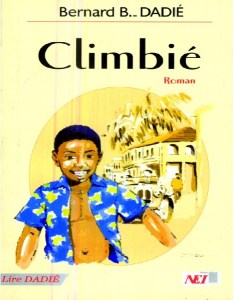
Climbié by Bernard Dadié
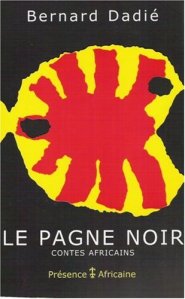
Climbié, his most well-known novel was published in 1956, and was the first Ivorian fiction. With his theater piece The cities (Les Villes), played in Abidjan in April1934, Dadié gave Francophone Africa its first drama piece. I am sure there were others played in the olden ancestral days, but this was the first one written in Molière’s language. He was also the first to win the great literary price of Black Africa (le grand prix littéraire de l’Afrique noire) twice in 1965 with Boss of New York (Patron de New York, Présence Africaine, 1964), and The City where No One Dies (La Ville où nul ne meurt, Présence Africaine, 1969) in 1968. His other big novels are: Le Pagne noir – Contes africains (1955), Un Nègre à Paris (Présence Africaine, 1959), Les voix dans le vent (1970), Monsieur Thôgô-Gnini (1970) ou les poèmes du recueil La rondes des jours(1956). In recent years, his poem “Dry Your Tears Afrika” (“Seche Tes Pleurs” de Bernard Binlin Dadié / “Dry your Tears Afrika” by Bernard B. Dadié) was set to music by American composer John Williams for the Steven Spielberg movie Amistad. Lastly, a street bears his name in Abidjan.
Le Pagne Noir – Contes Africains by Bernard Dadié
Among many other senior positions, starting in 1957, he held the post of Minister of Culture in the government of Côte d’Ivoire from 1977 to 1986. As a twist on fate, next week will come out in Côte d’Ivoire, a book titled 100 writers pay tribute to Dadié (100 écrivains rendent hommageà Dadié) in the Éburnie éditions. Bernard Dadié is the symbol of Côte d’Ivoire‘s deep and rich culture, marking a literary resistance to colonialism and neo-colonialism, and a strong love for his people, continent, and race.
A crown from the Maqdala exhibition at the V&A in south-west London – looted in 1868. (Source: V&A Museum)
A British museum [National Army Museum] is to return a lock of hair that the Ethiopian government considers a national treasure.
It was cut from the head of Emperor Tewodros II, who killed himself rather than be taken prisoner by the British during their 1868 invasion of Ethiopia. …
Strands of Emperor Tewodros II’s hair were given to the National Army Museum in London 60 years ago. …
The museum told the BBC it had decided not to make photographs of the hair public out of respect, because the matter was “too sensitive”. The remains are described as two pieces “no bigger than the size of a two-pence coin”.
Departure of the British expeditionary forces from Maqdala with the loot – Illustrated London News 1868
The National Army Museum has now agreed to return the artefact, but says it is not returning any other items of African origin.
“It’s definitely not a precedent,” a spokesperson for the museum told the BBC.
“That’s the only one that’s been requested. They have to be formal, written requests to the director with a case“. …
The move has reignited demands for the UK to return all the looted artefacts on display in British museums. …
FESPACO 2019 (featuring Maimouna N’Diaye – 2015 winner of Best Actress in a leading role)
2019 marks the 50th year anniversary of the FESPACO. As a reminder, the FESPACO (Festival Panafricain du cinema et de la television de Ouagadougou) is the Panafrican Film and Television Festival of Ouagadougou, and is the largest African film festival, held biennally in Ouagadougou, the capital of Burkina Faso. First established in 1969, and boasting some of Africa’s greatest writers and filmmakers (like Ousmane Sembene), the FESPACO offers a chance for African filmmakers and professionals to showcase their work, exchange ideas, and meet other filmmakers, and sponsors. Filmmakers from around the continent come together in Ouagadougou which is transformed into the Hollywood or the Cannes of the continent for this 8-day celebration. This year’s FESPACO ran from February 23 to March 2nd.
The Golden Stallion of Yennenga
To mark the 50th-year edition, a particular focus was set on reflecting on the collective memory and future of the pan-African cinema. Films from 16 African countries were vying for the Golden Stallion of Yennenga, a prize named after the story of a 12th century beautiful princess who is considered the mother of the Mossi people, Princess Yennenga.
The Golden Stallion of Yennenga 2019 was awarded to the movie “The Mercy of the Jungle” directed by Joel Karekezi of Rwanda. “The Mercy of the Jungle” shows the arduous road trip taken by foot of two soldiers lost in the jungle during the time of the Democratic Republic of Congo wars. It beat out 19 other candidates to get the Golden Stallion of Yennenga. Marc Zinga, a Belgian, also took best actor for his role in “The Mercy of the Jungle.”
Joel Karekezi, winner of the 2019 Golden Stallion of Yennenga (Fraternite Matin)
Second prize went to “Karma”, a drama by Egyptian director Khaled Youssef, while third place was awarded to Tunisian Ben Hohmound, who directed “Fatwa”, another drama.
This year also, women have complained about the fact that in 50 years, not a single woman has won the top prize at FESPACO. This highlights a problem of gender equality for film directors. South African actress Xolile Tshabalala, who featured in “Miraculous Weapons”, directed by Jean-Pierre Bekolo, a Cameroonian asked, “can it be that in 50 years, there hasn’t been a single woman capable of telling a great story to win the Fespaco?” Burkinabe director Apolline Traore said that any award had to be earned, not considered a token gesture, but admitted that there is a problem in gender equality for directors. “There’s no equality for the craft of a woman director, not just in Africa, but in the world,” she said. Traore won a special prize on Friday for her film, “Desrances”.
At last, Germany is returning artifacts back to Namibia which it had stolen some 126 years ago from a Namibian freedom fighter, Hendrik Witbooi. This is a good step forward, as they also returned the human remains of people they had killed via committing a genocide, last August. As a flashback, the First Genocide of the 20th Century was committed by Germany on the Nama and Herero people of Namibia. During that time, it is estimated that Germany wiped out at least 75% of the Herero and 50% of the Nama population (the Namibian genocide or the Herero and Namaqua genocide). The skulls and bones of the people they decimated had been sent to Germany to study the racial superiority of Europeans. To that effect, tens of thousands of Nama and Herero people were murdered. There are thought to be hundreds of Namibian skulls in Germany and last August about 25 remains were handed back. Their descendants are still waiting today for an apology from the German government, as well as reparations. Skulls from Germany’s other African colonies, including modern day Cameroon, Tanzania, Rwanda and Togo, were also used in these now discredited studies.
A bible and a whip from the estate of Hendrik Witbooi. (Getty images)
The German city of Stuttgart will return artifacts looted from the country’s colony in what is now Namibia on March 1 during a ceremony with Namibian president Hage Geingob.
German state minister for science Theresia Bauer will travel to Namibia to hand over a whip and bible from the collection of Stuttgart’s Linden Museum that once belonged to Namibian national hero Hendrik Witbooi, a leader in the fight for independence against the German colonizers during the Nama-Herero uprising.
“The restitution of these objects is for us the beginning of a reappraisal of German-Namibian colonial history,” Bauer said in a statement published on the Linden Museum website.
The ceremony is taking place in Witbooi’s hometown of Gibeon, where a museum is being built and will eventually house the items. In the meantime they will be safeguarded by the state.
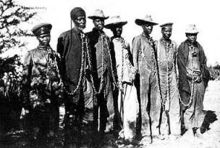
Chained Herero men
German soldiers stole the artifacts during an attack on Witbooi’s stronghold of Hornkranz in 1893. Colonial troops in former German southwestern Africa launched a brutal crackdown on Witbooi’s people after the leader refused to sign a protection treaty to cede territory to the colonizers. In response, German troops ransacked the village, took livestock, burnt huts, and looted possessions.
Both the whip and bible were donated to the Linden Museum in 1902, according to the German art magazine Monopol.
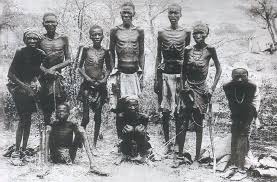
The German imperial empire colonized parts of Namibia from 1884 to 1915. Germany officially [recognized] the Nama-Herero genocide in 2004, in which an estimated 65,000 members of the Nama and Herero tribes were murdered in response to the uprising.
Survivors of the Herero genocide
In November 2018, the Minister President of Baden-Württemberg said that the German state “is aware of its historical responsibility and is ready to take action. Sending an important message and signaling an important step in the process of reconciliation.”
Today Witbooi is revered as a national hero in Namibia and one of the most important chiefs of the Nama tribes. He is honored by numerous monuments across the country and his portrait is printed on numerous paper bills.
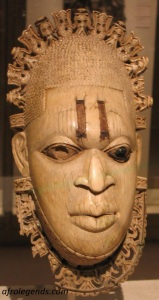
Pendant Ivory mask representing Queen Idia, Iyoba of Benin City (16th Century) – exposed at the MET
France, like so many European countries, is being urged to return looted art to Africa. Below is the article. For the full article, go to the Guardian.
=====
A report commissioned by Emmanuel Macron will call for thousands of African artworks in French museums taken without consent during the colonial period to be returned to the continent.
Unless it could be proven that objects were obtained legitimately, they should be returned to Africa permanently, not on long-term loan, said the authors of the report, the Senegalese writer and economist Felwine Sarr and the French historian Bénédicte Savoy.
They have recommended changing French law to allow the restitution of cultural works to Africa, after Macron announced that he wanted it to begin within five years.
… “I cannot accept that a large part of the cultural heritage of several African countries is in France,” the French president said last year in Ouagadougou, the capital of Burkina Faso. “There are historical explanations for this but there is no valid, lasting and unconditional justification. African heritage cannot be only in private collections and European museums – it must be showcased in Paris but also in Dakar, Lagos and Cotonou. This will be one of my priorities.” [Politicians always make promises, but never deliver. Let’s wait and see if Macron can do anything. In 2015, Francois Hollande, then French President Acknowledged French Genocide in Cameroonwhile in visit in Cameroon, without ever apologizing!]
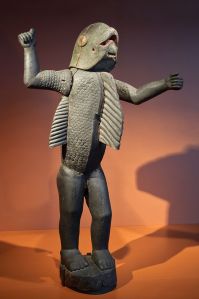
Fon statue symbolizing King Behanzin, the Man-Shark by Sossa Dede (c. 1890) – currently exposed at the Musee du quai Branly in Paris
The extent to which France, Britain and Germany looted Africa of its artefacts during colonialism is not known, but according to the report, which will be released this Friday, about 90% of Africa’s cultural heritage currently lies outside the continent.
… The report’s authors travelled to Mali, Senegal, Cameroon and Benin and looked through the works held by the Musée du quai Branly, a museum focused on non-European cultures in Paris, and found that about 46,000 of its 90,000 African works were “acquired” between 1885 and 1960 and may have to be returned.
Cast Bronze figurine from Benin City at the MET museum
Unbelievable! I had to share this article about European museums loaning looted African artifacts back to Africans. It sounds so mind-boggling! How can someone steal from you, steal your cultural work, the work of your ancestors, your sweat, and then several years later loan it back to you, not even return it? and they call that progress! For the entire article, go to Europe’s Largest Museums Will Loan Looted Benin Bronzes to Nigeria and What do you know about Africa’s looted art treasures.
=======
Major museums across Europe have agreed to loan important artifacts back to Nigeria for a new museum the country plans to open in2021. The African nation’s Royal Museum will house a rotating display of artifacts, including the Benin bronzes that were looted during the Benin Expedition of1897. The agreement marks a significant step after years of negotiations among European institutions and Nigerian authorities.
Benin City art exposed at the MET Museum, NYC
… Together, museum leaders from Austria, Germany, the Netherlands, Sweden, and Britain agreed to facilitate a display at the planned institution within three years. Further specifics—including which objects will be loaned over what period of time—have yet to be confirmed.
… The objects in question were looted by the British army during a so-called “punitive expedition” in1897. The army took around4,000intricate sculptures, including bronze works now known as the Benin bronzes, from the king’s palace in the former Kingdom of Benin.
One of Seychelles’ most acclaimed and prolific author is the writer Antoine Abel, who had been an ambassador of the indigenous culture of the island nation. He is considered by many as the father of Seychelles’ literature, and had an extensive career writing novels, short stories, poetry and plays in French, English, and Creole. Most of his work dealt with the folklore of the Seychelles, and the natural environment of the islands, in which he wove in colorful personalities and histories inspired from the local culture. Descending from a family of slaves, he is the first Seychellois writer to expose to wide world to the literary gems of the country.
Below is one of his poems, ‘Dances d’hier‘ translated to English by Dr. Y., Afrolegends.com. Enjoy the poem below, and also check out The Seychelles Ministry for Youth Sports and Culture which ‘remembers Antoine Abel.’
Danses d’hier
J’entends encore les staccatos Le prolongement des sons des tam-tams Des tam-tams du temps jadis
Alors les collines s’enflamment Dans la nuit sèche Les pieds des danseurs Se baignent dans la fine poussière De latérite Et leurs pas scandent sauvagement Un rythme endiablé
J’entends encore les notes rapides La voix étouffée du « commandeur » Se modulant dans l’air tiède du soir.
Alors les échines s’arc-boutent Les unes aux autres Et les hanches roulent comme des houles Les ventres des danseuses voluptueuses Ondulent lascivement… Et des voix confuses s’interpellent Impudemment.
Je perçois toujours les staccatos Les grondements des “grosses caisses” Par delà les années de mon enfance … Je les porte en moi Comme des stigmates.
Dances of Yesterday
I still hear the staccatos The extension of the sounds of the drums The drums from the old days
Then the hills ignite (flare) In the dry night The dancers’ feet bathe in the fine dust of laterite And their steps wildly chant A frenzied rhythm
I still hear the quick notes The muffled voice of the « commander » Modulating in the warm evening air.
Then the backs bridge One with the other And the hips roll like swells The bellies of the voluptuous dancers Wave sensually… And confused voices call out Impudently.
I still perceive the staccatos The rumblings of the “big drums” Beyond the years of my childhood… I carry them in me Like stigmas.


 Adinkra in 1817
  Adinkra work, 1825











 African Heritage