Pendant Ivory mask representing Queen Idia, Iyoba of Benin City (16th Century), exposed at the MET
Just like Cheikh Anta Diop, Leo Frobenius, the German ethnologist and archaeologist who visited Africa in the 1900s saw fetishism as a creation of Europe, made to dehumanize Africans to justify and normalize slavery of the Black man [Dum Diversas or The Vatican’s Authorization of Slavery]. In all his travels throughout Africa, he had never seen natives worship fetishes!
“The new country of America needed slaves and Africa offered them: hundreds, thousands, full shiploads of slaves. “However, the slave trade was never a matter of peace; it required its justification ; so the Negro was made into a half-animal, a commodity. And this is how the notion of the fetish was invented (Portuguese : feticeiro) as a symbol of an African religion. European trademark. As for me, I have not seen in any part of black Africa the natives worship fetishes.
The idea of the “barbarian Negro” is a European invention which, as a consequence, dominated Europe until the beginning of this century.”
Leo Frobenius, La Civilisation africaine, Le Rocher, Paris, “Civilisation et Traditions”, Jean-Paul Bertrand Editeur, p. 16-17 (1984). Translated to English by Dr. Y, Afrolegends.com.
In Africa, there is the concept of fetishism which has been prevalent as a description of African beliefs. Thus, a fetish is an object which holds spiritual power or supernatural significance. Given that African statues hold deep cultural, spiritual, and symbolic significance [Authorship in African Art: The Case of Yoruba Art], the term fetishism has been historically associated to them. Early European anthropologists have linked African religions and statues to fetishism. However, we are learning that this was a technique designed by Europeans to denigrate and dehumanize the African person so as to justify slavery [Dum Diversas or The Vatican’s Authorization of Slavery] early on, and colonialism later on.
Cheikh Anta Diop, the great Senegalese historian, anthropologist, philosopher, physicist, and politician, showed in his book, Nations Nègres et Culture: de l’Antiquite nègre égyptienne aux problèmes culturels de l’Afrique noire d’aujourd’hui, that fetishism in Africa is not an inherent school of thought, but rather arose from the disconnection of modern Africans to their original religions due to violent exposure to centuries of attacks (slavery) from the West. Thus, he said,
Cheikh Anta Diop
“From one end of Black Africa to the other, passing through Egypt, the statues were originally intended to be the support of the immortal “double” of the ancestor after his earthly death. Placed in a sacred place, the statue was the object of offerings and libations: this fact, misinterpreted by Westerners, created the false idea of fetishism. In reality, there is a tendency towards fetishism, that is, idolatry, only where the meaning of the cult has been forgotten through a break in tradition.”
Cheikh Anta Diop, Nations Nègres et Culture, Présence Africaine, Paris p. 339 (1954). Translated to English by Dr. Y, Afrolegends.com.
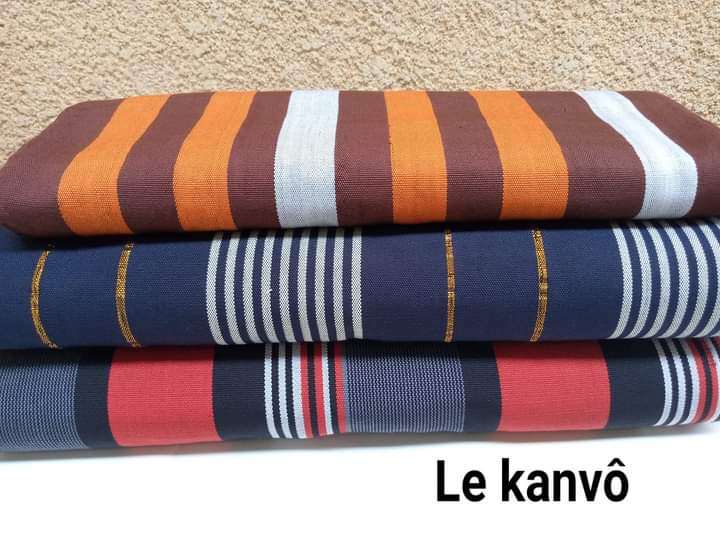
Today, we will talk about another African textile, the Kanvô of Benin. The Kanvô, which means “woven cloth” in the Fon language of modern-day Benin, is a prestigious cloth once worn only by kings from the Dahomey Kingdom, including the great King Behanzin. It is said to have been introduced to Benin by King Agonglo, one of the kings of the Dahomey who reigned at the end of the 18th century. Legend has it that, during one of his conquests in Yoruba lands in modern-day Nigeria, King Agonglo came across a young weaver whose work impressed him; he was so astounded that he asked the young man to follow him to his kingdom to become his personal tailor, and thus was born the Kanvô. Later, King Ghezo popularized it by giving rise to large families of weavers throughout the kingdom. The Kanvô used to be worn by kings on great occasions, and is woven from threads of cotton, linen, or hemp fabric. The origin story of the Kanvo is also different whether you are in the south or the north of the country; as we saw in the south, the cloth was introduced by King Agonglo, while in the north, legend has it that the Gurma people of Burkina Faso brought it into the country, that is why there is some resemblance to the Faso Dan Fani of Burkina Faso.
In its original form, the Kanvô is very heavy and not so easy to work with as a tailor. Thus, today, a new generation of tailors has worked to make the woven cloth more malleable and lighter for general consumption, mixing it with other fabrics such as silk, cotton, etc to appeal to the modern palate.
Check out UniversCulturelEtArtistique who wrote a really good article on the Kanvô, or RFI which interviewed some young generations of Beninese fashion designers who are modernizing the Kanvô.
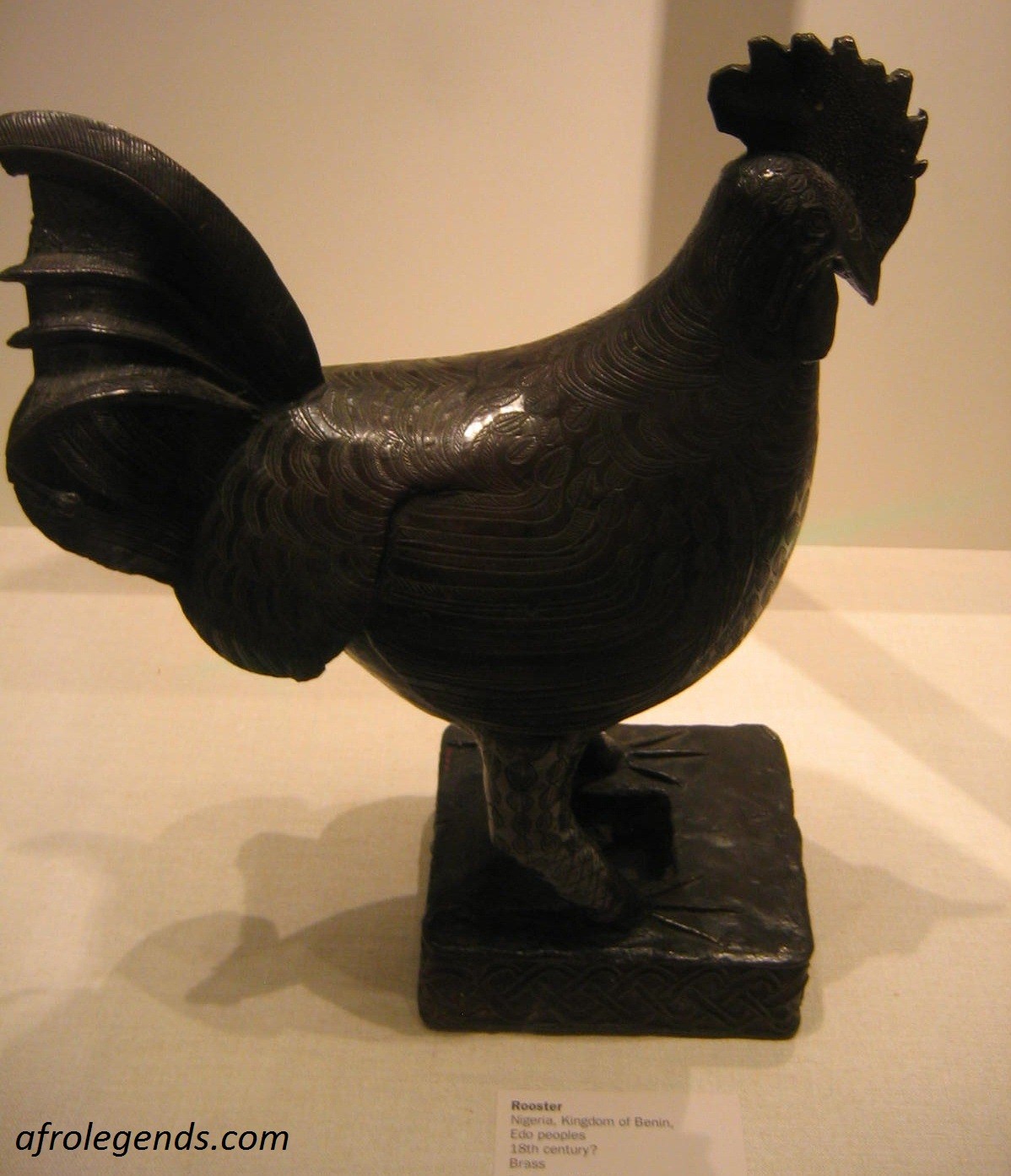
Rooster from Benin Kingdom (18th century), exposed at the MET
A thief comes to your house, steals from you, and then years later when you try to recover what is yours, he gives you conditions for the return of what he looted from your house. Does it not sound unbelievable? This is what is currently going on with the restitution of African artifacts: everyday new conditions are given for the return of African art. Conditions such as “the works be well kept and exhibited after their return,” make no sense given that these objects in African cultures were mostly not used for art-sake but rather held functional values. It is sad, but hey, if you have no power, it is hard for others to return what they have stolen from you. Just because one artifact is returned here and there, it does not account for all of them. As stated countless times before, united we stand, divided we fall. As African nations ask for the return of what is rightfully theirs, each country should not go on its own to ask for the return of its national treasures, we should all be united. A couple of years back, Madagascar paid for the return of the belongings of Queen Ranavalona III. Similarly, this past April, Algeria recently got the return of a 17th-century manuscript written by the venerated leader of Algerian fight against colonialism Abd el Kader, which had been confiscated by French authorities in 1842; Algerian diaspora mobilized to combine money and resources to recover this Islamic manuscript. Being united will also help in countering conditions like “the object must not be claimed by another nation and the request cannot be accompanied by a request for monetary reparations,” especially since the current boundaries of African countries were formed after independence, thus there are bound to be common artifacts between countries.
France is finally releasing its long-awaited policy on the charged issue of the restitution of cultural property… The report was commissioned by President Emmanuel Macron [to ex-Director of the Louvre Museum Jean-Luc Martinez, who has since then been charged with complicity in fraud and concealing the artworks’ origins] and the government has already implemented some of its recommendations, most notably a bill on art looted by the Nazis, which will be discussed by the Senate on 23 May.
And a further two laws will be passed in coming months, … One could apply to items from the former colonies of Western empires, which the report defines in global terms, rather than just Africa and its former French dominions. The other pertains to human remains.
… Martinez tells the Art Newspaper that his report recommends studying the requests for restitutions by eight African countries to establish a “criteria of returnability”. Rather than basing this on an ideological or moral standpoint, he says he wishes to take a “pragmatic approach in order to define a framework policy of restitutions“.
He has come up with two main criteria as the basis for restitutions: “illegality and illegitimacy“. For example, according to French law at the time of France’s colonial invasion of Algeria in the early 19th century, weapons can be legally seized from an enemy but cultural goods had to be returned after battle. So the books and clothes of the rebel leader Abdelkader ibn Muhieddine (commonly known as Abdelkader) should have been given back to him when he surrendered, making their status in France “illegitimate“.
Likewise, if an officer handed looted goods to a French museum, as was the case for many objects looted from the Kingdom of Benin, the donation should be considered “illegal because such personal war booty is not allowed.” A key recommendation of the report is that requests for restitution be studied by a bilateral scientific commission which will publicly provide an opinion before the final decision of French courts [more bureaucracy].
… This report comes nearly six years after Macron publicly called for the “return of African heritage” during a state visit to Burkina Faso. And it has been four-and-a-half years since the academics Bénédicte Savoy and Felwine Sarr made the case for systematic restitutions to African countries. Since then, the issue has been somewhat downplayed, but it remains a sensitive subject.
Chert pebble with ochre residue from Sai Island, Sudan. (Source: Illustration by Van Peer, et al. (2004))
Saï Island, in Sudan, is located in the Nubian region of the Nile River, and is the very earliest site with evidence of ochre use by modern humans. It is the largest island on the Nile River, and was occupied intermittently by people throughout the Paleolithic. The island is rich in history, and today we will focus on the color impact of Saï island in the history of the world.
Found on the island, there are several archaeological layers dating from about 180,000 to 200,000 years ago. Excavation there has yielded large quantities of red and yellow ochre. While red is almost always the dominant color at early human sites, the inhabitants of Saï Island seem to have preferred yellow pigment. The significant use of yellow ochre there indicates strong cultural choices and the use of new manipulation techniques to change colors, call it chemistry, which could have been heating or something else. Thus, Saï Island is known for being the site of the earliest ochre-processing kit in the world; on the site were found sandstone mortars, a rectangular sandstone slab with a depression carefully hollowed out in its center. The slab appears to have been a grinding stone, with evidence of ochre powder within the depression. Two small pieces of chert stone with fragments of ochre still attached were found nearby. The pieces of chert were used to crush the ochre into a fine powder on the slab, like an early mortar and pestle. These were dated to about ca 180,000 years ago. This makes Saï island an important site to understand the initial emergence of modern human behavior in the world, and thus the start of colors, and new techniques of manipulations of ochre.
To learn more, check out Van Peer et al. J. of Human Evolution 45, 187 (2003) and Fulcher et al., J. of Archaeological Sci. Rep. 33, 102550 (2020).
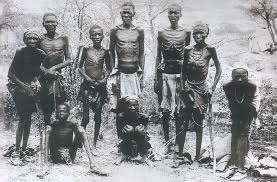
We have discussed the first genocide of the 20th century, committed by Germany in … Namibia, on African soil. We are not talking about World War II, but instead the real first genocide of the 20th century which almost wiped out all the Herero and Nama people of Namibia, Germany in Namibia: the First Genocide of the 20th Century. It was a campaign of racial extermination and collective punishment that the German Empire undertook in German South-West Africa (modern-day Namibia) against the Herero and Nama people, which took place between 1904 and 1907 during the Herero Wars. Today it is known as the Namibian genocide or the Herero and Namaqua genocide. It was cruel, gruesome, and yet today, many Germans don’t even know that their country had a colonial past! Hello? Germany had 4 colonies in Africa, Togoland (Togo), Kamerun (Cameroon), German East Africa (Tanzania), and German South-West Africa (Namibia), and in most of them great atrocities were committed, yet, it is as if the history annals of the world have refused to acknowledge the humanity of the countless Africans who died. Recently, a German movie producer made a movie to reintroduce the German society to its colonial heritage. Recently, Germany agreed to pay Namibia €1.1bn over historical Herero-Nama genocide, while recognizing the actions as genocide, yet falling short of calling it reparations. Excerpts below are from the Guardian. You will also hear of the painful requests of many families for the return of their ancestors’ skulls (why on earth are these museums still holding onto people’s skulls?) Germany Returns Skulls of Namibians Genocide Victims, Germany Returns Artifacts Stolen From a Namibian Freedom Fighter.
=====
Survivors of the Herero genocide (Wikimedia)
It was one of the darkest eras in German history, and the first genocide of the 20th century: the mass killing of tens of thousands of people in German South West Africa after a rebellion against colonial rule by the Herero and Nama tribes.
More than 100 years later, a feature film about the violence perpetrated by Germany in what is now Namibia explores that brutal colonial past for the first time. Its director hopes Measures of Men will bring the calamitous episode to the attention of ordinary Germans.
“Germany has denied its colonial past for 120 years,” Lars Kraume said, in advance of the film’s domestic release on Thursday. “Most people are unaware Germany even had a colonial past, let alone anything about the brutality of it – it is not even taught in schools.” [Aren’t Africans humans too? are their deaths meaningless?]
… Measures of Men, filmed mainly on location in Namibia using local crew and expertise, tells the story of Alexander Hoffmann – played by Leonard Scheicher – a young, idealistic but wide-eyed ethnologist who questions the evolutionist racial theories of the time, according to which sizes and shapes of skulls determined intelligence. His attempts to rebut the pseudoscientific legitimisation of the superiority of white people over people from the colony of south-west Africa leads him to take first an intellectual and then a romantic interest in Kezia Kambazemi, the interpreter of a delegation of Nama and Herero people who are shipped to Berlin to participate in the Kaiser’s “Völkerschau”, or human zoo exposition.
Despite studying history for his final exams in Germany, Kraume became aware of Germany’s colonial past only when he visited Namibia in the early 1990s, immediately after its independence from South Africa. …
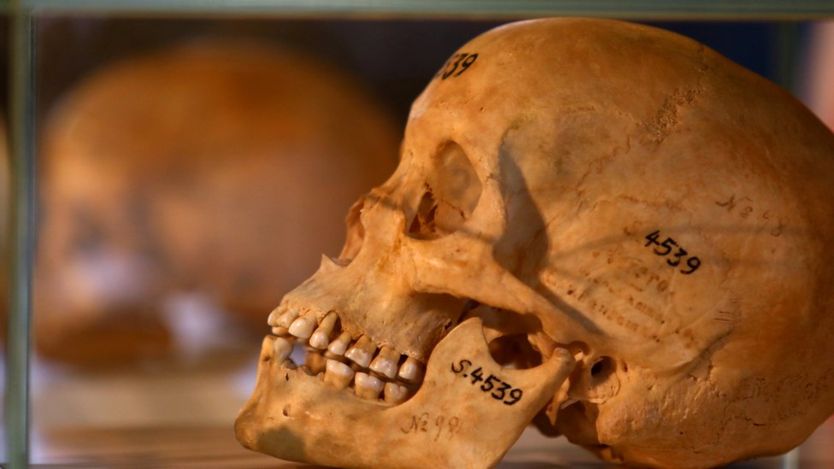
Namibian skulls (Reuters)
Kraume was particularly shocked by the existence of thousands of skulls of people murdered by Germans, which were gathered and shipped to Germany in large quantities and still exist in museums across the country.
“I cannot comprehend the fact that we have these skulls, like artefacts, stored in ethnological museums,” he said. “I cannotunderstand why they are still being kept and have not been given back.
“You ask yourself: ‘Why were the skulls collected in the first place, and why have we not seen fit to give themback?’”
… The film’s relevance to the present day, Kraume said, is also in its depiction of how those in power choose to ignore scientific facts and truth for political gain and in order to maintain the status quo. …
When I was growing up, I was fascinated by images on the television, of women on their motorcycles cruising through the streets of Ouagadougou, the capital of Burkina Faso. Seeing women on motorcycles was always a wonder. It was so refreshing, and seemed like such a simple act, yet a mark of independence. These are not women riding Harleys or fast bikes, but simple women wearing wrappers or boubou (The Boubou: A Traditional African Garment) or Faso dan Fani, everyday women taking their children to school, going to work, etc. Even more amazing is that many of these women are Muslim. It is no secret that women in Ouagadougou love their motorcycles. This means of transportation which particularly boomed in the late 1980s is synonymous with independence, freedom, courage, and near infinite possibilities for the women. After all, for anybody who has ridden on a motorcycle, it feels so freeing to have the wind bashing all over oneself while zipping through the city. Today, the country has trained hundreds of women mechanics.
FESPACO 2023
When Thomas Sankara, the president of the Faso, came in power in 1983, he led a series of changes that emancipated women, bringing them closer to equal rights in the society. It is no wonder that Nigerian filmmaker Kagho Idhebor felt the same way as I did, and was so intrigued by these women on their motorcycles, that he made the documentary”Burkina Babes” which was featured at this year’s FESPACO. Excerpts below are from AfricaNews. Enjoy!
====
‘Burkina Babes’ by Kagho Idhebor
In Burkina Faso’s capital, many ride their motorcycles every day to commute, go to school or move around the city.
In 2020, nearly one Burkinabe in seven owned a motorcycle.
the vehicle is also a tool of emancipation, For women like Valérie Dambré
“This defines the Burkinabe woman, the courage of women. In fact, riding a motorcycle demands courage,” the motorist.
When Nigerian filmmaker Kagho Idhebor first came to Ouagadougou he was blown away by how many women whizzed about on motorcycles. So much so that he directed “Burkina Babes“, a documentary on that. It even ran at Africa’s largest film the FESPACO, the pan-African cinema and TV festival of Ouagadougou.
“I have been to couple of parts of the world and even in Nigeria you see a lot of motorcycles, guys driving motorcycles but I have not seen women in the last country driving motorcycles with so much attitude and very independent and that captivated me, like I was blown away!,” the man in his thirties exlaims.
Since 1977, the Women’s School for Skills Initiation and Training is based in Ouagadougou. It has trained over 700 women to be mechanics and bodywork repairers.
…. During his four years in power in the 1980s, which ended traumatically with his assassination, Sankara “played an emancipating role, breaking down traditional mindsets and thrusting women into the public space, outside the home,” she said. “Young women today were brought up on his ideas.”
Last year, the Thieboudienne entered into the UNESCO Intangible Cultural Heritage list. Anybody invited to a Senegalese home, or country, cannot leave without a taste of Senegal national dish: the Thieboudienne. In the Wolof language, Thieboudienne or Ceebu Jën in Wolof literally translates to ‘the rice of fish’, ceeb (rice) and jën (fish).
Thieboudienne is a dish that originated in the fishing communities on the Island of Saint-Louis in Senegal in the 19th century. The story has it that a cook by the name of Penda Mbaye who was working in the colonial governor’s mansion (Saint Louis was the capital of the French colony of Senegal from 1673 to 1902) substituted broken rice for barley; barley was more prominent and local but in short supply at the time, while the broken rice was an introduction from Vietnam by French merchants in Senegal (side note: do you see how breaking the local market is done?).
Although recipes vary from one region to the next, the dish is typically made with fresh fish (grouper or snapper usually), broken rice, dried fish, mollusc and seasonal vegetables such as onions, parsley, garlic, chilli pepper, tomatoes, carrots, eggplant, white cabbage, cassava, sweet potato, okra and bay leaf. As one can imagine, the quality of the fish and the choice of vegetables are determined by the importance of the event or the degree of affection one has for the guest. Like many traditional dishes, the recipe and techniques are passed down from mother to daughter, from generation to generation. Senegalese are known to eat together, so the ceebu jën is served on a large platter, and eaten with hands. It is associated with the Senegalese teranga or hospitality. Today, there are variations thieb ganaar (thieb with chicken) or thieb yappa (thieb with meat). It is said that the Gullah red rice dish from the Gullah people of the south of the United States may actually have derived from the thieboudienne, suggesting that enslaved Africans took their culinary expertise to the Americas, which is a no-brainer.
If you visit Senegal, or if you ever go to a Senegalese restaurant, try the national dish Thieboudienne, which is now on the UNESCO list of Intangible Cultural Heritage. Enjoy!
Have you ever stood in front of an African mask and wondered about the artist who made it: what was his name, origin, and life like? A few weeks ago, I had an argument with a European friend who specializes in art history, who tried to convince me, a child of mother Africa, that African art does not have authorship. He claimed that while looking at African masks, they were all cloaked with anonymity, and that probably African art traditions prized anonymity. I had to tell him that he needed to stop looking at African art through his tainted European lenses, but rather try it through African tunnel vision. First of all, African art’s function is not similar to that used by Europeans as decorative art. African art actually has functions that go beyond decorative; the art work has meaning, and a real place in society.
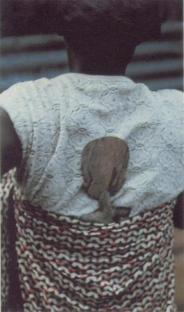
An Akua’ba tucked into the wrapper of an Asante woman. Photograph by Herbert M. Cole, Ghana, 1972 (RandAfricanArt.com)
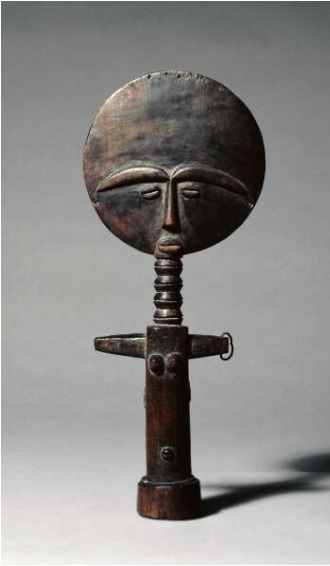
For instance, in the Asante (Ashanti) culture of Ghana, the Akua’ba (Akua’s child) figurines which are among some of the best well-known African wooden figures recognizable by their small disc head lodged on a cylindrical torso with or without arms, were used as legend says by Akua who could not have children; she ordered a figurine which she tied to her back and cared for as instructed by an African traditional priest, eventually being able to conceive; since then, many women desiring children have ordered Akua’ba figurines from artists and gotten them consecrated at shrines, and cared for in hope of conceiving. Also, some of the statues, like fertility statues, serve a particular purpose as the name states.
Pendant Ivory mask representing Queen Idia, Iyoba of Benin City (16th Century), exposed at the MET
Anonymity in African art is only a myth invented by Europeans as they came in contact with a foreign culture which they tried to explain via their own tainted cultural glasses. In the case of the Yoruba people of West Africa, as we saw earlier in the naming ceremonies [African Naming Tradition], names given at birth are not just used to differentiate individuals, but also serve to identify the essence of one’s personality and destiny called ori inu (inner spiritual head), which in Yoruba religious belief, determines a person’s success or failure in this world and directs his or her actions. The name also gives information about the person’s family, beliefs, history, origin, and environment. It is sacred! With every naming celebration, there begins a corresponding oriki (citation poetry), which grows with an individual’s accomplishments. Leaders, warriors, diviners, and other important persons, including artists are easily identified by their oriki, which chronicles their achievements [The Griot, the Preserver of African Traditions]. In Yoruba culture, there are different kinds of oriki: oriki Olurun (oriki for God), oriki orisa (oriki for gods/goddesses), oriki Oba ati Ijoye (oriki for monarchs and chiefs), oriki Akinkanju (oriki for warriors), oriki idile (oriki for families), to name just a few.
Below is the part of the oriki of Olowe, one of the greatest traditional Yoruba sculptors of the twentieth century; it was collected by John Pemberton III in 1988 from Oluju-ifun, one of Olowe’s surviving wives, and has been found to be instrumental in reconstructing his life and work. Outstanding Yoruba artists like Olowe whose works have been collected and studied by researchers have been identified in scholarly literature only by their nicknames or bynames such as, Olowe Ise (meaning Olowe from the town of Ise); Ologan Uselu (Ologan from Uselu quarters in Owo); and Baba Roti (father of Rotimi). This was done to protect the artist as he could become a vulnerable target to malevolent forces because of his standing in society or closeness to the king’s court, etc; in that case the artist never revealed his full name to strangers. However, when a person’s oriki is recited, it is assumed that anyone who listens carefully and understands it will know enough about the subject’s identity, name, lineage, occupation, achievements, and other qualities so that stating the person’s given name becomes superfluous. This is found on P. 11 – 12 of A History of Art in Africa, Monica Blackmun Visona, Harry N. Abrams (2001). Thus, authorship in African art is not veiled in anonymity, but rather the way authorship is conceived of is different. Enjoy!
Olowe, oko mi kare o
Aseri Agbaliju
Elemoso
Ajuru Agada
O sun on tegbetegbe
Elegbe bi oni sa
O p’uroko bi oni p’ugba
O m’eo roko daun se…
Ma a sin Olowe
Olowe ke e p’uroko
Olowe ke e sona
O lo ule Ogoga
Odum merin lo se libe
O sono un
Ku o ba ti de’le Ogoga
Ku o ba ti d’Owo
Use oko mi e e libe
Ku o ba ti de’kare
Use oko mi i libe
Ku o ba ti d’Igede
Use oko mi e e libe
Ku o ba ti de Ukiti
Use oko mi i libe
Ku o li Olowe l’Ogbagi
L’Use
Use oko mi i libe
Ule Deji
Oko mi suse libe l’Akure
Olowe suse l’Ogotun
Ikinniun
Kon gbelo silu Oyibo
Owo e o lo mu se
Olowe, my excellent husband
Outstanding in war.
Elemoso (Emissary of the king),
One with a mighty sword
Handsome among his friends.
Outstanding among his peers.
One who carves the hard wood of the iroko tree as though it were as soft as a calabash
One who achieves fame with the proceeds of his carving …
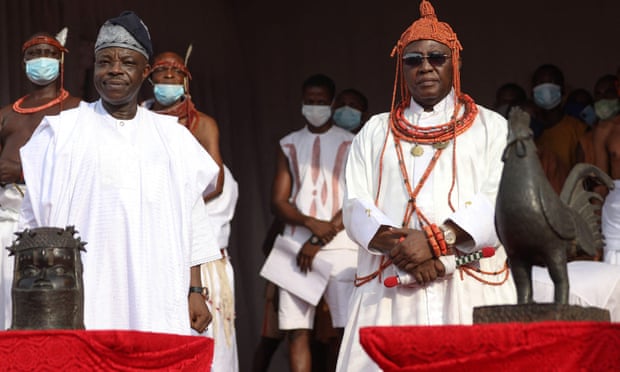
Return of cockerel sculpture and head of an Oba raises hopes that thousands more artefacts could be returned to their ancestral home. Photograph: Kola Sulaimon/AFP/Getty Images – The Guardian
It has been104 yearssinceBenin City: the Majestic City the British burnt to the groundwas looted and destroyed. Now, a century later, two of the numerous Bronze statues that were taken at the time, are being returned. Some may ask, who cares about 2 Bronze statues? These statues are not just a symbol of the craftsmanship of the Benin people, but they also symbolize the essence of the people. Back in those days, the statues were not used like they are by Europeans, to be placarded in museums, they had a symbolic, and some even had a spiritual or energetic importance. Below are excerpts from the article on the Guardian’s website.
=====
Two Benin bronzes were returned on Saturday [19 February 2022] to a traditional palace in Nigeria, more than a century after they were pillaged by British troops, raising hopes that thousands more artefacts could finally be returned to their ancestral home.
The artefacts, mostly in Europe, were stolen by explorers and colonisers from the once-mighty Benin Kingdom, now [part of] south-western Nigeria, and are among Africa’s most significant heritage objects. They were created as early as the 16th century onwards, according to the British Museum.
At a colourful ceremony to mark the return of a cockerel sculpture and head of an Oba or king, spokesperson Charles Edosonmwan for the Oba palace in Benin City noted that some of the bronzes were kept as far away as New Zealand, the United States and Japan.
Rooster from Benin Kingdom (18th century), exposed at the MET
The two artefacts were handed over to the Nigerian High Commission in October by the University of Aberdeen and Cambridge University’s Jesus College but had yet to return to their ancestral home.
“They are not just art but they are things that underline the significance of our spirituality,” Edosonmwan said in an interview on the sidelines of a ceremony attended by traditional leaders.
… About 90% of Africa’s cultural heritage is believed to be in Europe, French art historians estimate. Musée du quai Branly – Jacques Chirac in Paris alone holds about 70,000 African objects and London’s British Museumtens of thousands more.














 African Heritage