Frankie Fredericks: Sprinting to the Finish for Namibia

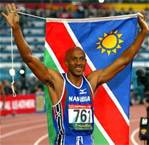
Frankie Fredericks raising the flag of Namibia

The athlete of the week is Frankie Fredericks: the handsome, good-looking, strong, fast, and powerful brother from Namibia.  Yep that’s right, Frankie Fredericks is one of those athletes I loved watching in the 1990s.  Always consistent, always strong, and everpresent, Frankie Fredericks was a force to reckon with.  How many silver medals has he gotten while contending the 100 m and 200 m at the Olympics?  4 Silver medals!  That’s right, an African with 4 silver olympic medals!  He has also won several gold medals at the World Championships, World Indoor Championships, All-Africa Games, and Commonwealth Games.  He is thus far Namibia’s only olympic medalist.

Frankie Fredericks coming 2nd to Donovan Bailey during the 100 m finale at the 1996 Atlanta Olympics

Born in Windhoek, Namibia’s capital, Frankie began running at the age of 13, and particularly loved football (soccer for Americans).  However, when he was awarded a scholarship to attend Brigham Young University, in the USA in 1987, he quickly moved his passion to track and field.  In 1991, as Namibia gained independence from South Africa, Frankie started officially compete for his country.  At the Barcelona Olympics in 1992, Frankie Fredericks won 2 silver medals in 100 m and 200m, giving Namibia its very first olympic medal.  In 1996 at the Atlanta Olympics, Frankie again won 2 silver medals coming 2nd to Donovan Bailey in the 100m, and 2nd to Michael Johnson in the 200 m.  Due to injuries, Frankie was absent at Sydney Olympics in 2000, and Namibia dearly missed him there.  He raced the 200m at the Athens Olympics in 2004, and came out 4th, and finally retired at the end of that year at the age of 37 (Imagine a 37 year-old sprinter coming 4th at the olympics, running against young folks like Shawn Crawford, Justin Gatlin, and Bernard Williams).  At the beginning of that run in Athens, Frankie was given a standing ovation that lasted few minutes, and at the end, he said “It is quite emotional, … I always wanted to go out with a medal, but sometimes in life you don’t get everything you want.” Frankie has run the 100 m under 10 s more consistently than most athletes (he is ranked 4th behind Ato Boldon of Trinidad & TobagoMaurice Greene of the US, and Asafa Powell of Jamaica).
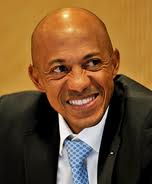
Frankie Fredericks
Frankie Fredericks

Off track, Frankie has a computer science degree and a masters of business administration, and he has created the Frank Fredericks Foundation to foster young Namibian athletes. In 2004, he was  elected by fellow athletes to serve on the board of the International Olympic Committee. Please check out the tribute to Frankie Fredericks given by International Association of Athletics Federations IAAF athletics.

The personable and wildly popular Fredericks spent the greater part of a decade-and-a-half at the pinnacle of his craft, a record for longevity nearly unprecedented in the sprints.  What was always fun about watching Frankie run was his consistency: Frankie was constant on the distance, and a very reliable athlete, training hard to represent his country and continent at the highest level.  I am sure most people had never heard of the country Namibia, but when Frankie was running, the whole world could hear and feel Namibia rising!

How to Write about Africa, by Binyavanga Wainaina

An antelope at dusk
An antelope at dusk, with the African sun

This really good article by the Kenyan writer Binyavanga Wainaina on ‘How to Write about Africa‘ was recently shared with me. It was published by Granta magazine.  One will be surprised to see that this is exactly the way Africa is depicted in Western televisions, magazines, news, and books. Such an interesting read, very satirical, and yes very thought-provoking.  This is not the Africa I know, but this is the Africa sold on Western media.  The entire article can be found on Granta.com.

==========

Always use the word ‘Africa’ or ‘Darkness’ or ‘Safari’ in your title. Subtitles may include the words ‘Zanzibar’, ‘Masai’, ‘Zulu’, ‘Zambezi’, ‘Congo’, ‘Nile’, ‘Big’, ‘Sky’, ‘Shadow’, ‘Drum’, ‘Sun’ or ‘Bygone’. Also useful are words such as ‘Guerrillas’, ‘Timeless’, ‘Primordial’ and ‘Tribal’. …

Never have a picture of a well-adjusted African on the cover of your book, or in it, unless that African has won the Nobel Prize. An AK-47, prominent ribs, naked breasts: use these. If you must include an African, make sure you get one in Masai or Zulu or Dogon dress.

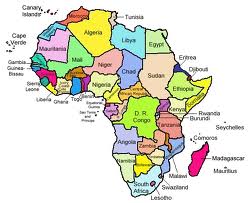
Africa
Africa

In your text, treat Africa as if it were one country. It is hot and dusty with rolling grasslands and huge herds of animals and tall, thin people who are starving. Or it is hot and steamy with very short people who eat primates. Don’t get bogged down with precise descriptions. Africa is big: fifty-four countries, 900 million people who are too busy starving and dying and warring and emigrating to read your book. The continent is full of deserts, jungles, highlands, savannahs and many other things, but your reader doesn’t care about all that, so keep your descriptions romantic and evocative and unparticular. […] Continue reading “How to Write about Africa, by Binyavanga Wainaina”

Mozambique’s First Gold Medal, and World Greatest 800m Runner: Maria Mutola

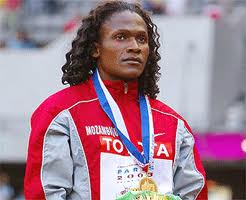
Maria Mutola winning gold in Sydney

With the olympics fast approaching, I have decided to feature one African athlete per week to keep us in Olympics mood. Today, I would like to talk about an athlete hailing from Mozambique: Maria Mutola.

Maria de Lurdes Mutola was born in Maputo, the capital of Mozambique, and was running so fast that she was nicknamed ‘The Maputo Express’.  She specialized in 800 m, and is the 4th athlete to have competed in 6 olympic games (imagine that: the olympic games happen every 4 years… thus it took a total of 24 years of intense competition at the highest level, as a world class athlete).  As a young girl, she excelled in football(soccer), and played with boys.  Later on, she was encouraged by the great

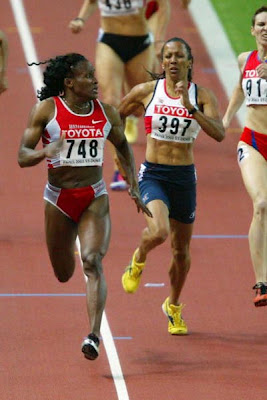
Maria Mutola defeating Kelly Holmes at World Championships

Mozambican writer Jose Craveirinha to pursue track and field.  Her very first olympic was in 1988 at the Seoul Games, at the age of 15.  She finished last, but this made her even stronger.  After that, she dominated the 800 m distance, winning the gold medal at the IAAF World Indoor Championships in 1993 and 1995, and the Stuttgart 1993 IAAF World Championships.  She won the bronze medal in 1996 at the Atlanta Olympic games, and finally won a sweet Gold medal at the Sydney Olympic Games in 2000.  Mutola retired from track and field at the 2008 Beijing Olympics where she sadly finished 5th, after being in contention for a medal.  Mutola is often ranked as the greatest female 800 m runner of all time, since her consistency, her record at major championships and her ability to compete at the highest levels of the sport for well over a decade are unmatched.

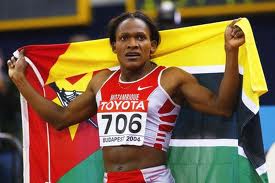
Maria Mutola raising the flag of Mozambique

As a sports fan, I watched Maria at the 1995 World indoor games in Barcelona.  The year 2000 was so special, as we all saw Maria finally lift the Olympic gold medal for Mozambique, at the Sydney games.  In 2003, she became the sole winner of the IAAF $1million Golden league title, for being undefeated throughout that year at all major competitions.  I have always been a big fan of hers, even though I always thought that she had too much of a ‘male’ physique.  With that physique, she ran with power and grace, and raised the flag of Mozambique with pride.  Greatness to you Maria, you’ve made us proud!

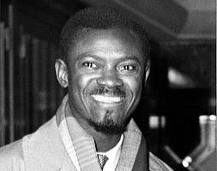
La Dernière Lettre de Patrice Lumumba / Patrice Lumumba’s Last Letter

Patrice Emery Lumumba

Avec la commémoration de l’indépendance du Congo Démocratique acquise le 1er Juillet 1960, j’ai trouvé bon de poster cette si belle lettre de Patrice Lumumba à Pauline, sa femme (c’est d’ailleurs sa dernière lettre) était très appropriée, car bien que triste, elle est pleine d’espoir à la pensée qu’un jour le Congo sera libre, à la pensée que les enfants congolais doivent tous s’unir pour re-bâtir le Congo!

Ma compagne chérie, Je t’écris ces mots sans savoir s’ils te parviendront, quand ils te parviendront et si je serai en vie lorsque tu les liras.  Tout au long de ma lutte pour l’indépendance de mon pays, je n’ai jamais douté un seul instant du triomphe final de la cause sacrée à laquelle mes compagnons et moi avons consacré toute notre vie.  Mais ce que nous voulions pour notre pays, son droit à une vie honorable, à une dignité sans tache, à une indépendance sans restrictions, le colonialisme et ses alliés occidentaux—qui ont trouvé des soutiens directs et indirects, délibérés et non délibérés, parmi certains hauts fonctionnaires des Nations, cet organisme en qui nous avons placé toute notre confiance lorsque nous avons fait appel à son assistance—ne l’ont jamais voulu.

Ils ont corrompu certains de nos compatriotes. Ils ont contribué à déformer la vérité et à souiller notre indépendance.  Que pourrai je dire d’autre ? 

Que mort, vivant, libre ou en prison sur ordre des colonialistes, ce n’est pas ma personne qui compte.  C’est le Congo, c’est notre pauvre peuple dont on a transformé l’indépendance en une cage d’où l’on nous regarde du dehors, tantôt avec cette compassion bénévole, tantôt avec joie et plaisir.  Mais ma foi restera inébranlable.  Je sais et je sens au fond de moi même que tôt ou tard mon peuple se débarrassera de tous ses ennemis intérieurs et extérieurs, qu’il se lèvera comme un seul homme pour dire non au capitalisme dégradant et honteux, et pour reprendre sa dignité sous un soleil pur.

Nous ne sommes pas seuls.  L’Afrique, l’Asie et les peuples libres et libérés de tous les coins du monde se trouveront toujours aux côtés de millions de congolais qui n’abandonneront la lutte que le jour où il n’y aura plus de colonisateurs et leurs mercenaires dans notre pays.  A mes enfants que je laisse, et que peut-être je ne reverrai plus, je veux qu’on dise que l’avenir du Congo est beau et qu’il attend d’eux, comme il attend de chaque Congolais, d’accomplir la tâche sacrée de la reconstruction de notre indépendance et de notre souveraineté, car sans dignité il n’y a pas de liberté, sans justice il n’y a pas de dignité, et sans indépendance il n’y a pas d’hommes libres.

Ni brutalités, ni sévices, ni tortures ne m’ont jamais amené à demander la grâce, car je préfère mourir la tête haute, la foi inébranlable et la confiance profonde dans la destinée de mon pays, plutôt que vivre dans la soumission et le mépris des principes sacrés.  L’histoire dira un jour son mot, mais ce ne sera pas l’histoire qu’on enseignera à Bruxelles, Washington, Paris ou aux Nations Unies, mais celle qu’on enseignera dans les pays affranchis du colonialisme et de ses fantoches.  L’Afrique écrira sa propre histoire et elle sera au nord et au sud du Sahara une histoire de gloire et de dignité.

Ne me pleure pas, ma compagne.  Moi je sais que mon pays, qui souffre tant, saura défendre son indépendance et sa liberté.

Vive le Congo !  Vive l’Afrique !

Patrice Lumumba

My beloved companion, I am writing these words not knowing whether they will reach you, when they will reach you, and whether I shall still be alive when you read them.  All through my struggle for the independence of my country, I have never doubted for a single instant the final triumph of the sacred cause to which my companions and I have devoted all our lives.  But what we wished for our country, its right to an honourable life, to unstained dignity, to independence without restrictions, was never desired by the Belgian imperialists and their Western allies, who found direct and indirect support, both deliberate and unintentional, amongst certain high officials of the United Nations, that organization in which we placed all our trust when we called on its assistance.

They have corrupted some of our compatriots and bribed others.  They have helped to distort the truth and bring our independence into dishonour.  How could I speak otherwise? 

Dead or alive, free or in prison by order of the imperialists, it is not myself who counts.  It is the Congo, it is our poor people for whom independence has been transformed into a cage from whose confines the outside world looks on us, sometimes with kindly sympathy, but at other times with joy and pleasure But my faith will remain unshakeable.  I know and I feel in my heart that sooner or later my people will rid themselves of all their enemies, both internal and external, and that they will rise as one man to say No to the degradation and shame of colonialism, and regain their dignity in the clear light of the sun.

We are not alone.  Africa, Asia and the free liberated people from all corners of the world will always be found at the side of the millions of Congolese who will not abandon the struggle until the day when there are no longer any colonialists and their mercenaries in our country.  As to my children whom I leave and whom I may never see again, to be told that the future of the Congo is beautiful and that their country expects them, as it expects every Congolese, to fulfill the sacred task of rebuilding our independence, our sovereignty; for without justice there is no dignity and without independence there are no free men.

Neither brutality, nor cruelty nor torture will ever bring me to ask for mercy, for I prefer to die with my head unbowed, my faith unshakable and with profound trust in the destiny of my country, rather than live under subjection and disregarding sacred principles.  History will one day have its say, but it will not be the history that is taught in Brussels, Paris, Washington or in the United Nations, but the history which will be taught in the countries freed from imperialism and its puppets.  Africa will write its own history, and to the north and south of the Sahara, it will be a glorious and dignified history.

Do not weep for me, my dear wife.  I know that my country, which is suffering so much, will know how to defend its independence and its liberty.

Long live the Congo!  Long live Africa!

Patrice Lumumba

Nkosi Sikelel’ iAfrika – God Bless Africa

Africa
Africa

Today I would like to talk about the great ode to Africa, ‘Nkosi Sikelel’ iAfrika‘ or ‘God Bless Africa‘ which used to be the national anthem of five African countries.  Little did Enoch Sontonga, a simple school teacher in Johannesburg, know that his hymn praising his love for his country and land of ancestors would become one of the most known African national anthems when he wrote it in 1897, in his mother tongue Xhosa.  This song became a pan-African anthem to the countries of Zambia, South Africa, ZimbabweNamibia and Tanzania … Zimbabwe and Namibia have since then adopted new anthems.  At its creation, it was sung to the 1879 tune ‘Aberystwyth‘ by Joseph Parry.  In 1927, seven more Xhosa stanzas were added by poet Samuel Mqhayi.  In 1996, under President Nelson Mandela, a shortened version of ‘Nkosi Sikelel’ iAfrika‘ was added to the national anthem of South Africa, and Sontonga’s grave was dedicated as a national monument.  In Zimbabwe, after independence in 1980, it was sung in Shona language as ‘Ishe Komborera Africa‘; in Tanzania, it is still the national anthem and is sung in Kiswahili as ‘Mungu ibariki Afrika‘.  In Zambia, it is ‘Stand and Sing of Zambia, Proud and Free‘ or ‘Lumbanyeni Zambia‘.  Enjoy… sing… and feel it… as God blesses Africa.  Watch Miriam Makeba, Hugh MasekelaLadysmith Black Mambazo, and Paul Simon sing it… and reap the blessings.

Nkosi Sikeleli Africa
Malup hakanyiswu phando lwayo
Yiswa imithanda zo yethu
Nkosi Sikelela
Thina lusapo lwayo

Nkosi Sikeleli Africa
Malup hakanyiswu phando lwayo
Yiswa imithanda zo yethu
Nkosi Sikelela
Thina lusapo lwayo

Woza Moya (Woza, Woza)
Woza Moya oyingcwele
Nkosi Sikelela
Thina lusapo lwayo

Morena boloka sechaba sa heso (sa heso)
O fedise dintwa le matswenyeho
Morena boloka sechaba sa heso
O fedise dintwa le matswenyeho
O seboloke (O se boloke)
O seboloke morena
O seboloke sechaba, Sechaba sa Heso
Sechaba sa Africa

God bless Africa
May her glory be lifted high
Hear thou our prayers
God bless us
Us Your children

God bless Africa
May her glory be lifted high
Hear thou our prayers
God bless us
Us Your children

Come Spirit
Come Spirit
Come Spirit Holy
God bless us
Us Your children

Lord, we ask you to protect our nation
Intervene and end all conflicts
Lord, we ask you to protect our nation
Intervene and end all conflicts
Protect us
Protect us Lord
Protect us, Protect our nation
Protect Africa


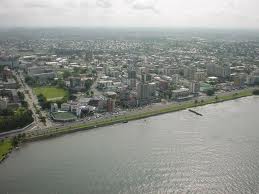
Libreville: Why the Name?

Libreville today
Libreville today, 2012

Two capitals in Africa share the same name: Freetown in Sierra Leone, and Libreville in Gabon; one in English, the other in French.  I always knew that Freetown was named the way it was because it was a city founded in 1792 by freed African American Slaves also called Nova Scotian who had fought on the side of the British during the American Revolutionary war.  The land was named Freetown as a land for freed slaves.

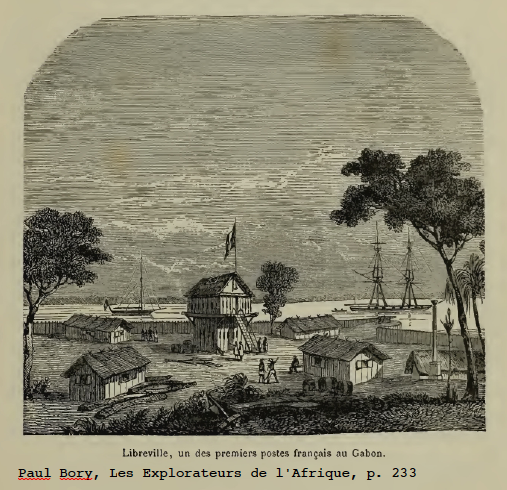
Libreville in 1846
Libreville in 1846

But why on earth is Libreville named free town?  Since, there were apparently no freed slaves returning from the colonies, or running away from slavery?  I recently found out that the story of Libreville is very similar to that of Freetown, as it does involve slaves!  Yes… that’s right!  In the old days, i.e. prior to French occupation (the French acquired land there in 1839), the area that is today Libreville was inhabited by the Mpongwé people since the 11th century.  In 1846, l’Elizia, a slave ship en route for Brazil, carrying slaves for sale was captured by the French navy near Loango, offshore from the Mbongwé’s kingdom.  260 negroes were thus freed and taken to the Island of Gorée in Senegal in 1846.  After an intervention from Paris, 30 – 50 of these slaves will return to Gabon, where the French governor Bouët-Willaumez will take advantage of this, and found Libreville (French for ‘free town’ or ‘free city’) in 1849, in close proximity to Fort d’Aumale, where the French navy was installed to “fight” against slavery.  The small town, Libreville, was then organized as a “French christian village” around 5 places: the Mpongwé’s place, the freedom place, the Bakélé place, the Pahué place, and the Bulu place, after the main tribes in the area at the time.

Amanishakheto, Warrior Queen of Nubia

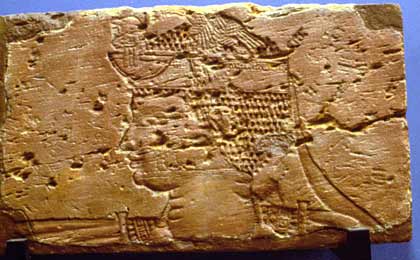
Candace Amanishakheto on a mural

Great women are often left out of history.  Rarely do we hear or read about African queens.  It is already hard enough to read about great African men and leaders in history books, but as for African women… it is more like impossible.  How many have heard of the great warrior queen of Nubia, Amanishakheto, who defeated a Roman army?  Who has heard of this great queen whose pyramid/tomb was leveled to the ground by an Italian treasure hunter, Giuseppe Ferlini, in 1832? Who has heard of this woman who led her people with a strong arm, and built pyramids in Meroë?  Who has heard of this great candace, whose daughter Amanitore, also queen of Nubia, is mentioned in the Bible (Acts 8:27) … yeah the Queen of Sheba is not the only African queen mentioned in the Bible!

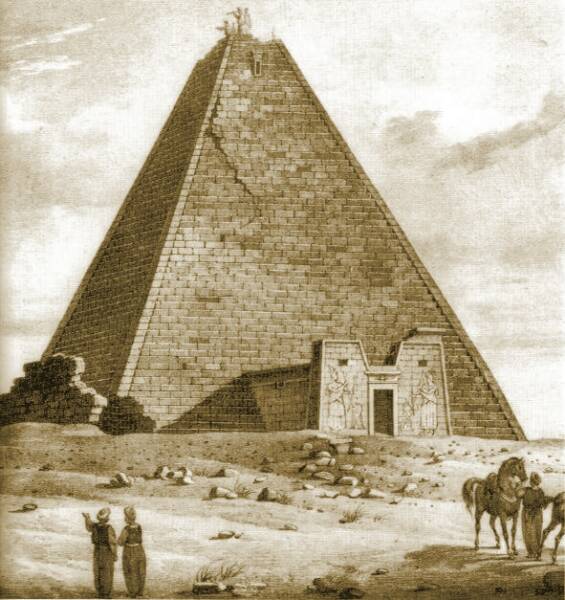
Pyramid N6 of Amanishakheto in Meroe, before its destruction

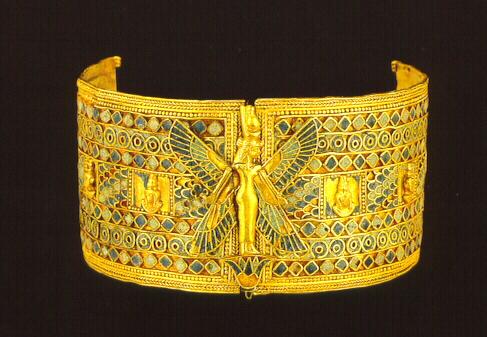
Well, let me tell you about the great Candace (Kandake or queen) of Nubia (present day Sudan), Amanishaketo (also written Amanishaket, or Amanikasheto or Mniskhte in meroitic hieroglyphs) who reigned from around 10 BC to 1 ADCandace Amanishaket was an extremely wealthy and powerful queen.  She succeeded to Candace Amanirenas who was also a great warrior queen (and will be the subject of another post).  She built considerable pyramids and temples at Wad Ban Naqa, where she was buried with great treasures.  Her residence and several temples were based there.  Her palace is one of the largest treasures identified at Wad ban Naqa.  It was 61 m long, and covered an area of  3700 m2 with the ground floor made up of over 60 rooms.  The palace originally had a second floor as indicated by the remains of columns found on the ground floor, and may have contained an atrium or other structure.  Inside Amanishakheto’s grave, the Italian treasure hunter Ferlini discovered an amazing quantity of golden artifacts such as armlets, necklaces.  The treasure found (or what has been recovered) contained ten bracelets, nine shield rings, sixty seven signet rings, two armbands, and an extraordinary number of loose amulets and necklaces, especially made for queen Amanishakheto created by Nubian artists from her kingdom.  Some of her treasures (stolen by Ferlini) are now on display at the Egyptian Museum of Berlin, and at the Egyptian Museum of Munich.

Bracelet of Amanishakheto from the Egyptian Museum of Berlin

Amanishakheto defeated a Roman Army sent by the first emperor of the Roman empire, Augustus, (who broke a peace treaty) to conquer Nubia.  She was a strong, and powerful woman, and a great pyramid builder.  Her tomb at Meroë was one of the largest ever built.  She is often depicted on pyramid murals as a massive, powerful woman, covered with jewels, elaborate fringed, tasseled robes, and carrying weapons in one hand, preparing to lead her army against others. Enjoy the video below on Amanishakheto, the great warrior queen of Nubia, and do not forget to check out The Treasures of Queen Amanishakheto.

Francafrique: Raison d’Etat

After the joke of elections held in Egypt this past month, and with all the turmoil in Libya, Mali, and Côte d’Ivoire, I thought it will be best to watch this great documentary by Patrick Benquet which stirred thoughts across French Africa since December 16, 2010, date of its official diffusion.  It tells you all about the tricks, and machiavelism of France (Africa’s policeman) in Africa, and of course the effect of the cold war on African leaders and countries. Enjoy the first part titled the Francafrique Reason of State (Raison d’Etat) and share with others! It is important to know!

Comment L’Araignee obtint la Nourriture sans Travailler

Yevi, l'Araignée
Yevi, l’Araignée

Il était une fois dans un petit village, Yévi l’Araignée.  Yevi avait quatre femmes et beaucoup d’enfants.  Il possédait un grand champ qu’il travaillait avec ses fils.  Le soir, ils revenaient tous ensemble vers leur maison et partageaient entre eux la nourriture.  Mais Yevi était très astucieux et très vorace.  Jamais il ne se satisfaisait de la part de repas qu’on lui donnait et il réfléchissait constamment au moyen de s’approprier tous les meilleurs produits de son champ sans avoir à en distribuer à ses femmes et à ses enfants.

Voici la ruse qu’il avait inventée :

Un beau matin, il se plaint de sa tête et de son ventre et déclare qu’il est trop malade pour aller travailler.  Il reste donc tranquillement étendu sur sa natte durant toute la journée.  Chaque fois qu’une de ses épouses, inquiète, s’approche de lui, il pousse de sourds gémissements.  Lorsque la nuit tombe, ses fils reviennent au village et vont aussitôt prendre nouvelle de leur père.

Champs Africains
Champs Africains

Toute le famille se rassemble dans la case de Yevi et s’installe au chevet du faux malade …Quand celui–ci voit que toutes ses femmes et tous ses enfants sont auprès de lui il ouvre les yeux et d’une voix expirante leur dit :

Pauvre de moi! hélas! … hélas! … Je sens … que… Je … Vais mourir … Hélas !… Quelle douleur !…

Aussitôt, les épouses se mettent à sangloter … Yevi  reprend alors la parole.

Approchez mes fils … Approchez … Je veux vous donner mes dernières instructions…

Les garçons viennent s’asseoir tout près du soi-disant moribond et prêtent une oreille attentive aux paroles que leur père prononce d’une voix de plus en plus faible.

Après ma mort, vous irez … m’enterrer … dans mon champ … Vous creuserez un grand trou … pour y déposer mon cercueil … N’oubliez pas !… Je veux que le cercueil reste grand ouvert … Et que la tombe ne soit pas refermée … Afin que mon esprit puisse venir vous protéger tous … Autour de la tombe ,vous déposerez  en offrande les aliments qui me permettront de faire le grand voyage dans l’au-delà … N’annoncez ma mort à personne … Et si quelqu’un vous question à mon sujet, dites que je suis parti en voyage …

Continue reading “Comment L’Araignee obtint la Nourriture sans Travailler”

Le cube Maggi, Un Héritage Colonial / Maggi Cube, a colonial heritage

Le Cube Maggi
Le Cube Maggi

Depuis que je suis enfant, le cube Maggi faisait déjà partie de la vie culinaire d’une femme… mais ce n’est qu’en grandissant, avec l’avenue de la télévision et des publicités spéciales aux heures des feuilletons favoris que Maggi cube est entré dans le quotidien de tous les foyers. Dans certains pays, le cube maggi est surnommé ‘le corrige madame’ une appellation pour venter son mérite dans la cuisine. Mais corrige-t-il vraiment la cuisine, ou la déforme-t-il? A mon humble avis, le cube maggi déforme la cuisine africaine, et détruit les gouts et les saveurs originelles.  Car imaginez-vous que les cuisinières ne font plus appel à nos bonnes herbes, épices, et ingredients locaux, mais jettent 2 ou parfois meme 4 ou 5 cubes bouillons dans la sauce pour y relever le goût. Alors un Ndolé normal épicé avec crevettes, ou autres, est maintenant épicé avec un maggi crevette! Comme si un cube de sel aromatisé pouvait contenir toute la saveur de bonnes crevettes de chez nous.  Imaginez mon choc lorsque j’ai vu une jeune mère jetter des cubes maggi dans un met traditionnel camerounais, le Mbongo Tchobi? Kaï! Ayooooo! Quel affront!

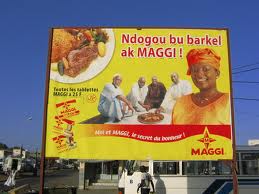
Une pancarte publicitaire de Maggi au Senegal

Mais pourquoi cette insistance à vouloir substituer nos bonnes épices pour ces atrocités fabriquées en occident (ces substituts pas cher d’extrait de viande), donc non adaptées à nos mets locaux? La vidéo qui suit vous fera part de la stratégie de Julius Maggi pour utiliser le grand marché colonial. Hey oui… le cube maggi est un héritage de la colonisation existant depuis 1886 (soit 2 ans après la conference de Berlin)!

Click here for the English version Continue reading “Le cube Maggi, Un Héritage Colonial / Maggi Cube, a colonial heritage”