A blog about African history, and heritage, through audio and video files.
Author: Dr. Y.
I am an African in love with the history of the world, and particularly that of Africa. I am a child of love, an artist, a scientist, a lover, a friend, a human.
I am in love with nature and beautiful things, art, history, geography, travel, dance, food, science, and technology, and much more.
‘The No1 Ladies Detective Agency’ by Alexander McCall Smith
Many of you have probably heard about Gaborone, the capital of Botswana, from the book series, The No. 1 Ladies’ Detective Agency, by Alexander McCall Smith. The series follows Precious Ramotswe, the first female private detective in Botswana, and the mysteries that she solves; her agency is based in Gaborone. Have you ever stopped to wonder what the name Gaborone actually meant?
Map of Botswana
Gaborone was the name of the Chief of the Batlokwa, Kgosi Gaborone, who left the Magaliesberg to settle in the area around 1880, and called the settlement Moshaweng. Moshaweng meant ‘place where the river’s sand has washed out.’ Today, Moshaweng has been renamed Tlokweng, or Place of the Batlokwa, and is located on the east of the Notwane river, facing the Village. Gaborone was then known as Chief Gaborone’s village. His name itself, Gaborone, meant ‘it does not fit badly’ or ‘it is not unbecoming.’ The city was then called Gaberones by European settlers. Tlokweng was across the river from the Government Camp, the name of the British colonial headquarters. In 1890, Cecil John Rhodes picked Gaberones to house a colonial fort. The fort was where Rhodes planned the Jameson Raid.
Aerial View of Gaborone
In 1965, the capital of the Bechuanaland Protectorate was moved from Mafeking in South Africa to Gaberones. When Botswana gained independence on 30 September 1966 from Great Britain, Lobatse was considered as the first choice for the nation’s capital. However, Gaberones was chosen over Lobatse because of its proximity to fresh water, its proximity to the railway to Pretoria (South Africa), its central location among the central tribes, and its lack of association with those surrounding tribes: it was a sort of ‘neutral ground.’ The city changed its name from Gaberonesto Gaboronein 1969. Meanwhile, Chief Gaborone had died in 1932, aged about 106 years old; he never saw the capital of his country take his name.
National Assembly of Botswana (in Gaborone)
Geographically, Gaborone is situated between Kgale and Oodi Hills, on the Notwane River in the southeastern corner of Botswana, and just 15 km from the South African border. The city lies at an elevation of 1,010 m above sea level.
Today, Gaborone is rapidly growing. It is currently home to over 250,000 people. It is a very vibrant city, and is one of the fastest growing cities in the world. Nowadays, Gaborone is called the “White City” and is nicknamed “Gabz” by locals. Enjoy the video below on Gaborone!
Le maître demande à Digbeu : « 2 – 1 = combien ? » Digbeu répond : « 2 ». Très furieux et curieux, le maître pose la question autrement : « ta mère te garde 2 foutous* ; Séry, ton petit frère, mange 1 foutou. Il reste combien de foutou ? » Digbeu répond toujours : « 2 ». Le maître lui demande pourquoi ? Digbeu dit : « Séry n’a pas coeur de manger mon foutou ».
*Foutou est un mets très prisé de Côte d’Ivoire qui se présente sous la forme d’une boule de manioc et plantains pilés, et est mangée avec une sauce.
========
The teacher asks Digbeu:”2 – 1 = how much” Digbeu replies:”2.” Very furious and curious, the teacher asks the question differently: “your mother saves you 2 foutous*; Sery, your little brother, eats one foutou. How many foutous are left?” Digbeu replies again:”2.” The teacher asks him why. Digbeu replies: “Sery will not have the heart to eat my foutou.”
*Foutou is a traditional recipe from Côte d’Ivoire for a classic accompaniment, and is made up of plantains and cassava that are cooked and pounded separately, before being mixed right before serving. It is eaten with a sauce.
I just stumbled upon this poem by Vernon J. Davis Jr., and wanted to share with all. It is an ode to the beauty of the black woman; I love the comparison to the shining sun. Enjoy!
========
Beautiful black woman,
Your beauty is surpassed by none.
Beautiful black woman,
Your sensuous splendor is like the shining sun
Your wondrous ways come from your soul
Which no one man may hope to control
Beautiful black woman,
You are the guiding hope of our people
Beautiful black woman,
your mind maintains your glorious power.
Beautiful black woman,
Your spirit is like a shining church tower
which points the way to heaven above
and which seeks to find true love.
Beautiful black woman,
you are the guiding hope of our people.
Beautiful Black woman,
Your time is like a precious commodity.
Beautiful Black Woman,
Your ebony will is strong and free,
so take your precious time,
and your determined will,
and use them both to emphasize what you really feel.
Même un peu de sel donne du goût(Proverbe Ovimbundu – Angola). Même si je ne suis pas important, si je venais à manquer, la perte sera sensible malgré tout.
Even a little of salt gives taste (Ovimbundu Proverb – Angola). Even if I am not important, if I ever came to be missing, the loss will be felt anyway.
There was a very tired woman living alone. One day she slept without closing the door, in the daytime, and night fell. During the night the hyena came and took the woman with her cow skin mat wrapped up. He left her in a corner and went to call his friends. The woman woke up and when she realized she wasn’t at home she was frightened. She rolled the cow skin as if there was someone in it and ran away.
When she got home she closed the door and fell asleep again. When the hyena came with his friends, he found the skin, and thought the woman was there. When he touched the skin the woman had gone. He was upset and went back to her home, but it was closed. So he went back to his friends.
15 jours et 27 ans, après avoir fait assassiner Thomas Sankara, Blaise Compaoré est à son tour forcé ou plutot jeté dehors. En effet, c’était le 15 Octobre 1987 que Thomas Sankara était assassiné par des hommes de Compaoré. Donc le fameux Compaoré est tombé le 30 Octobre 2014. Comme on le dit si bien, quiconque se sert de l’épée perira par l’épée. Maintenant, notre voeu le plus cher est que cette révolution populaire ne soit pas confisquée par l’armée qui est constituée d’hommes de Compaoré, et des bras de la France. Bye Bye Compaoré.
==========
Flag of Burkina Faso
15 days and 27 years, after having murdered Thomas Sankara, Blaise Compaoré is in his turn forced to resign or rather booted out of office. On 15 Octobre 1987 that Thomas Sankara was murdered by men of Compaoré. Now, Compaoré himself fell on 30 October 2014. As it so well said, anyone who uses the sword, will die by the sword. Now, our hope is that the people’s revolution will not be hijacked by the army who are Compaoré’s men and France’s men. Bye Bye Compaoré.
After learning about the origin of the name Addis Ababa, from Empress Taytu Betul‘s visit to its location, I could not help but talk about the Empress herself. Who was Taytu Betul?
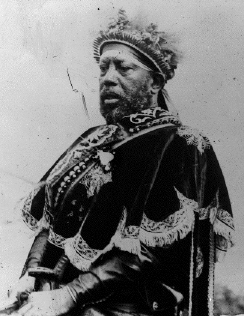
Well, Taytu Betul was Emperor Menelik II‘s third wife and was thereby Empress of Ethiopia. She was his confidante, a loyal wife, a commander, and a brilliant military strategist.
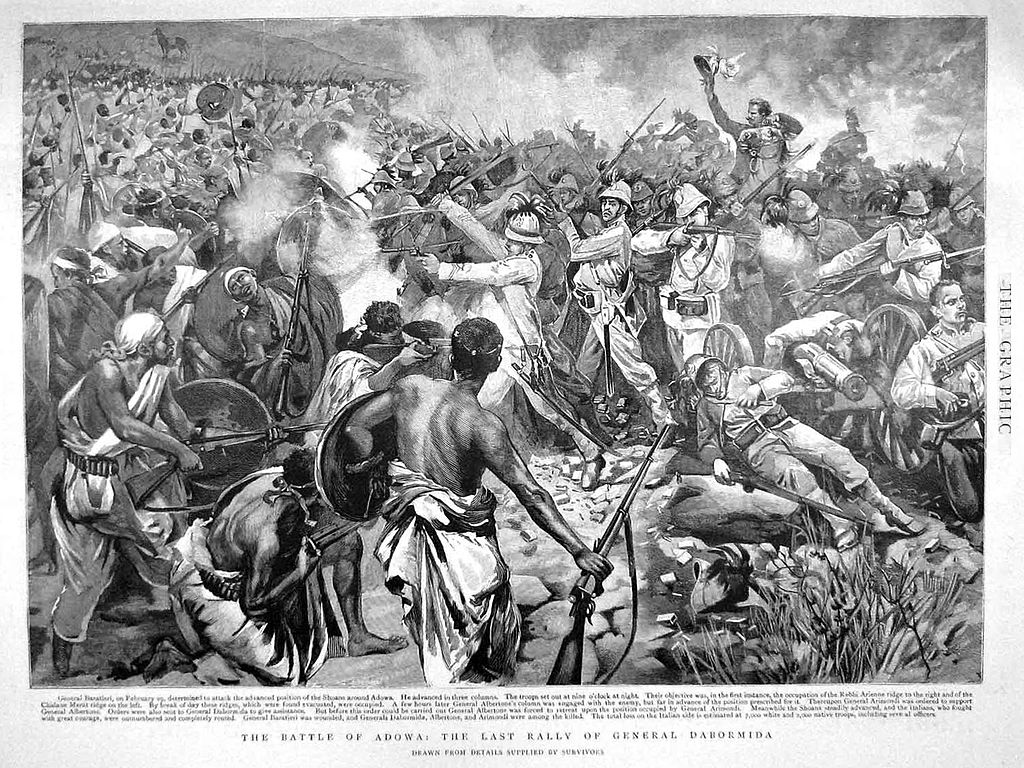
Taytu Betul (also Taitu Betul), whose name Taytu means Sunshine, was a sunshine for her nation when it was about to fall into the hands of the Italian colonizer. Perhaps, there would not have been the famous Battle of Adwa on March 1, 1896, which marked the Ethiopian victory against colonialism, without Empress Taytu, for she inspired it.
Emperor Menelik II, of Ethiopia
Empress Taytu Betul was born in Wollofrom a Christian and Muslim family. She had a comprehensive education and was fluent in Ge’ez, the classical Ethiopian language; which was a rare achievement for a woman at the time, as education was mostly reserved for boys. Taytu was the third of four children in an aristocratic family related to the Solomonic dynasty of Ethiopia. Her uncle, DejazmachWube Haile Maryam, was the ruler of Tigray and much of Northern Ethiopia in the 1840s, and a rival of Emperor Tewodros II. Her father’s family were the ruling family of Semien province, claiming descent from Emperor Susenyos I. Her grandfather was Ras Gugsa, a member of the powerful ruling family of Yejju, of Oromo origin, which had ruled as Regents in Gondar during the Zemene Mesafint (“Era of the Princes”). After four failed marriages, Taytu Betul was married to Emperor Menelik II (he was still King of Shewa at the time) in 1883 in a full communion church service and thus fully canonical and insoluble, which Menelik had not had with either of his previous wives (whom he had divorced). Their marriage was not just about romance but was also a political marriage sealing alliances with the northern regions of Begemder, Lasta, Semien, and Yeju. She remained his wife until his death in 1913.
The Battle of Adwa, 1896
Empress Taytu was a loyal and respectful wife to her husband Emperor Menelik II. According to royal historians, she was co-equal with Menelik, who always consulted her prior to making important decisions. She was the one who pushed him to declare war against Italy at the Battle of Adwa—tearing up the 1889 Treaty of Wuchale between the Ethiopian Empire and Italy, a treaty whose article 17 had two different meanings in Amharic and Italian versions: The Amharic version recognized the sovereignty of Ethiopia and its relationship with Italy as just a diplomatic partnership, while the Italian version made Ethiopia Italy’s protectorate. The moment that discrepancy was uncovered, Empress Taytu was the first to agitate the hesitant Emperor and other men to stand up for liberty, dignity and against Italian aggression.
Edition of the Petit Journal of August 1896 titled: “Negus Menelik II at the Battle of Adwa”
Empress Taytu, as a military strategist, facilitated the downfall of Italy at the Battle of Adwa. She had her own battalion, which she bravely commanded in the battlefield, fighting in the frontline and motivating men against retreat. She also mobilized women, both as fighters and nurses of wounded soldiers. At the Battle ofMekelle, she advised Ras Mekonen to cut off the water supply to the Italians in order to disgorge them from their entrenched and heavily fortified positions at Endeyesus Hillon the eastern part of Mekelle City. Taytu was also the receiver and analyzer of intelligence information collected by spies, which historians have characterized as of crucial importance to the Ethiopian victory at the battle. This information enabled Menelik to attack the Italians, at a site of his choosing, at Adwa instead of Adigrat, near the Eritrean border where the Italians expected to have a relative logistical advantage. The Italians were hoping that Menelik would meet them in Adigrat, close to where they had a well-protected military base.
Empress Taytu Betul in Le Petit Journal of March 1896
Independence and cooperation defined Taytu’s relationship with Emperor Menelik II. Their marriage was that of equals characterized by trust, respect and reciprocity. After Menelik was incapacitated due to strokes in 1906, she essentially governed the country, angering all the rivals to the throne. She was ousted from power in 1910. After Menelik II’s death in 1913, she was banished to the old palace at Entoto.
Taytu Betul was an authentic Ethiopian leader. Her deeds at a critical moment in Ethiopian history not only saved Ethiopia from European colonization, but it also paved the way for the decolonization of Africa. Her advice and action resulted in the defeat of the Italian army at the 1896 Battle of Adwa, a mighty European army defeat at the hands of Africans. Taytu strongly defended national interests by overcoming challenges both from within and from without. Just as there was no Menelik II without Taytu Betul, there would have been no Ethiopia without Taytu’s great strength, courage, devotion, and determination. Taytu Betul was truly Ethiopia’s sunshine, and should forever be remembered as one of the greatest empresses of Ethiopia and of Africa as a whole. Please check out Tadias.com which has outstanding information on this great empress. Enjoy this video about the Battle of Adwa.
Si vous n’avez pas encore coupé du bois, ne cherchez pas une liane(Proverbe Batabwa, République Démocratique du Congo et Zambie). – Chaque chose en son temps.
If you have not yet cut the wood, do not look for a rope (Batabwa proverb, Democratic Republic of Congo (DRC) and Zambia). – Everything in due time.
I have often wondered about the meaning of the name Addis Ababa or Addis Abeba, the capital of Ethiopia. The name always sounded so poetic, and full of beauty somehow.
You can imagine my surprise when I found out that the name of the largest city of Ethiopia, Addis Ababa or Addis Abeba, actually meant “New Flower.” No wonder the sound of it was always so pretty.
The region where Addis Ababa is founded is called Finfinne, or Natural Springs, by the local Oromo population; it is an area rich with fauna and flora. In the southwest, can be found Mount Wachacha, and in the north Mount Entoto. Before the foundation of Addis Ababa, Emperor Menelik II and the empress Taytu Betul were installed in the area of Mount Entoto as it was used a military base for operations in the south of the realm; however that area had a rude climate, was cold, and very windy. So the imperial couple used to visit the thermal sources of Filwoha, hot mineral springs, located at a lower altitude.
Empress Taytu Betul
In 1886, while Empress Taytu Betul was admiring the landscape, she saw a flower of rare beauty. Enchanted by the nice climate, she asked her spouse, Emperor Menelik II, to build her a house in the area. Menelik II agreed and promised Taytu to build her a residence there. The choice of the precise location of Addis Ababa followed the prophecy of Menelik II’s grandfather, Sahle Selassie, Negus of Shewa from 1813 to 1847. During a game of chess, Sahle Selassie declared: “This country is covered with scrub and vegetation, but the day will come when my grandson will build a house here, and will found a city.” Menelik II founded the city at the exact location where his grandfather was practicing fencing. The name was Empress Taytu’s choice: she had been stunned by that beautiful flower she had never seen before, hence she named the city Addis Ababa, or “New Flower” in Amharic.
Emperor Menelik II
Menelik expanded his wife’s house to become the Imperial Palace which remains the seat of government in Addis Ababa today. Addis Ababa became Ethiopia’s capital when Menelik II became Emperor of Ethiopia. The town grew by leaps and bounds. One of Emperor Menelik II’s contributions still visible today is the planting of numerous eucalyptus trees along the city’s streets. The city lies at an altitude of 2300 meters, and is a grassland biome.
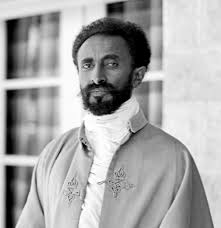
Following reconstruction, Haile Selassie helped form the Organisation of African Unity in 1963 and invited the new organization to keep its headquarters in the city. The OAU was dissolved in 2002 and replaced by the African Union (AU), also headquartered in Addis Ababa. The United Nations Economic Commission for Africa also has its headquarters in Addis Ababa. It is home to Addis Ababa University. The Federation of African Societies of Chemistry (FASC) and Horn of Africa Press Institute (HAPI) are also headquartered in Addis Ababa. Ethiopia has often been called the original cradle of humanity due to various humanoid fossil discoveries like the AustralopithecineLucy. Recent DNA evidence have suggested origins in south central Ethiopian regions like present-day Addis Ababa: after analyzing the DNA of almost 1,000 people around the world, geneticists and other scientists claimed people spread from what is now Addis Ababa 100,000 years ago. Enjoy video about the new flower, and all its cultural wealth.



















 African Heritage