The Omanhene Who Liked Riddles

omanhene
Omanhene of Akropong, Oseadeayo Addo Dankwa III (Tripdownmemorylane.blogspot.com)

THE Omanhene is the chief of a village. A certain Omanhene had three sons, who were very anxious to see the world. They went to their father and asked permission to travel. This permission he readily gave.

It was the turn of the eldest to go first. He was provided with a servant and with all he could possibly require for the journey.

After traveling for some time he came to a town where lived an Omanhene who loved riddles. Being a stranger the traveler was, according to custom, brought by the people before the chief.

The latter explained to him that they had certain laws in their village. One law was that every stranger must best the Omanhene in answering riddles or he would be beheaded. He must be prepared to begin the contest the following morning.

Next day he came to the Assembly Place, and found the Omanhene there with all his attendants. The Omanhene asked many riddles. As the young man was unable to answer any of them, he was judged to have failed and was beheaded.

After some time the second son of the Omanhene started on his travels. By a strange chance he arrived at the same town where his brother had died. He also was asked many riddles, and failed to answer them. Accordingly he too was put to death.

By and by the third brother announced his intention of traveling. His mother did all in her power to persuade him to stay at home. It was quite in vain.

kenkey
Kenkey (Foodiciary.com)

She was sure that if he also reached the town where his brothers had died, the same thing would happen to him. Rather than allow this, she thought she would prefer him to die on the way.

She prepared for him a food called kenkey—which she filled with poison. Having packed it away in his bag, he set off. Very soon he began to feel hungry. Knowing, however, that his mother had not wished him to leave home, and therefore might have put some poison in the food, he thought he would test it before eating it himself. Seeing a vulture nearby, he threw it half the cake.

The bird ate the kenkey, and immediately fell dead by the roadside. Three panthers came along and began to eat the vulture. They also fell dead.

The young man cut off some of the flesh of the panthers and roasted it. He then packed it carefully away in his bundle.

A little farther on he was attacked by seven highway robbers. They wanted to kill him at once. He told them that he had some good roast meat in his bundle and invited them to eat with him first. They agreed and divided up the food into eight parts.

While they were eating the young man carefully hid his portion. Soon all the seven robbers fell ill and died. The young man then went on his way.

At last he reached the town where his brothers had died. Like them, he was summoned to the Assembly Place to answer the riddles of the Omanhene. For two days the contest proved equal. At the end of that time, the young man said, “I have only one riddle left. If you are able to answer that, you may put me to death.” He then gave this riddle to the Omanhene:

Half kills one—
One kills three—
Three kills seven.

The ruler failed to answer it that evening, so it was postponed till the next day.
Kente cloth
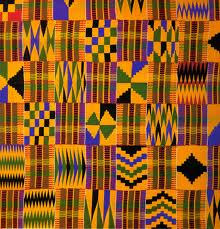
Kente cloth

During the night the Omanhene disguised himself and went to the house where the stranger was staying. There he found the young man asleep in the hall.

Imagining that the man before him was the stranger’s servant, and never dreaming-that it was the stranger himself, he roused the sleeper and promised him a large reward if he would give him the solution to the riddle.

The young man replied that he would tell the answer if the Omanhene would bring him the costume which he always wore at the Assembly.

The ruler was only too pleased to go and fetch it for him. When the young man had the garments quite safely, he explained the riddle fully to the crafty, Omanhene. He said that as they were leaving home, the mother of his master made him kenkey. In order to find out if the kenkey were good, they gave half to a vulture. The latter died. Three panthers which tasted the vulture also died. A little of the panther’s roasted flesh killed seven robbers.

The Omanhene was delighted to have found out the answer. He warned the supposed servant not to tell his master what had happened.

In the morning all the villagers assembled together again. The Omanhene proudly gave the answer to the riddle as if he himself had found it out. But the young man asked him to produce his ceremonial dress, which he ought to be wearing in Assembly. This, of course, he was unable to do, as the young man had hidden it carefully away.

The stranger then told what had happened in the night, and how the ruler had got the answer to the riddle by cheating.

The Assembly declared that the Omanhene had failed to find out the riddle and must die. Accordingly he was beheaded—and the young man was appointed Omanhene in his place.

This tale comes from: West African Folk-tales by W. H. Barker and C. Sinclair. Lagos, Africa: Bookshop, 1917




Final African Tally at the Rio 2016 Olympics

Rio2016_145 medals for Africa this year. A record. Wayde Van Niekerk, the South African, being the first African to win a gold medal in sprint, and also broke the world record established by Michael Johnson in 1999 on 400 m. Ethiopian Almaz Ayana also broke the 1993 record in 10000m.  Here are the remaining medals from the tally I published before the end of the games.

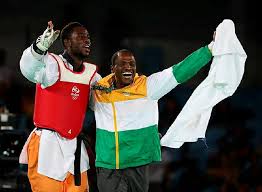
Cheikh Salla Cisse gave Côte d’Ivoire its very first Gold medal (in less than 80 kg Taekwondo men)


Cisse1
Cheikh Salla Cisse

Caster Semenya – 800 m women (South Africa) – Gold


Ruth Gbagbi – Taekwondo less than 67 kg women (Côte d’Ivoire) – Bronze

Francine Niyonsaba – 800 m women (Burundi) – Silver

Margaret Nyairera Wambui – 800 m women (Kenya) – Bronze

Nigeria men Soccer team – Bronze

Semenya
Caster Semenya

Eliud Kipchoge – Men Marathon (Kenya) – Gold

Julius Yego – Men Javelin (Kenya) – Silver

Almaz Ayana – 5000 m women (Ethiopia) – Bronze

Hagos Gebrhiwet – 5000 m men (Ethiopia)- Bronze

Feyisa Lilesa – Men Marathon (Ethiopia) – Silver

Taoufik Makhloufi – 1500 m Men (Algeria) – Silver

Abdoulrazak Issoufou Alfaga – over 80kg Taekwondo men (Niger) – Silver

Oussama Oueslati – less than 80 kg Taekwondo men (Tunisia) – Bronze

Hellen Obiri – 5000 m women (Kenya) – Silver

Vivian Cheruiyot – 5000 m women (Kenya) – Gold


Proverbe Bété sur l’Oisiveté / Bété Proverb on Idleness

nose1Quand le doigt ne sait où aller, il entre dans le nez (Proverbe Bété – Côte d’Ivoire) .- Trop d’inactivité conduit l’homme à n’importe quelle bêtise.

When the finger knows not where to go, it goes into the nose (Bété proverb – Côte d’Ivoire). – Too much inactivity leads the man to commit any sort of stupidity.

African Colors at the Rio 2016 Olympics

Rio2016_1Thus far, African colors have been flying high at the Rio 2016 olympics, with 31 medals. Here are the names and the medals by country. Congratulations to all the athletes. They make us proud!

Chad LeClos – 200 m freestyle (South Africa) – Silver

LeClos
Chad LeClos

Chad LeClos – 100 m butterfly (South Africa) – Silver

Shaun Keeling – Rowing (South Africa) – Silver   

Cameron van Der Burgh – 100 m breaststroke ( South Africa) – Silver

Dylan Sage – Rugby (South Africa) – Bronze

Seabelo Senatla – Rugby (South Africa) – Bronze

Lawrence Brittain – Rowing (South Africa) – Silver

Rudisha
David Rudisha

David Rudisha – 800 m men (Kenya) – Gold

Taoufik Makhloufi – 800 m men (Algeria) – Silver

Sara Ahmed – weightlifting women (Egypt) – Bronze

Mohamed Mahmoud – weightlifting men (Egypt) – Bronze

Hedaya Malak – Taekwondo women (Egypt) – Bronze

Marwa Amri – Wrestling – less than 58 kg (Tunisia) – Bronze

Ines Boubakri – Fencing (Tunisia) – Bronze  

Ayana1
Almaz Ayana

Almaz Ayana – 10000 m women (Ethiopia) – Gold

Vivian Cheruiyot – 10000 m women (Kenya) – Silver

Tirunesh Dibaba – 10000 m women (Ethiopia) – Bronze

Jemima Sumgong – Women Marathon (Kenya) – Gold

Mare Dibaba – Women Marathon (Ethiopia) – Bronze

Niekerk
Wayde van Niekerk

Wayde van Niekerk – 400 m men (South Africa) – Gold

Hyvin Jepkemoi – 3000 m steeplechase (Kenya) – Silver

Mohamed Rabii – Weight Welters men 69 kg (Morocco) – Silver

Faith Kipyegon – 1500 m women (Kenya) – Gold

Gensebe Dibaba – 1500 m women (Ethiopia) – Silver

Conseslus Kipruto – 3000 m men steeplechase (Kenya) – Gold

Paul Tanui – 10000 m men (Kenya) – Silver

Kipyegon1
Faith Kipyegon

Tamirat Tola – 10000 m men (Ethiopia) – Bronze

Luvo Manyonga – Long jump men (South Africa) – Silver

Sunette Viljoen – Women javelin (South Africa) – Silver

Henri Schoeman – Triathlon men (South Africa) – Bronze

Boniface Mucheru – 400 m hurdles men (Kenya) – Silver

“Nuit de Sine” Léopold Sédar Senghor / “Night in Sine” by Leopold Sedar Senghor

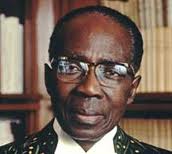
Léopold Sédar Senghor

Today, I will publish another poem,” Nuit de Sine / Night in Sine,” by Léopold Sédar Senghor. The poem was published in Oeuvre Poetique, Paris, Seuil, 1990 P. 14-15.  The English translation was done by Melvin Dixon, in The Collected Poems, 1998, Univ. of Virginia Press.

Nuit de Sine

Femme, pose sur mon front tes mains balsamiques,
tes mains douces plus que fourrure.
Là-haut les palmes balancées qui bruissent dans la haute brise nocturne
À peine. Pas même la chanson de nourrice.
Qu’il nous berce, le silence rythmé.
Écoutons son chant, écoutons battre notre sang sombre, écoutons
Battre le pouls profond de l’Afrique dans la brume des villages perdus.

Voici que décline la lune lasse vers son lit de mer étale
Voici que s’assoupissent les éclats de rire, que les conteurs eux-mêmes
Dodelinent de la tête comme l’enfant sur le dos de sa mère
Voici que les pieds des danseurs s’alourdissent,
que s’alourdit la langue des chœurs alternés.

C’est l’heure des étoiles et de la Nuit qui songe
S’accoude à cette colline de nuages, drapée dans son long pagne de lait.
Les toits des cases luisent tendrement.
Que disent-ils, si confidentiels, aux étoiles ?
Dedans, le foyer s’éteint dans l’intimité d’odeurs âcres et douces.

Femme, allume la lampe au beurre clair, que causent autour les Ancêtres
comme les parents, les enfants au lit.
Écoutons la voix des Anciens d’Elissa. Comme nous exilés
Ils n’ont pas voulu mourir, que se perdît par les sables leur torrent séminal.
Que j’écoute, dans la case enfumée que visite un reflet d’âmes propices
Ma tête sur ton sein chaud comme un dang au sortir du feu et fumant
Que je respire l’odeur de nos Morts, que je recueille et redise leur voix vivante,
que j’apprenne à
Vivre avant de descendre, au-delà du plongeur,
dans les hautes profondeurs du sommeil.


Night in Sine

Woman, place your soothing hands upon my brow,
Your hands softer than fur.
Above us balance the palm trees, barely rustling
In the night breeze. Not even a lullaby.
Let the rhythmic silence cradle us.
Listen to its song. Hear the beat of our dark blood,
Hear the deep pulse of Africa in the mist of lost villages.

Now sets the weary moon upon its slack seabed
Now the bursts of laughter quiet down, and even the storyteller
Nods his head like a child on his mother’s back
The dancers’ feet grow heavy, and heavy, too,
Come the alternating voices of singers.

Now the stars appear and the Night dreams
Leaning on that hill of clouds, dressed in its long, milky pagne.
The roofs of the huts shine tenderly. What are they saying
So secretly to the stars? Inside, the fire dies out
In the closeness of sour and sweet smells.

Woman, light the clear-oil lamp. Let the Ancestors
Speak around us as parents do when the children are in bed.
Let us listen to the voices of the Elissa Elders. Exiled like us
They did not want to die, or lose the flow of their semen in the sands.
Let me hear, a gleam of friendly souls visits the smoke-filled hut,
My head upon your breast as warm as tasty dang streaming from the fire,
Let me breathe the odor of our Dead, let me gather
And speak with their living voices, let me learn to live
Before plunging deeper than the diver
Into the great depths of sleep.


Proverbe sur l’Acceptation de Soi / Proverb on Self Acceptance

bull2
Bull

C’est au taureau que sièrait la barbe, mais c’est au bouc que Dieu l’a donnée (Proverbe Sérère – Sénégal). Ce n’est pas nous qui décidons de ce que nous avons, le Créateur c’est Dieu.

boucIt is to the bull that the beard would fit better, but God gave it to the goat (Serer proverb – Senegal). We do not decide of our talents, the Creator is God.
Reclaiming African History: Gorée and the Slave Trade in Senegal

Goree_Le_fort_d'Orange_et_de_Nassau_à_l'île_de_Gorée_17th century
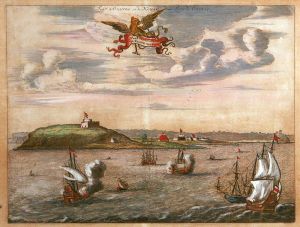
Goree Island: Fort of Nassau and Orange, 17th century (Wikipedia)

Today I will be talking about the island of Gorée, in Senegal. Located less than 4 km from the city of Dakar, Gorée island offers a sure route for ships. Since the 15th century, it has been the center of rivalries between diverse European nations which used it for slave trading. Locally known as “Beer” or “Ber” or “Bir” in Wolof, it was first named “La Palma” by Portuguese in 1444, with some ancient maps also showing the name “Beseguiche” for it. The Dutch navy named it “Goede Reede” or “Good Harbor” in 1588. In 1677, the island was occupied by the French.

Goree_Map_of_Goree
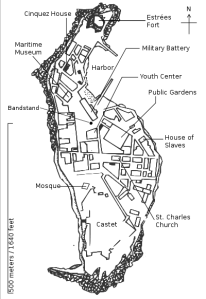
Map of Goree (Wikipedia)

Before I dive further into the atrocities of human trading on the island, I would like to address ideas circulated by some stating that the island of Gorée was never really used for slave trading and that slave trading had been done in Saint Louis in the north or south in Gambia. These claims were so outrageous that the Senegalese government sponsored an international conference on the history of the island, and researched and found original archives from the French Port of Nantes showing that between 1763 and 1775 alone, one port had traded more than 103,000 slaves from Gorée; this thus shows that Gorée was indeed at the epicenter of slave trading, and stating otherwise is an attempt at falsifying history. The first slaves were taken from Gorée in 1536, and the trade continued at least until 1848.

Goree1w
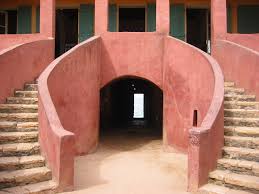
House of Slaves (Wikipedia)

Now back to the island itself. One of the most important if not the main stop on the island is the house of slaves. Of Reddish/pinkish color, this house was first built by the Dutch in 1776, and is the last standing slave house on the island. At the end of the 18th century, the island was a prosperous crossroad of merchants, soldiers, and administrators, with at its center slave trade. Today, it serves as a museum and a memorial to humanity. The upper part of the building like most slave houses was used by the Europeans who lived there; while the bottom part was used to house slaves packed on top of each other in humid, sordid, and disgusting rooms built for 15-20 people but housing sometimes over 100 people, while waiting to be taken to the Americas. On the bottom floor, there is a room used to pack young women among which the slave traders would come every night and choose those who will be used for their sexual pleasures; if any of these women were found pregnant from these traders’ visits, they were freed on the island or sent to Saint Louis. There were also rooms to house strong men, children, and women. There was also a dark tiny room where the most defiant ones were stacked on top of each other, and salty water was seeped through the walls to force dehydration and later death. The value of a man depended on his weight and muscles; the minimum weight was 60 kg. The value of a child depended on his/her denture, while that of a woman on her breasts.

Goree_Jeunes filles
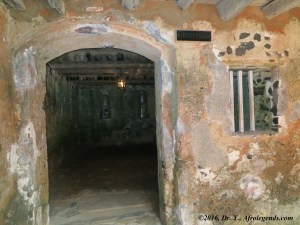
Cell for young girls in the House of Slaves

The small size of the island made it easy for merchants to control their captives. The surrounding waters are so deep that any attempt at escaping would mean sure drowning. With a 5kg metal ball permanently attached to their feet or necks, a captured African who ever tried running away would surely drown in deep sea.

From the door of no return, the slaves were loaded onto ships which took them across the Atlantic. This was their last time on African soil.

Entire families were captured and brought to Gorée, but their destinations were seldom the same: the father could be shipped to America, while the Mother to Brazil, and the child to Haiti or the West indies. Separation was irrevocable.

Goree_Cellule
Cell in the House of Slaves

Not too far from the house of slaves is the castle which was used as a warehouse for millions of captured slaves.

After the abolition of slavery in 1848, the island’s population declined, with many moving to Dakar. Since 1978, the island is a UNESCO World Heritage Site.

Today the island of Gorée is a memorial to all those who were separated from their loved ones, their lands, their society, their culture, uprooted and sold like cattle across the globe. It serves as a reminder of humanity’s ugly past, and what it is capable of for capital gain, hatred, and greed. Gorée is and should remain all of that, but also a true reminder to future generations that mankind should be loved, and a man’s life is precious, not to be sold like cattle. Attempts by some to absolve themselves from their ugly pasts should not stop those who were hurt from remembering, for celebrating the lives of those who perished, who were uprooted, and those who survived. Truth is truth whether beautiful or not, it is truth, and remembering is acknowledging all the good those who lost their lives, those who survived, gave to the world, because America will not be America without the Slaves’s lives and hard labor; Brazil will not be Brazil without the blood of those slaves; France will not be France, or Great Britain will not be Great Britain without the sweat and blood of African slaves. So Gorée is a reminder of all of that, and should be cherished for it.

Proverbe Douala sur la Persévérance / Duala Proverb on Perseverance

poule3
La poule / The hen

La poule se dit: fouillons des deux pattes; si l’une ne trouve rien, l’autre trouvera (Proverbe Douala – Cameroun).- Ne pas abandoner après un insuccès.

The hen says: “let’s search with two feet; if one does not find, the other will” (Duala proverb – Cameroon). – Do not abandon after a failure.

How to Heal Fear

There once was a man who was walking alone in the forest. He walked for so long that he got hungry. He stopped in a village. There, he was given food, ate so well that he renounced to continue on his trip. He took a wife among the young women of the village, started a home, and no longer thought of leaving.

Lion
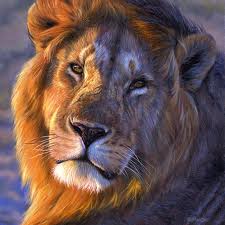
Lion

One day, after a good meal, the man decided to go to the forest which, unfortunately, was full of beasts, especially lions. The man knew not this.  As soon as he walked in, the king of the jungle came out with a long roar. Scared, the trembling old man peed on himself. The lion got close, and the old man  rushed into a thorny bush. The lion searched in vain; it could not find the man. However, it remained on the lookout for a week, then left disgusted. Then the old man stayed in his bush, completely stunned by his fate. A hunter came around. The man heard his footsteps and called out:

  • Who goes there?
  • It’s me
  • Who are you?
  • I am a hunter looking for game.
  • Hunter friend, could you please get me out of here?
  • But how did you manage to get in there?
  • It is big fear that drove me in here.
  • Then! It is a big fear that will get you out soon!
  • So what will you do?
  • You will know shortly.
feu3
Fire

Then the hunter started collecting firewood under the bush. All of a sudden, he put a fire in several places around the bush. Frightened, the old man rushed out, and with a violent head kick in the thorns, got himself out of danger.

The hunter welcomed him with a large smile. They hugged and became friends.

Told by Amsata Dieye, Contes Wolof du Baol, J. Copans and P. Couty, Ed. Karthala, 1988, p. 81. Translated to English by Dr. Y., Afrolegends.com

Proverbe Fang sur l’Experience / Fang Proverb on Experience

20150724_Gorille
Gorille / Gorilla

On n’apprend pas le chemin au vieux gorille (Proverbe Fang – Cameroun, Gabon, Guinée Equatoriale).

You cannot teach the way to an old gorilla (Fang proverb – Cameroon, Equatorial Guinea, Gabon).