Royal Resistance to Slavery: the Case of an Almany of West Africa in 1780s

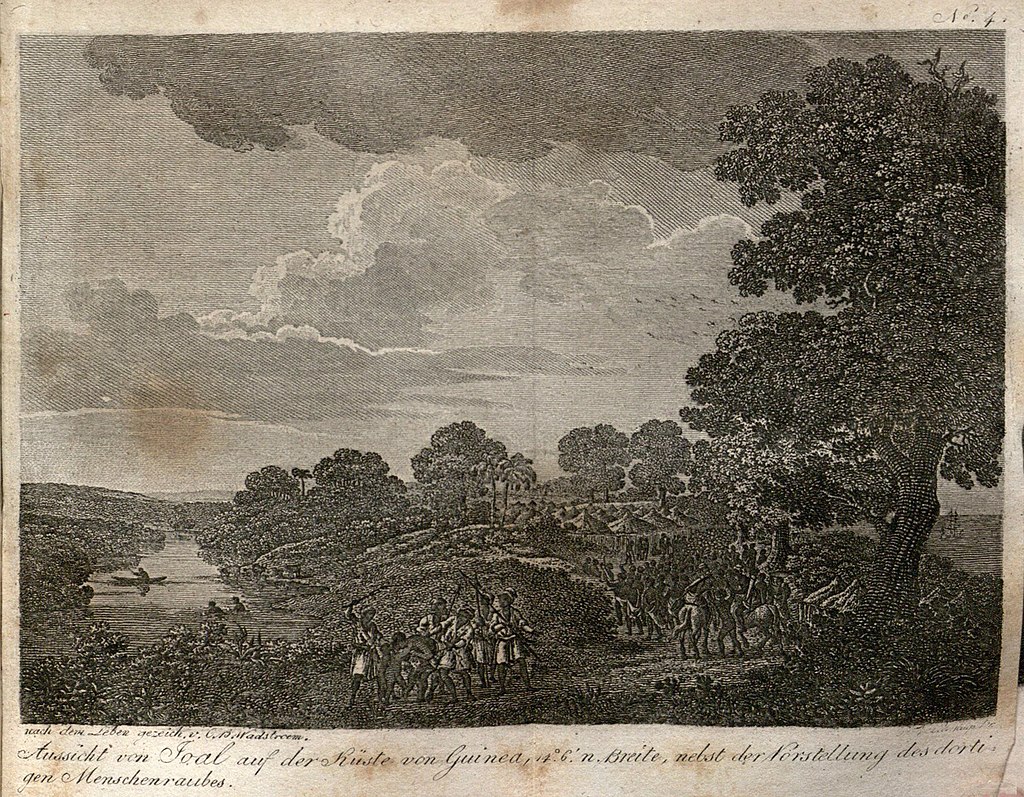
View from Joal on the coast of Guinea, 14° and an idea of the kidnapping of slaves there (Carl Wadstrom, ca 1802)

The Swede abolitionist and explorer Carl Bernhard Wadström (Charles Berns Wadstrom) once described his travel in Africa from 1787-1788 with fellow Swede Anders Sparrman. He wrote of an African king’s resistance to slavery and the kindness he observed. In 1790, he was called to testify in front of the British Government Select Committee; his testimony was published on 11 May 1790 in a report entitled “Minutes of the evidence taken before a Committee of the House of Commons, being a Select Committee, appointed to take the Examination of Witnesses respecting the African Slave Trade.”

An African King who was called King of Almamany [Dalmanny] “had entirely prohibited the Slave trade throughout his whole Kingdom, so that they could no longer contact the French slave traders anchored in the mouth of the Senegal [river].” He also banned the sale of alcohol. However, the Senegal Company [Compagnie du Sénégal], a French company which administered the territories of Saint-Louis and Gorée island as part of French Senegal, initially attempted to bribe the King to change his policy on the trade in people, but he refused their presents. Consequently, the Senegal Company resorted to bribing the lighter-skinned Moors to attack and kidnap Dalmanny’s subjects. The Company supplied the Moors with the necessary arms, gunpowder and ammunition to carry out the raids [does it not remind of something today in West Africa with all these jihadists? History repeats itself]. Many of his subjects were made prisoners and taken into slavery. Wadstrom himself had seen a few in the enclosures. They were chained two by two by the ankles; wounded in combat, they did not receive any kind of care. There were also individual kidnappings. Wardstrom said that “Negroes never venture to go out into the fields unless very well armed.”

From Bwemba Bong, Quand l’Africain etait l’or noir de l’Europe. L’Afrique: actrice ou victime de la traite des noirs? MedouNeter (2022), p. 165; George Kay, La Traite des Noirs, Robert Laffont (1968) p.129

Royal Resistance against Slavery: the Case of Afonso I, King of the Kongo Empire

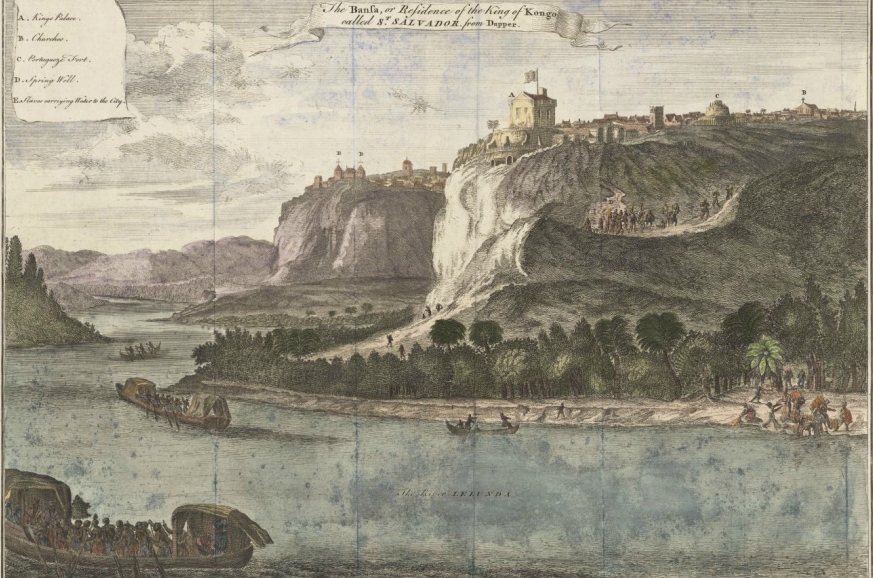
Mbanza Kongo, capital of the Kingdom of Kongo, in 1745

History repeats itself! It is extremely important to know our history. We have already shown that the narrative that states that African kings sold “their” own into slavery was very flawed and was made up to shift the blame of slavery from the European merchants and their powers (kings and queens, the Catholic church with the papal bull, and much more) to the Africans themselves (the victims). How many times in modern day have we seen how the blame is placed on the victim rather than the aggressor? As we read here another account of an African king who hated slavery, it is important to note the similitude with modern days: the king did not want slavery, therefore attempts were made on his life; does it not remind you of Patrice Lumumba, Sylvanus Olympio, Amilcar Cabral, Ruben Um Nyobé, and so many… when African leaders opposed the narrative being played, they were eliminated! And this behavior spans centuries! Below is the account of an attempt made on King Afonso I [King Nzinga Mbemba] on his life; this is the same Kongo king who wrote to the King of Portugal against Slavery.

The hatred devoted by Affonso I [King Nzinga Mbemba] to the overseas slave trade and the vigilance he maintained so as not to see his authority erode earned him the animosity of some of the Portuguese merchants living in the capital. On Easter Sunday 1540, eight of them tried to make an attempt on his life while he was attending mass. He escaped, a bullet having simply passed through the fringe of his royal tunic, but one of the nobles of his court was killed and two others wounded.

Adam Hochschild,  King Leopold’s Ghost: A Story of Greed, Terror, and Heroism in Colonial Africa p. 228

Proverbe Angolais sur les clients / Angolan Proverb on Customers

Quem faz muitas perguntas nunca compra nada (provérbio ovimbundu – Angola)

Celui qui pose trop de questions, n’achète jamais rien (proverbe Ovimbundu – Angola)

The one who asks too many questions never buys anything (Ovimbundu proverb – Angola)

‘Iwájú’, First Pan-African Series to premiere on Disney+

For the past few days, I have received several messages about Iwájú, the first pan-African series to premiere on Disney+. I congratulate the authors, and send them encouraging messages to keep up the great work.

Excerpts below are from AfricaNews.

=====

Video on demand service Disney+ has collaborated with pan–African studio Kugali Media for a innovative animated series set in futuristic Lagos – Nigeria.

The series which is expected to premiere globally on February 28 explores themes of class and defiance. …

Iwájú’s casted Nigerian vocal talents Simisola Gbadamosi as Tola, a young girl from the wealthy island, and Siji Soetan as her best friend Kole, a self-taught tech expert.

The duo explore the dangerous tapestry of a neo-futuristic Lagos filled with greed and corruption alongside voice actors Femi Branch, Dayo Okeniyi, and Weruche Opia.

The soundtrack, out March 1st, will feature African-influenced music by renowned Nigerian composer Ré Olunuga. “I rarely bring my own emotions into writing a score. In this case, it couldn’t be avoided,” Olunuga said in a press release.

In addition to Tola’s adventurous spirit, Kole’s ingenuity, and the many other fun and beautiful emotional threads explored in Iwájú – the score is steeped in my own very deep love for Lagos and its multiplicitous layers.”

‘Ma vie est une chanson / My Life is a Song’ by Francis Bebey

music_1Below is ‘Ma vie est une chanson‘ or ‘My Life is a Song‘, a love poem by Cameroonian author Francis Bebey, a poem celebrating his love for the African woman, in this case for his lover. As we remember that Francis Bebey was multi-talented as a journalist, writer, sculptor and musician, it is no surprise that the title of his poem is “My Life is a Song”. He even headed the UNESCO music department researching and documenting traditional African music. In the poem, he highlights that he was born from the love of the earth with the sun, thus a birth that was very celebrated and a life full of love. As we read the poem, Bebey’s love for his country is abundantly clear as he dreams of taking his lover there, and not only that, but lets her know that his country is where to find the love between the earth and the sun; it is almost as if he was telling all that he was born on the equator. Moreover, let’s face it, the link between the earth and the sun is undeniable, unbreakable, unavoidable, constant, and forever omnipresent. He is so taken by the love so much so that his life is a song that he will sing everyday to his precious one. Wouldn’t you all like to be loved like that? Enjoy!

The poem Ma vie est une chansonby Francis Bebey, was published in Anthologie africaine: poésie, Jacques Chevrier, Collection Monde Noir Poche, Hatier 1988. Translated to English by Dr. Y. Afrolegends.com.

Ma vie est une chansonOn me demande parfois d’où je viens

Et je reponds “je n’en sais rien

Depuis longtemps je suis sur le chemin

Qui me conduit jusqu’ici

Mais je sais que je suis né de l’amour

De la terre avec le soleil”

Toute ma vie est une chanson

Que je chante pour dire combien je t’aime

Toute ma vie est une chanson

Que je fredonne auprès de toi

Ce soir il a plu, la route est mouillée

Mais je veux rester près de toi

Et t’emmener au pays d’où je viens

Ou j’ai caché mon secret

Et toi aussi tu naîtras de l’amour de la terre avec le soleil

Toute ma vie est une chanson

Que je chante pour dire combien je t’aime

Toute ma vie est une chanson

Que je fredonne auprès de toi.

My Life is a SongI am sometimes asked where I come from

And I answer “I don’t know

For a long time I have been on the way

That leads me here

But I know that I was born from the love

between the land and the sun”

My whole life is a song

That I sing to tell you how much I love you

My whole life is a song

That I hum next to you

Tonight it has rained, the road is wet

But I want to stay close to you

And take you to the land where I come from

Where I hid my secret

And you too will be born from the love of the earth with the sun

My whole life is a song

That I sing to tell you how much I love you

My whole life is a song

That I hum next to you.

CAN 2023: the Elephants of Côte d’Ivoire are the New Champions

The Elephants are winners of the Africa Cup of Nations 2023 (Source: CAFonline.com)

The 2023 Africa Cup of Nations or Coupe d’Afrique des Nations CAN2023 has ended with a new champion: the Elephants of Côte d’Ivoire, the host country, which took home the trophy for the third time in its history, defeating the Super Eagles of Nigeria 2-1. The Elephants have really given us a thrill from being redeemed in the knockout stage with 2 defeats (among which a 4-0 loss against Equatorial Guinea) that left them open to elimination, and a redemption that came from being one of the four best 3rd-placed team, a coach sacking, and a coach change. The change in coach, and the redemption really made the Elephants more serious. The Ivorians add to their previous Nations Cup wins in 1992 and 2015 (Côte d’Ivoire wins the 2015 Africa Cup of Nations) and become the first tournament hosts to triumph since Egypt lifted the trophy in 2006. The Elephants pick up $7m (£5.54m) in prize money, while the Super Eagles get $4m by the Confederation of African Football (CAF).  The Bafana Bafana of South Africa took home the third place after defeating the Leopards of the Democratic Republic of Congo (DRC).

Akwaba, the elephant welcomes you to Cote d’Ivoire (Source: COCAN2023.ci)

This year’s mascot, the elephant, named “Akwaba“, which means “Welcome” in Baoulé language, has been a testimony to the welcome and legendary Ivorian hospitality felt by teams and visitors throughout the tournament. There were quite a few upsets in the competition’s group stage, Algeria, Tunisia, and Ghana were the big ones, getting knocked out in the first round. The cup also allowed us to see or reveal some strong teams like Cape Verde, Mali, Angola, Mauritania, Equatorial Guinea, and Democratic Republic of Congo. It was a tournament that uncovered some great teams and plays.

Elephants celebrating their win (Source: Eurosport.com)

Ivory Coast’s unlikely progression through the knockout stage as it overcame setback after setback convinced many devout Ivorians that God was on the team’s side. As the naming goes, the team inherited the nickname “Zombies” as they really came from behind to win, never giving up, to triumph as the 34th edition of the Africa Cup of Nations. Interim coach Emerse Faé, who took the head of the team after the French coach was sacked due to the very poor results in the group stage knockout, rightfully said, “It was an extraordinary tournament.” Indeed, it was an extraordinary tournament, and we salute all the teams that made us vibrate for the whole month, and ultimately congratulate the Elephants on their win.

One of the Last International Acts of President Geingob: Support Against Genocides

Flag of Namibia

A few weeks ago, the Namibian government then represented by President Hage Geingob issued one of the strongest expressions of solidarity to the Palestinians facing the blows of Israel’s ongoing destruction of Gaza on January 13, in support of South Africa’s case bringing the charge of genocide against Israel to the International Court of Justice. It issued the following statement in response to the German government’s decision to officially support Israel’s denial of these charges [Namibia criticizes Germany]:

Namibia rejects Germany’s support of the genocidal intent of the racist Israeli state against innocent civilians in Gaza. Germany committed the first genocide of the twentieth century in 1904–1908, in which tens of thousands of innocent Namibians died in the most inhumane and brutal conditions . . . President [Hage] Geingob appeals to the German Government to reconsider its untimely decision to intervene as a third-party in defense and support of the genocidal acts of Israel before the International Court of Justice.

The German Government is yet to fully atone for the genocide it committed on Namibian soil…

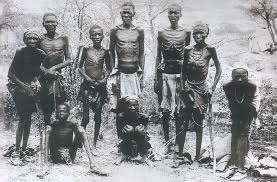
Survivors of the Herero genocide (Wikimedia)

It is no secret that the first genocide of the 20th century was perpetrated by Germany on African soil, in Namibia. It was extremely brutal and almost wiped out all Nama and Herero people. It was a campaign of racial extermination and collective punishment that the German Empire undertook in German South-West Africa (modern-day Namibia) against the Herero and Nama people [Germany in Namibia: the First Genocide of the 20th CenturyGermany Returns Skulls of Namibians Genocide VictimsNamibia Rightfully Rejects 10 million Euros Compensation for Genocide].

Proverbe Namibien / Namibian Proverb

Namibia landscape seen from above, approaching Windhoek

La terre est la reine de tous les lits (proverbe Nama – Namibia).

Earth is the queen of beds. — (Nama proverb – Namibia)

So Long Hage Geingob, Third President of Namibia

President Hage Geingob (Source: TheHealthSite)

The third president of Namibia, Hage Geingob, passed away this past Sunday in Windhoek, Namibia, from cancer. As a strong freedom and anti-apartheid activist, in his early years, he fought to set the international stage for the South West Africa People’s Organization (SWAPO) and the Namibian fight for independence from South Africa. After exile in Botswana, and the United States where he studied, he advocated for the acceptance of SWAPO which was ultimately recognized by the United Nations General Assembly as the sole and authentic representative of the people of Namibia. Namibians’ struggle at the international fora, and their armed struggle launched in 1966, eventually led to the independence of Namibia in 1990 from South Africa. Like Cameroon, Togo, or Tanzania, Namibia had been a German colony known as German South West Africa established in 1884, until Germany lost world War I, after which the League of Nations gave the country to the United Kingdom as a mandate under the administration of South Africa; it was simply like a de facto fifth province of South Africa.

Flag of Namibia

Geingob had served the country as its first prime minister from 1990 to 2002, and then later from 2012 to 2015. Between 2008 and 2012, Geingob served as Minister of Trade and Industry. In 2015, after elections, he became president of the nation, and was set to finish his second and final term this year. Upon his passing on February 4, his deputy, Vice President Nangolo Mbumba, was sworn in as acting president in the capital, Windhoek, to complete the term as allowed by the constitution. Mbumba will be in office until next year, when the winner of this year’s November election will take office.

The Namibian nation has lost a distinguished servant of the people, a liberation struggle icon, the chief architect of our constitution and the pillar of the Namibian house,” the office of the presidency said.

South African President Cyril Ramaphosa described Geingob as “a towering veteran of Namibia’s liberation from colonialism and apartheid.”

Kenyan President William Ruto said Geingob “strongly promoted the continent’s voice and visibility at the global arena.”

Zimbabwe’s President Emmerson Mnangagwa posted on X that Geingob’s “leadership and resilience will be remembered.”

Freedom rather than Slavery by Sekou Touré

Sekou Toure, Cover Time Magazine, Feb. 16, 1959

President Sekou Touré of Guinea was the first president of a country in what was then colonial French Africa to say ‘NO’ to France by asking for its independence []. 66 years later, his words still ring true, especially as we watch the struggle for freedom of Mali, Burkina Faso, and Niger [Mali – Burkina Faso – Guinea Agree to form a Tri-Country AxisMali and Niger end Long-Standing Tax Treaties with FranceMali, Burkina Faso, and Niger Sign a Mutual Defence Pact]. Africans are still not free of their own destinies [The 11 Components of the French Colonial Tax in AfricaAfrica is funding Europe!], and it is only normal to fight for it.

On 25 August 1958, Sekou Touré said: “Il n’ya pas de dignité sans liberté. Nous préférons la liberté dans la pauvreté à la richesse dans l’esclavage.”

[There is no dignity without freedom. We prefer freedom in poverty to wealth in slavery].