As of June 2025, the Zimbabwean government has announced that exports of raw lithium concentrate will be banned starting in January 2027. This move is meant to push mining companies to build local processing plants and keep more of the value chain within the country, thus helping towards the country’s development, and stopping the cycle of exports of raw materials and barely anything (The Lithium of Zimbabwe). This should also create employment for the locals.
Lithium
Several Chinese firms—like Sinomine and Zhejiang Huayou Cobalt—are already building lithium sulfate plants at the Bikita and Arcadia mines. These facilities will refine lithium concentrate into lithium sulfate, a key ingredient for battery-grade chemicals like lithium carbonate and hydroxide.
There is not yet a full refinery built, but this ban indicates Zimbabwe’s clear shift from being just a raw exporter of lithium. Given the importance of lithium in the electric car revolution as a material for batteries, this is really a game changer. We applaud Zimbabwe, and call other countries to learn from Zimbabwe, Mali, Burkina Faso, and Niger.
Kwame Nkrumah
This is where the dream of Kwame Nkrumah, of a real African Union, comes back; we are not talking about the current union which is just a puppet organization serving the interest of the Western powers. Kwame Nkrumah: African Visionary and Ghana’s First President. Currently, each country is negotiating individually, which may yield good or not so good results, if they do not have good negotiators or good mining lawyers in the case of lithium for instance. However, some would end up being taken advantage of just because they are not exposed to the new changes, don’t know, and could accept really low prices which may affect even their neighbors. Being United would insure good negotiations across the board learning from others, and also ensure that the multinationals respect the local governments and populations; and if they are kicked out of one country because of law or contract infringements, that they do not just run to another to perpetuate the cycle. This is what the AES is doing (The AES Creates a Joint Military Force), and all African countries should.
After almost 2 years of talking, the Zimbabwe gold-backed currency is finally upon us. Inflation is everywhere at the gas pump, at the food store, rent, prices are going up and up, affecting everyone and making the poor even poorer. In Zimbabwe, it has been going up for years given that the country has been under economic embargo for over 2 decades now. The traitors who toppled Robert Mugabe thought that by getting rid of him, the West would finally lift the embargo… alas, it has not been the case, and the country is still under embargo from the UK, US, and EU. Just at the beginning of March, the US slapped fresh sanctions against President Mnangagwa and some of his cronies, even though Mnangagwa has signed all sort of deals with the westerners upon his arrival in power [Is Zimbabwe the New Haiti?] and returned land [Zimbabwe to Return Seized Land to Foreigners].
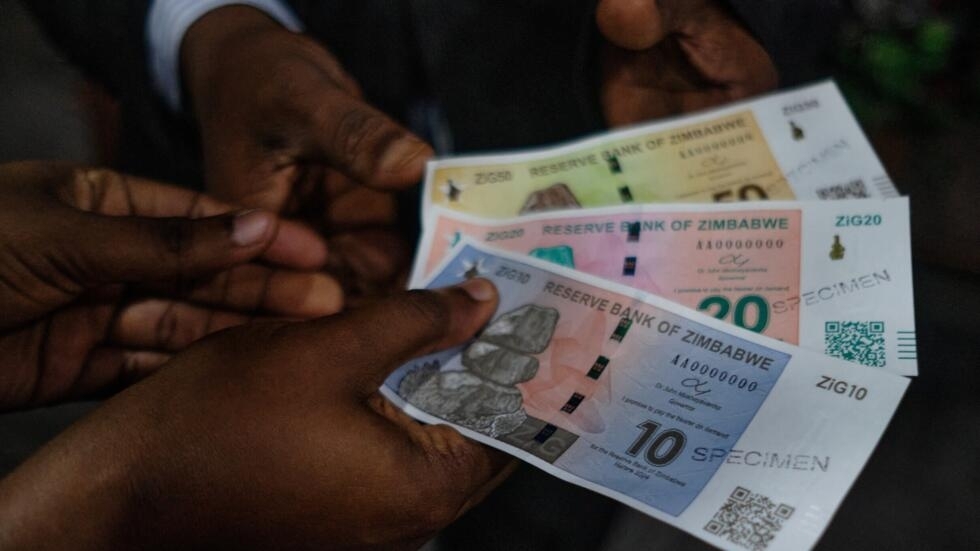
Zimbabwe’s new currency, the ZiG (Source: France24)
As stated earlier, it is no secret that inflation is particularly high in Zimbabwe and has been for many years. Last week, the government of Zimbabwe has introduced a new gold-backed currency called ZiG, which stands for Zimbabwe Gold, in an effort to try to alleviate inflation, and stabilize the economy. The currency has been rolled out on Monday, and will replace the Zimbabwean dollar immediately; companies will be made to pay at least half of their taxes in ZiG. We hope that this will help the Zimbabwean economy to stay afloat. In honesty, isn’t this the way every currency should be: backed by gold and not just thin air? Upon its launch on Monday, the ZiG has fared well, and the hope is that it continues.
Excerpts below from the BBC. For a good read, check out also Business Insider.
=====
John Mushayavanhu, Governor of the Reserve Bank of Zimbabwe, presents the new national currency Zimbabwe Gold, or ZiG. (Source: Columbus Mavhunga/picture alliance/Getty Images; Business Insider)
Zimbabwe has introduced a new gold-backed currency called ZiG – the name stands for “Zimbabwe Gold”.
It is the latest attempt to stabilise an economy that has lurched from crisis to crisis for the past 25 years.
Unveiling the new notes, central bank governor John Mushayavanhu said the ZiG would be structured, and set at a market-determined exchange rate. The ZiG replaces a Zimbabwean dollar, the RTGS, that had lost three-quarters of its value so far this year. Annual inflation in March reached 55% – a seven-month high.
Zimbabweans have 21 days to exchange old, inflation-hit notes for the new currency. However, the US dollar, which accounts for 85% of transactions, will remain legal tender and most people are likely to continue to prefer this.
The new ZiG banknotes come in denominations of between 1 and 200. Coins will also be introduced to overcome the shortage of US coins, which has seen people receive change in sweets, small chocolates and pens.
Mr Mushayavanhu said the new currency was being rolled out with immediate effect and banks must convert current Zimbabwe dollar balances to the ZiG. He committed to ensuring that the amount of local currency in circulation was backed by equivalent value in precious minerals – mainly gold – or foreign exchange, in order to prevent the currency losing value like its predecessors.
Big deposits of lithium found in Zimbabwe has made it Africa’s largest lithium reserve. It is no secret that there have been big efforts worldwide to develop renewable energy sources, thus leading to a growing demand for batteries to supply the car industry as there is a push for electric vehicles. Zimbabwe hopes to become one of the world’s largest exporters of lithium. In July of this year, a Chinese mining company completed the $300m construction of a lithium mine in Zimbabwe. Presidential elections which will take place this month will determine the future of Zimbabwe’s resources.
To cash in on the global demand, Zimbabwe last year banned the export of raw lithium ore. In doing so, it joined countries like Indonesia and Chile that are trying to maximize their return on deposits of lithium, cobalt and nickel by requiring miners to invest locally in refining and processing before they can export. Let’s hope that these resources will actually help Zimbabweans and not line up the pockets of Mnangagwa and cronies.
Chinese investors racing to secure lithium supplies could help Zimbabwe rise to become the world’s fifth biggest primary producer of the material that’s vital to battery electric vehicles and the green revolution, mining consultancy CRU said.
The lithium industry in Africa’s top producer has rapidly expanded, buoyed by about $1 billion of investments during the past two years by Chinese companies including Zhejiang Huayou Cobalt (603799.SS), Sinomine Resource Group (002738.SZ), Chengxin Lithium Group (002240.SZ) and Yahua Group (002497.SZ).
… The investments could boost capacity to 192,000 tons of lithium carbonate equivalent (LCE) per year of petalite and spodumene in 2027, from 13,000 tons per year LCE in 2022, Cameron Hughes, a battery markets analyst at CRU said in a report.
“These investments will place Zimbabwe as the fifth largest primary producer of lithium by 2025, after Argentina, contributing more than either Canada or Brazil,” Hughes said.
It is no secret that prices are high everywhere: at the gas pump, at the food store, rent, prices are going up and up, affecting everyone and making those who are poor even poorer. Many African countries are trying to find ways to alleviate inflation. Zimbabwe is one such country.
Robert Mugabe, president of Zimbabwe
It is no secret that Zimbabwe has been going through an economic embargo for many years. Many thought, the traitors who toppled Robert Mugabe, that by getting rid of him, the economy would be better and all the embargo restrictions placed by the UK, US, and EU would be lifted… Lesson to traitors: it never works as planned! Five years on, and Zimbabwe is no better, even though Mnangagwa has signed all sorts of deals with the westerners [Is Zimbabwe the New Haiti?]and returned land [Zimbabwe to Return Seized Land to Foreigners]. Well, as I was saying, it is no secret that inflation is particularly high in Zimbabwe and has been for many years. This week, the government of Zimbabwe has announced that it will issue gold coins as legal tenders, thus trying to alleviate inflation. Not sure that I trust Mnangagwa’s government to do anything right… particularly given that the price of gold is particularly high and exacerbated by the problems in Mali [France had become 4th world producer of gold from Mali’s gold mines; Mali Rescinds France Defense Agreements, France confirms it will withdraw from Mali … moving to neighboring countries and beyond, Tensions Escalating in Mali]. Excerpts below are from the AfricaNews; for more, read also this Guardian article.
=====
Zimbabwe’s central bank says it will start issuing gold coins as legal tender in late July, as the country battles to control soaring inflation that has considerably weakened the local currency.
The gold coin is named ‘Mosi-oa-Tunya‘, after Victoria Falls, and can be converted into cash according to the apex bank.
The latest measure comes as the country’s inflation rate more than doubled last month to 191%, bringing back memories of the hyperinflation of the 2000s that saw the Zimbabwean dollar redenominated three times. The local currency would later be abandoned in 2009.
Governor of the central bank, John Mangudya in a statement released Monday, said that “the gold coins will be available for sale to the public in both local currency and US dollars and other foreign currencies at a price based on the prevailing international price of gold and the cost production”.
The coins are expected to act as a ‘store of value and to reduce the demand for US dollars’ – something that has been blamed for the weakening value of the local currency.
There have been mixed feelings over the news as Zimbabweans experience with the central bank’s policies is often of concern and uncertainty. Many Zimbabweans are known to have lost their savings including pensions when the Zimbabwean dollar crashed in 2009.
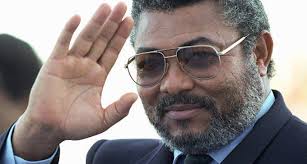
President Jerry Rawlings of Ghana (Source: thecable.ng)
Well, 2020 has been quite a year… when 2020 started, nobody could have told me that there would be a “global pandemic” and I would have believed it, that there will be a confinement and I would have believed, that people will be having “virtual parties” and I would have believed, or that people would have been walking around faceless i.e. masked and I would have believed. What a year! For sure, 2020 is going out, and there will be no other 2020. So let us remember 2020 in Africa, and remember the people, situations, and more that we said goodbye to.
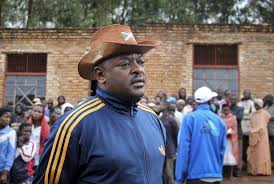
Pierre Nkurunziza during a community event (Source: PressHerald.com)
President J.J. Rawlings, former President of Ghana joined his ancestors this past November. The Ghanaian president J.J. Rawlings has a strong place in history as an influential, courageous, tough-talking, bold, impactful leader and charismatic Statesman who left deep impressions on the political landscapes of his country and, indeed, Africa.Just like the Ghana of today owes a lot to Kwame Nkrumah the father of its independence, the Ghana of today owes a lot to J.J. Rawlings, the father of its economic stability and face-lift. There were a lot of tributes, and I found so much similarities between the words of Rawlings and some that I have echoed here on his blog, J.J. Rawlings in His Own Words: African Identity, Betrayal, and More.
The soldier of democracy, the former president of Mali, Amadou Toumani Toure (ATT), also changed plane this year: GoodBye to Amadou Toumani Touré (ATT) -Former President of Mali. As I said earlier, this was a man of integrity! Some may call him a realist. When then president Traoré asked the army to keep firing at the Malian people, he stood up and said ‘NO’. He took power, and steered the country towards its first democratic elections. Then he stepped down. Later, he won the presidential election with a coalition, and served 2 terms. When in 2012 there was a coup against him, he resigned, and left the office. Others in Africa should copy a page from ATT’s book.
This year we said goodbye to Mory Kante : the Electrifying Griot from Guinea. Often known as the “electronic griot” because he modernized local traditional instruments such as his kora which he electrified, and fused African music with styles and instruments from Western pop. His 1987 hit “Ye Ke Ye Ke” is a hit I still dance to. If you ever come across a kora, or listen to Ye Ke Ye Ke remember the electrifying griot Mory Kante and the great musical century-long traditions dating back to the Ghana Empire, Ancient Kingdom of Africa.
Zindzi Mandela (Source: Timeslive.co.za)
In July, Zindzi Mandela: the daughter of Nelson and Winnie Mandela passed away. As well, as being remembered by her family and loved ones, the world remembers her as the young woman who read Nelson Mandela‘s letter of rejection in 1985. Reading that letter required a lot of courage, determination and strength to defy the apartheid regime and stand in front of a full stadium thirsty for words of encouragement, and hope from their leaders to keep facing the injustices of an inhumane regime.
This past November as well, Mamadou Tandja, the former President of Niger changed his plane of existence. Did you know that France’s nuclear power is funded by the uranium of Niger? and that Niger gets nothing for it? Tandja was the president who asked that the French nuclear company Areva start to pay something to Niger. During his terms, the relationship with Areva, which had enjoyed a de facto four decade monopoly in the country, worsened as he sought to curb the power of French influence by striking a deal with Sino-U in 2007 to develop a uranium mine, resulting in competition for Areva. As you can guess, he was deposed in a coup. Remember The 11 Components of the French Colonial Tax in Africa which gives France monopole over riches, mines, in a country? So long brother!
In September, common sense left the government of Zimbabwe, when it decided to compensate white farmers the hefty sum of 3.5 billion dollars… within 12 months, when the country is currently on life support and there is no money in its coffers [Is Zimbabwe the New Haiti?]! This is outrageous! When the economy is in shambles, how can the government agree to this? Did these white farmers ever compensate the Africans after independence in 1980 for using their lands for a century, for abusing them off their lands? And for all the years of economic embargo forced on the country? Then in September, Zimbabwe agreed to return seized land to foreigners. What is funny is that the government has been doing this in hopes of having the embargo removed, but the country is still under serious economic embargoes. Don’t they learn from history? Zimbabwe is indeed the new Haiti!
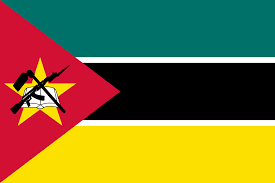
Flag of Mozambique
Peace in northern Mozambique seems to have become evasive, ever since that 15 billion dollars contract with the French firm Total for the oil in Cabo Delgado, and the discovery of one of the largest oil, diamonds, rubies in the world there. Tell me it is not connected? Now they want us to believe that there is islamist insurgency in Mozambique of all places!… And now Pope Francis has money to help the people and children of Mozambique who have been displaced by conflict! … Why did the Vatican not help the government of Samora Machel back then? why the people of Mozambique? Those diamonds and riches are really Africa’s downfall! Just a look at the banks financing the project reminds you of the Berlin conference of 1884 [Selection from the 1885 Berlin Conference Final Act]: 19 commercial bank facilities among which UK Export Finance (UKEF), the Export Import Bank of the United States, Italy’s SACE, the Netherlands’ Atradius, the Export Credit Insurance Corporation of South Africa, Japan Bank for International Cooperation, Nippon Export and Investment Insurance, and the Export-Import Bank of Thailand [Reuters].
After the Zimbabwean government agreed to compensate the White farmers the hefty sum of $3.5 bn last month (Is Zimbabwe the New Haiti?) when they have no money in their coffers, it was only a short step to agreeing to return seized land to foreigners. Excerpts below are from an article on the BBC website. Again why are the people, who will be forced to pay for all this, not consulted?
=====
Zimbabwe has offered to return land to foreign nationals whose farms were seized under a controversial government programme two decades ago. Thousands of white farmers were forced from their land, often violently, between 2000 and 2001. The seizures were meant to redress colonial-era land grabs but contributed to the country’s economic decline and ruined relations with the West [caused by foreign economic sanctions and embargo]. A separate compensation scheme has been launched for local white farmers. They have not been offered land, but the government last month promised them $3.5bn (£2.6bn) for seized infrastructure[Is Zimbabwe the New Haiti?]. The US has said compensating farmers is one of the requirements for it to lift decades of economic sanctions.
Zimbabwe on Monday said foreign citizens who had their land seized could now apply to get it back. Hundreds of Europeans – mostly Dutch, British and German nationals – whose investments were protected under international agreements could benefit from the offer [if their investments were protected, why do they need compensation now?], reports the BBC’s Shingai Nyoka from the capital, Harare. …
In a joint statement on Monday, the ministers of finance and agriculture said some black farmers who received land under the programme would now be moved [to where?]. To allow the former owners “to regain possession” of their land, the government will revoke offers made to black farmers [will they also be compensated like the white farmers?]currently occupying the farms and “offer them alternative land elsewhere” [really? – I don’t trust this sneaky government- with the West they have binding agreements, but with the locals… nothing ], the statement said. …
“Did you ever see a chameleon catch a fly? The chameleon gets behind the fly and remains motionless for some time, then he advances very slowly and gently, first putting forward one leg and then the other. At last, when well within reach, he darts his tongue and the fly disappears. England is the chameleon and I am that fly.” King Lobengula
Did you guys hear about the government of Zimbabwe agreeing to compensate white farmers the hefty sum of 3.5 billion dollars? I was shocked! When there is barely any money in the country, and the economy is in shambles, how can the government agree to this? Moreover, did these white farmers ever compensate the Africans after independence in 1980 for using their lands for a century, for abusing them off their lands? And for all the years of economic embargo forced on the country? Lastly, the clause is set so that the country will be paying this debt forever… 12 months to raise half of the money when the country is on life support? This is so disgusting, Robert Mugabe must be rolling in his grave!
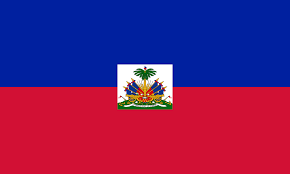
Flag of Haiti
So my question is, is Zimbabwe the new Haiti? Remember how Haiti was made to pay France for over a century because of their freedom (When France extorted Haiti, the greatest heist in history)? Because the past slaves had beaten the masters, they were forced to pay France for over a century the hefty sum of 90 million goldfrancs (equivalent to 21 billion U.S. dollars in today’s money – when Jean-Bertrand Aristide requested reparations, he was ousted) after winning its freedom from France…? And this is why Haiti is so poor! Imagine this: Someone abuses you for years, not to say decades and generations, you finally free yourself, and now you are forced to compensate them because you freed yourself through a ruthless battle from their years of inhumanity. How fair is that? We must be living in a different type of world, because I just don’t understand the logic! Now, it would seem to be Zimbabwe’s turn?
I have always been skeptical of Mnangagwa… but now it has been fully confirmed! When I see this, I wonder why Africa’s leadership is so full of traitors, collabos, and haters of their own people! This will be the topic for another day. Excerpts below are from the CNN article of July 29, 2020.
======
Zimbabwe’s government signed an agreement Wednesday worth $3.5 billion to compensate white farmers who were evicted from their land during a controversial and often violent land redistribution program in the early 2000s under former President Robert Mugabe.
“This momentous occasion is historic in many respects, brings both closure and a new beginning in the history of the land discourse in our country Zimbabwe,” said current President Emmerson Mnangagwa, after signing the agreement at State House with Andrew Pascoe, the president of the Commercial Farmers Union of Zimbabwe….
According to the agreement, 50 percent of the $3.5 billion would be paid with 12 months from the day of signing, while the balance is paid within five years.
Economists agree that the Zimbabwean government, cash strapped after years of hyper-inflation and allegations of mismanagement [and economic embargo imposed by Western powers], cannot afford to make the compensation.
In a statement, the Finance Ministry said that they will be issuing long term bonds and that the parties will approach international donors to try and raise the funds.
I always loved the sound of the name Bulawayo, the second largest city in Zimbabwe, after the capital Harare, and the largest city in the country’s province of Matabeleland. BU-LA-WA-YO… Doesn’t it roll on your tongue? Doesn’t it sound like thunder ? … like something big must have happened there? Well, …
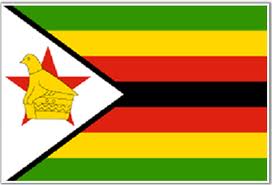
Flag of Zimbabwe
Bulawayo was founded by the Ndebele king, Lobengula, son of Mzilikazi, when he settled in Zimbabwe in the 1840s, after the Ndebele’s people great trek from northern Kwazulu, in South Africa. The name Bulawayo comes from the Ndebele word bulalawhich translates to “the one to be killed.” It is said that at the time of the city’s founding, there was a civil war due to a kingship succession dispute. The dispute was between Mbiko ka Madlenya Masuku, a trusted confident of King Mzilikazi and leader of the Zwangendaba regiment, and Prince Lobengula who he (Mbiko Masuku) thought was not a legitimate heir because Lobengula was the son of the king born to a Swazi mother, of a lesser rank.
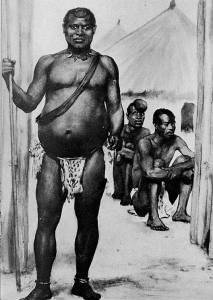
King Lobengula of Matabeleland
At the time Lobengula, was a prince fighting to ascend the throne of his father Mzilikazi. It was common at the time for people to refer to Bulawayo as “KoBulawayo UmntwaneNkosi“, “a place where they are fighting or rising against the prince” or the “the place where the prince shall be slain“. The city of Bulawayo coincidentally has the same name as the capital of the great Zulu warrior king Shaka ka Senzangakhona in Kwazulu, where Mzilikazi and his Khumalo clan and other Nguni people came from.
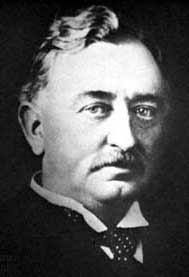
In the 1860s, the city was highly coveted by Europeans, because of its land, wealth, and strategic location. Cecil Rhodes tried different tactics to trick King Lobengula. Lobengula once described Britain as a chameleon and himself as the fly. The fact that Lobengula was a force to reckon with is not to be ignored. Cecil Rhodes himself confided to Rothschild saying, “I have always been afraid of the difficulty of dealing with the Matabele King. He is the only block to central Africa, as, once we have his territory, the rest is easy … the rest is simply a village system with separate headmen …” So trickery was the only resort for Rhodes in order to get Lobengula. Thus, the treacherous Rudd Concession – 30 October 1888 (British Colonial Treaties in Africa: The Ruud Concession in Zimbabwe 30 Oct 1888).
Cecil Rhodes
During the 1893 Matabele War, British South Africa Company (BSAC) troops invaded and forced King Lobengula to evacuate, after first detonating munitions and setting fire to the town. BSAC troops and white settlers occupied the ruins. On 4 November 1893, Leander Starr Jameson declared Bulawayo a settlement under the rule of the British South Africa Company. Cecil Rhodes ordered the new settlement to be founded on the ruins of Lobengula’s royal kraal,a typical action by a conquering power. This is where the State House stands today.
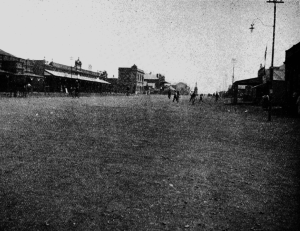
The principal street of Bulawayo in 1905
Historically Bulawayo has been the principal industrial centre of Zimbabwe (former Southern Rhodesia – after Cecil Rhodes); its factories produce cars and car products, building materials, electronic products, textiles, furniture, and food products. Bulawayo is also the hub of Zimbabwe’s rail network and the headquarters of the National Railways of Zimbabwe. Thus its nickname: “City of Kings” and also “kontuthu ziyathunqa” – meaning “smoke arising” in Ndebele, because of its large industrial base, and the large cooling towers of its coal-powered electricity generating plant situated in the city center which once used to exhaust steam and smoke. Today, as the rest of Zimbabwe, it slowly pushes through the steam.
Well, if you visit the city of Kings, remember King Lobengula, remember his fire, and his fight for his people’s freedom from western domination… remember the greatness of the Ndebele king, and remember the fire that burns dormant in the people of Bulawayo, fanned by their ancestors. Enjoy the video below on Bulawayo.
“Africa must revert to what it was before the imperialists divided it. These are artificial divisions which we, in our pan-African concept, will seek to remove.” – Speech at Salisbury, 1962
“Was it not enough punishment and suffering in history that we were uprooted and made helpless slaves not only in new colonial outposts but also domestically.” 1960s
“We of Africa protest that, in this day and age, we should be treated as lesser human beings than other races.” 2003
Flag of Zimbabwe
“If the choice were made, one for us to lose our sovereignty and become a member of the Commonwealth or remain with our sovereignty and lose the membership of the Commonwealth, I would say let the Commonwealth go. What is it to us? Our people are overjoyed, the land is ours. We are now the rulers and owners of Zimbabwe.” – Speech at ZANU-PF Congress December 2003 . This is somewhat reminiscent of when Sekou Touré said ‘NO’ to France in 1958, “It is better to be poor and free, than to live in opulence and be a slave.”
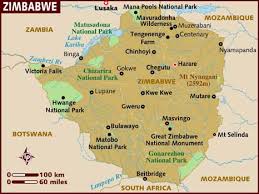
Map of Zimbabwe
“We have fought for our land, we have fought for our sovereignty, small as we are we have won our independence and we are prepared to shed our blood … So, Blair keep your England, and let me keep my Zimbabwe.” – Earth Summit, South Africa, 2002
“We don’t mind having sanctions banning us from Europe. We are not Europeans.” 2000s
“Our small and peaceful country is threatened daily by covetous and bigoted big powers whose hunger for domination and control of other nations and their resources knows no bounds.” 2000s – Isn’t this true for Africa as a whole today since the Berlin conference of 1884?
“The white man is not indigenous to Africa. Africa is for Africans. Zimbabwe is for Zimbabweans.” ZANU-PF Congress December 2000.
“The land is ours. It’s not European and we have taken it, we have given it to the rightful people … Those of white extraction who happen to be in the country and are farming are welcome to do so, but they must do so on the basis of equality.” 2000s
Robert Mugabe at a ZANU PF Congress (Source: Nehanda Radio)
“Mr Bush, Mr. Blair and now Mr Brown’s sense of human rights precludes our people’s right to their God-given resources, which in their view must be controlled by their kith and kin. I am termed dictator because I have rejected this supremacist view and frustrated the neo-colonialists.” UN General Assembly 2007.
“African resources belong to Africa. Others may come to assist as our friends and allies, but no longer as colonisers or oppressors, no longer as racists.” 2015
“We have said we will never collapse, never ever. We may have our droughts, our poverty, but as a people, we shall never collapse, never ever.”












 African Heritage