

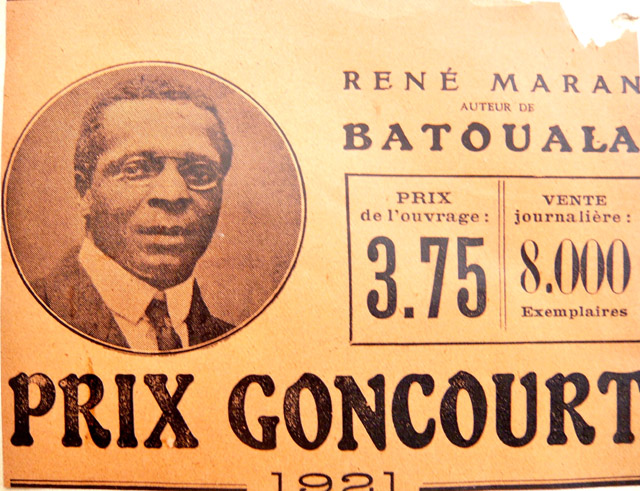
At the end of 2021, we celebrated the win of Senegalese author Mohamed Mbougar Sarr, the first man from sub-Saharan Africa to win the prestigious literary Prix Goncourt, 100 years after René Maran who was the first person of African descent to win the prize for his controversial novel Batouala. Mbougar Sarr’s winning novel, La plus secrète mémoire des hommes (The Most Secret Memory of Men), tells the story of a young Senegalese writer living in Paris who stumbles by chance across a novel published in 1938 by a fictional African author named TC Elimane, nicknamed “the Black Rimbaud” by an ecstatic Paris media. The story, described as a reflection on the links between fiction and reality, follows the life of a cursed African writer echoing the real-life experience of the Malian writer Yambo Ouologuem who in 1968 was the first African winner of the prix Renaudot, but was later accused of plagiarism, and had to flee France back to his natal Mali, to live a reclusive life, and die in utter misery.

Now thanks to Mbougar Sarr’s work, the publishing house Penguin Modern Classics is re-publishing the Yambo Ouologuem’s book over 50 years after his work was pulled out and banned. Le devoir de violence (published in English as Bound to Violence) was first published in 1968 by Editions du Seuil. After winning the Prix Renaudot that very year, Ouologuem became a celebrity equated to the likes of Leopold Sedar Senghor. “Ouologuem’s novel is harshly critical of African nationalism, and in fact reserves its greatest hostility for the violence Africans committed against other Africans” (Richard Posner on Plagiarism, the case of Yambo Ouologuem). For many critics, Africans in particular, Ouologuem’s book is a validation of the twisted views of the West on Africa who exonerate themselves of the violence they committed on Africans throughout centuries.
Excerpts below are from the Guardian. You can also check out the blog created by Ouologuem’s daughter or Richard Posner on Plagiarism, the case of Yambo Ouologuem at Amardeep Singh, or The Tortured Legacy of Yambo Ouologuem.
=====
In 1968 the books pages of the French newspaper Le Monde excitedly praised an uncompromising new novel, Bound to Violence, going on to salute its author as one of “the rare intellectuals of international stature presented to the world by Black Africa”.
The newspaper’s words, written in tribute to the young Malian writer Yambo Ouologuem, sound condescending today. Back then, however, the intended compliment was genuine and many European critics soon agreed: the publication of Ouologuem’s strange novel really did mark the arrival of a major new talent.
But the literary world can be brutal, and particularly so for a young African novelist living in Paris who was attempting a fresh twist on conventional storytelling.
Fellow African writers began to express shock at Ouologuem’s harsh parody of his own culture. Three years later damaging accusations of plagiarism had also emerged, including a public skirmish with Graham Greene, which ended Ouologuem’s short career. He retreated into the life of a recluse, returned to Mali and died in 2017, having never published again.
Now, 50 years after this scandal, Penguin Classics is to bring out a new English edition of Bound to Violence in a bid to rehabilitate the gifted author and introduce him to new readers.
…



 African Heritage