Why the Name: Togo?

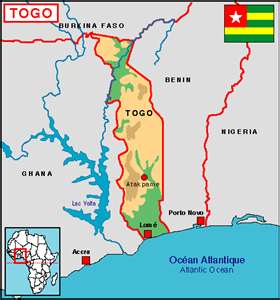
Map of Togo
Map of Togo

A few years back, a Malagasy friend of mine was telling me how upset he had been to find out that his name’s short version, Togo, had been made by Americans to sound like ‘to-go‘ as in ‘to-go containers‘ as opposed to ‘Togo‘ (pronounce ‘Tow – go’ or ‘Taw -go’) as it was supposed to be. This got me thinking about the name of one of the smallest countries in Africa, Togo, which had undoubtedly also gone through that transformation to sound like ‘to-go containers.’ Well, do you think the meaning of Togo could in some way be related to leftover containers or food-on-the-run?


Togoland_1908
Togoland in 1908

Togo lies in the Bight of Benin, surrounded by Ghana in the west; Benin in the east; and Burkina Faso in the north. To many, the name Togo stands for “land where lagoons lie“. In reality, the name Togo was the name of a small village Togodo which means in the Ewe language, “the land (or city) beyond the cliff” or “land on the other side of the shore.” This became Togoville, a town and canton in southern Togo, lying on the northern shore of Lake Togo; it was originally known as Togo. The country took its name from the town of Togoville when Gustav Nachtigal signed a treaty with the town’s chief, Mlapa III, on 5 July 1884, from which Germany claimed ownership over what became Togo. Togoland, a  German colony, was born. The village which gave its name to the country, mean originally “city or land beyond the cliff” and not “city beyond the river.” It is in reality located on the edge of a very shallow lagoon, whose name is Lake Togo, which had the effect of misleading many people about the origin of the word.
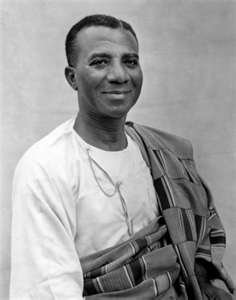
 

Sylvanus Olympio
Sylvanus Olympio

Archaeological finds indicate that ancient tribes which inhabited the area were able to produce pottery and process iron. From the 11th to the 16th century, various tribes entered the region from all directions. From the 16th century to the 18th century, the coastal region was a major trading center for Europeans to search for slaves, earning Togo and the surrounding region the name “The Slave Coast“. In 1884, a treaty was signed at Togoville with King Mlapa III, whereby Germany claimed a protectorate over a stretch of territory along the coast and gradually extended its control inland; its borders were defined after the capture of hinterland by German forces and signing agreements with France and Britain. In 1905, it officially became the German colony of Togoland. After Germany lost the First World War, the land was divided between France and Great Britain to be ruled as mandates. After World War II, these mandates became UN Trust Territories. In 1957, the residents of British Togoland voted to join the Gold Coast as part of the new independent nation of Ghana; while French Togoland became an autonomous republic within the French Union in 1959, as France (as always) retained the right to control the defense, foreign relations and finances. The Togolese Republic was proclaimed on 27 April 1960. In the first presidential elections in 1961Sylvanus Olympio became the first president of the country. Since the coup that led to his assassination in 1963, Togo has been ruled 3 presidents, the most notorious being Olympio’s murderer Gnassingbé Eyadéma, who ruled Togo for 38 years, and after his passing, his son Faure Gnassingbé has now been president.

Togo_Beach in Lome
Beach in Lome, Togo (Wikipedia)

The coast of Togo in the Gulf of Guinea is 56 km long and consists of lagoons with sandy beaches; thus the reason why people think its name is associated with lagoons and mean “land where lagoons lie“. If you ever visit Togo, do not forget to check out its lagoons, its sandy beaches, and above all its people.

Sylvanus Olympio: Togo’s first president

Sylvanus Olympio
Sylvanus Olympio

Today I will be talking about Sylvanus Olympio, the first president of Togo, a small country in West Africa, which was once a German colony, and later became a French and British protectorate.  The story of Togo is a little bit like that of my country Cameroon which was once a German colony but was later divided between France and Great Britain as protectorates (this will be a story for another day).

Sylvanus Olympio really embodies what the singer Tiken Jah Fakoly said in one of his songs “They [Europeans] divided the world among themselves, nothing amazes me anymore: part of the Mandinka empire found its way in the Wolof empire, part of the Mossi empire found its way in the Ghana empire, part of the Soussou empire found its way into the Mandinka empire and part of the Mandinka empire found its way into the Mossi’s empire …” what do I mean by this? Sylvanus Olympio was from Dahomey (current day Benin) of Afro-Brazilian ancestry, born in Kpando in actual Ghana, and became president of Togo!  How was this possible? well because of the balkanization of Africa or rather the scramble for Africa which took place at the Berlin Conference in 1884 where Europeans split Africa among themselves dividing entire empires, people, villages, nations.  One of these people were the Ewe people in West Africa who found themselves split among three countries: Gold Coast (Ghana), Togoland (Togo), and Dahomey (Benin).

Map of Togo
Map of Togo

Sylvanus Olympio believed that the Ewe people should be reunited under one flag…. unfortunately he could never come to agreement with Kwame Nkrumah, his Ghanaian counterpart, and other powers at play.  Olympio tried to unite and educate the people about their new nation, and the needs for development.  From what a Togolese friend of mine once said, he used to ride a bike from villages to villages talking to people in their languages and educating them about politics, development, and patriotism, at a time when there was no radio (1950s) in most places.

Togo -- A History
Togo — A History

Sylvanus Olympio barely had a chance to execute anything politically.  He was assassinated in a military coup in the US embassy compound in Lomé in 1963, two years after Togo’s independence and his investiture as president.  The presidential palace was just next to the US embassy in Lomé.  When Olympio heard gunshots, he sent his family to safety, and climbed the wall that separated him to the American embassy.  Once there, he knocked at the door of the embassy to seek refuge… Unfortunately, the embassy was closed.  Sylvanus hid in one of the cars in the American compound.  The American Ambassador comes back to the compound and finds Olympio in the car who explains everything; the ambassador claimed not to have the keys to open the door… and asked him to wait while he would go find the keys.  Rumors says that the American ambassador probably called his French counterpart who then contacted the gunmen and sent them to the American compound.  Sylvanus was found in the car, and gunned by Eyadéma, one of Africa’s worst dictators backed by the West.  The Time magazine wrote an article on that day entitled Togo: Death at the Gate; JFK also had a statement about his death.  The journalist, Alain Foka, of RFI did a piece on Olympio.

Many wonder what Togo would have become under someone with such love, brilliance, and vision for his country.  No one will ever know.  Please enjoy this rare footage of an interview of Sylvanus Olympio to NBC in the US.

Don’t forget to watch the second part.