Unrest in Sudan

Flag of Sudan

A few weeks ago, we talked about The New Scramble for Africa. Our hearts go out to our brothers and sisters in Sudan as unrest rises in the country. Those who think that this is a “simple” feud between two generals, or two “brothers” as portrayed in the news, must look deeper. Why are US troops getting deployed there? In the early 2000s, people around the globe were bombarded non-stop with information about the genocide in Darfur and “slavery” in Sudan; we were all told that Northern Sudanese were “white” who treated poorly their Southern Sudanese brothers who were “Black” which is a very simplistic and exaggerated way of looking at Sudan (remember Libya and Slavery: Sheep without a Shepherd in recent years?). Hollywood stars such as George Clooney came out in numbers claiming to care about the plight of the Black man, and saying that the Black people of Darfur Sudan were enslaved by their lighter skinned Sudanese brothers.To all who know the tactic of divide-and-conquer, and know social conflicts in Africa, we are always manipulated into thinking that every conflict in Africa is about this tribe vs. that tribe, this group vs. group; thus neighbors become enemies, when in reality, it is a diamond mine or oil field coveted by external forces which is at the core of the issue (Northern Mozambique today). The conflict in Sudan led to the split of Sudan, which was then Africa’s largest country, into Sudan with capital in Khartoum, and South Sudan with capital in Juba. Many forget that the southern part of then-Sudan was rich in oil fields, and that this split diminished Sudan’s oil output to the detriment of the newly created South Sudan (in passing, wasn’t the Pope in South Sudan in February? The Pope Visits the Democratic Republic of Congo and South Sudan), thus putting a big dint on Sudan’s partnerships with China (Sudan was providing more than 10% of China’s oil needs and a Chinese presence on the horn of Africa). After the split, the world’s attention which was on Darfur moved on, Darfur which was supposedly the goal of Western interventions was never resolved, but South Sudan with the oil fields was detached from Sudan.

The New Scramble for Africa (Source: Source: Dr Jack & Curtis for City Press, National Institute African Studies (NIAS))

The cold war between the West and the East took place mostly in other countries like Angola, Mozambique, Congo, Afghanistan, Nicaragua in Africa, Asia, Latin America with many coups d’état and conflicts around the globe. Similarly today, the new kind of war has started yet again, but this time, it is on African soil with The New Scramble for Africa as the world moves toward energy-“conscious” policies.

How do we, Africans, stop from having our lands be a theater for others’ wars? How can we independently make learned decisions for our people without being dragged in others’ conflict?

Saï Island: Influences from Pharaonic Egypt, Christianity, and Islam in Nubia

Church pillars on Sai Island (Source: Atlas Obscura)

Our hearts go out to our brothers and sisters in Sudan whose country is going through unrest again. This unrest is part of the New Scramble for Africa, and to a greater extent the great global war between the West and the East which as always plays on other continents.

Today, we will continue our exploration of Saï Island, an island in Sudan which contains ruins spanning thousands of years and several empires. It is the largest island on the Nile river, about 12 km long and 5.5 km wide. Although Sudan is today an Islamic country, Saï was once occupied by Egyptians during the New Kingdom, and later was the site of the ancient medieval Christian Nubian Empire known as Makuria which flourished in Sudan between the 7th and 14th centuries. Later, during the 16th century, the Ottomans founded a fortress on the island. Saï Island has always been Nubian, and over the centuries has seen different cultures, religions, and much more.

Ruins on Sai Island (Source: Lendi Travel)

Many Empires have prevailed on the island. The presence of the Egyptian town and temple which dates back to 1500 BC is a good example of the strong imprint of the Pharaonic Egypt, with among many other things a spolia bearing the  cartouche of Amenhotep IV, amongst other 18th Dynasty rulers: the fort was founded by Pharaoh Ahmose and then overbuilt by Amenhotep I and his successors. Saï Island was also an important royal site during the Meroitic period as testified by the discovery of pillars/columns with the names of the Queen Amanitore and King Natakamani of Nubia. It is clear today that Saï Island was the seat of a Nubian Bishop as indicated by the remains of a Medieval Christian cruciform church, identified as a cathedral, the largest in Nubia; while the Ottoman presence is noted by the remains of a fort built in the 2nd half of the 16th century AD. The place is full of pottery dating several centuries, if not millenia. However, part of the island, the northern part, was flooded when Lake Nasser was created in 1971 (most monuments that were destroyed were on the Nubian/Sudan side of the dam, while a lot on the Egyptian side were recovered and moved to higher ground – don’t get me wrong, Abu Simbel is amazing and worthy to have been saved, but wasn’t the fortress at Buhen just as important?).

Chert pebble with ochre residue from Sai Island, Sudan. (Source: Illustration by Van Peer, et al.
(2004))

Saï Island is an exceptional testimony to early human occupation in this part of Africa, notably the Homo-erectus and the Homo-Sapiens. It provided early attested evidence for the use of color in the world with rare finds of ochre and ways to manipulate it (Saï Island in Sudan – Earliest Site with Evidence of Ochre Use by Modern humans). It is one of the key sites in Sudan (which was not flooded) which shows the prime influence of Egyptian culture in Nubia during the 2nd millennium BC, and the evolution and fusion of both cultures with mutual influences from Nubia and Pharaonic Egypt across centuries. All these attributes qualify Saï Island as unique with an outstanding Universal Value.

To learn more about the findings of this cathedral and more on Saï Island, check out these articles on the Smithsonian Magazine, UNESCO World Heritage, the Art Newspaper, Sudan National Museum‘s website, Tomb26 on Saï Island, and much more.

Saï Island in Sudan – Earliest Site with Evidence of Ochre Use by Modern humans

Chert pebble with ochre residue from Sai Island, Sudan. (Source: Illustration by Van Peer, et al.
(2004))

Saï Island, in Sudan, is located in the Nubian region of the Nile River, and is the very earliest site with evidence of ochre use by modern humans. It is the largest island on the Nile River, and was occupied intermittently by people throughout the Paleolithic. The island is rich in history, and today we will focus on the color impact of Saï island in the history of the world.

Found on the island, there are several archaeological layers dating from about 180,000 to 200,000 years ago. Excavation there has yielded large quantities of red and yellow ochre. While red is almost always the dominant color at early human sites, the inhabitants of Saï Island seem to have preferred yellow pigment. The significant use of yellow ochre there indicates strong cultural choices and the use of new manipulation techniques to change colors, call it chemistry, which could have been heating or something else. Thus, Saï Island is known for being the site of the earliest ochre-processing kit in the world; on the site were found sandstone mortars, a rectangular sandstone slab with a depression carefully hollowed out in its center. The slab appears to have been a grinding stone, with evidence of ochre powder within the depression. Two small pieces of chert stone with fragments of ochre still attached were found nearby. The pieces of chert were used to crush the ochre into a fine powder on the slab, like an early mortar and pestle. These were dated to about ca 180,000 years ago. This makes Saï island an important site to understand the initial emergence of modern human behavior in the world, and thus the start of colors, and new techniques of manipulations of ochre.

To learn more, check out Van Peer et al. J. of Human Evolution 45, 187 (2003) and Fulcher et al., J. of Archaeological Sci. Rep. 33, 102550 (2020).

The US Proposes to Remove Sudan from Terrorism’s List for $300 million Compensation

Flag of Sudan

Yes… I know this is another news that is just outrageous! What about the breaking of the country into two: Sudan and South Sudan… Some of it had been supported or helped by the US and foreign forces… so is there compensation for that? Excerpts below are from an article on the Guardian’s website. All of this makes my blood boil! And weird how all these funky deals are taking place right now in these uncertain times during lockdown. Is it because African economies have been hit by the pandemic, thus are vulnerable, and so the leadership is ready to make blood-boiling deals like these? It’s like the elders made a mistake (by the way, which one?) and the kids are paying for it…. yet, when we talk about compensation from genocide perpetrated on our parents and grandparents, nobody wants to hear! Lastly, why are these deals made without consulting the people?

=====

A US proposal to remove Sudan from a list of states that sponsor terrorism – in exchange for a $330 million payment compensation to American victims of al-Qaida – has caused anger in the poverty-stricken east African country.

Mike Pompeo, the US secretary of state, visited Khartoum on Tuesday to underline US support for the new transitional government that took power following the fall of Omar al-Bashir last year, whose 30 year authoritarian rule saw Sudan become an international pariah.

The US has moved to incrementally restore relations with Sudan over recent years but has insisted that outstanding legal claims are settled before the country is struck from the list of state sponsors of terrorism. …

Sudan has been on the list since 1993, and so faces a range of damaging measures including the denial of much needed financial aid from international multilateral institutions.

The double bombing of embassies in Tanzania and Kenya in 1998 was the work of al-Qaida, then run by Osama bin Laden from Afghanistan. More than 224 people died and 4,000 were injured in the bombings.

Courts in the US have found Sudan guilty of providing essential support to al-Qaida when Bin Laden was based in the country between 1991 and 1996.

But ministers, opposition leaders and ordinary people in the country have expressed their dismay at the prospect of a multimillion-dollar payment to the US. Some complained that it was unfair that the new reformist government in Sudan should suffer for the misdeeds of a fallen dictator.

Activist Mohamed Babiker, 32, accused the US of intensifying Sudan’s problems: “We opposed the regime and overthrew it. Now we have to pay for what it did wrong,” he said.

Shamael el-Noor, a participant in the mass protests that led to Bashir’s ousting, said that the US should have immediately removed Sudan’s name from the list of countries supporting terror once Bashir was gone.

The terrorism was linked to the former regime’s ideology … It’s unfair to keep Sudan on that list while people revolted against the terrorism of that regime,” El-Noor said.

Others contested the basis for the compensation claim, saying that Sudan had sought to cooperate with the US by expelling Bin Laden and that the attacks had occurred two years after the Saudi-born extremist had left their country.

….

Why the Name: Khartoum?

Khartoum_from_air_with_Nile_1936
Aerial view of Khartoum in 1936

What comes to mind as you say the name of the capital of Sudan, Khartoum? Well, for me, I imagine the great Nubian Empire with its queen Amanishakheto or King Taharqa; I imagine big sand dunes, and of course history… so much history, the history of one of the greatest African kingdoms, one which dominated ancient Egypt for centuries. So how far am I from the real meaning of the name Khartoum?

The origin of the word, “Khartoum“, is uncertain. There are many interpretations. One of them states that the name khartoum is derived from the Arabic khurṭūm (tuskstrunk or hose) for elephant tusks, or it could be referring to the narrow strip of land extending between the Blue and White Niles [not sure how trunk or hose could be thought to be a strip of land].

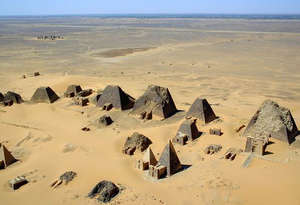
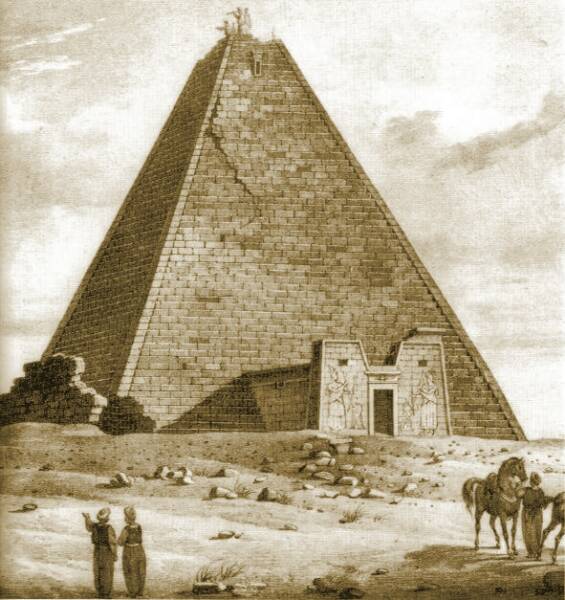
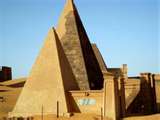
Pyramids of Nubia
Pyramids of Nubia (Wikipedia)

Captain J.A. Grant, who reached Khartoum in 1863 with Captain Speke‘s expedition, thought the name was most probably from the Arabic qurtum (قرطم safflower, i.e., Carthamus tinctorius), which was cultivated extensively in Egypt for its oil to be used as fuel [not sure why a city in Sudan will be named for a plant which is cultivated in its neighbor’s country]. Some scholars speculate that the word may be derived from the Nubian word, Agartum (“the abode of Atum“), the Nubian and Egyptian god of creation. Other Beja scholars suggest “Khartoum” is derived from the Beja word, Hartoom (“meeting“). Additionally, the dream interpreting magicians in Genesis 41:8 are referred to as חַרְטֻמֵּ֥י (Khartoumei) [as you can see Black Africans are in the Bible everywhere].

So, which one of these interpretations is the most accurate?

SONY DSC
Khartoum, today (Source:Wikipedia)

The city as it is known today was established in 1821, 24 kilometers north of the ancient city of Soba, by Ibrahim Pasha, the son of Egypt‘s ruler, Muhammad Ali Pasha, who had just incorporated Sudan into his realm. Originally, Khartoum served as an outpost for the Egyptian Army, but the settlement quickly grew into a regional center of trade. It also became a focal point for the slave trade. Later, it became the administrative center of Sudan and official capital.

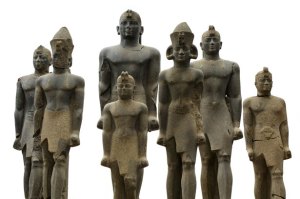
Black Pharaohs of Nubia

Khartoum is located in the middle of the populated areas in Sudan, and is part of the tri-cities composed of Khartoum proper, and linked by bridges to Khartoum North and Omdurman to the west, with an overall population of 5 million inhabitants. Khartoum and Sudan as whole, were the home of several ancient flourishing civilizations, such as Nubia, the Kingdom of Kush, Kerma, Nobatia, Alodia, Makuria, Meroë and others, most of which flourished along the Nile. During the pre-dynastic period Nubia and Nagadan Upper Egypt were identical, simultaneously evolved systems of Pharaonic kingship by 3300 BC. Khartoum is home to amazing museums, including the largest museum of Sudan,  the National Museum of Sudan, where one can be immersed in the rich culture of Sudan and the different eras of its history. Among the exhibits are two Egyptian temples of Buhen and Semna, originally built by Queen Hatshepsut and Pharaoh Tuthmosis III, respectively, but relocated to Khartoum upon the flooding of Lake Nasser.

Well, if you visit Khartoum, don’t forget to visit the National Museum of Sudan, and learn of the great African civilizations that flourish there, reclaim your history, African history, and above all enjoy the warmth and hospitality of the people of Khartoum!


Amanishakheto, Warrior Queen of Nubia

Candace Amanishakheto on a mural

Great women are often left out of history.  Rarely do we hear or read about African queens.  It is already hard enough to read about great African men and leaders in history books, but as for African women… it is more like impossible.  How many have heard of the great warrior queen of Nubia, Amanishakheto, who defeated a Roman army?  Who has heard of this great queen whose pyramid/tomb was leveled to the ground by an Italian treasure hunter, Giuseppe Ferlini, in 1832? Who has heard of this woman who led her people with a strong arm, and built pyramids in Meroë?  Who has heard of this great candace, whose daughter Amanitore, also queen of Nubia, is mentioned in the Bible (Acts 8:27) … yeah the Queen of Sheba is not the only African queen mentioned in the Bible!

Pyramid N6 of Amanishakheto in Meroe, before its destruction

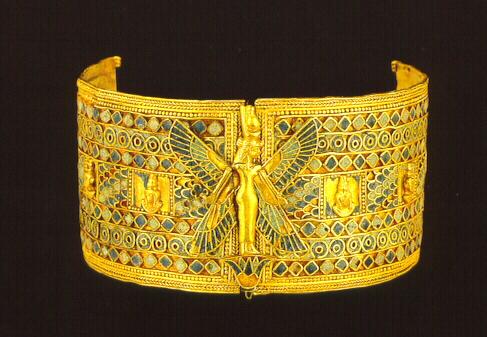
Well, let me tell you about the great Candace (Kandake or queen) of Nubia (present day Sudan), Amanishaketo (also written Amanishaket, or Amanikasheto or Mniskhte in meroitic hieroglyphs) who reigned from around 10 BC to 1 ADCandace Amanishaket was an extremely wealthy and powerful queen.  She succeeded to Candace Amanirenas who was also a great warrior queen (and will be the subject of another post).  She built considerable pyramids and temples at Wad Ban Naqa, where she was buried with great treasures.  Her residence and several temples were based there.  Her palace is one of the largest treasures identified at Wad ban Naqa.  It was 61 m long, and covered an area of  3700 m2 with the ground floor made up of over 60 rooms.  The palace originally had a second floor as indicated by the remains of columns found on the ground floor, and may have contained an atrium or other structure.  Inside Amanishakheto’s grave, the Italian treasure hunter Ferlini discovered an amazing quantity of golden artifacts such as armlets, necklaces.  The treasure found (or what has been recovered) contained ten bracelets, nine shield rings, sixty seven signet rings, two armbands, and an extraordinary number of loose amulets and necklaces, especially made for queen Amanishakheto created by Nubian artists from her kingdom.  Some of her treasures (stolen by Ferlini) are now on display at the Egyptian Museum of Berlin, and at the Egyptian Museum of Munich.

Bracelet of Amanishakheto from the Egyptian Museum of Berlin

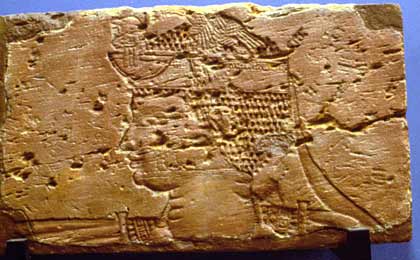
Amanishakheto defeated a Roman Army sent by the first emperor of the Roman empire, Augustus, (who broke a peace treaty) to conquer Nubia.  She was a strong, and powerful woman, and a great pyramid builder.  Her tomb at Meroë was one of the largest ever built.  She is often depicted on pyramid murals as a massive, powerful woman, covered with jewels, elaborate fringed, tasseled robes, and carrying weapons in one hand, preparing to lead her army against others. Enjoy the video below on Amanishakheto, the great warrior queen of Nubia, and do not forget to check out The Treasures of Queen Amanishakheto.

The forgotten kingdom of Nubia

Pyramids of Nubia
Pyramids of Nubia

The general public is familiar with Egypt and the pharaohs, but is not so aware that there was a highly important, sophisticated, and independent ancient civilization in Nubia, which is south of Egypt in present-day Sudan.  For over a century, Nubian pharaohs dominated Egypt, and their kingdom extended from Lake Chad and well into the middle east.  The conquest of Egypt started with Pharaoh Piye of Nubia, and continued with Taharqa who launched the most audacious building campaign of any pharaoh since the New Kingdom (around 1500 B.C.).  Under Taharqa, the capitals were Napata and Thebes, and Jebel Barkal the holy mountain.

Black Pharaohs of Nubia

Nubia is a kingdom with 3 times as many pyramids as Egypt.  Their language still needs to be decoded, and archaeologists are searching for a Rosetta stone similar to that discovered by Champollion which allowed the translation of Egyptian hieroglyphs.  The Nubians were well known for their military genius, and Egyptian pharaohs will sometime hire Nubian mercenaries to fight their battles.  Theirs was a civilization of strong queens such as Amanishaket, and Amanitore.  One of these queens Candace Amanirenas defeated the roman army of Augustus Caesar.

Pyramids of Meroe
Pyramids of Meroe

To learn more, check out some of these great websites: http://www.thenubian.net/index.php, http://www.ancientsudan.org/index.html. National Geographic also had a series of articles on Nubia: Black Pharaohs, Rare Nubian King statues uncovered in Sudan. The site of Gebel Barkal was added to the UNESCO list of world treasures in 2003… check it out on the UNESCO World heritage website, and the Society of Nubian Cultures.

Please discover Nubia, and revel in African genius!

Don’t forget to watch Part 2-5 .