So Long to Sam Nujoma, Namibia’s First President

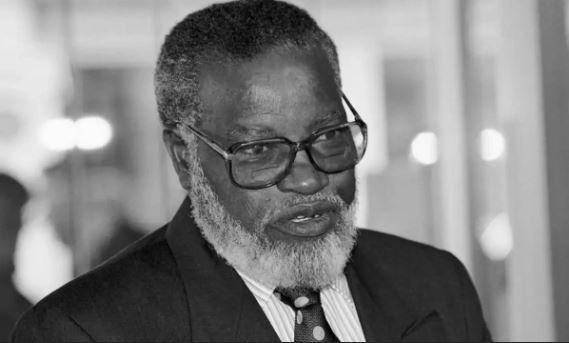
Sam Nujoma (Source: newscentral.africa)
This past Saturday, February 8 2025, Sam Nujoma, Namibia’s first president and founding father passed away at the age of 95. The ancestors are greeting this illustrious brother who fought for the independence of his country. Nujoma led the long fight for independence from South Africa for many years, which culminated with independence on 21 March 1990 of South West Africa, as the country was formerly known. Nujoma helped found Namibia’s liberation movement known as the South West Africa People’s Organisation (SWAPO) in the 1960s. After independence, Nujoma became president in 1990 and led the country until 2005.
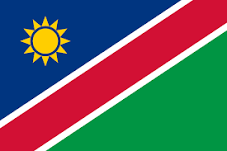
Flag of Namibia
Samuel Shafiishuna Daniel Nujoma was born at Etunda, a village in Ovamboland, on 12 May 1929, to Daniel Uutoni Nujoma and Helvi Mpingana Kondombolo, an Uukwambi princess. From his mother, he inherited his strong charismatic influence during his political career.  He was the oldest of 11 children. His childhood was spent taking care of his siblings, tending to the family’s cattle, and farming.
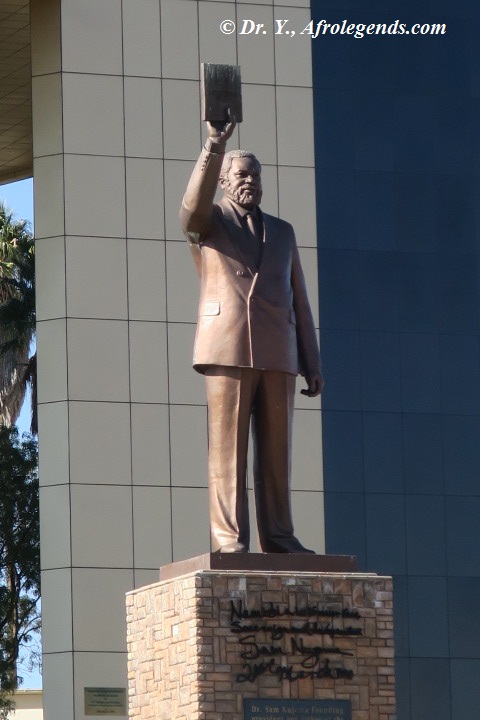
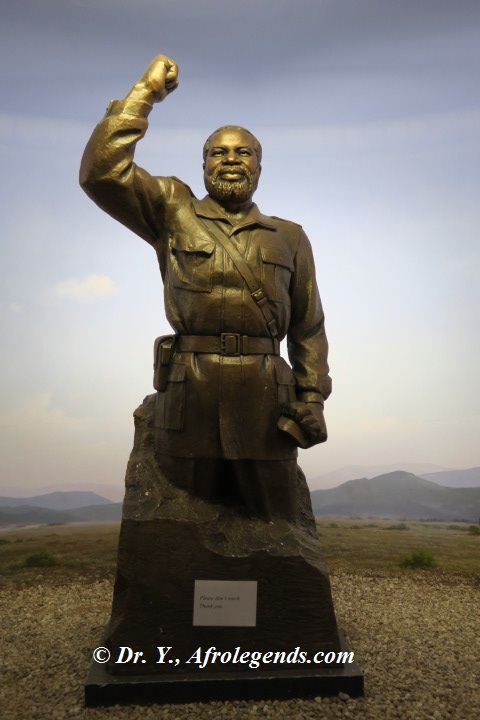
Statue of Sam Nujoma in front of the Independence Museum in Windhoek, Namibia
At the age of 17, Nujoma moved to the harbor town of Walvis Bay, where he slowly learned about the plight of Black people under white-minority rule; he also worked at a general store and later at a whaling station. In 1949, Nujoma moved to Windhoek where he worked as a railway sweeper for the South African Railways (SAR), while he went to night school. It was there that he was introduced to the Herero tribal chief Hosea Kutako, who was lobbying to end apartheid rule in Namibia, then known as South West Africa. Kutako took the young Nujoma under his wing, and mentored him as he became politically active among Black workers in Windhoek who were resisting a government order to move to a new township in the late 1950s. First, he joined with the Ovamboland People’s Congress (OPC) co-founder Jacob Kuhangua to start a Windhoek branch; at its first congress, he was elected president. At Kutako’s request, Nujoma began life in exile in 1960, first to Bechuanaland (now Botswana), then Bulawayo in then Southern Rhodesia (Zimbabwe), and later ending in Tanzania where he was welcomed by President Julius Nyerere. The same year, he was elected president of the South West Africa People’s Organization (SWAPO) in abstencia. The problem of South West Africa, similar to Kamerun, was that they were former German colonies, which had been placed under League of Nations mandate of South Africa in the case of South West Africa, and France and Great Britain for Kamerun; thus the country should have been independent a while back. Nujoma spent a few years asking the United Nations to ensure that the occupying power that was South Africa released control of South West Africa. After many unsuccessful tries, while shuttling from capital to capital in quest for support, he authorized the launch of armed resistance in 1966 against South African forces. The attack marked the beginning of the Namibian War of Independence, which would last more than 25 years.
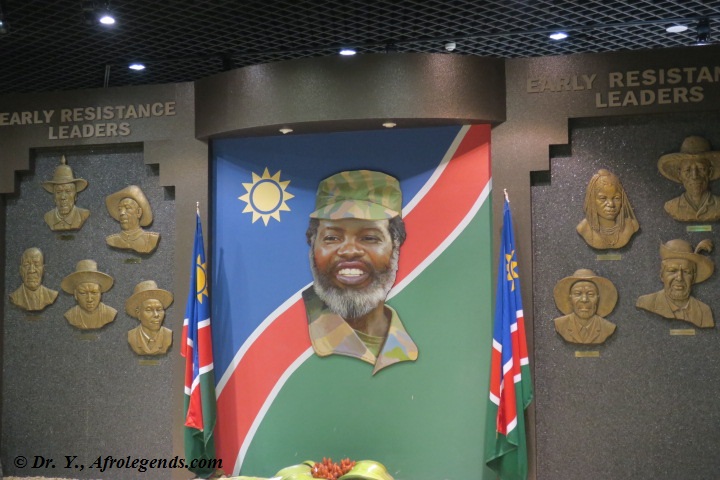
Sam Nujoma on a plaque to Early Resistance Leaders inside the Independence Museum in Windhoek, Namibia
On 19 March 1989, the signing of the cease-fire agreement with South Africa took place. After 29 years in exile, Nujoma returned to Namibia in September 1989 to lead SWAPO to victory in the UN-supervised elections that paved the way for independence. Nujoma was elected first president of the new nation which became independent on 21 March 1990. He was re-elected in 1994 and 1999, and stepped down in 2005. The current president of Namibia, President Nangolo Mbumba said of Sam Nujoma, He “inspired us to rise to our feet and to become masters of this vast land of our ancestors,” … “Our founding father lived a long and consequential life during which he exceptionally served the people of his beloved country.” Namibia’s Vice-President Netumbo Nandi-Ndaitwah, who is due to be inaugurated as president in March after leading SWAPO to victory in elections, said his “visionary leadership and dedication to liberation and nation-building laid the foundation for our free, united nation“.
Bust of Sam Nujoma, inside Independence Museum, in Windhoek, Namibia
South Africa’s President Cyril Ramaphosa said the former Namibian president was an “extraordinary freedom fighter” who played a leading role in not only his country’s fight against colonialism, but also in the campaign that led to the end of the apartheid regime in South Africa in 1994. “President Nujoma’s leadership of a free Namibia laid the foundation for the solidarity and partnership our two countries share today – a partnership we will continue to deepen as neighbours and friends.” South African President Cyril Ramaphosa said Nujoma led Namibia’s independence movement “against the seemingly unshakeable might of colonial and apartheid authorities and forces” and spurred the anti-apartheid movement in South Africa on its own final steps to freedom. “Sam Nujoma inspired the Namibian people to pride and resistance that belied the size of the population,” Ramaphosa said. “Namibia’s attainment of independence from South Africa in 1990 ignited in us the inevitability of our own liberation.”

Disputed Land Issues: The Case of the Khoi and San People and Amazon’s Headquarters

Normal 0 false false false EN-US X-NONE X-NONE
Flag of South Africa

The recent struggle faced by the Khoi and San people of South Africa over their land being used to build Amazon’s African headquarters brings back to light never ending issues: the appropriation of indigenous land by mega corporation, with the cooperation of local governments. While sometimes these local governments are powerless in the face of seemingly great deals that will “foster the local economy”, very often the governments are led by corrupt or ignorant individuals who seek immediate personal gains at the expense of the well-being of their communities (recent events in Sierra Leone). Lastly, why is it that it is always on “significant” indigenous lands that this occurs? Why not elsewhere? Of all places to build headquarters, couldn’t Amazon with its money find another piece of land in Cape Town? I am not against “development” or providing jobs to communities, but I wonder why these disputes are always recurrent. The excerpt below is from the BBC.

=====

Campaigners in the South African city of Cape Town are trying to halt the building of the African headquarters for Amazon. It’s a battle that pits cultural concerns against economic interests, as the BBC’s Vumani Mkhize writes.

San (Basarwa/Bushmen) hunters

It is an overcast day in Cape Town and the scenic Table Mountain is shrouded in a ghostly cloud that silently cascades down the rocky green slopes. At the foot of this historic landscape, a small group of activists from the Khoi and San communities have gathered near the entrance of a huge building site known as the River Club. The communities are seen as some of the earliest inhabitants of southern Africa.

… Across the road from where the activists have gathered, construction is already under way. …

The first phase of the nearly $300m (£215m) development, which will include the Amazon offices, is set to be completed in two years. However the Khoi and the San are determined to stop it.

Tauriq Jenkins, of the Goringhaicona Khoena Council, a Khoi traditional group, says the land has profound historical and cultural value to his people. “This place for us is sacred because it’s on a confluence of Liesbeek and Black Rivers. These embankments are known as the birthplace of the Khoena [Khoi] people,”
he tells the BBC.

It is also where the European colonisers had their first battle with South Africa’s indigenous people, which is marked with a blue plaque.

The 150,000 sqm development will include residential properties and shops as well as offices.

The Amazon site, which is seen as key to pulling in other companies, is set to take up nearly half the space, from where it will run its bourgeoning operations across Africa.

… Jody Aufrichtig, who heads the project, says the development will provide a massive boost to Cape Town’s tourism-reliant economy, hit hard by the coronavirus pandemic. He said it would create 6,000 jobs during construction and about 13,000 indirect jobs. “It’s so desperately needed, especially post-Covid and some of the riots and troubles we’ve had in South Africa. It will give the people of Cape Town and South Africa hope and economic development.” [yeah right… so unless it is built on this specific site, there will be no jobs for South Africans? Of all the places to build, it had to be that one? Will elsewhere in Cape Town still not provide jobs to South Africans?]The tussle between the developer and the indigenous people of Cape Town comes amid the biggest unemployment crisis South Africa has ever faced.

… The site of the development is where the first conflict between the indigenous people and the Dutch colonisers took place in 1659.

This very place is where land was stolen for the first time in South Africa,” Mr Jenkins says. The dispossession of Khoi and San land set in motion centuries of land seizures across the rest of the country. The issue of land ownership, or the lack of it, remains a thorny issue.

… Mr Jenkins and members of the Khoi and San communities remain unmoved by the argument that the new development will bring much-needed jobs. “The reason why this development is so expensive is because it’s on a floodplain. If Amazon and the developer could take its money and build the same scale development off this flood plain, you’d find the size of the development three to four times bigger, which means you’d be able to employ exponentially more people.” [So Amazon is building on floodplains, and it costs more to build there?… so why is the government allowing it? Are there not better sites in Cape Town that will be cost-efficient to the parties involved? Or is there something missing in this information? … doesn’t this scream of corruption?]