Ethiopia and Somalia Historic Treaty

Flag of Ethiopia

With a population of over 100 million inhabitants, Ethiopia is the largest landlocked country in the world. Sea access is not just a common question, but is an existential issue for the country. On January 1, 2024, Ethiopia announced an agreement signed with Somaliland (way to announce the colors of the new year) to lease the port of Berbera in Somaliland, on the Red Sea, and a 20-km stretch of Red Sea coastline for 20 years, Ethiopia – Somaliland Agreement: Will Sea Access lead to Conflict in the Horn of Africa? The agreement made countries in the entire Horn of Africa sweat pools in fear of war, even though those same countries, Ethiopia’s coastal neighbors, Djibouti, Eritrea, and Somalia all rejected its pleas for direct access to a port on the Red Sea. African countries are always ready and eager to lease their lands, ports, airports, railways (Lobito), for a specific duration to European or Chinese or even South African companies, why is it so hard to do the same for fellow African neighbors? Somalia’s president was particularly vocal, calling the Ethiopia-Somaliland agreement an act of agression, saying that the agreement implied that Ethiopia was recognizing Somaliland (which has seceded from Somalia) as an independent state. 
Flag of Somalia

Last week, a historic agreement was signed between Ethiopia and Somalia, under the patronage of Turkey. It centered around, 1) resolving misunderstandings, with both countries committing to resolve issues in upcoming months; 2) cooperation and dialogue to ensure mutual prosperity (should this even be a question among neighbors?); 3) access to the sea for Ethiopia, which Somalia agreed to facilitate under its sovereign authority; 4) both countries will begin technical talks to iron details no later than the end of February 2025, aiming to complete them within 4 months with Turkey’s assistance if needed.
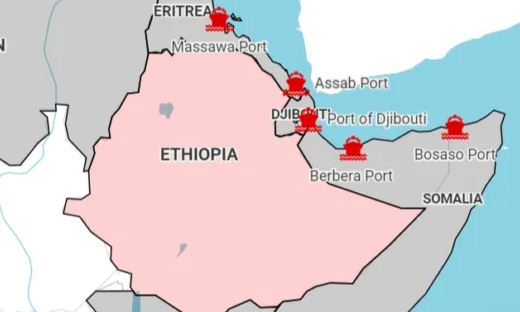
Map of the region with the different countries involved and ports (Source: Medium.com)

We applaud the historic agreement, and can only breathe a sigh of relief for a year which has been tough in the Horn of Africa with war intensifying in neighboring Sudan. However, the agreement still seems a bit vague as to the fundamental issue of whether Ethiopia will use the port of Berbera in Somaliland or whether another port (perhaps in Somalia) will be used instead.

Under the United Nations Convention on the Law of the Sea (UNCLOS), specifically Part X of the convention addresses the rights of landlocked states to access the sea and freedom of transit. Sea access should not be used as a carrot and a stick as it is an existential issue for these countries. Part X ensures that landlocked countries have the right to access the sea for the purpose of exercising their rights, including freedom of the high seas. Nobody has heard of European countries blocking Switzerland, Austria, Hungary, or Slovakia from sea access. However, we saw ECOWAS countries try that during the year, particularly Benin which even went as far as blocking the Niger pipeline which goes through its territory until China gave Benin a reminder (want to bet that it was not a gentle one?) that it was not right.  

For more information on this agreement brokered by Turkey between Ethiopia and Somalia, check out the articles on DW and The Economist

Ethiopia – Somaliland Agreement: Will Sea Access lead to Conflict in the Horn of Africa?

Flag of Ethiopia

Last October, Ethiopian prime minister Abiy Ahmed declared that having sea access was an existential issue for Ethiopia, which is the largest most populous landlocked country in the world with over 100 million inhabitants. Everyone started fearing, because since Abiy’s arrival, Ethiopia has been in conflict internally in Tigray and Oromia. Everyone started fearing for a renewed conflict with Eritrea, after the peace treaty signed between both nations on 9 July 2018 which formally ended the Eritrean–Ethiopian border conflict. The worries stemmed from the fact that Ethiopia lost its sea access when Eritrea seceded in 1993. The conflict between Ethiopia and Eritrea is like the conflict between China and Taiwan… except it takes on an existential nature in the case of Ethiopia which is landlocked because of it. So when Prime Minister Abiy made his announcement in October, everyone on the horn of Africa started sweating. Ethiopia begged its coastal neighbors, but Djibouti, Eritrea, and Somalia all rejected its pleas for direct access to a port on the Red Sea.

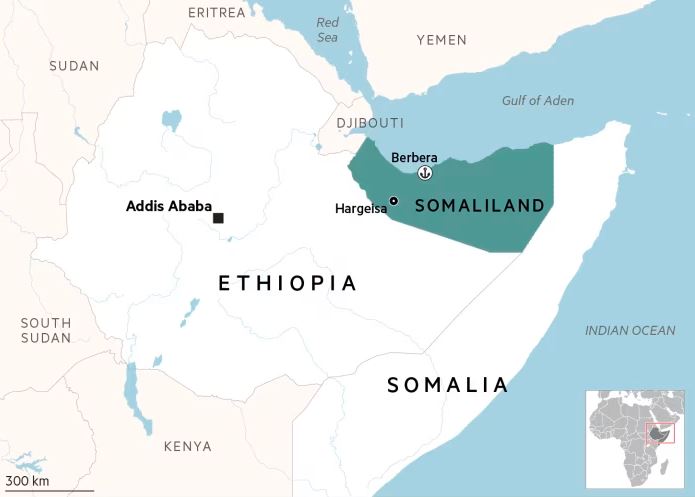
Map of the sub-region with Somaliland and its port of Berbera highlighted (Source: Financial Times)

On January 1, 2024, Ethiopia announced an agreement signed with Somaliland to lease the port of Berbera on the Red Sea, and a 20-km stretch of Red Sea coastline for 20 years, in exchange Somaliland will receive shares in its neighbor’s flagship carrier, Ethiopian Airlines, Africa’s most successful airline – and eventual recognition as an independent state. Prime Minister Abiy’s office said the agreement would “pave the way to realize the aspiration of Ethiopia to secure access to the sea.Somaliland’s foreign ministry said in a statement that the “historic agreement ensures Ethiopia’s access to the sea for their naval forces, reciprocated by formal recognition of the Republic of Somaliland, marking this as a significant diplomatic milestone for our country.” This agreement paves the way for Ethiopia to establish a commercial and military presence on the coast. I breathed a sigh of relief… which I had to take back the following day when Somalia’s President Hassan Sheikh Mohamud called the Ethiopia-Somaliland agreement an act of agression! He sees it as such, because the agreement would seem to imply that Ethiopia will recognize Somaliland as an independent state. Somaliland seceded from Somalia more than 30 years ago, but is not recognized by the African Union (AU) or the UN as an independent state. Quickly, both the US and the African Union have backed the territorial integrity of Somalia and urged all parties to cool tensions. 

Flag of Somalia

Ethiopia and Somalia are two states with a lengthy history of military conflict and animosity. Now, the president of Somalia is campaigning up and down the horn of Africa and has gotten the support of Egypt (remember that Egypt is mad at Ethiopia for building the Grand Ethiopian Renaissance Dam on the Nile and getting its proper share of the Nile’s waters – story for another day), Turkey, the puppet organization that is the AU, the European Union (EU), and the US. He stepped up the rhetoric by saying: “We will defend our country, we will defend it by all means necessary and seek the support of any ally willing to help us.” and called on youths “to prepare for the defense of our country“.

Map of the region with the different countries involved and ports (Source: Medium.com)

In my simple views, given Ethiopia’s large population, economic weight, and regional cloud (Ethiopia is now a member of the BRICS), any neighboring coastal state would benefit from working with it and developing agreements that will allow the use of its ports; it should be a win-win situation! Thus, it would seem careless for Somalia to want to start war, when all that could be done is get an agreement from Ethiopia to pay Somalia instead or split the proceeds from Somaliland… Ethiopia is definitely not getting access to the port of Berbera for free! Why is Somalia seeing a war threat from Ethiopia and not Somaliland… their issue is with Somaliland, why not deal with that? Neighboring Sudan has been at war since the middle of last year. Conflict would further destabilize the entire region, which is so close to the strategic Gulf of Aden on the Red Sea, one of the world’s largest shipping routes. Could this be a way for the Somalian president to justify his poor internal politics, by diverting his people’s attention towards war? These African countries are always ready and eager to lease their lands, ports, airports, for a specific duration to European or Chinese or even South African companies, why is it so hard to do the same for fellow African neighbors?

To learn more, read this article from the Conversation, Medium, or Modern Diplomacy. Dear reader, do you think this is the beginning of yet another conflict in the Horn of Africa? Do you think this will further play into the New Scramble for Africa?

Why the name: Mogadishu?

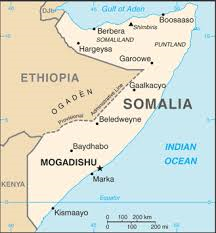
Map of Somalia
Map of Somalia

Have you ever wondered what the name of the capital city of Somalia, Mogadishu, meant? Somalia has been in the news in recent decades, particularly after the humiliation the American army received with Operation Restore Hope in 1993 at the hand of the local proclaimed president-to-be Mohamed Farrah Aidid, and also because of pirates roaming its coasts in the 2000s. The movie Black Hawk Down shows part of this operation with the ensuing Battle of Mogadishu, while Captain Phillips focuses on pirates.

The city of Mogadishu is located on the Indian Ocean coast of the Horn of Africa, in the Banaadir administrative region (gobol) in southeastern Somalia. The name Mogadishu is said to come from the Persian word Maq’ad-i-Shah, which means “the seat of the Shah.” This is a reflection of the city’s early Persian influence. Locally, it is spelled Muqdisho. To locals, the city is also known as Xamar.

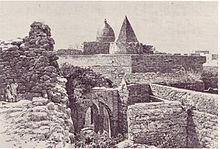
Engraving of the 13th century Fakr ad-Din Mosque in Mogadishu

So where does the Persian influence stem from in a city on the horn of Africa? Well, for starters, the city was founded in the 10th century by Arab traders. However, 2500 years old relics and pictographs were found on rocks in northern Somalia attesting to the area’s ancient occupation. Tradition and old records assert that southern Somalia, including the Mogadishu area, was inhabited in early historic times by hunter-gatherers of Khoisan descent who were later either driven out of the region, or assimilated by other migrants in the area.

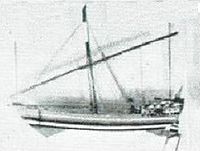
Mogadishan medieval ship

In 1331, the Moroccan explorer Ibn Battuta visited the city when it was at its zenith. He described Mogadishu as “an exceedingly large citywith many rich merchants, which was famous for the high quality fabric that it exported to destinations including Egypt. Batutta added that the city was ruled by a Somali Sultan, Abu Bakr ibn Sayx ‘Umar, who was originally from Berbera in northern Somalia and spoke both Somali (referred to by Battuta as Mogadishan, the Benadir dialect of Somali) and Arabic with equal fluency. The Sultan also had a retinue of wazirs (ministers), legal experts, commanders, royal eunuchs, and other officials at his service.

There appears to have been a strong Persian presence in both Mogadishu and Zeila for a time. A Shi’a influence can still be seen in some areas, as in the southern Somalia veneration of Fatimah, the Prophet Muhammad‘s daughter. Moreover, in the olden days, the city’s textiles were forwarded far and wide throughout the interior of the continent, as well as to the Arabian peninsula and as far as the Persian coast.

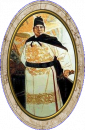
Zheng He
Zheng He, Chinese explorer

The Chinese navigator Zheng He visited the region with his expedition from 1413 to 1415.  From the 13th to the 15th centuries, Mogadishu was an important city of the Ajuran Sultanate. The city was governed by the Muzzaffar dynasty. Mogadishu is one of the rare cities on the East coast of Africa which was never conquered by the Portuguese whose attempts to occupy the city failed in the 16th century. However, the Muzzaffar dynasty lost control of the city to the Hawiye Somali when the Ajuran sultanate was defeated in the 17th century.

By 1892, Mogadishu was under the joint control of the Somali Sultanate of the Geledi and the Omani Sultanate of Zanzibar. The Geledi Sultans were at the height of their power. They dominated the southern ivory trade, and also held sway over the Jubba and Shebelle valleys in the hinterland.

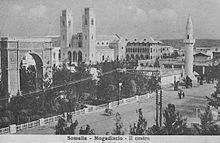
In 1905, Italy made Mogadishu the capital of the newly established Italian Somaliland. The Italians subsequently referred to the city as Mogadiscio. After World War I, the surrounding territory came under Italian control with some resistance. Thousands of Italians settled in Mogadishu and founded small manufacturing companies. They also developed some agricultural areas in the south near the capital, such as Janale and the Villaggio duca degli Abruzzi (present-day Jowhar). In the 1930s, new buildings and avenues were built. A 114 km (71 mi) narrow-gauge railway was laid from Mogadishu to Jowhar. An asphalted road, the Strada Imperiale, was also constructed and intended to link Mogadishu to Addis Ababa.

Mogadishu (downtown) in 1936, Arba'a Rukun Mosque to the centre right
Mogadishu (downtown) in 1936, Arba’a Rukun Mosque to the centre right

British Somaliland became independent on 26 June 1960 as the State of Somaliland, and the Trust Territory of Somalia (the former Italian Somaliland) followed suit five days later. On 1 July 1960, the two territories united to form the Somali Republic, with Mogadishu serving as the nation’s capital.

In 1990, Mogadishu fell under the control of rebels who forced President Mohamed Siad Barre into exile. The rebels formed rival factions each recognizing different presidents, and civil war broke out. In 1992, the United Nations sent armed forces led by American forces. After deadly combats, the American forces were defeated and forced to run away by Aidid‘s troops.

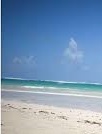
Sandy beach in Mogadishu

Today, the amazing sandy beaches of Mogadishu with its vibrant coral reefs are prime land for tourist resorts. Since the city’s pacification on 2011, the city is slowly rebuilding, and establishing international trades with other cities and countries. Mogadishu traditionally served as a commercial and financial centre. Mogadishu’s economy has grown rapidly since then. The Port of Mogadishu is the official seaport of Mogadishu, and the largest harbour in the country. Please enjoy this vibrant, reviving, and historical city. Do check out Somaliagenda.com for amazing pictures of Mogadishu and its people.