Reclaiming African History: Cape Coast Castle, a Slave Fort in Ghana

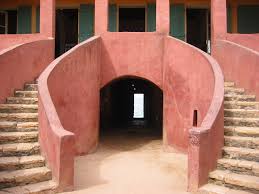
Cape Coast Castle (Wikipedia)

The Cape Coast Castle is one of the 30 slave forts of Ghana. In 2009, the US president Barack Obama and his family, made a point to visit the Cape Coast Castle. So why should you learn about it?

Well, it took 50 years to build the three-story building that forms today’s Cape Coast Castle. It was originally built by the Swedes (the Swedish Africa Company), starting in 1653 (it was then known as Fort Carlsborg or Carolusborg) for timber and mineral exportation, and then taken over by the Dutch before the British wrestled it away. The original cannons, cannon balls, and mortars used to defend the fort can still be seen today, facing the Atlantic Ocean.

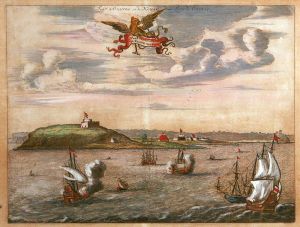
Cape Coast Castle in 1682

The brick courtyard of the castle, which Ghanaians commonly refer to as Cape Coast Dungeon, has two 18-foot water wells and four graves. The first grave is for the Rev. Phillip Quarcoo, the first black Anglican pastor in the area. Beside him lies C.B. Whitehead, 38-year old British soldier who was killed by a Dutch soldier in the courtyard. Besides them are the graves of Letitia Elizabeth Landon, and her husband George MacLean, the British governor of Cape Coast from 1830 to 1844. I am not sure how a woman could possibly live next to such atrocities; maybe by rationalizing that the people being imprisoned, were not human beings?

The open auditorium on the top floor of the former administration building now hosts an exhibit chronicling the history of slavery on Ghanaian shores.

Cape Coast Castle in 1890 (National Archives UK - Wikimedia)
Cape Coast Castle in 1890 (National Archives UK – Wikimedia)

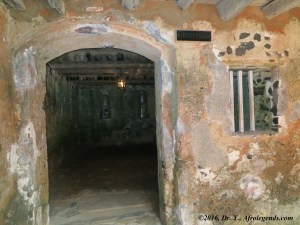
During the 17th and 18th centuries, the Cape Coast slave fort imprisoned about 1000 men and 300 women for any given 3 months period, before they were crammed into ships bound for a life of slavery in the Americas. Its corridors are full of dungeons where only dim light coming from tiny windows let the light and air in. 200 males will be kept in space meant for 50 people or less, where they will spend over 23h a day for three months, and will only be brought briefly out to eat. Ironically, Christian services were held in the fort while these poor souls were screaming for their lives underneath.The majority of captives ranged between 15 and 35 years of age.

Women were locked in 2 similar dungeons, 150 of them per chamber. They will be raped daily by the British soldiers, who would come into the cells and select the ones to spend the night with. Any slave who challenged the authorities was thrown into the condemned cellwhich held 30 – 50 in a room no bigger than most walk-in closets. There, they would die deprived of food, water, light, and oxygen, clawing the brick walls and floors as they suffocated.

Cape Coast Castle (WZM - Wikipedia)
Cape Coast Castle (WZM – Wikipedia)

To descend into the exposed brick castle feels like entering the depth of the underworld (I can only imagine how those captives felt going through there). There are five dungeon chambers for men. The strongest ones were separated during branding, when hot iron rods were used to mark their chests, and then chained and shackled together in the first chamber. The last cell has a hole in the wall, which leads into a deep dark tunnel which was used to take slaves underneath the castle’s courtyard, leading them to the “door of no return.” Cape Coast Castle was once the most active slave trading hub in West Africa.

Slavery was not just a European affair, but an African one as well, since many African chiefs traded slaves  (rarely their own people – but people from other nations) to the Europeans in exchange for goods. Thus, the Ghana House of Chiefs – a body comprising all the country’s traditional kings and chiefs- has placed a plaque on one of Cape Coast castle’s walls, asking for forgiveness to the souls of those who were sold. When will European nations also ask for forgiveness?

Reclaiming African History: Slavery and its Ugly Head

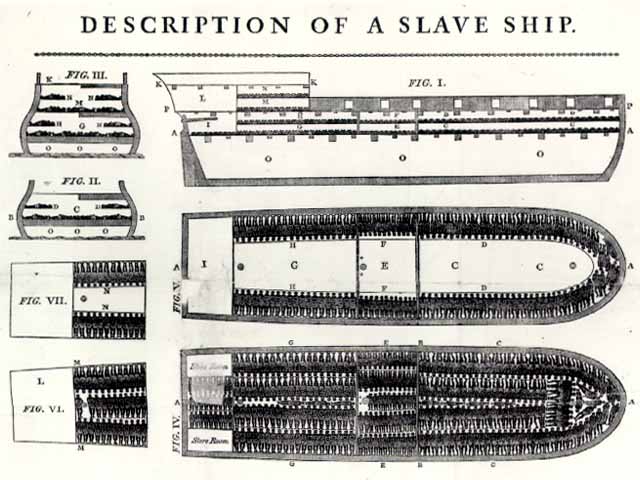
Slave ships
Slave ships

I am going to start a series on reclaiming our history. I will be talking about slave forts across Africa. There were over 30 slave forts in Ghana only. How many in other countries? We will find out through this exercise. These fortified trading posts were built between 1482 and early 1800s by Portuguese, British, Swedish, English, Danish, Dutch, and French traders that plied the African coast. Initially, they had come in search of gold (in Ghana), ivory (in Ivory Coast), pepper (along the Pepper Coast) and then later, they discovered cheap labor: thus was born the slave trade. There was intense rivalry between those European powers for the control of the West African coast from Senegal, to as far south as Angola.

Slave capture
Slaves marching after capture

It is estimated that over 20 million Africans were sold into slavery during the Atlantic slave trade; this does not account for those who died during the trip aboard the ship (about 1/3), and those who were killed during the capture. Slaves were taken to North America, the Caribbeans, and Brazil. Moreover, this is an estimate for the transatlantic slave trade only, but did you know that slaves were also taken by Arabic sailors from the East Coast of Africa, to places like Saudi Arabia and as far as India?

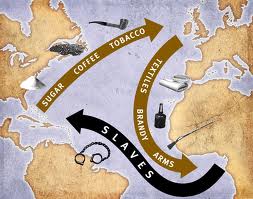
The Transatlantic slave trade

The Portuguese began dealing in black slaves from Africa in the 15th century. Initially, they purchased slaves from Islamic traders, who had established inland trading routes to the sub-Sahara region. Later, as the Portuguese explored the coast of Africa, they came upon the Senegal River, and found that they could purchase slaves directly from Africans. The European slave trading activity moved south along the African coast over time, as far south as Angola. On the east coast of Africa and in the Indian Ocean region, slaves were also taken from Mozambique, Zanzibar and Madagascar. Many of the slaves were from the interior of Africa, having been taken captive as a result of tribal wars, or else having been kidnapped by black slave traders engaged in the business of trading slaves for European goods. These slaves would be marched to the coast to be sold, sometimes traveling hundreds of miles. Many perished along the way. The captured Africans were held in forts or slave castles along the coast. They remained there for months crammed in horrible conditions inside dungeons for months before being shipped on board European merchant ships chained at the wrists and legs with irons, to North America, Brazil, and the West Indies.

Slaves on board a ship

Some African rulers were instrumental in the slave trade, as they exchanged prisoners of war (rarely their own people) for firearms which in turn allowed them to expand their territories. The slave trade had a profound effect on the economy and politics of Africa, leading in many cases to an increase in tension and violence, as many kingdoms were expanding.

Inspection of slave for sale

The slave trade was responsible for major disruption to the people of Africa. Women and men were taken young, in their most productive years, thus damaging African economies. The physical experience of slavery was painful, traumatic and long-lasting. We know this from the written evidence of several freed slaves. Captivity marked the beginning of a dehumanizing process that affected European attitudes towards African people. Can you imagine losing 1/3 or more of your active population? It is hard to fathom what crippling effect that will have on any country’s progress. That is why, in upcoming months, I will be talking and trying to identify slave forts in Africa, in an attempt to reclaim our history. I know this is a touchy subject, but it is history: the bad, the ugly, the beautiful, the joyous. It is important to know history in order to be able to claim the future fully, without any baggage.

Letter of a Freed Slave to his Old Master

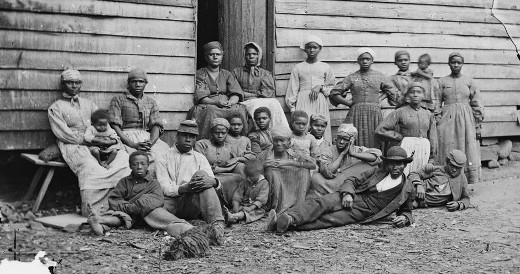
A group of escaped slaves in Virginia in 1862 (courtesy of the Library of Congress)

A newly discovered letter from a freed former slave to his onetime master is creating a buzz. Letters of Note explains that in August of 1865, a Colonel P.H. Anderson of Big Spring, Tennessee wrote to his former slave Jourdan Anderson, requesting that Jourdan return to work on his farm.  In the time since escaping from slavery, Anderson had become emancipated, moved to Ohio where he found paid work and was now supporting his family. The letter turned up in the August 22 edition of the New York Daily Tribune. ENJOY!

———-

Dayton, Ohio,

August 7, 1865

To My Old Master, Colonel P.H. Anderson, Big Spring, Tennessee

Sir: I got your letter, and was glad to find that you had not forgotten Jourdon, and that you wanted me to come back and live with you again, promising to do better for me than anybody else can. I have often felt uneasy about you. I thought the Yankees would have hung you long before this, for harboring Rebs they found at your house. I suppose they never heard about your going to Colonel Martin’s to kill the Union soldier that was left by his company in their stable. Although you shot at me twice before I left you, I did not want to hear of your being hurt, and am glad you are still living. It would do me good to go back to the dear old home again, and see Miss Mary and Miss Martha and Allen, Esther, Green, and Lee. Give my love to them all, and tell them I hope we will meet in the better world, if not in this. I would have gone back to see you all when I was working in the Nashville Hospital, but one of the neighbors told me that Henry intended to shoot me if he ever got a chance.

I want to know particularly what the good chance is you propose to give me. I am doing tolerably well here. I get twenty-five dollars a month, with victuals and clothing; have a comfortable home for Mandy,—the folks call her Mrs. Anderson,—and the children—Milly, Jane, and Grundy—go to school and are learning well. The teacher says Grundy has a head for a preacher. They go to Sunday school, and Mandy and me attend church regularly. We are kindly treated. Sometimes we overhear others saying, “Them colored people were slaves” down in Tennessee. The children feel hurt when they hear such remarks; but I tell them it was no disgrace in Tennessee to belong to Colonel Anderson. Many darkeys would have been proud, as I used to be, to call you master. Now if you will write and say what wages you will give me, I will be better able to decide whether it would be to my advantage to move back again.

Continue reading “Letter of a Freed Slave to his Old Master”