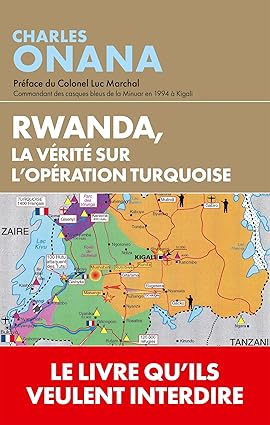
“Rwanda, la Verite sur l’Operation Turquoise” de Charles Onana
On Monday, a French court found the Franco-Cameroonian journalist and author Charles Onana guilty of downplaying the 1994 Rwandan genocide. Onana has been condemned to pay 8400 Euros of penalty. His editor, Damien Serieyx has also been found guilty and condemned to pay 5000 Euros. They also have to further pay 11,000 Euros in compensation to human rights organisations that filed the suit. The book at the center of the controversy is, “Rwanda, la vérité sur l’opération Turquoise: quand les archives parlent.”
The court said that Onana’s book had “trivialised” and “contested” in “an outrageous manner” the genocide that occurred between April and July1994. Onana’s lawyer, Emmanuel Pire, insisted that Onana did not question that genocide took place, or that Tutsis were particularly targeted as per the BBC; but rather that many lost lives in the 1994 horrendous events including Tutsis, Hutus, and Twas. Onana invites all to read his book without pulling passages out of context, but reading the book in its entirety. Both Onana and his publisher have appealed against the verdict.
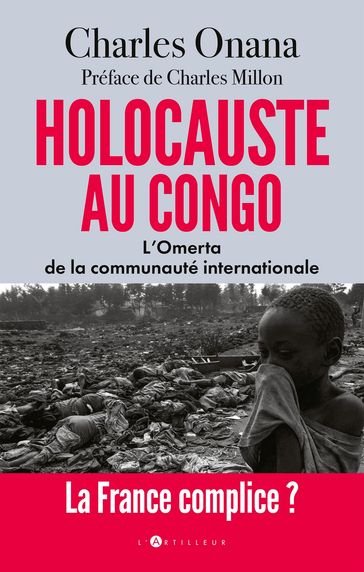
“Holocauste au Congo, L’Omerta de la Communaute Internationale” by Charles Onana
Could this be a vendetta against Onana for shedding light on the horrors happening in the East of the Democractic Republic of Congo (DRC), with his book “Holocaust in Congo: the International Community’s Omerta“? Until his book and a few by others like Patrick Mbeko, Michela Wrong, Pierre Pean, …, the international community had turned a blind eye on the atrocities committed in the DRC. With over 10 million dead, 7 million internally displaced, 500 000 woman raped, the story should have been in the front pages of news outlets around the world, yet it is a total blackout. Why? Because of the Geological Scandal that is the Democratic Republic of Congo (DRC), The New Scramble for Africa with Congo as the centerpiece, and the special first rate place played by that country ‘wrongfully’ dubbed by some as the Switzerland of Africa.
Have you ever wondered about the meaning of the name Kigali, the capital of Rwanda? Is the name from the ancient Kingdom of Rwanda? Was Kigali its capital? Or is it the name of a local town the colonizer decided to turn into the seat of a new protectorate state in Africa?
Boulevard in Kigali, Rwanda
Well, Kigali takes its name from Mount Kigali at the foothills of which the city is located. In Kinyarwanda, the prefix ki- denotes objects, while the adjective –gali means ‘vast’, ‘broad’, ‘wide’. Thus the translation of the name Kigaliyields ‘great or big mount’ or ‘vast mountain,’ because the mountain itself is broad and wide. However, based on oral tradition, it is said that the name might have originated in the 14th century when local king Rugwe after conquering the area stood on top of the hill and stated “burya iki gihugu ni Kigali,” which translates to “this country is vast.” Note that the capital of the Kingdom of Rwanda was never Kigali, but Nyanza.
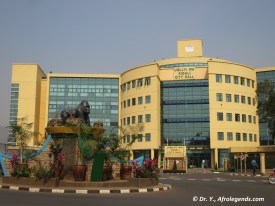
Kigali City Hall, Kigali, Rwanda
The city was established in 1907 by the German administrator and explorer Richard Kandt, who chose Kigali for its central location, and good views of the entire region (security-wise). Perched at an altitude of 1500 m, Kigali is made up of rolling hills and valleys, thus it is quite a strategic point. Kandt’s house was the first European house in the city, and is still in use today as the Kandt House Museum of Natural History. Very often to destroy the power of traditional and local kingdoms, colonial main cities and capitals were chosen away from the usual centers of power which might have carried a lot of the indigenous people’s traditions and thus caused a resistance to the colonial rule; this could also explain the choice of Kigali as the capital.
Kigali Genocide Memorial, Kigali, Rwanda
Kigali became the capital upon independence in 1962. Two other cities were considered as contenders for the title of capital, Nyanza the seat of the Mwami and the capital of the ancient kingdom, and Butare which was considered a cultural and religious center. Yet again Kigali won over the other two because of its central location. Over the years, Kigali has grown and expanded. However, the Rwandan civil war and Rwandan genocide of 1994 cast a dark cloud over Kigali, the Rwandan sky, and the entire sub-region. Over 800,000 people died during that time, which marked one of the darkest times in the history of the country. Today, one can still visit the Genocide Memorial in Kigali to remember those whose lives were taken.
Hotel des Mille Collines which at the height of the 1994 genocide housed over 1200 Hutus and Tutsis refugees, and was made famous by the movie Hotel Rwanda with his general manager Paul Rusesabagina who has been abducted from exile in 2020 and is currently jailed in Kigali by the Kagame regime
Today, Kigali has expanded tremendously, and grown significantly. Much of the city has been rebuilt, and today flourishes. It is the economic and financial hub of the country. In 2013, the economy was reported to be dependent on foreign aid and illegal resource extraction from the DRC. I once read comments from a member of the Rwandan financial ministry who explained that they were finding new precious stones or minerals every day on Rwandan soil… in reality, it is from neighboring DRC.
Overall, Kigali knows cooler temperatures than most countries around the equator, because of its high elevations. The city is particularly lauded for its cleanliness, innovation, and foreign investments. The quick turnaround and rebuilding of Kigali and Rwanda as a whole has made it a key player in all continental organizations. Although many criticize the government of Paul Kagame, it is no doubt that Kigali and Rwanda have experienced undeniable growth, thanks to a combination of the neighbor’s wealth and good governance.
Amahoro National Stadium entrance in Kigali, Rwanda
If you visit Kigali and Rwanda as a whole, please make sure to check your plastic bags at your point of origin as plastic bags are prohibited on Rwandan soil. Make sure to visit the Kigali Genocide Memorial, the Amahoro Stadium, the Presidential Palace Museum which was the abode of past president Juvénal Habyarimana, the Muslim mosque of the city, and the different craft centers. The city expands along all the different hills, and so make sure to ride around on the moto-taxis or use public transportation, and do not forget to buy the famous agaseke baskets for which Rwandans and Burundians are known for.





 African Heritage