Thomas Kanza was a Congolese diplomat who served as Congo (now Democratic Republic of Congo (DRC))’s first ambassador to the United Nations from 1960 to 1962. He also served as a minister of foreign affairs at some point. He wrote a memoir entitled, The Rise and Fall of Patrice Lumumba: Conflict in the Congo, which covered his own personal experiences as the Congo became independent, and his interactions with Patrice Emery Lumumba. He said, about Lumumba in an interview to Jeune Afrique:
“Patrice Lumumba represents for Congo what Fidel Castro represents for Cuba, Nasser for Egypt, N’krumah for Ghana, Mao Zedong for China, and Lenin for the Soviet Union.
Despite his short political life and his tragic end, perhaps because of them, Patrice-Emery Lumumba has entered history through the front door : that of heroism and martyrdom.
He is at once the flag and the symbol. He is all.He embodies everything : the struggle, the courage, even temerity, the suffering, the action and the perseverance. He lived as a free man, as an independent thinker : his writings, his words, his acts were those of the responsible man, conscious of his vocation as a liberator.”
(Lumumba et le lumumbisme, Jeune Afrique, nº 268, 13 Février 1966) Translated to English by Dr. Y., Afrolegends.com
Every June30, we commemorate the “independence” of the Democratic Republic of Congo (DRC) by posting a speech or letter by its first prime minister Patrice Emery Lumumba. The word independence is placed in quotes because we know that independence cha-cha never really occurred and that many African countries including the DRC are still suffering from the sequels of neo-colonialism.
Patrice Lumumba gave the speech below on December 11, 1958 in Accra, Ghana, at a conference sponsored by Kwame Nkrumah, Ghana’s first president who also succumbed to imperialism. In his speech, all the evils that plague Congolese and African societies are cited: Western domination, external domination, balkanization of the Congolese territory (and Africa), and all the ‘ism‘ that undermine the unity of Africa. His speech is still very current today. The speech can be found in its entirety on Blackpast.org.
====
Kwame Nkrumah
On December 11, 1958, 34 year old Patrice Lumumba, president of the Congolese National Movement, spoke at the Assembly of African Peoples, an international Pan African Conference sponsored by Kwame Nkrumah, the Prime Minister of newly independent Ghana. His remarks appear below. Two years later Lumumba would become the first Prime Minister of the Congo.
…
Our Program of Action
The Congolese National Movement, which we represent at this great conference, is a political movement, founded on October 5, 1958.
This date marks a decisive step for the Congolese people as they move toward emancipation. I am happy to say that the birth of our movement was warmly received by the people for this reason.
The fundamental aim of our movement is to free the Congolese people from the colonialist regime and earn them their independence.
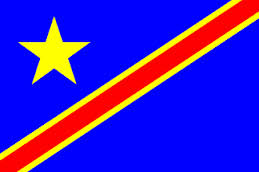
Flag of the Democratic Republic of Congo
We base our action on the Universal Declaration of the Rights of Man — rights guaranteed to each and every citizen of humanity by the United Nations Charter — and we are of the opinion that the Congo, as a human society, has the right to join the ranks of free peoples.
We wish to see a modern democratic state established in our country, which will grant its citizens freedom, justice, social peace, tolerance, well-being, and equality, with no discrimination whatsoever.
In a motion we recently transmitted to the minister of the Congo in Brussels, we clearly stipulated — as did many other compatriots of ours — that the Congo could no longer be treated as a colony to be either exploited or settled, and that its attainment of independence was the sine qua non condition of peace.
In our actions aimed at winning the independence of the Congo, we have repeatedly proclaimed that we are against no one, but rather are simply against domination, injustices and abuses, and merely want to free ourselves of the shackles of colonialism and all its consequences.
These injustices and the stupid superiority complex that the colonialists make such a display of, are the causes of the drama of the West in Africa, as is clearly evident from the disturbing reports of the other delegates.
Map of the Democratic Republic of Congo
Along with this struggle for national liberation waged with calm and dignity, our movement opposes, with every power at its command, the balkanization of national territory under any pretext whatsoever.
From all the speeches that have preceded ours, something becomes obvious that is, to say the least, odd, and that all colonized people have noticed: the proverbial patience and good-heartedness that Africans have given proof of for thousands of years, despite persecution, extortions, discrimination, segregation, and tortures of every sort.
The winds of freedom currently blowing across all of Africa have not left the Congolese people indifferent. Political awareness, which until very recently was latent, is now becoming manifest and assuming outward expression, and it will assert itself even more forcefully in the months to come. We are thus assured of the support of the masses and of the success of the efforts we are undertaking.
This historical conference, which puts us in contact with experienced political figures from all the African countries and from all over the world, reveals one thing to us: despite the boundaries that separate us, despite our ethnic differences, we have the same awareness, the same soul plunged day and night in anguish, the same anxious desire to make this African continent a free and happy continent that has rid itself of unrest and of fear and of any sort of colonialist domination.
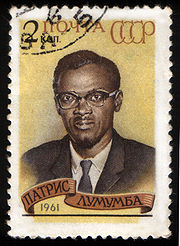
Lumumba on a USSR commemorative stamp in 1961
We are particularly happy to see that this conference has set as its objective the struggle against all the internal and external factors standing in the way of the emancipation of our respective countries and the unification of Africa.
Among these factors, the most important are colonialism, imperialism, tribalism, and religious separatism, all of which seriously hinder the flowering of a harmonious and fraternal African society.
This is why we passionately cry out with all the delegates:
Down with colonialism and imperialism!
Down with racism and tribalism!
And long live the Congolese nation, long live independent Africa!
The 30 June 1960 marks the independence of the then Congo-Belge (Democratic Republic of the Congo (DRC)) from Belgium. We will celebrate DRC’s independence today with a poem by one of Congo’s proud sons, none other than its first democratically elected Prime Minister Patrice Lumumba, “Pleure, Ô Noir Frère bien-aimé (Weep, beloved black brother)”. This poem was published in the journal INDEPENDANCE, organe du M.N.C., en septembre 1959 (Cf. La pensée politique de Patrice LUMUMBA, textes et documents recueillis par Jean VAN LIERDE, Présence Africaine, 1963, p. 69-70). Translated to English by Lillian Lowenfels and Nan Apotheker.
Pleure, O Noir Frère bien-aimé
O Noir, bétail humain depuis des millénaires Tes cendres s’éparpillent à tous les vents du ciel Et tu bâtis jadis les temples funéraires Où dorment les bourreaux d’un sommeil éternel. Poursuivi et traqué, chassé de tes villages, Vaincu en des batailles où la loi du plus fort, En ces siècles barbares de rapt et de carnage, Signifiait pour toi l’esclavage ou la mort, Tu t’étais réfugié en ces forêts profondes Où l’autre mort guettait sous son masque fiévreux Sous la dent du félin, ou dans l’étreinte immonde Et froide du serpent, t’écrasant peu à peu. Et puis s’en vint le Blanc, plus sournois, plus rusé et rapace Qui échangeait ton or pour de la pacotille, Violentant tes femmes, enivrant tes guerriers, Parquant en ses vaisseaux tes garçons et tes filles. Le tam-tam bourdonnait de village en village Portant au loin le deuil, semant le désarroi, Disant le grand départ pour les lointains rivages Où le coton est Dieu et le dollar Roi Condamné au travail forcé, tel une bête de somme De l’aube au crépuscule sous un soleil de feu Pour te faire oublier que tu étais un homme On t’apprit à chanter les louanges de Dieu. Et ces divers cantiques, en rythmant ton calvaire Te donnaient l’espoir en un monde meilleur… Mais en ton cœur de créature humaine, tu ne demandais guère Que ton droit à la vie et ta part de bonheur. Assis autour du feu, les yeux pleins de rêve et d’angoisse Chantant des mélopées qui disaient ton cafard Parfois joyeux aussi, lorsque montait la sève Tu dansais, éperdu, dans la moiteur du soir. Et c’est là que jaillit, magnifique, Sensuelle et virile comme une voix d’airain Issue de ta douleur, ta puissante musique, Le jazz, aujourd’hui admiré dans le monde En forçant le respect de l’homme blanc, En lui disant tout haut que dorénavant, Ce pays n’est plus le sien comme aux vieux temps. Tu as permis ainsi à tes frères de race De relever la tête et de regarder en face L’avenir heureux que promet la délivrance. Les rives du grand fleuve, pleines de promesses Sont désormais tiennes. Cette terre et toutes ses richesses Sont désormais tiennes. Et là haut, le soleil de feu dans un ciel sans couleur, De sa chaleur étouffera ta douleur Ses rayons brûlants sécheront pour toujours La larme qu’ont coulée tes ancêtres, Martyrisés par leurs tyranniques maîtres, Sur ce sol que tu chéris toujours. Et tu feras du Congo, une nation libre et heureuse, Au centre de cette gigantesque Afrique Noire.
Weep, Beloved Black Brother
O black man, beast of burden through the centuries, Your ashes scattered to the winds of heaven, There was a time when you built burial temples In which your murderers sleep their final sleep. Hunted down and tracked, driven from your homes. Beaten in battles where brute force prevailed. Barbaric centuries of rape and carnage That offered you the choice of death or slavery. You went for refuge to the forest depths, And other deaths waylaid you, burning fevers, Jaws of wild beasts, the cold, unholy coils Of snakes who crushed you gradually to death. Then came the white man, more clever, tricky, cruel, He took your gold in trade for shoddy stuff, He raped your women, made your warriors drunk, Penned up you sons and daughters on his ships. The tom-toms hummed through all the villages, Spreading afar the mourning, the wild grief At news of exile to a distant land Where cotton is God and the dollar King. Condemned to enforced labor, beasts of burden, Under a burning sun from dawn to dusk, So that you might forget you are a man They taught your to sing the praises of their God, And these hosannas, tuned in to your sorrows, Gave you the hope of a better world to come. But in your human heart you only asked The right to live, your share of happiness. Beside your fire, your eyes reflect your dreams and suffering, You sang the chants that gave voice to your blues. And sometimes to your joys, when sap rose in the trees And you danced wildly in the damp of evening. And out of this sprang forth, magnificent, Alive and virile, like a bell of brass Sounding your sorrow, that powerful music, Jazz, now loved, admired throughout the world, Compelling the white man to respect, Announcing in clear loud tones from this time on This country no longer belongs to him. And thus you made the brothers of your race Lift up their heads to see clear, straight ahead The happy future bearing deliverance. The banks of a great river in flower with hope Are yours from this time onward. The earth and all its riches Are yours from this time onward. The blazing sun in the colorless sky Dissolves our sorrow in a wave of warmth. Its burning rays will help to dry forever The flood of tears shed by our ancestors, Martyrs of the tyranny of the masters. And on this earth which you will always love You will make the Congo a nation, happy and free, In the very heart of vast Black Africa.





 African Heritage