The UN Peacekeeping Force Reduced by 25%

UN flag

There is a news which has gone undetected or rather not talked about much. Did you know that because of lack of funding, the United Nations (UN) is going to lose about a quarter of its peacekeepers! It is said that this is happening due to budget cuts from the American government; the UN will have to reduce its blue helmets (casques bleus) force on the ground, including some civilians. It was announced on October 8th.

Nous allons devoir rapatrier, réduire d’environ 25% le nombre de nos effectifs de maintien de la paix militaires et policiers, ainsi que leur équipement, et un nombre important d’employés civils des missions vont également être touchés,” (“We will have to repatriate, reduce by about 25% the number of our military and police peacekeeping personnel, as well as their equipment, and a significant number of civilian employees of the missions will also be affected“) said an anonymous UN person to RFI.

This is equivalent to about 13,000 to 14,000 soldiers and policemen. Their repatriation could start in 6 weeks (now 4 weeks) and could go on over 12 to 18 weeks.

For those of us who watched MINUSMA (Mali), ONUCI (Cote d’Ivoire), MONUSCO (Democratic Republic of Congo (DRC)), MINUSCA (Central African Republic (CAR)), MINUSTAH (Haiti), etc… it is no secret that those have troops have been used to impose the wishes of the West and serve the interest of their masters in our countries. It is also well-documented that the UN peacekeeping has a sexual abuse problem. In the DRC, there are countless reports of UN peacekeepers being accused of rape, sexual abuse and exploitation; moreover, they have been accused of helping the rebel forces for all the minerals, and have rarely worked for the safety of the people. In Haiti, they caused the largest cholera outbreak in the nation’ history and deadliest in modern history. Furthermore, an Associated Press (AP) investigation revealed in 2017 that at least 134 Sri Lankan peacekeepers from the UN were involved in a child sex ring in Haiti (both of girls and boys) over a 10-year period and that although 114 of them were sent home, none were charged for the crimes. In Mali, they have been accused of looting, and failing to uphold security and even fueling tensions – which they were brought in to do. In Cote d’Ivoire, the representative of ONUCI actually took sides in the country’s elections above the country’s supreme institutions; while the forces in the north of the country never helped stop the advancement of the rebel forces over the years, despite the government asking for help. In CAR, they have been accused of sexual exploitation, abuse, and other misconduct. The sex abuse is rife in CAR; at least 98 girls said they had been sexually abused by UN peacekeepers from Burundi and Gabon in 2014 and 2015. The UN successfully identified 41 troops accused of involvement in the incidents, and the personnel identified were returned to their homelands but have not faced charges. A public UN database has been recording sexual abuse and exploitation.

Thus, in view of all these, we will be happy when these so-called peacekeeping forces are removed from our territories or when they undergo a serious cleaning to serve the fair interests of ALL.

Celebrating the Centennial of Frantz Fanon’s Birth

Frantz Fanon
Frantz Fanon

This year, we are celebrating the centennial of the birth of Frantz Fanon, the great revolutionary psychiatrist, philosopher, and anti-colonial French author from Martinique. His work explored the psychological effects of colonization and the struggles of decolonization, and inspired liberation movements across Africa, Latin America, the Caribbean, and even the United States. To date, his works,  Black Skin, White Masks (1952) and The Wretched of the Earth (1961) remain essential reading in postcolonial studies and political philosophy. He died quite young at the age of 36, but he left his imprints everywhere, particularly on the African continent, and in particularly Algeria where he lived and fought for the liberation of the Algerian people.

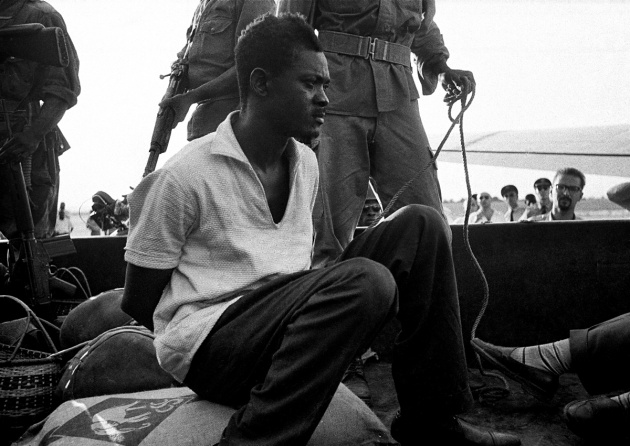
Lumumba detained
Lumumba detained

Fanon saw Congo, then Belgian Congo, clearly, as the center for pan-african solidarity, and believed that the assassination of its prime minister, Patrice Emery Lumumba, was a blow not just to Congo, but to the entire African liberation movement. When Lumumba was alive, he had invited Fanon to attend the inter-African Conference in 1960, thus showing his active engagement in Congo’s political future.   He wrote on Congo, Lumumba’s death: Could we (Africans) have acted differently? Like Amilcar Cabral, he warned of the presence of “traitors from within” seeing that the greatest threat to African independence was not just Western imperialism, but also African elites who had internalized colonial values and acted against their own people; like Moise Tshombe who played a great role in Lumumba’s demise.

Please join the Frantz Fanon Foundation in celebrating Fanon’s life and impacts on African liberation. There will be events throughout the year. Below are some excerpts from Fanon’s article, Lumumba’s death: Could we (Africans) have acted differently? For more, check it out. His words still ring true!

Patrice Lumumba

The great success of the enemies of Africa is to have corrupted the Africans themselves.  It is true that these Africans had vested interest in the murder of Lumumba.  Heads of puppet governments, in a fake independence, faced everyday by massive opposition from their peoples, it did not take long to convince themselves that the real independence of the Congo would put them personally at risk.

And first by Lumumba when he sought the intervention of the UN.  He should have never called on the United Nations.  The UN has never been able to properly solve problems brought to man’s consciousness by colonialism, and whenever it has intervened, it was to actually come to the aid of the colonial power to the oppressed country [see … think about MONUSCO].

In reality the UN is the legal card used by imperialist interests when brute force has failed.  The sharing, the mixed controlled joint committees, under guardianship are international means of torture to break the will of the people, cultivating anarchy, banditry and misery.

Lumumba’s fault was then initially to believe in the impartiality of the UN. He forgot that the UN, particularly in the current state, is only a reserve assembly established by the Greats to continue, between two armed conflicts, the “peaceful struggle” for the balkanization of the world.

Africans should remember this lesson.  If outside help is necessary to us, let us call on our friends.  Only they can truly and fully help us achieve our goals precisely because the friendship between us is a friendship of struggles. [The AES should remember this].