There is a news which has gone undetected or rather not talked about much. Did you know that because of lack of funding, the United Nations (UN) is going to lose about a quarter of its peacekeepers! It is said that this is happening due to budget cuts from the American government; the UN will have to reduce its blue helmets (casques bleus) force on the ground, including some civilians. It was announced on October 8th.
“Nous allons devoir rapatrier, réduire d’environ 25% le nombre de nos effectifs de maintien de la paix militaires et policiers, ainsi que leur équipement, et un nombre important d’employés civils des missions vont également être touchés,” (“We will have to repatriate, reduce by about 25% the number of our military and police peacekeeping personnel, as well as their equipment, and a significant number of civilian employees of the missions will also be affected“) said an anonymous UN person to RFI.
This is equivalent to about 13,000 to 14,000 soldiers and policemen. Their repatriation could start in 6 weeks (now 4 weeks) and could go on over 12 to 18 weeks.
For those of us who watched MINUSMA (Mali), ONUCI (Cote d’Ivoire), MONUSCO (Democratic Republic of Congo (DRC)), MINUSCA (Central African Republic (CAR)), MINUSTAH (Haiti), etc… it is no secret that those have troops have been used to impose the wishes of the West and serve the interest of their masters in our countries. It is also well-documented that the UN peacekeeping has a sexual abuse problem. In the DRC, there are countless reports of UN peacekeepers being accused of rape, sexual abuse and exploitation; moreover, they have been accused of helping the rebel forces for all the minerals, and have rarely worked for the safety of the people. In Haiti, they caused the largest cholera outbreak in the nation’ history and deadliest in modern history. Furthermore, an Associated Press (AP) investigation revealed in 2017 that at least 134 Sri Lankan peacekeepers from the UN were involved in a child sex ring in Haiti (both of girls and boys) over a 10-year period and that although 114 of them were sent home, none were charged for the crimes. In Mali, they have been accused of looting, and failing to uphold security and even fueling tensions – which they were brought in to do. In Cote d’Ivoire, the representative of ONUCI actually took sides in the country’s elections above the country’s supreme institutions; while the forces in the north of the country never helped stop the advancement of the rebel forces over the years, despite the government asking for help. In CAR, they have been accused of sexual exploitation, abuse, and other misconduct. The sex abuse is rife in CAR; at least 98 girls said they had been sexually abused by UN peacekeepers from Burundi and Gabon in 2014 and 2015. The UN successfully identified 41 troops accused of involvement in the incidents, and the personnel identified were returned to their homelands but have not faced charges. A public UN database has been recording sexual abuse and exploitation.
Thus, in view of all these, we will be happy when these so-called peacekeeping forces are removed from our territories or when they undergo a serious cleaning to serve the fair interests of ALL.
We said goodbye to a lot of people and things in Africa in 2023. Below are 11 of them:
1. We said goodbye to MINUSMA, a UN peacekeeping mission in Mali, which was found to be complicit to the destabilization of the country. The organization had been in Mali for a decade, with no results except a clear collusion with the terrorists (funded by external forces) who have divided the country. On their way out, weeks before they were set to leave at the request of the Malian government, MINUSMA breached their agreements with the government for a safe handout, and left abruptly leaving all sorts of heavy artillery for the rebel groups to take over the city, but the Mali governmental forces were able to defeat the terrorists and free the city of Kidal, a rebel stronghold. Mali Forces Succeed in Kidal where France and Allies could not!
Flag of Burkina Faso
2. In February, France agreed to withdraw its troops from agreed to a request from Burkina Faso’s military leaders to withdraw all its troops from the country within a month. France to Withdraw Troops from Burkina Faso. There were other defense agreements signed in 2018; this is a rescinding on the 2018 agreements. It is the third African country from which France is forced to move out its troops: Central African Republic, Mali, and now Burkina Faso.
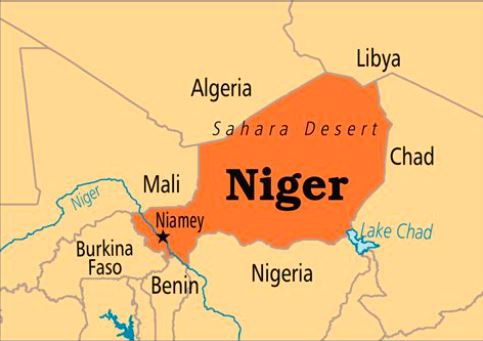
Map of Niger
3. On July 26, 2023, President Mohamed Bazoum of Niger was ousted by a military coup d’etat that saw the arrival of president Abdourahamane Tchiani at the helm of the country. France and the international community have been totally against the new government. This has let to a successive rupture of French relations in Niger, starting with a Niger – France Diplomatic Arm Wrestling, where the French ambassador refused to leave the country after the country told him to, which came to an end a few days ago with French troops leaving the country. Since the coup, Niger has been one of the fastest growing economies of the continent, now that the uranium revenues are actually entering the country’s coffers vs. France. All Eyes on Niger, Why is Niger so Poor and Why the Anti-French Sentiment?, Bye Bye to French Troops in Niger.
Flag of Gabon
4. On August 30, 2023, we all woke up to a military coup d’etat in Gabon by the army which ended 56 years of the Bongo dynasty by putting out Ali Bongo. We all thought we were getting someone new, but we got General Brice Clotaire Oligui Nguema, who is a cousin of Bongo and used to be the bodyguard of Bongo’s father, the late President Omar Bongo. He was also head of the secret service in 2019 before becoming head of the republican guard. Unlike the coup in Niger, the coup in Gabon was applauded by France and the rest of the international community. Is the Wind of Change blowing in Gabon too?
Map of Morocco
5. In September, Never Before Seen Catastrophes hit Morocco and Libya Few Days apart: Morocco was hit by a magnitude 6.8 earthquake, the deadliest in the country in over a century, said to have claimed over 3,000 lives. Libya was hit by unbelievable floods a few days later on September 10; these floods, the deadliest ever on the continent, and said to have claimed between 5,000 – 10,000 lives, and displaced at least 30,000 people. Our hearts go out to our Moroccan and Libyan brothers and sisters. Africa stands with you.
Ruben Um Nyobé
6. Marie Um Nyobe (born Marie Ngo Ndjock Yebga), the widow of one of Cameroon’s greatest opposition fighters and freedom fighters, the real Father of Cameroonian independence, Ruben Um Nyobé, passed away on the exact same day that her husband was murdered 65 years ago, on 13 September 1958, on the 65th Commemoration of Ruben Um Nyobe’s Murder. This came just as Cameroon and the Union des Populations du Cameroon (UPC) was commemorating the 65th year of his murder by the French forces in Cameroon.
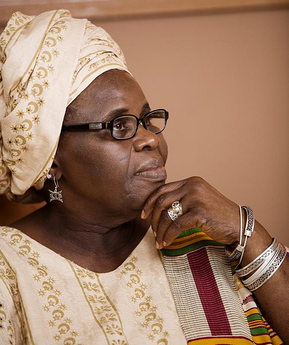
Ama Ata Aidoo (Source: W4.org)
7. This year, we said goodbye to Ama Ata Aidoo, the first published female African dramatist with her play The Dilemma of a Ghost published in 1965. She was a Ghanaian author, poet, playwright, who served in the government of Jerry Rawlings as Secretary for Education from 1982 to 1983. So Long to Ghanaian Writer Trailblazer Ama Ata Aidoo. She belongs to the generation of African women writers who dared to speak up loud and clear about African women issues at a time when it was not common. In a 2014 interview with Zeinab Badawi of BBC, she said “People sometimes question me, for instance, why are your women so strong? And I say, that is the only woman I know.”
Ni John Fru Ndi (Source: Bonaberi.com)
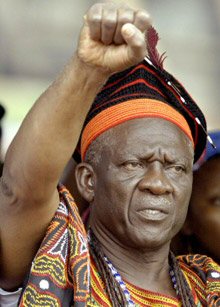
8. Ni John Fru Ndi, the major political opponent to the current president of Cameroon for almost 3 decades passed away this year. Affectionately called “The Chairman,” John Fru Ndi came up at the twilight of the National Conference in Cameroon with the creation of the Social Democratic Front (SDF) in 1990. Over the years, his party came to symbolize hope in a place where there had been no ‘real’ leadership change in over 30 years. His party was seen as the main opposition party to the government for over 2 decades. GoodBye to a Courageous Leader : Ni John Fru Ndi and Ushering the Multi-Party Era in Cameroon. He has left a major imprint in Cameroon’s politics.
9. At the beginning of this month, Mali and Niger ended Long-Standing Tax Treaties with France, putting an end to a 50 years old tax treaty that mostly benefited French companies in these African countries. This will help Mali and Niger to finally be able to tax these companies that make billions in their countries, to get the funds necessary to fund their own economies.
Poster of Sarafina
10. In mid-December, we were stunned by the passing of the South African singer Bulelwa Mkutukana, also known by her stage name as Zahara, a self-taught guitarist who gained recognition with her debut album, Loliwe, in 2011. She enchanted us all with Loliwe. The album was a commercial hit and won the Album of the Year at the South African Music Awards, and loved throughout Africa. Her style fell in the Afro-Soul register with her strong beautiful voice. So long blooming flower, we will keep singing to honor you.







 African Heritage