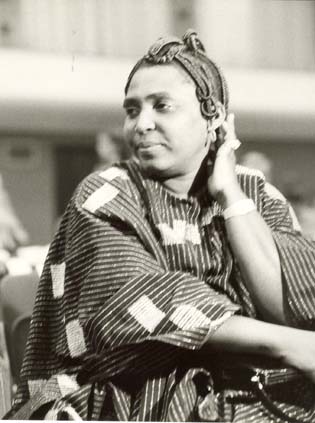
A few years back, we talked about the Senegalese author Mariama Bâ, the African female pioneer who is considered to have written the first African feminist novel. Her literary career, although short as she passed away few months after the publication of her first book, advocates for women’s rights. Une Si Longue Lettre [So Long a Letter] has been one of my favorite books in my library. It was written by a woman in 1979; it talks about the condition of the woman in the Senegalese society, conditions that are very similar in many African countries. It sheds a light on the place of the woman in the society, the effect of polygamy on women and society, and the clash between modernism and traditions. Her book became an African classic, and has been read in schools across the continent and translated in many languages. Her story still resonates today.
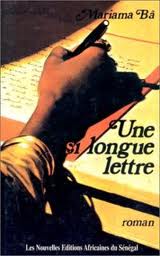
Une Si Longue lettre / So Long a Letter
It is important to note that Bâ’s feminism is deeply rooted on an African identity, humanity, and experience, which is different from the Western feminist frameworks.
The Senegalese screenwriter and producer Angele Diabang has decided to adapt this masterpiece for the big screen, and debuted the feature film at the Brooklyn Arts Music (BAM) FilmAfrica Festival (BAM | FilmAfrica 2025) in May 2025. Enjoy, and I hope all of you will get a chance to watch it.
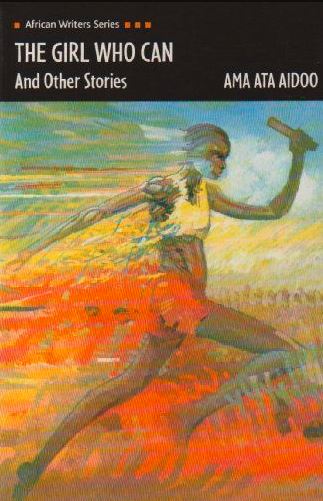
The Girl Who Can and Other Stories by Ama Ata Aidoo
“‘It’s not easy.’
She was superb. The words rolled off her tongue like pips from oranges or cherries: articles thrown away with wistful abandon, to be forgotten utterly or later, maybe, searched for, and used.
She was great: an advocate who could stand her ground with the best of them. A lawyer who knew how to get all to see her point. Their lordships would have been wowed.” Her Hair Politics, p. 1, The Girl Who Can and Other Stories, by Ama Ata Aidoo, Heinemann 1997.
Above is an extract from the short story Her Hair Politics by Ghanaian trailblazer Ama Ata Aidoo, from the book The Girl Who Can which graces my library. Who was Ama Ata Aidoo?
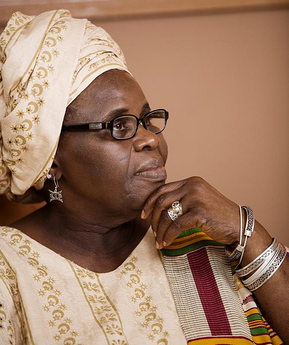
Ama Ata Aidoo (Source: W4.org)
Ama Ata Aidoo was the first published female African dramatist with her play The Dilemma of a Ghost published in 1965. She was a Ghanaian author, poet, playwright, who served in the government of Jerry Rawlings as Secretary for Education from 1982 to 1983. As the daughter of Nana Yaw Fama, chief of Abeadzi Kyiakor, she hailed from a royal family of the Fante ethnic group of southern Ghana. Her grandfather was murdered by neocolonialists, event which influenced her father in putting a huge emphasis on education and the learning of history and current events. In 1992, she won the Commonwealth Writers’ Prize for her novel Changes. In 2000, she established the Mbaasem Foundation in Accra, Ghana, to promote and support the work of African women writers. She taught at different universities in Zimbabwe, and the United States.
Ghanaian author Ama Ata Aidoo (Source: Africancelebs.com)
Writer Ama Ata Aidoo belongs to the generation of African women writers who dared to speak up loud and clear about African women issues at a time when it was not common. Like Mariama Ba, Buchi Emecheta, Flora Nwapa, Aidoo led the way and broke barriers for the current generation of African writers. In a 2014 interview with Zeinab Badawi of BBC, she said “People sometimes question me, for instance, why are your women so strong? And I say, that is the only woman I know.” This is what made Aidoo’s work touch millions because she portrayed the true African woman that we all know. So long Champion Aidoo, rest assured that you have influenced millions, and many are now following in your footsteps!
To learn more, please check out the articles on The Conversation by Rose Sackeyfio, BBC, and the Guardian. President Nana Akufo-Addo of Ghana said, “Through her work, she made a tremendous contribution to the development of our country and continent, and expressed so many of our feelings about our fate as Ghanaians, and, indeed as Africans.” As you read back the extract at the top, doesn’t it remind you of Ama Ata Aidoo herself, the writer who advocate for women’s rights… the lordships were definitely wowed!
I have wanted to write about Mariama Bâ for the longest time. She is a writer from Senegal… she is the author of “Une Si Longue Lettre” [So Long a Letter], and “Chant Ecarlate” [Scarlet Song]. Her book “Une si Longue Lettre” [So Long a Letter] is considered by many as being the first truly African feminist book, as it describes the woman’s condition in an African and Muslim society. It talks about the place of the woman in society, the effect on polygamy on women and society, and the clash between modernism and traditions. It is written as a letter from a widow Ramatoulaye to her best friend Aissatou who left her husband when he decided to marry a second wife. This book really describes the feminine condition in Africa, and was truly the first to address so overtly the woman’s hurdle in African society. Six months after the publication of “Une Si Longue Lettre,” Mariama Ba passed away… and her novel “Chant Ecarlate” was published posthumously.
Une Si Longue lettre
Chant Ecarlate [Scarlet Song] also deals with feminine conditions, but addresses more the clash between two different cultures the European (of the protagonist Mireille), and the African (of Mireille’s husband), and again polygamy. I always felt deeply connected to Bâ’s first book, and always wondered what a great loss African literature suffered when she left. She will always be an inspiration for many: orphan from her mother, raised by her father and grand-parents, mother of nine children, divorcée, professor, highly educated woman, she embodied the strength and determination that can so clearly be seen in African women. Today, “Une Si Longue Lettre” is an African classic, read in all schools across the continent, and translated in numerous languages. We are forever grateful for her work… she opened the door to many bold young African female writers.
Scarlet Song
The following is an interview that Mariama Bâ gave to Alioune Toure Dia for the magazine Amina in November 1979: Interview de Mariama Bâ à Amina. Relax and enjoy!




 African Heritage