Pendant Ivory mask representing Queen Idia, Iyoba of Benin City (16th Century), exposed at the MET
Just like Cheikh Anta Diop, Leo Frobenius, the German ethnologist and archaeologist who visited Africa in the 1900s saw fetishism as a creation of Europe, made to dehumanize Africans to justify and normalize slavery of the Black man [Dum Diversas or The Vatican’s Authorization of Slavery]. In all his travels throughout Africa, he had never seen natives worship fetishes!
“The new country of America needed slaves and Africa offered them: hundreds, thousands, full shiploads of slaves. “However, the slave trade was never a matter of peace; it required its justification ; so the Negro was made into a half-animal, a commodity. And this is how the notion of the fetish was invented (Portuguese : feticeiro) as a symbol of an African religion. European trademark. As for me, I have not seen in any part of black Africa the natives worship fetishes.
The idea of the “barbarian Negro” is a European invention which, as a consequence, dominated Europe until the beginning of this century.”
Leo Frobenius, La Civilisation africaine, Le Rocher, Paris, “Civilisation et Traditions”, Jean-Paul Bertrand Editeur, p. 16-17 (1984). Translated to English by Dr. Y, Afrolegends.com.
Royal Kuba Masqueraders in Nsheng, Kasai, Congo, ca 1909 (Source: RandAfricanArt.com)
Below is a description of an African city by a well-known European explorer. In 1904, German ethnologist and archaeologistLeo Frobenius, entered the Kasai district in Congo, formulating the African Atlantis theory during his travels. Frobenius entered the heart of Africa, and described the cities as beautiful, and the local art work as comparable to European style. He described the intricate craftsmanship in the work of iron, copper, and the quality of the art found on cutlery, cups, pipes, and more. He was astounded by the graceful manners and moral cannon of the locals of all ages and classes, and depicted it as far superior to those of Europeans. Frobenius stated that he knew “of no people who could compare in terms of unity of civilization.” This was at the turn of the past century, and the place was still unpolluted by European influence. Later, as he described, the full arrival of Europeans corrupted the place.
As the east of the Democratic Republic of Congo(DRC) has been going through so pain, war and genocide over the past decades, let us unite the way Frobenius saw it. Enjoy! This is from Leo Frobenius, La Civilisation africaine, Le Rocher, Paris, “Civilisation et Traditions”, Jean-Paul Bertrand Editeur (1984), p. 17-18 (translated to English by Dr. Y, Afrolegends.com).
=====
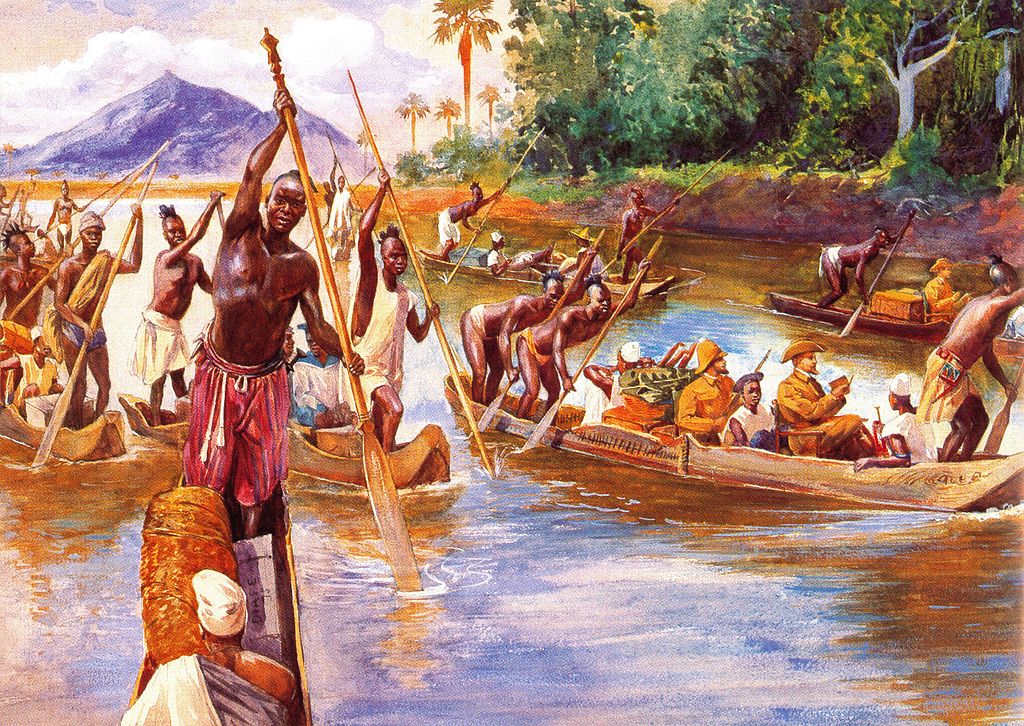
Leo Frobenius in Africa in 1910 (watercolor painting by Carl Arriens)
In 1906, when I entered the territory of Kassaï-Sankuru, I still found villages whose main streets were lined on each side, over several distances, with four rows of palm trees, and whose [houses], each charmingly decorated, were works of art. There was no man who did not carry sumptuous weapons of iron or copper, with inlaid blades and handles covered with snake skin. Velvet and silk fabrics everywhere. Every cup, every pipe, every spoon was an object of art perfectly worthy of comparison with the creations of the European Romanesque style. But all this was only the particularly tender and shimmering down which adorns a wonderful and ripe fruit; the gestures and manners, the moral canon of the entire people, from the small child to the old man, although they remained within absolutely natural limits, were marked by dignity and grace, in the families of princes and the rich as in those of vassals and slaves. I know of no people in the North who can compare with these primitives in terms of unity of civilization.
Alas, the last “Islands of the Blessed” were also submerged by the tidal wave of European civilization. And the peaceful beauty was swept away by the waves.



 African Heritage