Word of Caution to Our Governments

Ibises and a crocodile

As the end of the year slowly drifts in, we would like to share a word of caution to our legal governments of the AES and all those fighting for the freedom of their people around the globe. The temptation is high to party, it is the end of the year after all, and there were awesome results throughout the year; we have worked hard and rightfully deserve a break. However, these loved governments, those who fight for the dignity of their people are in the target of the well-known predators who tend to use periods like these to strike. We can all remember the Christmas coups that have happened over the years! Just ask the late Henri Konan Bédié, president of Cote d’Ivoire, who was destituted by Robert Guéï on Christmas Eve 24 December 1999, in a coup which has entered the annals of history as the Christmas Eve’s coup. Guéï said that “Nous sommes venus balayer la maison” (we have come to sweep the house); he was himself swept out later on. We remember the Saint-Sylvestre coup d’état in the Central African Republic when army leader Jean-Bédel Bokassa and his military officers staged a coup against the government of President David Dacko. There are also coups that have happened in the early days of the new year. Even in Burkina Faso, there was the 1966 Upper Voltan coup d’état in Upper Volta (now Burkina Faso) which took place on 3 January when Sangoulé Lamizana overthrew Maurice Yaméogo. Or like the ones by Gnassingbé Eyadéma in Togo that took out Sylvanus Olympio on January 13, 1963, and then Nicolas Grunitzky on the same day 4 years later in 1967. The examples are countless.

After the stunt the Nigerian army pulled, flying into Burkina Faso after the so-called coup attempt against Patrice Talon at the beginning of the month, the countries of the AES should be on high alert. Our South American brothers should also be on high alert. We are not saying that coups d’état only take place at the end of the year, as there are no dates for coups, just clear opportunities and weaknesses that the enemy (who is always standing ready) exploits. We are just saying to remain on high alert! When you are doing good for your people, wherever you are, you stand for something that the enemy hates… Remain alert at all times! Don’t stop the good you are doing, but remain alert!

Carthago Delenda Est! Sinister plots against Cote d’Ivoire…

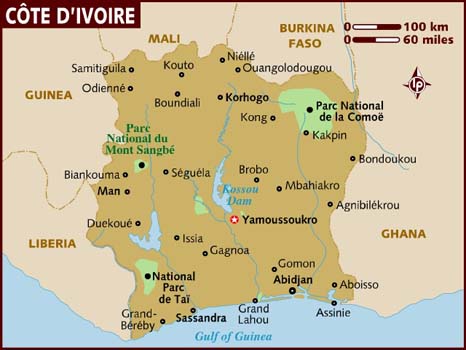
Map of Cote d'Ivoire

I saw this great article by Guy Kouame Gustave on the crisis in Ivory Coast. Such Truth!

“Carthago Delenda Est!” Carthage Must be Destroyed!

This terrible statement was made by Caton the Elder, a Roman citizen who, in his last days in 153 B.C., led a diplomatic mission to Carthage.  Impressed by the economic revival of Carthage, he adopted a systematic anti-Carthaginian attitude that led him to end all his speeches at the Senate by the phrase “Carthago delenda est!”, “Carthage must be destroyed!”. Caton the Elder advocated that Carthage, the competitive city to Rome during the Punic Wars had to be destroyed. Reading the biography of this multi-facet and hatred-filled individual, I couldn’t help but think of Cote d’Ivoire, our country. In fact, revisiting our history since Mr. Alassane Dramane Ouattara’s irruption in the Ivorian political life, one can paraphrase Caton the Elder saying: “Cote d’Ivoire delenda est!”.

The reason is that the successive events that the country has gone through since the election of President Laurent Gbagbo as Head-of-State in October 2000, demonstrate that there is a ferocious relentlessness to destroy the person chosen by the people to lead the country. But more tragically, the country itself, its choices, its soul, and all the institutions and laws on which the nation stands. There is an animalistic conspiracy to make Côte d’Ivoire a failed country.

“Cote d’Ivoire delenda est!”

Declarations such as “I will make this country ungovernable, we are going to gnagami it all!” by ADO, the media, military, political, social, cultural, diplomatic, financial and economic relentlessness (boy! To say the least!), multiple coups and other mistreatments the country is subjected to are all part of the sinister project of the destruction Côte d’Ivoire. Despite multiple sacrifices made by President Gbagbo and the people of Cote d’Ivoire for the sake of peace and democracy, the country continues on suffering since 2002. And the so-called post electoral crisis has just brought to light the sinister plot of destruction and submission against our country.  

For recall: December 1999, first coup d’Etat consecutive to the war for power between the heirs of Houphouët Boigny, the first President of Côte d’Ivoire. The coup went well: Bédié is exiled, but Ouattara did not succeed seizing power. General Guéi who led the military transition escaped two assassination attempts. He lost the October 2000 presidential elections and took refuge in his native village. Laurent Gbagbo, the people’s beloved, won the elections and came into office. From that day on a terrible and obnoxious lynching campaign against the country, its founding pillars, and its officials started. The nightmare of the Ivorian people was thus into motion.

Flag of Cote D'Ivoire

“Cote d’Ivoire delenda est!”, “Cote d’Ivoire must be destroyed ! »

The personality, the choices, and the relation and interactions that President Gbagbo has with his people for decades make many uncomfortable. His aspirations to diversify the economic partners of the country and to depart from the ongoing classic infantilizing paternalism from the former colonial power disturb and particularly worry.

ADO, the man of the outside world, has not given up his plans to seize power by all means necessary. He and his allies then decided to make Gbagbo undergo the same fate as Bédié. They set up, prepared, organized, financed, and implemented a coup d’Etat from and with the complicity of some countries of the sub-region and mainly with the help of a part of the international community. In the night of September 19th, 2002, assailants attacked the State. They failed to take over, fled from the economic capital Abidjan, and made up a cyst in Bouaké where they organized a rebellion.

“Cote d’Ivoire delenda est!”, “Cote d’Ivoire must be destroyed ! » … Click here to read more …

La Bataille pour le Contrôle d’Abidjan

La Côte d'Ivoire
La Côte d'Ivoire

A la veille du deuxième tour des élections en Côte d’Ivoire qui verra soit Laurent Gbagbo ou Alassane Ouattara être élu président de la Côte d’Ivoire, j’ai trouvé qu’il n’y avait rien de tel qu’une petite historique sur le conflit qui sévit en Côte d’Ivoire depuis 2001, et ses principaux acteurs. Le documentaire que vous allez voir a été produit par la chaine Arte, et fait lumière sur la bataille pour le contrôle d’Abidjan. De nombreux acteurs tels le defunt président Houphouët Boigny, le defunt général Robert Guéï, le président actuel du CI Laurent Gbagbo, l’ancient PM Alassane Ouattara, et l’ancien président du CI Konan Bédié (et son ivoirité), la France, le Liberia de Charles Taylor,  et le Burkina Faso de Blaise Compaoré y figurent.

Ivory Coast Flag
Ivory Coast Flag

A few days before the second round of elections in Ivory Coast, which will see either Laurent Gbagbo or Alassane Ouattara become president, I thought that a little turn down memory lane will be more than appropriate. The following documentary is from the channel Arte, and details the battle for the control of Abidjan and its numerous actors among which the first president of Ivory Coast Houphouet Boigny, General Robert Guei, President Laurent Gbagbo, ex-PM Alassane Ouattara, ex-president Konan Bedie, France, Liberia of Charles Taylor, and the Burkina Faso of Compaore. Enjoy!

N’oubliez pas de regarder Parties 2, 3, et 4.