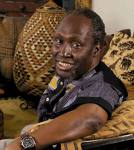
Ngugi wa Thiong’o, Kenyan Literary Baobab, is no Longer

Ngugi wa Thiong'o
Ngugi wa Thiong’o

World acclaimed Kenyan writer Ngũgĩ wa Thiong’o is no longer. Millions of school children in Africa grew up reading his first books Weep not child (1964), the first novel in English published by an East African, followed by The river between (1965) and A Grain of Wheat (1967). A Cameroonian friend of mine used to love reading The river between, and could recite almost every line. Weep not child explored the impact of the Mau Mau rebellion on a young boy’s family and education, The river between focused on the cultural clash between traditional Gikuyu society, while A Grain of Wheat focused on the disillusionment of the post-independence era.

Chinua Achebe (Source: AP Photo)

Like the venerated Chinua Achebe, Ngũgĩ wa Thiong’o was counted among the baobabs of modern African literature, as the author of several novels, plays, short stories, critical pieces, and children books. Like Achebe, he was tipped several times to win the Nobel Prize for Literature, leaving fans dismayed each time the medal slipped through his fingers. We are counted among those fans who each time hoped, but were always disappointed… it’s like the real African authors never get rewarded. This is a lesson for all that we need to reward our own, create awards and celebrate our own, instead of waiting for others to celebrate them. His daughter Wanjiku wa Ngũgĩ who announced his passing on May 28, 2025, said, “He lived a full life, fought a good fight. As was his last wish, let’s celebrate his life and his work.”

“Weep not Child” by Ngugi wa Thiong’o

Ngũgĩ reached fame writing in English, and then decided to write in Gikuyu, his mother-tongue. Today, his books are written in Gikuyu, and then translated into English; he was a strong proponent of African languages and was adamant about expressing his art in Gikuyu. Like so many East African leaders, he attended the prestigious Makerere University in Uganda, and later the University of Leeds in the UK. Upon his return to Kenya, he taught at the University of Nairobi where he worked to “decolonize the minds,” campaigning to decolonize the curriculum by prioritizing African literature and languages. He was instrumental in the abolition of the English Literature Department in favor of a broader, African-centered literary program. The 1970s decade also saw him drop his patronym James Ngugi, to be fully known as Ngũgĩ wa Thiong’o.
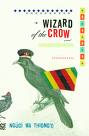
The wizard of crow
“The wizard of crow” by Ngugi wa Thiong’o

His work spanned over six decades, documenting the transformation of his country, Kenya, from a colony of Great Britain to a democracy with all its issues. He fought the government and was arrested several times, and spent a year at a maximum security prison where he wrote his novel Devil on the Cross (Caitaani mũtharaba-Inĩ), the first modern novel in Gikuyu, written on prison toilet paper. Once out of prison, faced with constant harassment from the government, he went into exile and taught at some of the world’s best universities, including Yale University, New York University, Northwestern University, and the University of California, Irvine where he was a Distinguished Professor of English and Comparative Literature and served as first director of the International Center for Writing and Translation.

Ngugi wa Thiong’o (Source: TTbook.org)

His was a unique voice, a voice which never stopped to urge for the decolonization of the minds. To this effect, he wrote Decolonising the Mind: The Politics of Language in African Literature (1986) which advocates for linguistic decolonization of Africa; the book became one of his best known non-fiction work. In his speech at Wits University in Johannesburg in 2017, titled ‘Secure the base, decolonise the mind, Ngũgĩ spoke about the ‘power relationship between the language of the conqueror and the language of the vanquished’, and asked whether, after fifty years, we have ‘regained the cultural and intellectual independence that we had lost to colonialism’, adding ‘I have always argued that each language, big or small, has its unique musicality; there is no language, whose musicality and cognitive potential, is inherently better than another,’ he said [The Johannesburg Review of Books]. Ngũgĩ is survived by 9 children of whom 4 are also authors like himself.

To learn more, please check out The Johannesburg Review of Books, Nyakundi Report, Pulse Kenya, and the BBC. So long to our Kenyan giant of literature… we will not weep, but keep celebrating Ngũgĩ wa Thiong’o ‘s life!

Ngugi wa Thiong’o and Domestic Violence

Ngugi wa Thiong'o
Ngugi wa Thiong’o (source: waterlinesproject.com)

A few weeks ago, the son of Africa’s revered writer, Ngugi wa Thiong’o: world acclaimed Kenyan writer, took to X and wrote about his father being an abusive husband, My father Ngugi wa Thiong’o physically abused my late mother. He would beat her up. Some of my earliest memories are of me going to visit her at my grandmother’s where she would seek refuge.” The tweet went viral, and took everyone by surprise. Surprise, because human tendency makes it so that we tend to place our heroes on pedestal as if they were no longer human; surprise, because Ngugi wa Thiong’o alongside Chinua Achebe is one of Africa’s greatest writers worthy of the Nobel prize of literature; surprise, because Ngugi wa Thiong’o work has been denouncing colonialism, imperialism, nepotism, neo-colonialism, and African governments’ repression and mismanagement, but never has he denounced the conditions of the African woman; lastly, surprise because, in Africa, and in Kikuyu culture particularly, it is not so common to air one’s dirty laundry in public, particularly against an elder. Sure enough, the son, Mukoma wa Ngugi responded to the backlash, “We cannot use African culture to hide atrocities,” he wrote on X. “My father beat up my mother. What is African about that?

I, like so many, am against violence in general, and violence against women in particular. As we digest the news about Ngugi wa Thiong’o, is it not time for our acclaimed African writer who is in his twilight years to give us one masterpiece which focuses on patriarchy, women condition, and women in general, as an atonement? Is it not time for this to open up a dialogue?

Below is an excerpt from Al Jazeera. Enjoy, it is a nice read!

=====

Ngugi wa Thiong’o (Source: TTbook.org)

On March 12, Mukoma wa Ngugi, the Kenyan American poet and author, who is the son of Ngugi wa Thiong’o, the famed writer widely seen as a giant of African literature, took to X, formerly Twitter, to allege that his father was an abusive husband. “My father Ngugi wa Thiong’o physically abused my late mother. He would beat her up. Some of my earliest memories are of me going to visit her at my grandmother’s where she would seek refuge.”

Mukoma’s tweet went viral and solicited hundreds of responses that exposed the long, dark shadow patriarchy continues to cast over many African societies. Sure, many commentators thanked Mukoma for sharing his account of a man who is not only his father, but an African cultural icon. Others, however, were less complimentary and appeared to be gravely offended by his openness. They accused him of embarrassing his father and seeking validation from Westerners.

… Ten days after his initial statement, on March 23, Mukoma responded to the criticism he received for speaking up for his mother. “We cannot use African culture to hide atrocities,” he wrote on X. “My father beat up my mother. What is African about that?” In another post, he described the culture of violence against women that underpins Kenyan society as a “patriarchal cancer”.

Chinua Achebe (Source: AP Photo)

Ngugi is a literary genius, a storyteller par excellence and a respected revolutionary. Before there was the internet, video on-demand platforms, TV or even radio in most households, two African giants dominated African literature: Chinua Achebe, the Nigerian author, and, of course, Ngugi. From the 1960s,  Achebe and Ngugi articulated African identity and consciousness amid the anti-colonial struggleThey stood up for the human rights of Africans with their words.

Through novels like Things Fall Apart and Arrow of God, to name a few,  Achebe chronicled the impact of colonialism on Igbo culture, religion and sociopolitical systems. And in a Man of the People, he explored the failings of postcolonial leadership and states.

“Weep not Child” by Ngugi wa Thiong’o

Ngugi, who went by the name James early in his career, also focused on African opposition to colonial rule. Weep not Child, for instance, deals with the so-called Mau Mau Uprising, while A grain of wheat looks at the state of emergency in Kenya’s struggle for independence (1952–60). Through these and other novels, Ngugi advocated for resistance against colonial oppression and repression in the independence era. In 1978, he was arrested and detained for a year without trial by the administration of former Kenyan President Jomo Kenyatta over a play titled Ngahlika Ndenda (I will marry when I want). Over the years, Ngugi was regularly harassed and victimised by authorities in Kenya for voicing his opposition to corruption, misrule and the abuse of power. He has stayed the course and today, at the age of 86, continues to advocate for freedom from neocolonialism and political oppression. With 13 honorary degrees from institutions around the world, as well as countless awards, including the 2022: PEN/Nabokov Award for Achievement in International Literature, Ngugi is a certified literary genius. But, for all of his achievements in the last 60 years, the famed author appears to have failed where it counted most: protecting African women.

He produced many timeless literary classics, and became a leading voice in the fight against colonialism and post-colonial repression, but according to his own son, could not liberate his dear wife, sons and daughters from the extreme ravages of toxic masculinity and domestic violence. Of course, in the wake of Mukoma’s public disclosures, Africans could choose to label Ngugi a flawed genius. He is, after all, human. They could – as many tried to do in lashing out at [Mukoma] – brush his alleged abuse of his wife under the carpet in the name of protecting his literary and revolutionary legacy. This would be an easy and convenient position to take.

But it wouldn’t be right.

The wizard of crow
“The wizard of crow” by Ngugi wa Thiong’o

… Ngugi, it seems, wanted women to experience liberty from colonialism and post-colonial subjugation, but remain bonded to the steely constraints of Kikuyu culture. … To his mind, it seems, there were limits to women’s human rights. For a long time, under the guise of tradition, African men have been allowed and even encouraged to discipline “their women” and children with violence [this does not apply to all African men]. Thus, many argue Ngugi is just a product of his times and what he is said to have done to his late wife should not be judged through a 21st-century progressive lens.

… Ngugi’s alleged violence is, unfortunately, a window to a continental (and, frankly global) problem. Hence, his son’s revelations should not become a point of contention. This should instead be a teaching moment.

It is time to say enough is enough.

How to Write about Africa, by Binyavanga Wainaina

An antelope at dusk
An antelope at dusk, with the African sun

This really good article by the Kenyan writer Binyavanga Wainaina on ‘How to Write about Africa‘ was recently shared with me. It was published by Granta magazine.  One will be surprised to see that this is exactly the way Africa is depicted in Western televisions, magazines, news, and books. Such an interesting read, very satirical, and yes very thought-provoking.  This is not the Africa I know, but this is the Africa sold on Western media.  The entire article can be found on Granta.com.

==========

Always use the word ‘Africa’ or ‘Darkness’ or ‘Safari’ in your title. Subtitles may include the words ‘Zanzibar’, ‘Masai’, ‘Zulu’, ‘Zambezi’, ‘Congo’, ‘Nile’, ‘Big’, ‘Sky’, ‘Shadow’, ‘Drum’, ‘Sun’ or ‘Bygone’. Also useful are words such as ‘Guerrillas’, ‘Timeless’, ‘Primordial’ and ‘Tribal’. …

Never have a picture of a well-adjusted African on the cover of your book, or in it, unless that African has won the Nobel Prize. An AK-47, prominent ribs, naked breasts: use these. If you must include an African, make sure you get one in Masai or Zulu or Dogon dress.

Africa
Africa

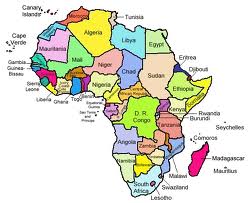
In your text, treat Africa as if it were one country. It is hot and dusty with rolling grasslands and huge herds of animals and tall, thin people who are starving. Or it is hot and steamy with very short people who eat primates. Don’t get bogged down with precise descriptions. Africa is big: fifty-four countries, 900 million people who are too busy starving and dying and warring and emigrating to read your book. The continent is full of deserts, jungles, highlands, savannahs and many other things, but your reader doesn’t care about all that, so keep your descriptions romantic and evocative and unparticular. […] Continue reading “How to Write about Africa, by Binyavanga Wainaina”

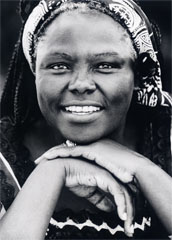
Wangari Maathai, first African Woman Nobel Peace Prize Laureate

Wangari Maathai
Wangari Maathai

I once took a class in environmental and social changes, where I studied the work of Dr. Wangari Maathai.  Her boldness and her stand for truth made her a great role model for many African women, and Africans in general.  She was bold! “Wangari Maathai was known to speak truth to power,” said John Githongo, an anticorruption campaigner in Kenya who was forced into exile for years for his own outspoken views.  “She blazed a trail in whatever she did, whether it was in the environment, politics, whatever.”  Indeed, Wangari Maathai was one of the most widely respected women on the continent, where she played many roles: environmentalist, politician, feminist, professor, human rights advocate, and head of the Green Belt Movement which she started in 1977. She was scoffed at by the Kenyan Forestry department who thought that uneducated women could not fight the desert.  She told them ‘We need millions of trees and you foresters are too few, you’ll never produce them. So you need to make everyone foresters.’ I call the women of the Green Belt Movement foresters without diplomas.

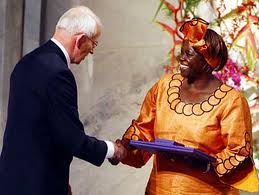
Wangari Maathai receiving the Nobel Peace Prize

As a star student after high school, she won a scholarship to study biology in Kansas (US), and went on for a Masters of Science at the University of Pittsburgh, and later a doctorate degree in veterinary anatomy at the University of Nairobi where she later taught and became chair of the department in the 1970s.  Wangari’s work started with the Green Belt Movement with the mission of planting trees across Kenya to fight erosion, stop desertification, create firewood for fuel, provide jobs for women, and empower the women of Kenya.  According to the United Nations’ data, her organization has planted over 45 million trees in Kenya, helped 900,000 women, and inspired similar projects in other African countries.  “Wangari Maathai was a force of nature,” said Achim Steiner, the executive director of the United Nations’ environmental program.  He likened her to Africa’s ubiquitous acacia trees, “strong in character and able to survive sometimes the harshest of conditions.

Maathai planting a tree

Her work was illustrated in one of my secondary school English textbook.  The government of Arap Moi was trying to build a skyscraper in one of Nairobi’s only parks, and she brought women who protested until the government abandoned the project.  She was beaten by police until she faintedWangari was not one to back down from her beliefsShe would go to jail for what she believed in.  For instance, her husband divorced her because he said she was too strong-minded for a woman.  When she lost her case in court, she criticized the judge and told him her mind, and was thus thrown to jail.

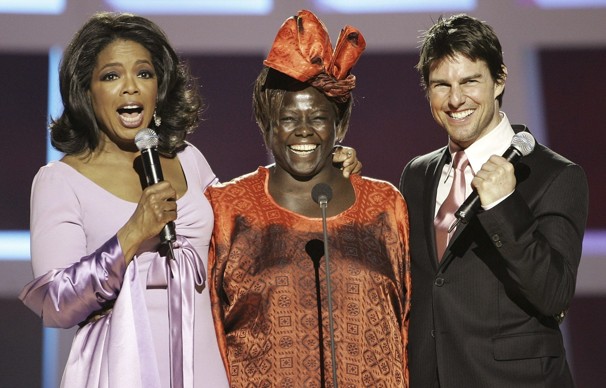
Oprah Winfrey and Tom Cruise congratulating Wangari Maathai on her Nobel Peace Prize

In presenting her with the Peace Prize, the Nobel committee hailed her for taking “a holistic approach to sustainable development that embraces democracy, human rights and women’s rights in particular” and for serving “as inspiration for many in the fight for democratic rights.”  Wangari Maathai has received many honorary degrees, including an honorary doctorate from the University of Pittsburg, her alma mater.  Check out articles by the BBC, CNN, her Interview on NPR, and the Huffington Post whose article is entitled “Wangari Maathai and the Real Work of Hope .”  Don’t forget to click also on the The Green Belt Movement website, and the movie “Taking Root: The Vision of Wangari Maathai.”   She once said that ‘we should all be hummingbirds‘: doers, and not spectators, even in the face of great challenges; do the best you canGoodbye Wangari, your work is not over, for Africa has been blessed with millions of Wangari Maathais who will continue your outstanding work.

Ngugi wa Thiong’o: world acclaimed Kenyan writer

Ngugi wa Thiong'o
Ngugi wa Thiong'o

Ngugi wa Thiong’o is a world-acclaimed Kenyan writer cut from the same cloth as African veteran Chinua Achebe. Ngugi is the author of several novels, plays, short stories, critical pieces, and children books. Ngugi reached fame writing in English, and then decided to write in Gikuyu, his mother-tongue. Today, his books are written in Gikuyu, and then translated into English. His first books Weep not child (1964) followed by The river between (1965) were on the secondary school syllabus in Cameroon, and a friend of mine used to love  reading The river between.

The wizard of crow
The wizard of crow

When Ngugi first started writing in Gikuyu, he was threatened by the Kenyan government, and in the late 70’s, the political overtone of his play I will marry when I want, got him arrested by the then vice-president Daniel Arap Moi (who later became president, and ruled Kenya for 22 years). After his release from jail, Ngugi spent two decades in exile, and tried returning to Kenya in 2004 under the new government, but was viciously attacked in his hotel and his wife was sexually assaulted… after that he returned to the USA where is a professor at New York University. His latest novel, The wizard of crow which is 1000-pages long, and which I own, discusses a dictatorship in an imaginary country in Africa.

Please enjoy an interview with Ngugi wa Thiong’o conducted by Granta magazine. To learn more about one of the greatest African literary geniuses, check out: http://www.ngugiwathiongo.com/, Wikipedia, Penpoints, Gunpoints, and Dreams. If you have never read Ngugi wa Thiong’o’s books, I recommend that you start with The river between, Petals of Blood, A grain of wheat, and Weep not Child.