GoodBye to a Courageous Leader : Ni John Fru Ndi and Ushering the Multi-Party Era in Cameroon

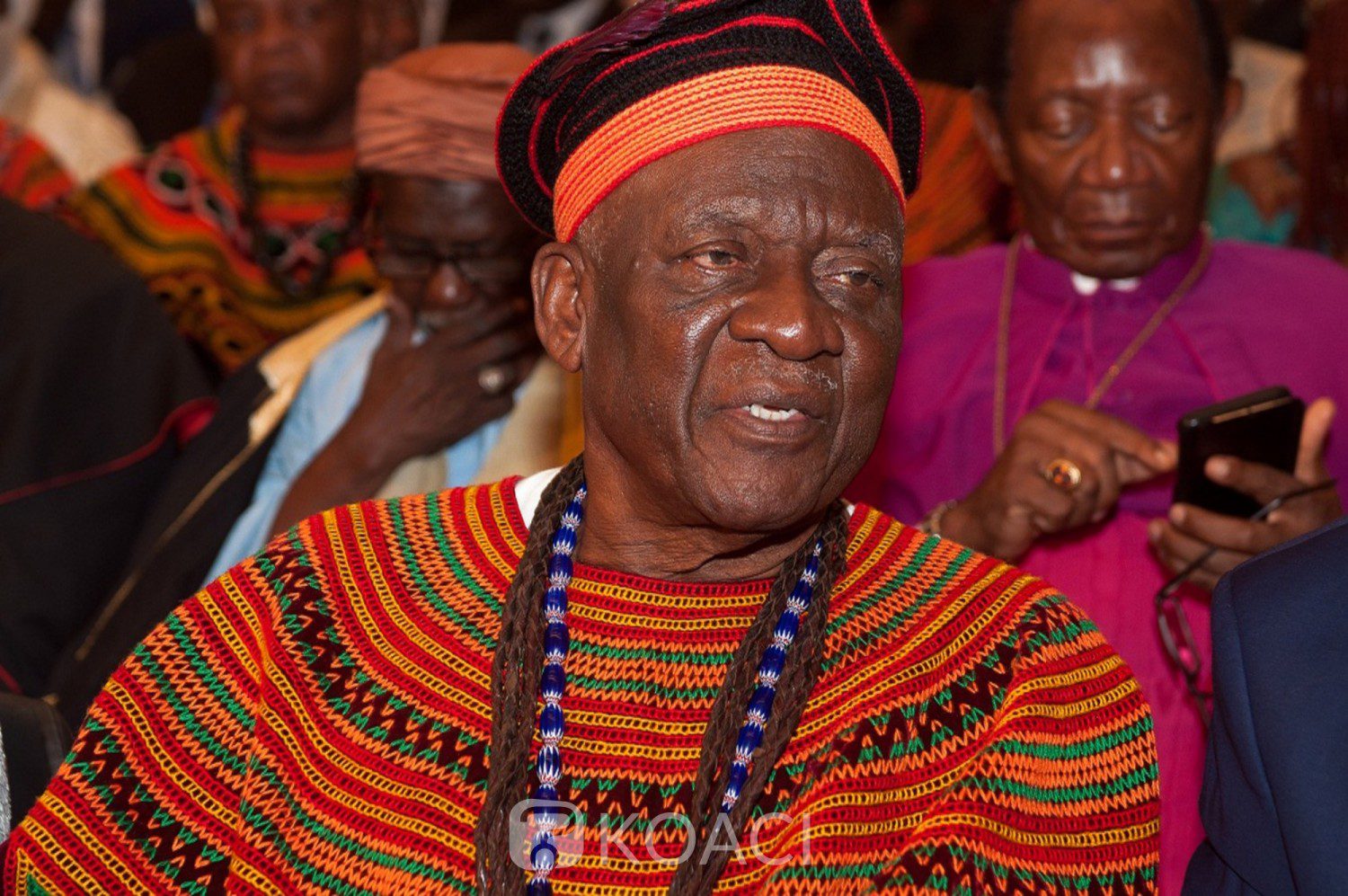
John Fru Ndi (Source: NewsduCamer.com)

Ni John Fru Ndi, the major political opponent to the current president of Cameroon for almost 3 decades has passed away. Affectionately called “The Chairman,” John Fru Ndi came up at the twilight of the National Conference in Cameroon with the creation of the Social Democratic Front (SDF) in 1990. Over the years, his party came to symbolize hope in a place where there had been no ‘real’ leadership change in over 30 years. His party was seen as the main opposition party to the government for over 2 decades. He was unavoidable in the political arena, and ran for president several times. He came close to winning in the October 1992 presidential election, but through some constitutional gymnastics and some play by the Supreme court (always) his win was pulverized and given to the governing party. The Supreme Court judge who heard his petition alleging fraud, said his “hands were tied” – and let the official results granting victory to incumbent Paul Biya, with 40% of the vote, stand. This caused great upset among SDF supporters and Fru Ndi was placed under house arrest for three months in his home in Bamenda, and a state of emergency was declared in the country. Later, Fru Ndi was nonetheless invited with his wife to the inauguration of US President Bill Clinton in January 1993.
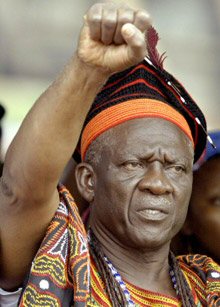
Ni John Fru Ndi (Source: Bonaberi.com)

Like everyone back then, Fru Ndi began his political career in the 1980s as a member of Biya’s Cameroon People’s Democratic Movement (RDPC). Through the years, he grew frustrated with the one-party system. In 1990, during the years of the National Conference when Cameroon officially ended the one-party rule, he formed the opposition party the Social Democratic Front (SDF). Although he hailed from the Northwest province of Cameroon (English speaking area of Cameroon), he strove to represent all Cameroonians, and aspired for the unity of the entire country seeking a federally unified Cameroon. He addressed the masses in pidgin English. Soon, SDF came to stand for “Suffer don finish” – where with his arrival in power, his party would usher the end to suffering. At political rallies, he would raise his fist to shout “SDF” to the crowd, who would chant back en masse: “Power to the people!” This call and response was repeated until the third time when they would roar back: “Power to the people and equal opportunities!” The masses were galvanized; for many Cameroonians who had been muzzled for far too long under the one-party frame, this was the opportunity to exercise their civic duties and participate in the political life of their country. They saw in Fru Ndi the alternative to the stuck-up politics. Their efforts were repressed by the governing party; the early 1990s were the years of strikes, street protests, “zero-deaths,” and more.
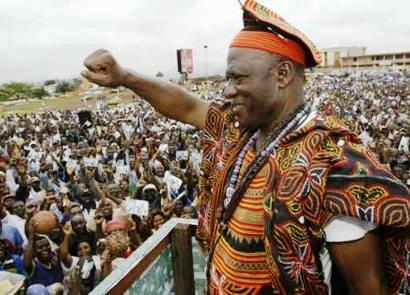
John Fru Ndi addressing the masses in Bamenda (Source: Cameroonpostline.com)

In recent years, Fru Ndi was not a supporter of the secessionist rebellion in Anglophone Cameroon that has claimed tens of thousands of lives and displaced countless people over the last six years. He was even kidnapped twice and beaten up by militants of the secessionist group in 2019, and part of his house was burnt down. The  secessionists were angered by what they saw as his betrayal for not supporting their demand for an independent state of Ambazonia, as they call Cameroon’s two English-speaking areas – the Northwest and Southwest regions. This forced him to sadly relocate from his beloved Bamenda to the capital Yaounde. He was very proud of his origins and rarely was seen wearing anything but atogho, traditional Bamileke clothing from the Northwest region, or Boubou: A Traditional African Garment.
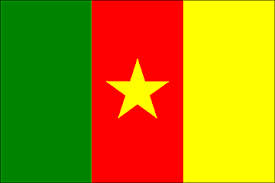
Flag of Cameroon

Many claim that he should have united the opposition behind one leader against the government, as he had failed to get the coalition formed by the opposition to agree to field a single candidate to take on Mr Biya; or that he had been corrupted by the governing party.  Fru Ndi may have made mistakes, but at some point he represented the hopes of millions, hopes for a different future, a different alternative; and he had the courage to stand up and create a party who united people from all levels of the society, ushering the era of multi-party in Cameroon which was often paved with thorns. He has left a major imprint in Cameroon’s politics.

Below are some tributes from AfricaNews,

I salute the memory of a singular, charismatic and courageous leader,” said current opposition leader Maurice Kamto who ran for president in 2018.

The story of the return to multi-party politics in Cameroon cannot be written without [Fru Ndi’s] name in bold gold,” said politician Akere Muna, who ran for president in 2018. “His life is a lesson to the fact that leadership is about serving and not about being served,” he said.

Ni John Fru Ndi for the SDF (Social Democratic Front, editor’s note) was the guide, that is to say, the man who traced the furrow along which we walk, the man who against all odds imposed the return to a multi-party system in Cameroon on 26 May 1990 and with it a set of individual and collective freedoms granted to the entire Cameroonian people” Marcel Tadjeu , Chairman of the Douala 5 SDF electoral constituency told AfricaNews correspondent.

Read also articles on the BBC, ABC, and AfricaNews.

Lapiro de Mbanga in his own words

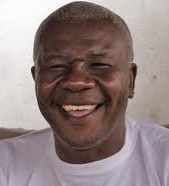
Lapiro de Mbanga
Lapiro de Mbanga

I decided to make a compilation of some of Lapiro de Mbanga’s words in his interviews.  The full interview to Daniel Brown from Freemuse can be found here; for the interview Lapiro gave to Le Messager, click here; and lastly the interview to Phoenix Gauthier can be found on RFI.  The video below shows Lapiro de Mbanga’s proudly expressing himself at the Oslo Freedom Forum in 2013.  Enjoy!!!

============

About life in prison: … There is no hygiene here and we must share our most intimate moments with the other cellmates. … I should have been taken to hospital for a consultation but my status as a political prisoner has meant I have not been allowed to go once in these two years. I somehow survived the typhoid attack in December by taking the antibiotics my wife Louisette brought me. It’s fortunate she comes every few days. It’s a five-hour round trip from Mbanga, it’s taking a toll on her, too. …  I wake at 7 to 8 every morning …. I keep informed about the outside world thanks to TV5 [France’s international station] or Radio France International. I eat, chat with the others in the cell, play Ludo, scrabble, draughts. It’s impossible to compose in such an atmosphere. I need calm, serenity. Here, I cannot concentrate and write the thoughtful songs people expect of me.

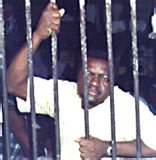
Pius Njawe in jail
Pius Njawe, a Cameroonian journalist and martyr in jail

We have penal rations twice a day. At 1pm we are given boiled corn and at 5pm there’s rice in some warm water. It’s the same every day. It’s way below minimum requirements. My wife brings me food every two days, I couldn’t survive otherwise. I’ve seen people die of hunger. It happens every day in Cameroonian prisons.

Normally, I should have no contact with the outside world. Telephones are illegal here. I’m speaking to you because we have to scheme like common crooks. In prison there are all kinds of trafficking going on, including this one. You pay guards to turn a blind eye. You know, in Cameroon you can buy everything. This country has been world champion in terms of corruption.  It’s everywhere and filters down to here. (Source: Daniel Brown, Freemuse)

On being scared for his life because of his outspokenness: It’s all part of my struggle. If I was the scared type I would never have started singing in 1985. I’m not going to start getting scared after all these years. My struggle has always been to denounce inequalities and danger is part of that mission. The only thing that has changed for me since 1985 is I’m at the head of a family with six children. I can guarantee my own security, but not theirs. I’m scared for them. But I have no choice. If you start such a struggle, somebody must pay. Still, my family is unhappy with such risk taking. That’s why I think if I don’t go into exile after this prison term, I won’t survive very long out therethey’ll kill me. Because it’s obvious people in charge don’t want to be confronted with somebody who stops them from just getting on with things. (Source: Daniel Brown, Freemuse)

On going to exile: For starters, I am not in exile; I am political refugee in the USA. I needed a social security and an insurance for the future of my children; I refuse to manufacture unemployed people full of diplomas who will retire without ever having worked.  [Pour commencer, je ne suis pas en exil; je suis réfugié politique aux USA. J’avais besoin d’une sécurité sociale et d’une assurance pour le futur de mes enfants; je refuse de fabriquer des chômeurs bardés de diplômes qui vont aller à la retraite sans avoir jamais travaillé.] (Source: Le Messager 04 April 2013)

Flag of Cameroon
Flag of Cameroon

About the way he spends his days now in the US: I dedicate myself to my children’s education. I have, during 3 decades, focused my life on my struggle, the fight against social inequalities, forgetting that I was first a head of family. Despite what the Um [Nyobé], Ouandié, Moumié, and all the known and unknown freedom fighters have done, nobody knows what has become of their offspring. For me, it is very serious. It is as if they had fought for nothing. [Je me consacre à l’éducation de mes enfants qui sont ici avec moi. J’ai pendant 3 décennies focalisé ma vie sur mon combat, à savoir la lutte contre les inégalités sociales oubliant que j’étais d’abord un chef de famille. Malgré tout ce que les Um, Ouandié, Moumié et tous les autres combattants connus et inconnus ont fait, personne aujourd’hui ne sait ce que sont devenues leurs progénitures, Pour moi, c’est très grave. C’est comme s’ils ont combattu pour rien …].  (Source: Le Messager 04 April 2013)

About his rupture with Biya and Fru Ndi: Paul Biya, even if he listens to my songs, does not count on my very short list of friends. So no need to break up with him even though I never voted neither for him, nor for Ahidjo’s party which he hijacked in Bamenda in 1985. Fru Ndi, whom I now call “CHIENMAN” and not Chairman, has ceased to be worthy of my respect, given his multiple reversals and changes. … I cannot be in good terms with an individual who plots against the people, it is as simple as that.  [Paul Biya même s’il écoute mes chansons, ne compte pas sur la liste très restreinte de mes amis. Donc pas besoin de rompre avec lui encore que je n’ai jamais voté ni pour lui-même, ni pour le parti de Ahidjo qu’il a détourné à Bamenda en 1985. Fru Ndi que j’appelle désormais “CHIENMAN” et non Chairman, a cessé depuis bien longtemps d’être une personne ayant droit à mon respect, compte tenu de ses multiples virements, revirements et retournements de veste. … Je ne peux pas être en bon terme avec un individu qui complote contre le peuple, c’est aussi simple que cela]. (Source: Le Messager 04 April 2013)

On his dream for Cameroon? I dream of a Cameroon where the power will belong to the people.  Where the wealthy will not use the misery of the poor by giving them some rice, fish, beer and 1000 FCFA to stay in power and plunder the country’s resources.  [Je rêve d’un Cameroun dont le pouvoir appartiendra au peuple. Où les riches ne vont pas se servir de la misère des pauvres en donnant aux démunis du riz, du poisson, de la bière et 1000f pour aller au pouvoir piller les ressources du pays.] (Source: Le Messager 04 April 2013)

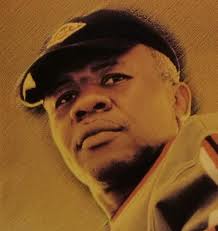
Lapiro de Mbanga
Lapiro de Mbanga

On his struggle: The fight continues. I got out of jail only three months ago. And I need to continue the fight at a greater level. … You have seen my environment. Here in Mbanga, it is 7:30PM and it is already dark everywhere. Without electricity, you can be attacked. Yet, there are people who fight at work all day. And at the end of the day, there is no light, no health, the children cannot go to school. There is no escape. That is my fight, my struggle. It is for that Cameroon that I am fighting. And I want the Americans and Europeans to understand. I come to tell them: thank you for fighting for Lapiro de Mbanga [release] , but there are 20 millions of Lapiro de Mbanga in Cameroon who experience the martyr daily. Wake up and do something. [Le combat continue. Je suis sorti de prison il y a seulement trois mois. Et je dois continuer le combat au niveau des grandes instances. … Vous avez vu mon environnement. Ici à Mbanga il est 19h30 et partout il fait noir. Sans électricité vous pouvez être agressé ici. Pourtant, il y a des gens qui se battent au travail toute la journée. Et, à la fin, il n’y a pas de lumière, ni de santé, les enfants ne peuvent pas aller à l’école. Il n’y a pas d’issue. C’est ça mon combat. C’est pour ce Cameroun-là que je me bats. Et je veux que les Américains et les Européens comprennent. Je viens leur dire par ma voix : merci d’avoir combattu pour Lapiro de Mbanga, mais il y a 20 millions de Lapiro de Mbanga au Cameroun qui subissent le martyr au quotidien. Réveillez-vous et faites quelque chose.] (Source: RFI, P. Gauthier, 12/07/2011)