Cameroonian Musical Genius : Ekambi Brillant

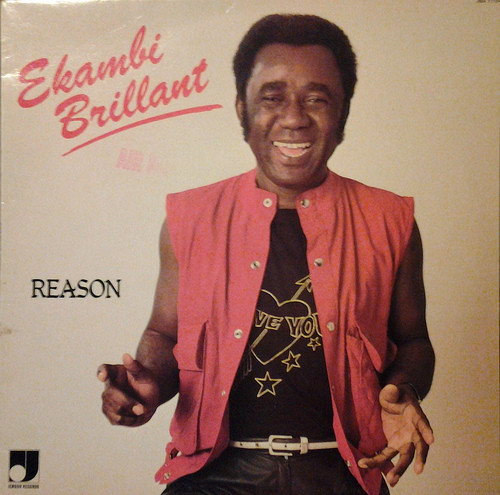
Ekambi Brillant on the cover of his 1987 album Reason (Source: RhythmConnection.Blogspot.com)

Ekambi Brillant was without doubt one of Cameroon’s greatest artists and one of the great African musicians. Originally from Dibombari, a village close to Douala, Brillant spent his youth with his maternal grandparents in Jebale, a suburban island of Douala. Per the words of Cameroonian author Elolongue Epanya Yondo, Jebale is known as the “emerald island, flamboyant jewel” on the Wouri estuary; no wonder, it served as the inspiration to a young Ekambi!  His passion for music was born from ancestral roots and from watching and listening to fishermen singing on their way back home from the sea.

Wouri river and the Djebale island seen on the other side

In 1962, Brillant was admitted to the 6th grade in the prestigious Lycée Général Leclerc (General-Leclerc High School) of Yaoundé. It was there, under the careful attention of Mr. Daniel Zane, his French music teacher, that he learned to play music, particularly the guitar. In 1971, at the age of 23, he stopped his studies and moved to Douala, where he joined the band The Crack’s as a guitarist. He applied for and won the music contest launched by the Office of French Broadcasting Television (ORTF), judged by some of the continent’s great musical personalities such as Manu Dibango and Francis Bebey. Thanks to this prize, he was able to release his first 45 rpm record, Jonguèlè la Ndolo, which sold 20,000 copies.
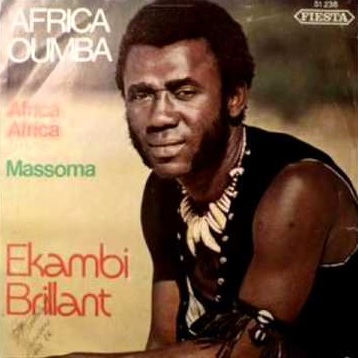
Ekambi Brillant’s album ‘Africa Oumba’

In 1972, he flew to France, where, with the support of Jean Dikoto Mandengue, a Cameroonian bassist, he produced and released his second 45 rpm record with Phonogram. The album was a major success and sold 25,000 copies. As stated before, Ekambi Brillant’s love for his country, his people, and music can be felt in every single note!

In 1975, he ended his deal with Phonogram and began a collaboration with Slim Pezin, with whom he released the album Africa Oumba, which included the major hit song “Elongui.” The song became an incredible source of inspiration for several other artists, both African and European, including the Greek singer Demis Roussos, who sang it as “L.O.V.E. Got a Hold of Me.” Roussos’ version used the exact melody of Ekambi Brillant’s original makossa hit, but he never acknowledged Ekambi Brillant—not even with a tribute. It was only later that African fans (including yours truly) loudly affirmed that this was Brillant’s original work. In the past, African compositions have often been adapted/plagiarized without formal credit, especially when entering European or American markets. Roussos earned millions from Ekambi’s song, without giving him a penny. This is reminiscent of Andre Marie Tala, Cameroon’s Blind Musical Virtuoso, and his song Hot Koki which was plagiarized by  James Brown, or more recently Shakira with “Waka Waka (This Time for Africa)” “adapting” the “Zamina mina (Zangaléwa)” song and claiming in an interview to have gotten inspiration while walking on a beach. The album Africa Oumba reached a record of about 4 million sales (diamond disk). Further collaborations with Slim Pezin as producer yielded titles such as Soul Castel and Musunguédi. In 1976, Ekambi Brillant formed his band known as The Ebis (Ekambi Brillant Show).
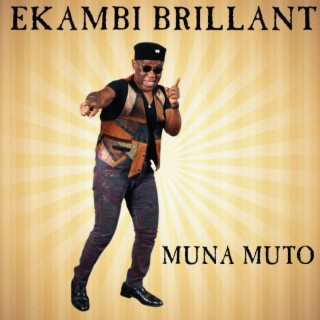
Ekambi Brillant ‘Muna Muto’

Over the course of his career, Brillant released nearly 20 albums. Brillant passed away on 12 December 2022 in Douala at the age of 74, after a battle with a long-term illness. Unfortunately, like many in Cameroon, he was a brilliant soul who barely received the recognition his genius deserved. He was from a generation of outstanding Cameroonian artists.

Ekambi Brillant remained an inspiration to generations of artists, propelling several careers and guiding many musicians—both Cameroonian, such as Marthe Zambo, Valery Lobe, and Alhaji Touré, and African, such as Cella Stella and Angelique Kidjo. He was so advanced, brilliant, and inspired … going through his music portfolio is filled with great sounds and a great source of inspiration. Cameroonians should get inspired from his work and celebrate his genius. 

.

“Jébalè / Jebale” by Elolongue Epanya Yondo

Douala_Wouri River_2_Djebale
Wouri river and the Djebale island seen on the other side

I share here a poem by the Cameroonian poet Elolongue Epanya Yondo about his beautiful native island of Jebale, Cameroon. Note that Elolongue Epanya is the uncle of another great Senegalese-Cameroonian poet David M. Diop known for his amazing poem “Afrique / Africa“. Jebale (Jébalè or Djebale) is an island on the Wouri River, in Douala, Cameroon. It is also one of the places whose kings signed on 15 July 1884, a treaty of protectorate with German merchants from the firm Jantzen & Thormählen, thereby agreeing to the infamous Germano – Duala Treaty signed 3 days earlier on 12 July 1884 by King Bell and others. In 1884, Jebale was then known as Jibarret.

Douala_Wouri River
View of Jebale and the Wouri river, Douala, Cameroon

As you read Yondo’s words, you can imagine the beauty of his homeland, this island, Jebale, on the Wouri river. Jebale is known as the “emerald island, flamboyant jewel” on the Wouri estuary, on the coast of Cameroon. The author cites well-known coastal rivers of Cameroon, the Bimbia creek, the Sanaga River, the  Dibamba river, the Kwa-Kwa river, and also notes other islands of the Littoral, Malimba and Suellaba. In this poem, the author anchors his words in the rich tradition of the coastal Sawa people as he cites the Miengu and the Mbeatoe, those big shrimps known as Camarões which led to the name of the country Cameroun via the Wouri RiverRio dos Camarões. For those who have visited Jebale, it is indeed an emerald island, mostly known as a small fishing village; however in the eye of Elolongue Epanya Yondo, it is his love, the one he cannot wait to come back to, from exile. Enjoy!

This poem was published in Paris on February 25th 1972, in revue Présence Africaine, numéro 84 (4e trimestre 1972), re-published in Anthologie Africaine: Poésie Vol2, Jacques Chevrier, Collection Monde Noir Poche, 1988, and translated to English by Dr. Y. Afrolegends.com .

====

Jebale by Elolongue Epanya Yondo

Jébalè’

A mon neveu David Morsamba Diop.

Jébalè mon île d’émeraude

Joyau flamboyant au confluent

De la gorge altière du Wouri

Je me souviens

De tes nattes verdoyantes

Fouettant en cascade

L’haleine salée du littoral

Jébalè mon île d’émeraude

Terre dont le souffle

Des Miengu et des Mamy-Wata

Féconde le cycle des Mbéatoè

Enigmatiques hommes d’eau

Qui sèment l’abondance

Jébalè mon île d’émeraude

Je cherche dans les fissures du temps

Dans la gueule écumante

de la baie du Biafra

tous les replis d’eau

qui mangèrent goutte à goutte

un chapelet d’îles

jaillies des entrailles de l’océan

comme des gerbes de nénuphars

Jébalè mon île d’émeraude

Je cherche dans l’écume poreuse

Les cônes bleu-gris

Dont la beauté effervescente

Arrachait des soupirs

          De lame de fond a l’océan

          Tombé en pâmoison

Jébalè mon île d’émeraude

Je cherche le chemin du retour

Du maquis de mon long exil

A travers l’île des buffles

Que fixait hier

La pointe multicolore de Suellaba

Je cherche sur tes flancs

Le point de repère de l’estuaire subjugué

Lançant à l’assaut de l’esprit gardien

De la crique du Bimbia

A l’île Malimba

Du Wouri coiffé de palétuviers

A la Dibamba des grandes profondeurs

De la Sanaga hydre immense

A la bouche silencieuse de la Kwa-Kwa…

Des gueules d’eau déchaînées

Et des bras de mers insaisissables

Pour pénétrer ton mystère

Consacrant ta légende des légendes

Jébalè mon île d’émeraude

Terre première de mon enfance

Dont le sel fermente ma mémoire

Je grave ton image impérissable

Sur la grève qui se moire

Au miroir d’un ballet lumineux

Du flux et du reflux

Qui propagent ton nom

Par la voix claire des clapotis.

Jebale’ 

To my nephew David Morsamba Diop.

Jebale my emerald island

Flamboyant jewel at the confluence

Of the haughty Wouri gorge

I remember

Your green braids

Whipping in cascade

The salted breath of the coast

Jebale my emerald island

Land whose breath

Of the Miengu and the Mamy-Wata

Fertilizes the cycle of the Mbeatoe

Enigmatic men of water

Who sow abundance

Jebale my emerald island

I search through the cracks of time

In the foaming mouth

Of the Biafra bay

All the folds of water

Which ate drop by drop

A rosary of islands

Sprung from the bowels of the ocean

Like sheaves of water lilies

Jebale my emerald island

I search in the porous foam

The gray-blue cones

Whose effervescent beauty

Drew out sighs

          Of groundswell from the ocean

          Fallen into a swoon

Jebale my emerald island

I am looking for the way back

From the maquis of my long exile

Through the buffalo island

That set yesterday

The multicolored tip of Suellaba point

I am looking on your sides

For the landmark of the subjugated estuary

Launching the assault of the guardian spirit

From the Bimbia creek

To the Malimba island

Of the Wouri dressed with mangroves

To the great depths of the Dibamba

To the Sanaga immense hydra

To the silent mouth of the Kwa-Kwa…

Ramps of water

And the elusive arms of the sea

To penetrate your mystery

Consecrating your legend of legends

Jebale my emerald island

First land of my childhood

Whose salt ferments my memory

I engrave your imperishable image

On the shore which shines

In the mirror of a luminous ballet

Of ebb and flow

Which spread your name

By the clear voice of the ripples.