

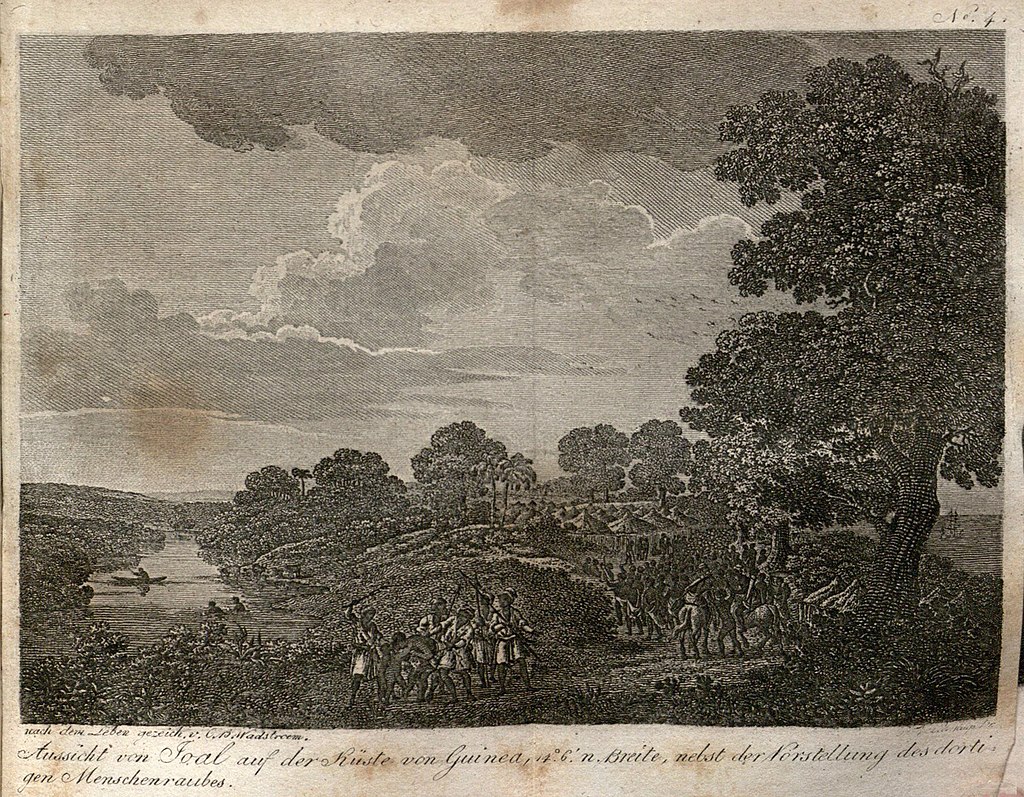
The Swede abolitionist and explorer Carl Bernhard Wadström (Charles Berns Wadström) once described his travels in West Africa from October 1787-1788 with fellow Swede Anders Sparrman and Carl Axel Arrhenius. They were sent by King Gustav III of Sweden, with the official goal of making new discoveries in natural sciences, history, and of course the non-official goal to help with the king’s colonial ambitions. The scientific expedition was quickly aborted when they were in Senegal, where they then witnessed diverse aspects of the transatlantic slave trade. As we saw earlier, Wadström was later called in 1790, to testify in front of the British Government Select Committee; published in a report entitled “Minutes of the evidence taken before a Committee of the House of Commons, being a Select Committee, appointed to take the Examination of Witnesses respecting the African Slave Trade.” Wadström described the advanced industries found in that part of Africa, ranging from textile, indigo, soap, leather, and gold… he even noted that he had never seen such advanced work in Europe! Accompanied by his doctor friend Sparrman and chemist Arrhenius, they were dumbfounded to realize that Africans had a large materia medica which listed over 3000 plants.
The Select Committee on the Slave Trade was keen to know about the quality of culture in that part of Africa. They asked Wadström: “Have they any manufactures amongst them?”
Mr Wadström’s reply was most edifying: “I have been surprised to see with what industry they manufacture their cottons, their indigo, and other dying articles, as well as several sorts of manufacture in wood; they make soap; they tan leather, and work it exceedingly well, and even with good taste … they work bar iron … into several articles, as for instance, lances, instruments for tillage, poniards, &c.; they work in gold very ingeniously, and so well, that I never have seen better made articles of that kind in Europe; a great number of articles for ornaments of gold, silver, brass, leather, &c.”
Wadström further stated that: “Their cloth and their leather they manufacture with uncommon neatness; and I have samples with me to shew [sic] in case it should be desired.”
As we saw earlier, the king who was called Dalmanny was a well educated man; he had held the position of Grand Marabout before becoming King. His subjects were very honest and hospitable and showed Wadström “all civility and kindness.” In addition, they had “an extraordinary genius for commerce.” Interestingly, they also had a “Materia Medica” of “about 2,000 or nearer 3,000” plants.

 African Heritage