We have seen that there were quite a few African kings who forbade the sale of liquor by Europeans on their territories: Gungunyane of the kingdom of Gaza in Mozambique, Mirambo: the Black Napoleon, king of the Nyamwezi people in Tanzania, and now the Almanny (which means leader) cited during Wadstrom report to the British Committee in 1790s (Royal Resistance to Slavery: the Case of an Almany of West Africa in 1780s). Just like Gungunyane, Mirambo thought that alcohol weakened societies. There are quite a few other African leaders throughout history. Why would they prohibit the sale of alcohol on their territories? In history, we have seen this tactic used by the Europeans in the Americas where they gave cheap liquor to the Native Americans turning them drunkards, violent, in order to dispossess them of their lands. Below is an account by the abbey Gregoire who clearly saw alcohol as a tool used to destabilize African societies during slavery times. It is good to note that history repeats itself: today in many African countries, the main breweries are owned by European companies, and particularly in countries with a lot of resources, the people have been slowly turned into drunkards (this will be a story for another day) while their resources get siphoned out.
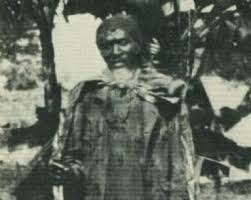
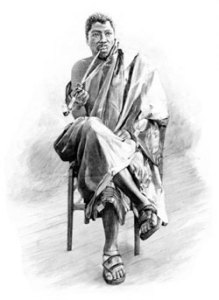
Mirambo, towards the end of his life
Abbe Gregoire, for his part, emphasizes that Barrow attributes: “…the current barbarity of some parts of Africa to the slave trade. To obtain it, the Europeans created it, and they perpetuate the usual state of war; they poisoned these regions with their strong liquors, by the accumulation of all kinds of debauchery, seduction, rapacity, cruelty. Is there a single vice whose example they do not daily reproduce before the eyes of the Negroes brought to Europe, or transported to our colonies? I am not surprised to read in Beaver, certainly a friend of the Negroes, and who in his African memoranda is full of praise for their native virtues and their talents: “I would rather carry thither a rattlesnake than a Negro who would have lived in London “.
Bwemba Bong, Quand l’Africain etait l’or noir de l’Europe. L’Afrique: actrice ou victime de la traite des noirs? MedouNeter (2022), p. 165; Barrow, African memoranda, relative to an attempt to establish a British settlement in the Island of Boulam, by Phylips Beaver, in 4, London 1805. I would rather carry thither a rattle snake, etc., p. 397, cited by abbey Gregoire, p. 43-44.
History repeats itself! Over 100 years ago, African Heads of states, Emperors and Kings, were deported by European colonizers for defending their people, lives, independence, land, livelihood, and themselves. Some were killed, and others were exiled. In those days, they were deported to other territories in Africa, far from their lands. Today, 100 years later, they are being deported to the Hague or to some other African lands again. Here are a few, and I am sure you know others.
Prempeh I, Asantehene of Ashanti Kingdom deported to Seychelles in 1896 by British forces. His throne is still displayed at the Royal Signals Museum in Blandford, England. He was allowed to return after 24 years in exile.
Yaa Asantewaa of Ashanti Kingdom
Queen Yaa Asantewa of the Ashanti Kingdom was deported to Seychelles in 1902 by the British. She arose her people to fight against the British. She died in exile.
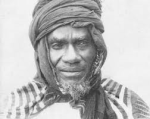
Samori Toure, Founder and leader of the Wassoulou Empire, was deported to Gabon (on an island of the Oogoue) in 1898 by the French. He died in exile.
Samori Touré
Behanzin, King of Dahomey,was deported to Martinique and then later Algeria by the French. He died in exile in Algeria in 1906.
The Oba of Benin Kingdom deported to Calabar by the British in 1897. He died in exile.
Gungunyane, King of Gaza in Mozambique, first sent to Lisbon, and then later to the island of Terceira on the Portuguese Azores. He died in exile in 1906.
Behanzin, the Last King of independent Dahomey
Cheikh Amadou Bamba, of Senegal, deported to Gabon in 1895 by the French. He was brought back 7 years later in 1902, but deported to Mauritania in 1903 for 4 years, before being brought back to Senegal. He died in Senegal.
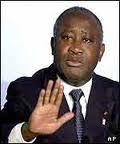
Nowadays, Laurent Gbagbo, President of Côte d’Ivoire, deported to the Hague in the Netherlands 2011 by the French and the Ivorian Ouattara. He is still there.
Laurent Gbagbo
Charles Ble Goude, Youth Minister of Côte d’Ivoire deported to the Hague in Netherlands in 2011 by the French, and the Ivoirian Ouattara. He is still there.
Moussa Dadis Camara,President of Guinea, shot and almost left for dead, deported to Burkina Faso(let’s call the cat by its name). …
And the list goes on… How long will it last? Can we not judge our people ourselves? Is this a choice by the people for the people? Are we really independent?
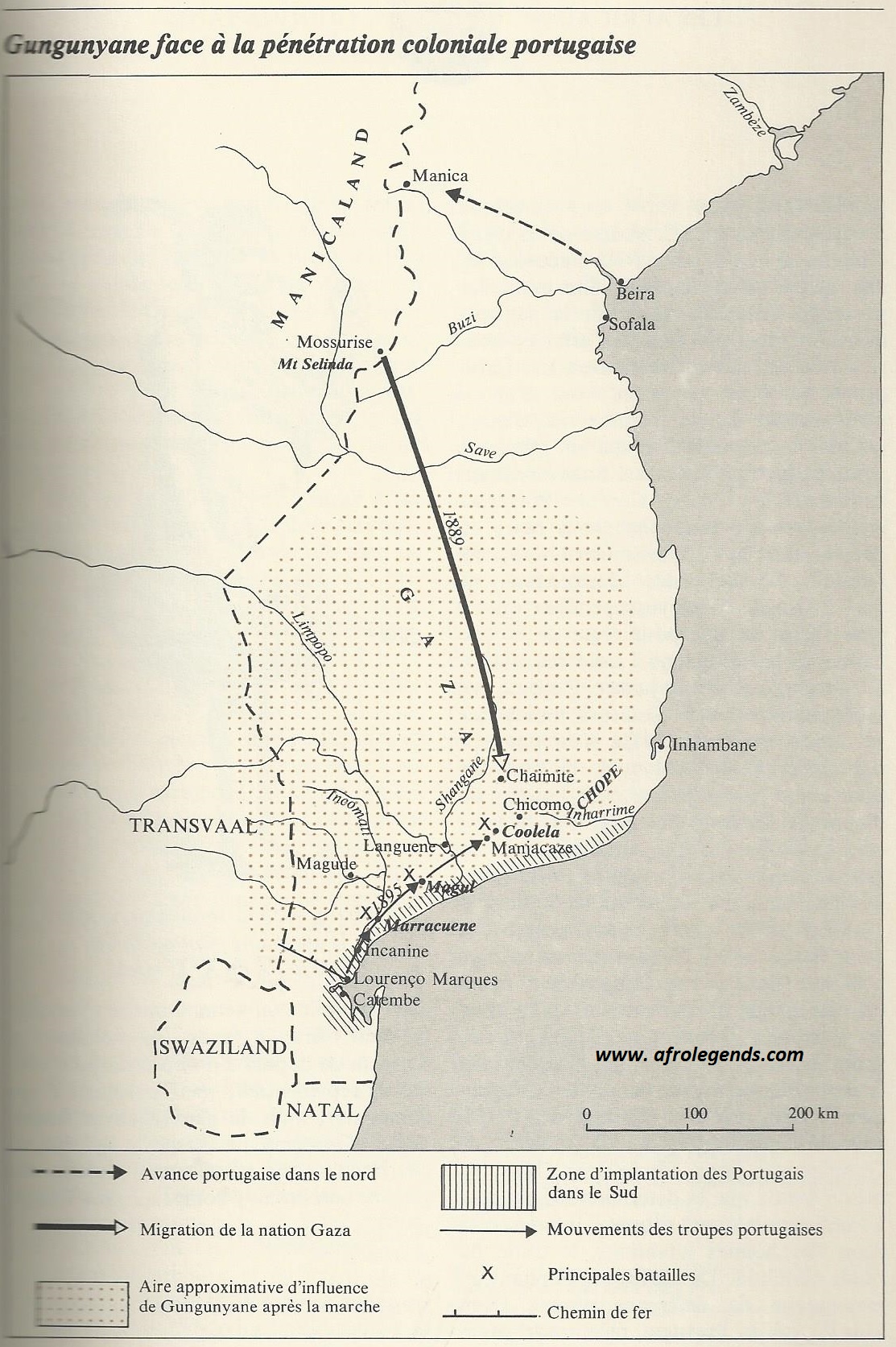
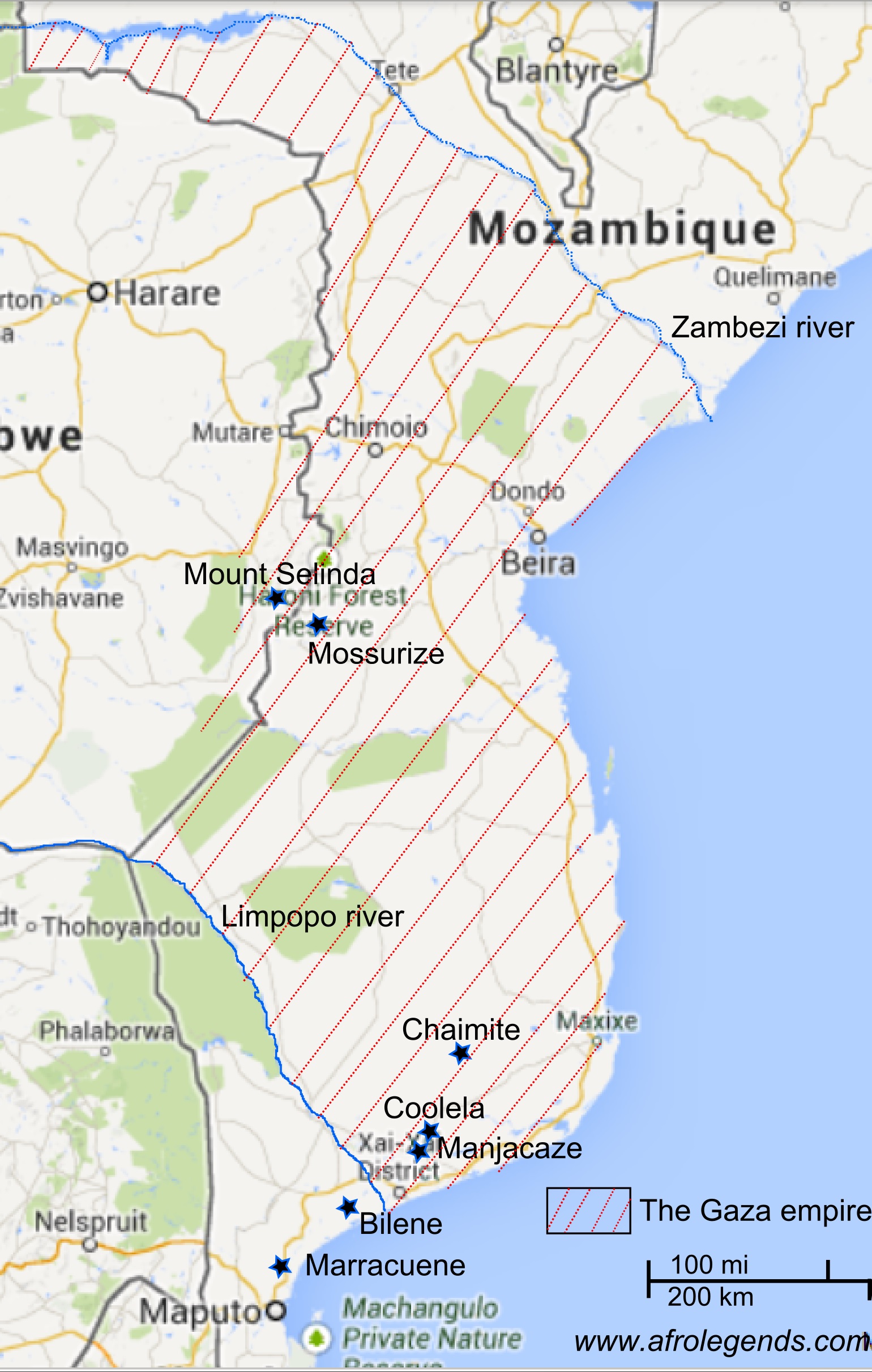
The Gaza empire after migration in 1889 (Source: Les Africains, Vol 3, P. 181, C. Julien, Ed. J.A., 1977)The Gaza empire at its heights around 1860s
Following up on Gungunyane, the Lion of Gaza, I propose here maps of his kingdom before and after the migration. I found a map of Gungunyane‘s kingdom, the Gaza empire, after migration from Mount Selinda, in ‘Les Africains,’ Vol. 3, P. 181, C. Julien, Editions J.A., 1977. I also made an approximative map of what would have been the Gaza empire at its heights in 1860s, before migration, using the well-known boundaries of the Zambezi and Limpopo rivers, and Mount Selinda (in modern day Zimbabwe) as well as the city of Mossurize in Mozambique. Enjoy!
Today, we will talk about one of the greatest chief in Mozambique‘s modern history: the Shangaan king Gungunyane, of the Gaza Empire. He governed a region which encompassed parts of eastern Rhodesia (in modern day Zimbabwe), and southern Mozambique. He was known as the Lion of Gaza.
So who was Gungunyane? Born Mdungazwe (which means ‘one who confuses the people’ in Zulu) around 1850, he will change his name from Mdungazwe to Gungunyane upon his ascension to the throne in 1884. Gungunyane was born on the Gaza territory, which extended from the rivers Zambezi and Incomati, to the Limpopo river, and would go all the way into modern-day Zimbabwe. He was the son of Mzila, who reigned from 1861 to 1884. He was also the grandson of Soshangane, the founder of the Nguni or Gaza empire, after his defeat at the hands of Shaka Zulu in 1820 in Zululand during the Battle of Mhlatuze river. In its initial stages, the Gaza empire expanded over 56,000 km2(22,000 sq mi) of land, with its capital being Chaimite. At the death of his father Mzila, Gungunyane ascended the throne after a fratricidal battle with his other brothers.
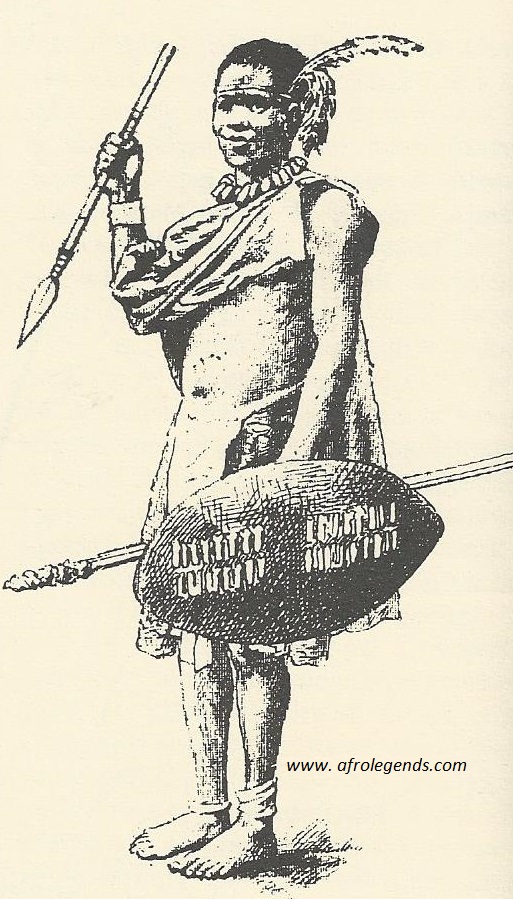
Picture of a Vatua-Shangaan warrior, taken at the end of the 19th century (Source: ‘Les Africains’, Vol.3, P.182, Ed. J.A. 1977)
At his ascension, the Portuguese sent him emissaries in 1885 who tried to have him sign treaties to recognize Portugal’s sovereignty in the region promising: to give his territory to no other than Portugal, to allow that a Portuguese agent reside with him as advisor, to have Portugal’s colors raised over his kraals, to allow Portuguese subjects to circulate freely in his territory, to allow only Portuguese to exploit his mines, to allow the establishment of schools and churches, etc. For which Gungunyane would retain full jurisdiction over the Gaza territory with the right to administer it, and to raise taxes. This was unacceptable to Gungunyane who refused to sign.
The southern region of Mozambique was a penetration road for the Portuguese who had been arming vassals of the Shangaan. Thus in 1888, Gungunyane and his advisors decided to move their kraals from the Rhodesian plateau to the shores of the Limpopo river. This decision will end up costing them a lot, as 40,000 to 100,000 people made the move. Several fractions left in april 1889, while the king himself moved from Mount Selinda on 15 June 1889. This decision was motivated by the desire of Gungunyane to settle an old score with chief Speranhana (who was armed by the Portuguese) of the Chopi people from between the Limpopo and Inharrime, and the need to recover his father’s land in the region of Bilene. In 1889, the Lion of Gaza invaded the Chopi territory, and installed a kraal in Manjacaze. However, the battle against the Chopi will last until the end of his reign, and will greatly weaken the Shangaan.
Throughout his reign, Gungunyane never signed any treaties, because he never trusted neither the Portuguese nor the translator (even if the translator was his own son). He was a skilled negotiator, and would always try to settle everything diplomatically. He played well the British and Portuguese interests in the region… this might have been his downfall in the end.
In 1890, Gungunyane prohibited the sale of alcohol by Portuguese merchants on Gaza territory. In 1891, the Portuguese adopted a decree to ban the sale of alcohol on Gazaland, and agreed to work with Gungunyane to implement this… but as we all know the Portuguese never stopped selling alcohol in the region (this seems like a century old practice from Europeans selling cheap alcohol in Africa, and turning Africans into drunkards).
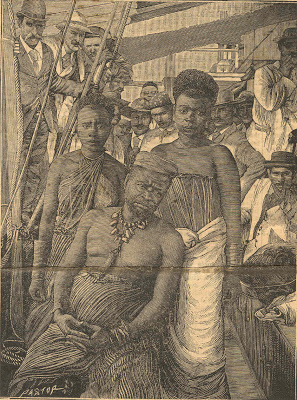
Picture of captured Gungunyane on board the ship ‘Africa’ from the Diario Ilustrado – 15 March 1896
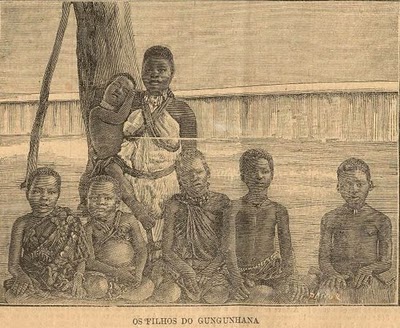
The Portuguese never stopped trying to control Gungunyane who never stopped wanting more independence (it was his land after all). They kept enforcing treaties. In 1893, the conflict in Matabeleland between the British and Lobengula forced several Ndebele to seek refuge in the Gaza territory (one of Gungunyane’s sister was married to Lobengula) creating confusion. In 1894, the Portuguese used a succession quarrel between Ronga chiefs to attack Gungunyane. No proof was found of Gungunyane’s involvement into the hostilities. On 22 August 1894, war started, when the Ronga troops defeated the Afro-Portuguese troops with Ronga chiefs Mahazul and Matibejana of Zixaxa attacking Lourenço Marques. However, the Ronga chiefs were defeated by the Portuguese during the battle of Marracuene on 2 February 1895. The Ronga chiefs thus sought refuge into Gungunyane’s kingdom. Gungunyane kept negotiating, but now the sine qua non condition to any negotiation was the surrender of the Ronga chiefs, with other clauses such as the full control of his territory by the Portuguese, the installation of military bases, the payment
Picture of Gungunyane’s children on board the ship ‘Africa’- from the Diario Ilustrado -15 March 1896
of an annual tax of 10,000 pounds, etc. For the Lion of Gaza, this meant the end of his independence. Negotiations were still ongoing, but by September, the Portuguese had invaded the territory of Cossine which was an integral part of the Gaza kingdom. On 7 November 1895, on lake Coolela, not far from Manjacaze, the Portuguese crushed 8 Shangaan regiments. Coolela became the Waterloo of Gungunyane. The Lion gathered his treasures and took off. For almost a month, Portuguese kept looking for him thinking that he had sought refuge in Transvaal. However, Gungunyane had sought refuge in Chaimite, the sacred village of the Shangaan people. While many of his dignitaries, and sons managed to escape into the Transvaal, the Lion never left Chaimite, and on 28 December 1895, he was captured there by Mousinho de Albuquerque, the Portuguese military governor of Gaza. Gungunyane was first sent to Lisbon, and then later to the island of Terceira on the Portuguese Azores, with his son Godide, some of his wives, and dignitaries. He will die there on 23 December 1906.
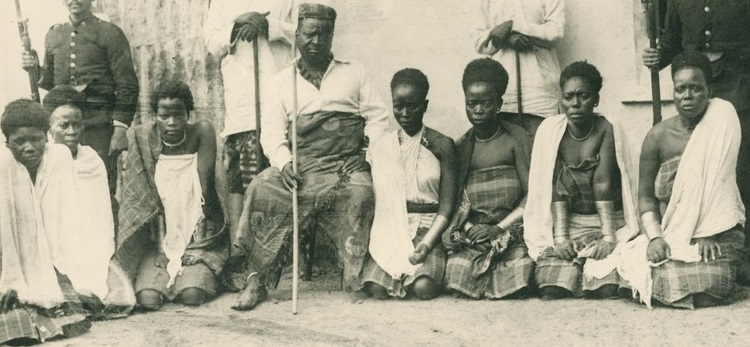
In exile in Acores, from l to r (top): Zixaxa, Molungo, Godide, and GungunyaneGungunyane and his wives in exile in Acores
Under Gungunyane, the Shangaan empire grew more powerful compared to his father’s years. The Shangaan system expanded at a time when Mozambique was at the center of European greed and attacks. Portuguese who had arrived in the area in 1891, were amazed by Gungunyane’s power, and wrote that the Gaza empire was “the biggest empire that the negro race had created in oriental Africa.” Many were quite skeptical when they learnt of the Lion of Gaza’s defeat. A contemporary Portuguese wrote in 1910 that: “the king of the Vatua [Shangaan] empire was a fine diplomat who, knowing that we did not have the military strength to counter his power, managed to turn us [the Portuguese] into docile vassals.” To learn more, check out the book ‘Les Africains, Vol. 3, C. Julien, editions J.A. 1977’, as well as VidasLusoFonas, and the book Gungunhana no seu Reino by Maria da Conceicao Vilhena.







 African Heritage