The Kanvô, the Cloth of the Dahomey Kings

King Behanzin wearing Kanvo, in 1895

Today, we will talk about another African textile, the Kanvô of Benin. The Kanvô, which means “woven cloth” in the Fon language of modern-day Benin, is a prestigious cloth once worn only by kings from the Dahomey Kingdom, including the great King Behanzin. It is said to have been introduced to Benin by King Agonglo, one of the kings of the Dahomey who reigned at the end of the 18th century. Legend has it that, during one of his conquests in Yoruba lands in modern-day Nigeria, King Agonglo came across a young weaver whose work impressed him; he was so astounded that he asked the young man to follow him to his kingdom to become his personal tailor, and thus was born the Kanvô. Later, King Ghezo popularized it by giving rise to large families of weavers throughout the kingdom. The Kanvô used to be worn by kings on great occasions, and is woven from threads of cotton, linen, or hemp fabric. The origin story of the Kanvo is also different whether you are in the south or the north of the country; as we saw in the south, the cloth was introduced by King Agonglo, while in the north, legend has it that the Gurma people of Burkina Faso brought it into the country, that is why there is some resemblance to the Faso Dan Fani of Burkina Faso.
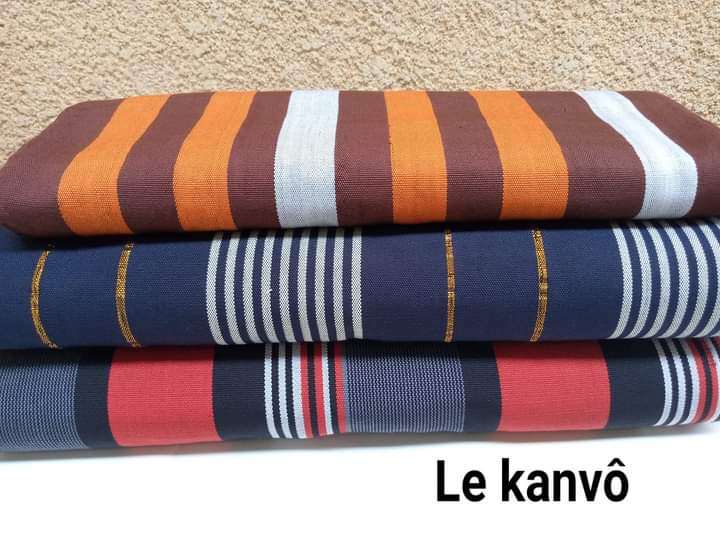
Kanvô (Source: Universcultureletartistique.wordpress.com)

In its original form, the Kanvô is very heavy and not so easy to work with as a tailor. Thus, today, a new generation of tailors has worked to make the woven cloth more malleable and lighter for general consumption, mixing it with other fabrics such as silk, cotton, etc to appeal to the modern palate.

Check out UniversCulturelEtArtistique who wrote a really good article on the Kanvô, or RFI which interviewed some young generations of Beninese fashion designers who are modernizing the Kanvô.

Why the name: Cotonou?

Benin with its map and flag

When I was little, I always wondered why the name Cotonou was given to a major city in Benin.  I used to think that the name was probably a French transcription of the word ‘coton’ (cotton) for ‘coton – ou’, and that maybe there used to be a lot of cotton there … but nowhere did I find cotton to be the main export or agriculture of Cotonou or Benin.

For starters, Cotonou is the largest city and the economic capital of the Republic of Benin.  Cotonou is known in West Africa for its international market Dantokpa, which is hosted over 20-hectares, and is the largest market in the whole of West Africa, generating over 1 billion CFA-Franc per day.  Cotonou is also well-known for its Zemidjans (or moto-taxis, similar to the Cameroonian bend-skins), and its pollution arising from its use of bad petrol (essence frelatée) also known as kpayo, which is fraudulously imported from neighboring Nigeria.

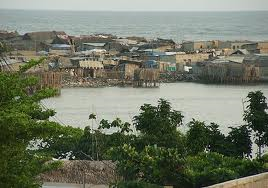
Cotonou, today.
Cotonou, today.

Located on the coastal strip between Lake Nokoué, and the Atlantic ocean, Cotonou’s name comes from the Fon language and means “mouth of the river of death.”  At the beginning of the 19th century, Kotonou (as it was then spelled) was a small fishing village.  It was originally ruled by the Kingdom of Dahomey until a treaty made with the French by King Ghezo in 1851 allowed the French to establish a trading post at Cotonou.  When Glèlè succeeded to his father Ghezo, the territory of Kotonou was ceded to France by a treaty signed on 19 May 1868.  After Glèlè’s death in 1889, his son Behanzin tried, unsuccessfully, to challenge the treaty.  The town Cotonou then developed itself quickly to become today the largest harbor in the region.

As the economic capital of the republic of Benin, Cotonou hosts 2/3 of the industries of the country, and is the seat of the main enterprises and banks of Benin.  It also hosts many of the governmental institutions of the country.  It is now the turntable of commerce in the region, especially because of its close proximity with the Nigerian border (and used to be a place for the conversion of the naira), and is the main port for its neighbor land-locked Niger, which is the world’s first producer of uranium. Enjoy this nice video of Cotonou by benin-passion.com.

Behanzin’s Farewell Speech in Dahomey

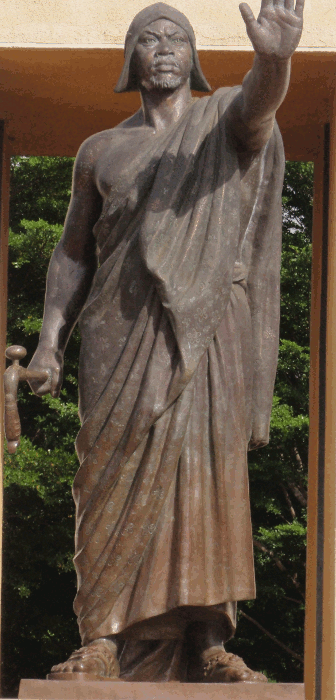
Behanzin, king of Dahomey

This famous speech of King Béhanzin is the last strong message he gave on January 20, 1894, in homage to his army which he always praised the courage, and bravery of the soldiers and amazons. For the original, click here. Since this is such an important piece of African history, I decided to translate his farewell speech into english. Enjoy!

“Fellow sufferers, last faithful friends, you know the circumstances under which, when the French wanted to grab the land of our ancestors, we decided to fight.

We had the certitude to lead our army to victory.  When my warriors rose by the thousand to defend the Danhomè and his king, I recognized with pride the same bravery manifested by those of Agadja, of Tégbessou, of Ghézo, and of Glèlè. I was by their sides in all the battles.

Despite the legitimacy of our cause, and our courage, our compact troops were decimated in an instant. They could not defeat the white enemies whom I also praise the courage and discipline. And already my weeping voice arouses no more echo.

An Amazon warrior ca 1890
An Amazon warrior, ca 1890

Where are now my ardent amazons who were inflamed by a mighty anger?

Where are their indomitable chiefs: Goudémè, Yéwê, Kétungan?

Where are their robust captains: Godogbé, Chachabloukou, Godjila?

Who will praise their splendid sacrifices? Who will tell about their generosity?

Since they sealed the pact of supreme loyalty with their blood, how could I accept any sort of abdication without them?

How could I dare presenting myself in front of you, brave warriors, if I signed the general’s paper?

Continue reading “Behanzin’s Farewell Speech in Dahomey”