Germany agrees to pay Namibia €1.1bn over historical Herero-Nama genocide

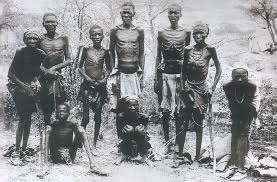
Survivors of the Herero genocide (Wikimedia)

This is historic, late and probably not enough compared to the loss in human lives… yet it is historic nonetheless! Germany has agreed to pay 1.1 billion Euros over the Herero-Nama genocide [Germany in Namibia: the First Genocide of the 20th Century]. This will be paid in existing aid programs over 30 years. I am always skeptical of these aid programs, because countries and companies usually get their money back that way…; plus there are probably billions worth of Namibian diamonds or cobalt mines that will profit German companies in the fine prints. Anyways, for the first time, Germany called the atrocities ‘genocide‘, but fell short of calling the arrangement ‘reparations’ and ‘compensation’ [Have Germans finally acknowledged the Namibian Genocide?]. It is a step forward, we acknowledge it, and recognize the progress. Enjoy! Excerpts below are from the Guardian.

=====

Germany calls atrocities ‘genocide’ but omits the words ‘reparations’ or ‘compensation’ from a joint statement.

Germany has agreed to pay Namibia €1.1bn (£940m) as it officially recognised the Herero-Nama genocide at the start of the 20th century, in what Angela Merkel’s government says amounts to a gesture of reconciliation but not legally binding reparations.

Tens of thousands of men, women and children were shot, tortured or driven into the Kalahari desert to starve by German troops between 1904 and 1908 after the Herero and  Nama tribes rebelled against colonial rule in what was then named German South-West Africa and is now Namibia.
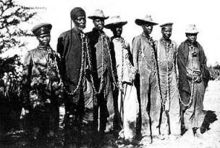
Chained Herero men

Since 2015Germany has negotiated with the Namibian government over what it calls an attempt to “heal the wounds” of historic violence.

Our aim was and is to find a joint path to genuine reconciliation in remembrance of the victims,” the German foreign minister, Heiko Maas, said in a statement. “That includes our naming the events of the German colonial era in today’s Namibia, and particularly the atrocities between 1904 and 1908, unsparingly and without euphemisms.

We will now officially call these events what they were from today’s perspective: a genocide.

On Thursday, official circles in Berlin confirmed reports in Namibian media that after nine rounds of negotiations the two sides had settled on the text of a joint declaration and a sum of €1.1bn, which will be paid separately to existing aid programmes over 30 years.

Of the overall sum, more than a billion euros will go towards projects relating to land reform, rural infrastructure, water supply and professional training. Communities of Herero and Nama descendants, which form ethnic minorities in all of the seven affected regions, are meant to be involved in the development of the specific projects.
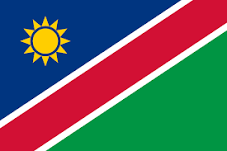
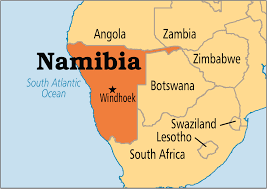
Flag of Namibia

… The text of the joint declaration calls the atrocities committed by German troops a “genocide” but omits the words “reparations” or “compensation” – a move borne out of fear that such language could set a legal precedent for similar claims from other nations.

A spokesman for the Namibian president, Hage Geingob, described German’s acknowledgment of genocide “as the first step” in the right direction. “It is the basis for the second step, which is an apology, to be followed by reparations,” the spokesman said.

Some of the numerous groups that make up the descendants of the genocide’s survivors have been critical of the framing of the negotiations from the outset and have declined to back the Namibian government’s stance. ….

Have Germans finally acknowledged the Namibian Genocide?

Namibia
Flag of Namibia

Here is an excerpt of an article by Kwame Opoku from Pambazuka about Germany’s recognition (?) of the Namibian genocide. For the full article, go to Pambazuka.

========

[…] For a long time, successive German governments have sought to avoid taking responsibility for the genocide of the Herero and Nama of South-West Africa, now Namibia, in 1904-1908. …

_55970031_namacc
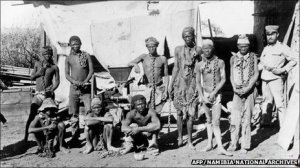
Herero people being enslaved in Namibia by Germans (Source: AFP/Namibia National Archives)

The attempt to deny historical evidence of German genocide was bound to fail in so far as all the elements of German responsibility have been fully documented in German official papers and writings of German scholars. The extermination order of the German General in South West Africa, General von Lothar should have been sufficient evidence of the declared intention to exterminate Herero and Nama: ” I say to the people: anyone who hands over one of the chiefs to one of our stations as prisoner shall receive 1,000 marks and whoever delivers Samuel Maharero will receive 5,000 marks. The Herero people must however leave the land. If the people refuse to do so, I shall force them with the Great Rohr [cannon”>. Any Herero found within the German borders, with or without a gun, with or without cattle, will be shot. I no longer receive women or children. I will drive them back to their people or order them to be shot. These are my words to the Herero people. ‘The great General of the mighty German Kaiser.” Vernichtungsbefehl (Extermination Order) by the German commander, General Lothar von Trotha.

Nambia2[…] After what has been written above, Lammert concludes that: “According to present day international law, the suppression of the Herero uprising was genocide. International law stipulates that if acts are committed with intent “to destroy, in whole or in part, a national, ethnical, racial or religious group, as such ”the criminal act of genocide has occurred Such is the interpretation of many, also German historians.”

At a Government press conference on 10 July, 2015, the question was raised as to whether, in view of the various pressures on the German government to define the massacres of the Herero and Nama as genocide, there was a chance the government might modify its position. Dr Schafer, Spokesperson of the Foreign Ministry, defined the Governments position as follows: “Firstly, the basis of all actions and for our political motivation is the guiding principle that the Federal Government-against the background of the brutal colonial war of Imperial Germany in South West Africa acknowledges Germany’s special historical responsibility towards Namibia and its citizens and especially towards the Herero, Nama, San and Damara. … “We Germans accept our historical-political and moral-ethical responsibility and the guilt incurred by Germans at that time. The atrocities committed at that time would today be termed genocide”.

Herero
Survivors of the herero genocide (Wikimedia)

[…] Frankly, I was surprised and worried by the various statements indicating that the Germans and the Namibians have been having negotiations and discussions aimed at finding “a common position and common language in dealing with the cruel colonial war of 1904-1908”. This is a remarkable statement. Does anybody really believe Germans and Namibians can find a common position and a common language regarding the cruel and inhuman atrocities of the Germans in South –West Africa? Is this really serious or is this intended to persuade the Namibians to get involved in a dangerous rewriting of history that would present the Germany in a less inhuman light? There are probably fewer aspects of recent African history that are as well documented as the German presence and atrocities in Namibia. What is there more for non-historians and politicians to discover and present as a common position and common language of the colonized and the colonizer, of the oppressor and the oppressed?

This can only be an attempt to modify the role of the perpetrator of atrocities and to make the victims partially responsible for the heinous crimes committed against them. The victim becomes involved in the criminal acts against him. Colonized victims cannot evaluate the events of which they were victims in the same way as the oppressive colonizers. …

Herero_chained
Chained Herero men (Wikimedia)

Could it be that the Germans, supported by the French, British, and Belgians and other former colonial powers are frightened about the effect of German recognition of genocide in Namibia? They would all like to avoid having to pay adequate compensation to their African victims and so urge the Germans to avoid setting a precedent; they are probably trying to find a formula, short of admitting genocide in Namibia that allows them to pay some compensation, less than what they would have to pay under the application of normal rules.

[…] Given what the Herero, Nama, San, Damara and all the Namibian peoples have gone through in their encounter with German colonial rule, it is amazing that these issues still remain unsolved. There is no way the Government of Germany can continue to evade assuming openly and fully the consequences of the 1904-1908 exterminations wars.