Maji-Maji Uprising: A German Genocide in East Africa

German troops commanded by Wilhelm Kuhnert during the Battle of Mahenge in 1905

At the beginning of the month, on November 1, 2023, the German president Frank-Walter Steinmeier apologized for the first time for the Maji Maji massacre and other colonial crimes committed by Germany in eastern Africa in what was then German East Africa, a colony comprised of BurundiRwanda (Ruanda-Urundi), mainland Tanzania (Tanganyika), and a small region in modern-day Mozambique known as the Kionga Triangle. The Maji Maji rebellion led to the death of over 300,000 Africans in 1905, in Tanganyika.

As we uncover this somber chapter of the history of Tanzania (then part of German East Africa), it is important to note that the events related mark yet again another part of German history that has been erased from history books: genocides in Africa.

Map of German East Africa with the areas affected by the rebellion highlighted in red

After the Berlin conference of 1884, Germany had several colonies in Africa, German South-West Africa (Namibia), German East Africa (Ruanda-Urundi, Tanganyika, and the Kionga Triangle), Kamerun, and Togoland. Germany tried to reinforce their presence in the different regions by using repressive methods. They built roads, bridges, and more, through forced labor. In 1902, in Tanganyika, they forced the populations to plant cotton as a cash-crop for export, levying harsh taxes upon whoever would not bring a particular quota of cotton. This caused an uproar among the populations who had to leave their own cultures of edible plants to cultivate cotton that nobody ate and which brought nothing to them but tough sanctions from the German occupants. In 1905, when a drought hit, the populations had reached breaking point. It is at that time that a prophet by the name of Kinjikitile Ngwale emerged, claiming to have made a war medicine, a potion that could repel German bullets called “Maji Maji,” which means “sacred water,” maji being water in Kiswahili. Armed with arrows, spears, and doused with Maji Maji water, the first warriors of the rebellion began to move against the Germans, attacking German outposts, and destroying cotton crops. Thus started the Maji Maji rebellion which spread throughout the colony, involving over 20 different ethnic groups, leading to a war which lasted from 1905 to 1907 where 75,000 to 300,000 Africans died.

Gustav Adolf von Götzen Governor of German East Africa from 1901 to 1905

As we saw earlier, there had been the Abushiri revolt of 1888 to 1889, the Chagga revolt with Mangi Meli in the North east of Tanganyika earlier, the Wahehe (Hehe) revolt of 1891 to 1898 which culminated with the decapitation of King Mkwawa, all served as precursors to the Maji Maji uprising. The height of the Maji Maji rebellion came at Mahenge on August 1905 where several thousand warriors attacked but failed to overrun a German stronghold defended by Lieutenant von Hassel. On October 21, 1905 the Germans retaliated with an attack on the camp of the unsuspecting Ngoni people who had recently joined the rebellion. The Germans killed hundreds of men, women, and children. This attack marked the beginning of a brutal counteroffensive that left an estimated 75,000 Maji Maji warriors dead by 1907. The Germans also adopted famine as a weapon, with their scorched-earth technique which destroyed the crops of the populations creating mass starvation; Captain Wangenheim, one of German troops’ leaders in the colony, wrote to the Governor of German East Africa Gustav Adolf von Götzen, “Only hunger and want can bring about a final submission. Military actions alone will remain more or less a drop in the ocean.”

Flag of Tanzania

During his visit to Tanzania at the beginning of the month, the German president stopped at the museum in Songea which was built in homage of Chief Songea Mbano, one of the leaders of the Maji Maji rebellion, executed in 1906 by German forces. Songea Mbano was a great Ngoni warrior, hanged in 1906 during the time of German repression of the Maji Maji rebellion. Songea had been spared the death sentence because he had surrendered. However he demanded to be hanged along with the other Ngoni leaders. The Germans happily complied.

This marked a dark chapter in the history of the country, and the entire region. Today, it is also seen by Tanzanians as the beginning of true nationalism triggered by the unity of several large groups in Tanzania to fight the foreign invaders. To learn more, check out Violence in Twentieth Century – The Maji Maji Rebellion, 300,000 Tanzanians were killed by Germany during the Maji-Maji uprising – it was genocide and it should be called that, and Was Quashing the Maji-Maji Uprising Genocide? An Evaluation of Germany’s Conduct through the Lens of International Criminal Law by K. Bachmann.

German President Apologizes for Colonial Past in Tanzania

Flag of Tanzania

On a visit to Tanzania on November 1, 2023, German President Frank-Walter Steinmeier apologized for the first time for the Maji Maji massacre and other colonial crimes committed by Germany in eastern Africa in what was then German East Africa, a colony comprised of Burundi, Rwanda (Ruanda-Urundi), mainland Tanzania (Tanganyika), and a small region in modern-day Mozambique known as the Kionga Triangle. The Maji Maji rebellion led to the murder of over 300,000 Africans at the hand of German forces in 1905, in Tanganyika .

Flag of German East Africa

President Steinmeier vowed to raise awareness of the atrocities in his country, in a step towards “communal healing” of the bloody past. “I would like to ask for forgiveness for what Germans did to your ancestors here,” Steinmeier said during a visit to the Maji Maji Museum in the southern Tanzanian city of Songea. “What happened here is our shared history, the history of your ancestors and the history of our ancestors in Germany.” “I want to assure you that we Germans will search with you for answers to the unanswered questions that give you no peace.”

Flag of Germany

A few years back, we shared how the German people we met did not even know that Germany had African colonies! or that Germany committed the very first genocide of the 20th century on African soil! What do they think was the place of Otto Von Bismark in the 1884 Berlin Conference? (Most are Unaware of Germany’s Colonial Past and the First Genocide of the 20th Century). This to say that Germans suffer from amnesia when it comes to Africa, so the German president is vowing to make it known.

We appreciate the German President’s formal apology. However, it needs to be followed by actions, and cannot be just another empty “sorry” meant to appease us so we close our eyes to future atrocities committed in the name of cooperation. Clear actions need to follow: return of remains, return of lands, opening of archives, a clear “here is what we will do to right the wrongs,…” a clear correction and inclusion in the history textbooks, and above all a clear “respect for those killed, and for those living today,” reparations, and so much more. We are tired of empty sorry!

Excerpts below are from the BBC.

=====

German troops commanded by Wilhelm Kuhnert during the Battle of Mahenge in 1905

The German president has expressed “shame” for the colonial atrocities his country inflicted on Tanzania.

German forces killed almost 300,000 people during the Maji Maji rebellion in the early 1900s, one of the bloodiest anti-colonial uprisings.

President Frank-Walter Steinmeier was speaking at a museum in Songea, where the uprising took place.

I would like to ask for forgiveness for what Germans did to your ancestors here,” he said.

What happened here is our shared history, the history of your ancestors and the history of our ancestors in Germany.”

The Maji Maji rebellion was triggered by a German policy designed to force the indigenous population to grow cotton for export. Tanzania, then known as Tanganyika, was a part of German East Africa, which also consisted of modern-day Rwanda, Burundi and parts of Mozambique.

President Steinmeier said he hoped Tanzania and Germany could work towards “communal processing” of the past. He promised to “take these stories with me to Germany, so that more people in my country will know about them.” Germany has, until recently, had “colonial amnesia”, according to Jürgen Zimmerer, a history professor at the University of Hamburg. The brutality and the racism of this colonial empire was not understood in the German public.”

As part of the three-day visit, the president met the descendants of one of the Maji Maji leaders, Chief Songea Mbano, who was among those executed in 1906. He is now considered a national hero in Tanzania and President Steinmeier told the family the German authorities would try to find his remains.

Thousands of human remains were brought from German colonies – partly as “trophies” but also for racist research.

On Tuesday, after meeting President Samia Suluhu Hassan in Dar es Salaam, he [President Steinmeier] promised that Germany would co-operate with Tanzania for the “repatriation of cultural property“.

Tanzania historian Mohamed Said welcomed the president’s apology but told the BBC it did not go far enough. They decided to set farms on fire so people would run out of food and be unable to fight. This is unacceptable, in today’s world they would be taken to court,” he said.

More on King Mkwawa and The Return of His Skull to Tanzania

King Mkwawa

I still don’t understand how a people can hold onto another people’s ancestors’ skulls, refuse to return it, and talk of partnership, friendship, among the people. Isn’t it ludicrous? Many of our ancestors’ skulls are still in museums in Europe, and to this date, Europeans refuse to return them, yet they talk of partnership. The information below shows all the obstacles met to find King Mkwawa’s skull, a skull which was included in the Treaty of Versailles, and return it, … As you read about all the hurdles, you wonder how hard it will be for the regular commoners. The excerpts below are from the article written by Dr. J. Desplat at the National Archives. For the full article, please go to the The National Archives, and see some of the correspondence quoted here, as well as the ones mentioning that the skull was said to have magical powers..

As a reminder, King Mkwawa’s skull’s return (King Mkwawa and the First German Colonial Forces’ Defeat in Africa) was stipulated in the 1919 Treaty of Versailles:

ARTICLE 246. Within six months from the coming into force of the present Treaty, … Germany will hand over to His Britannic Majesty’s Government the skull of the Sultan Mkwawa which was removed from the Protectorate of German East Africa and taken to Germany.

====

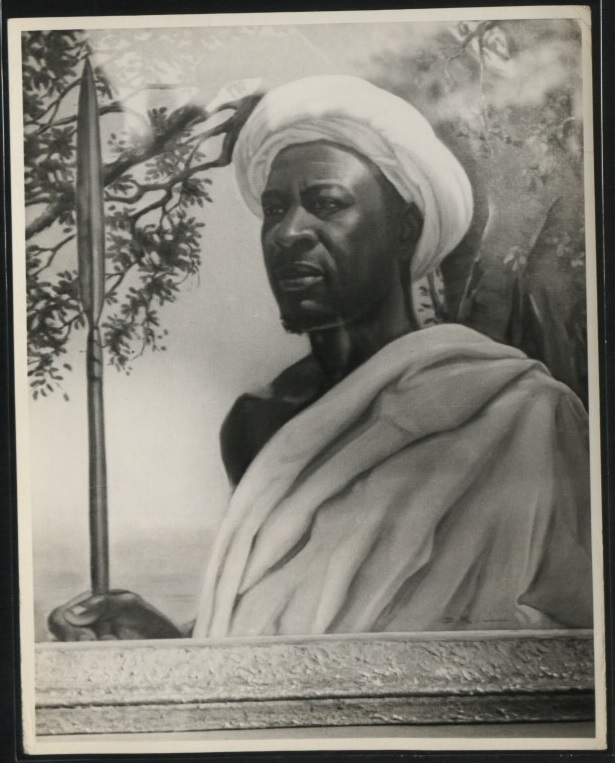
King Mkwawa was the king of the Uhehe tribe in German East Africa (modern-day Tanzania), and was opposed to German rule. In 1895, he declared that ‘rather than submit to German rule he would fight them to the utmost limit, and rather than surrender he would die by his own gun’.

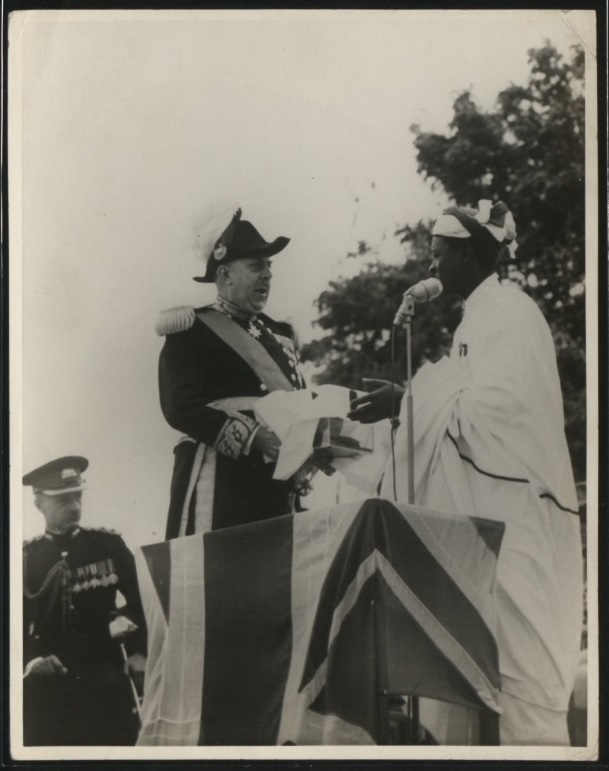
Sir Edward Twining returning King Mkwawa’s skull

In 1898, a bounty was placed on his head, which led to a manhunt. On 19 July, Sergeant Major Merkl and his party closed in on Mkwawa. Merkl reported that they heard a shot and hurried towards the camp, where they found ‘two natives lying down by the camp fire’. One of them was identified as Mkwawa himself. Merkl wrote: ‘I thought they were asleep, halted at about thirty yards and then fired. The bodies did not move. On reaching the spot, we found both men dead and cold (…). I ordered my askari to cut off Mkwawa’s head to take along to camp.’ (CO 822/770) …

[It took almost 40 years after the Treaty of Versailles to find the skull] … The [British] government of Tanganyika wasn’t too bothered. ‘This government does not now attach much importance to the question of Mkwawa’s skull’, they wrote, … The head mentioned was highly unlikely to be the right one as, by all accounts, it had been skeletonised rather than embalmed, but the German Foreign Ministry was asked to investigate again… The British embassy in Berlin commented: ‘it is of course possible that the German Government have made no very serious effort either to find out what truth there is in the story or to trace the skull.’ (CO 691/124/2)

… In January 1953, however, the German Foreign Ministry suddenly announced the skull might be among the large collection of the Museum für Völkerkunde in Bremen. As several skulls seemed to fit the description, they asked whether the skull had any marks by which it could be identified.

Twining [the Governor of TanganyikaSir Edward Twining] reported from Tanganyika that ‘nobody could be found still alive who remembered the Sultan’ (and if people had still been alive, they might have found it difficult to identify Mkwawa by simply looking at his skull anyway!) but Mkwawa’s cephalic index could be compared to that of his grandson Chief Adam Sapi, an apparently unusual 71%.

In June, Twining himself travelled to Bremen to identify the skull. Accompanied by the consul and the vice-consul, he went to the Museum.

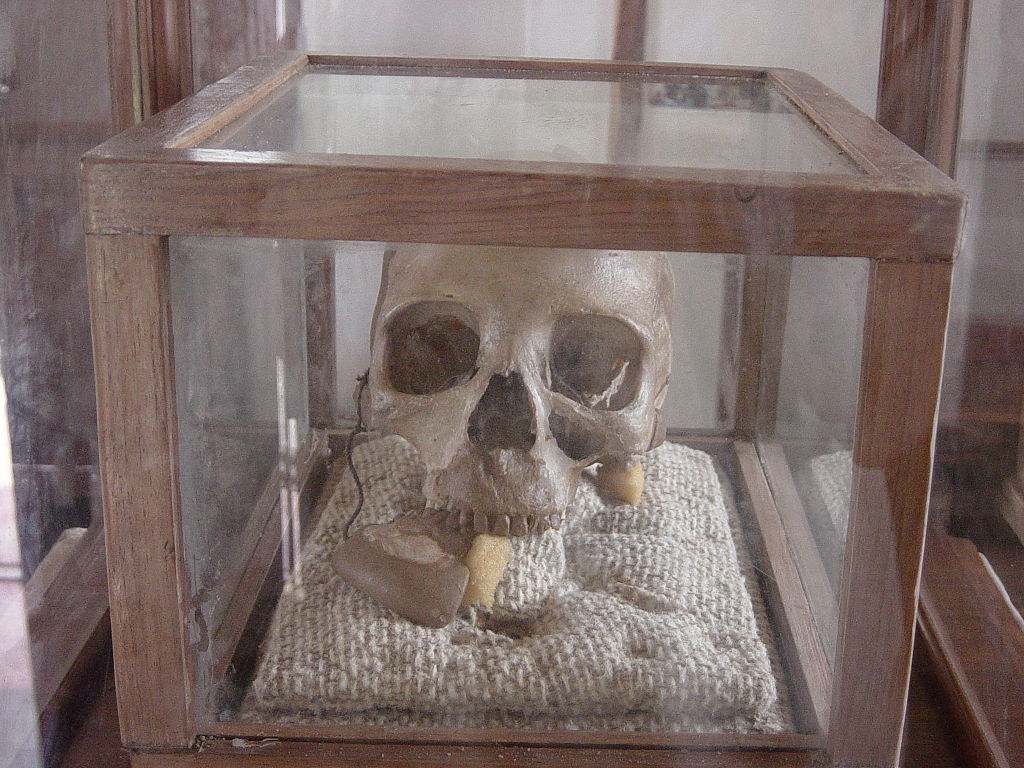
Skull on display at the Mkwawa Memorial Museum

They went to a storeroom where there was a large cupboard full of skulls, and it was arranged for those which had originated in German East Africa to be put together on a table and for their cephalic indexes to be measured. There were two in the 71 group which were selected, and one of these had a hole where a bullet had entered towards the back of the head and come out in front.’ (CO 822/566)

Twining had this skull examined by a German police surgeon who confirmed the hole was consistent with a 25mm rifle of the typed used by German troops in East Africa. Besides, Twining explained, ‘the skull was bleached, which probably happened when they boiled the meat off it’ – someone at the Colonial Office noted in the margin: ‘Ugh!’

[On the return trip], Twining’s irritation might actually have been due to the skull itself which ‘continued to behave very badly’[it was reportedly said to have magical powers]. He reported: We had a series of mishaps which cannot otherwise be accounted for. Our poor old Bandmaster, Gulab Singh, died on the train. My A.D.C. collected a sinus and had to go to hospital. The head boy had a soda water bottle burst in his face, and the cook was struck in the face by a flying saucer. We all got hay fever and we all got very irritable!(CO 822/770)