Every September we celebrate the lives of some of Africa’s great leaders who were either born or assassinated during that month, Ruben Um Nyobe, Agostinho Neto, Amilcar Cabral, Kwame Nkrumah, Gamal Abdel Nasser, and Steve Biko. I found this quote in Steve Biko’s book I Write What I Like p.32, by Sekou Touré, the Guinean leader who said NO to the France of General De Gaulle (Guinea: the country who dared say ‘NO’ to France). This quote by Sekou Touré is so on point, as it matches the revolutionary spirit that should be found in each African who fights to free his land. Each one of us is needed for the revolution, but we cannot just be bystanders, but need to add our hands to the fight. African leaders need to fashion the revolution with the people, if they want to free their lands.
“To take part in the African revolution, it is not enough to write a revolutionary song; you must fashion the revolution with the people. And if you fashion it with the people, the songs will come by themselves and of themselves.
In order to achieve real action you must yourself be a living part of Africa and of her thought; you must be an element of that popular energy which is entirely called forth for the freeing, the progress and the happiness of Africa. There is no place outside that fight for the artist or for the intellectual who is not himself concerned with, and completely at one with the people in the great battle of Africa and of suffering humanity.”
With this week’s event in Egypt, I thought that a trip down memory lane would be more than appropriate! One of the greatest political figures of modern Arab history and third world politics is the Egyptian president Gamal Abdel Nasser. Nasser was a pure political genius, and had great love and vision for his country, the Arab world, and developing countries in general. He was a strong player in the battle against imperialism in Africa, and in the Arab world. It was in Egypt that Um Nyobe and the UPC sought refuge to keep on working on Cameroon’s independence (this will be a story for another day).
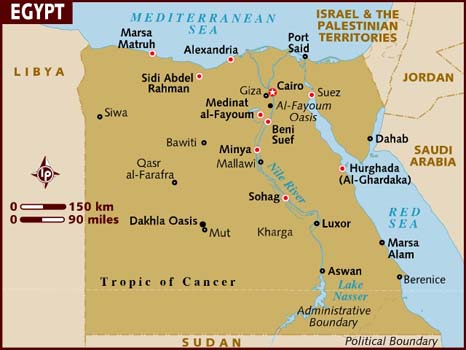
Map of Egypt
He was the first to negotiate the ownership/nationalization of the Suez Canal by Egyptians themselves. At its construction, as in most African countries, it belonged to the British since Egypt had been a British colony. Heled the Egyptian Revolution of 1952 which overthrew the monarchy of Egypt and Sudan, and started a new period of modernization and socialist reforms. He was determined to wean Egypt of its dependency on Western Economies. He was one of the few leaders in the world to declare his neutrality in the Cold War, which was considered very ‘gutsy‘. He moved Egypt toward a socialist economic system and instituted huge land, education and health reforms. As president, he was determined to modernize and improve Egyptians’ standard of living.
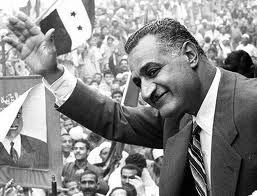
Nasser
After the humiliating Egyptian defeat during the Six-Day war against Israel, Nasser took responsibility for the debacle and resigned from the presidency (but thousands took to the street to demand that he returns to power). In his resignation speech he said: “I have taken a decision with which I need your help. I have decided to withdraw totally and for good from any official post or political role, and to return to the ranks of the masses, performing my duty in their midst, like any other citizen. This is a time for action, not grief…. My whole heart is with you, and let your hearts be with me. May God be with us—hope, light and guidance in our hearts.” You can read the entire speech on Al-Ahram Weekly. He died a couple of years later from a heart attack… many believe that the Six-day war defeat was a precursor. More than 5 million people attended his funeral. Nasser always wanted the best for his people!
Flag of Egypt
I wish more presidents, like Hosni Moubarak, in Africa could have the guts to resign from power, and could love their people so much as to want them to have the best. During an assassination attempt on Nasser’s life at a rally in Alexandria during the celebration of the British withdrawal from the Suez Canal, Nasser proclaimed: “If Abdel Nasser dies… Each of you is Gamal Abdel Nasser… Gamal Abdel Nasser is of you and from you and he is willing to sacrifice his life for the nation.” Moubarak today should learn from the past… like Dr. Zahi Hawass (world-renowned director of Egyptian Antiquities) said in a recent interview to BBC: “What will stay here after many years is Egypt… People will die, but Egypt will stay!” Moubarak should thus ask: “What would I be remembered by: those past few days of protests, or the love for my country?” If his answer is the second one, then he knows that he needs to pack his bags, and uphold Egypt’s liberty!




 African Heritage