

I came across another gem in the book of Professor Bwemba Bong, “Quand l’Africain était l’or noir de l’Europe. L’Afrique: Actrice ou Victime de la Traite des Noirs? – Démontage des mensonges et de la falsification de l’histoire de l’hydre des razzias négrières transatlantiques” (When the African was the black gold of Europe. Africa: Actress or Victim of the Slave Trade ? – Dismantling the lies and falsification of the hydra history of the transatlantic Slave Raids).” After the textile industry, this time, it is about the fertility of the Kongo soil, its agriculture, and the different cultures in the 16th century. In the text, it is good to note the ancient grains used in Central Africa at the time: a grain called luco (could it be the finger millet?) from which a white flour similar to wheat, corn (introduced by Portuguese in Kongo, and which had no real value except to feed pigs, just like rice), nuts like palm nuts (from the description of its usage, one can see the beginning of the multi-million dollar palm oil industry), kola nuts, date nuts, and banana tree. As we read, we note the use of some of those grains to feed but also to heal. I wonder if some these native grains are still used today?

In his book, Pr. Bong shows that traditional African agriculture was good, and fed correctly its populations from rich and fertile plateaus, until the arrival of the Europeans who collapsed their agriculture so as to turn the economy entirely toward the trade of humans which was the only commodity of interest to them. This led to cycles of famine on a continent full of arable lands and strong agricultural knowledge. The cycle has not changed today on the African continent, with the cash crops cultures destined for consumption in the West and now East, once again leaving streaks of famine on its wake; thus the constant news about famine in Africa in countries rich with arable lands, but which are cultivating say, coffee or cocoa or others for western consumption.
Filippo Pigafetta et Duarte Lopes, Le royaume de Congo et les contrees environnantes (1591), Chandeigne/Unesco, 2002, p. 133-136 (trad. Willy Bal, présentation et notes Willy Bal); Bwemba Bong, Quand l’Africain était l’or noir de l’Europe. L’Afrique: Actrice ou Victime de la Traite des Noirs?, MedouNeter 2022, p. 175-177 (translated to English by Dr. Y, Afrolegends.com). Enjoy!
=====
 The entire plateau is fertile and cultivated. It has grassy meadows and the trees are always green. It produces grains of various kinds; the main and best one is called luco. It resembles mustard see, although a little larger. It is crushed with hand mills; a while flour comes out from which we make a white bread, healthy, pleasant to the taste and which is in no way inferior to wheat bread, except that with it we celebrate mass. Such grains are found in abundance throughout the kingdom of Congo where they have been growing for a short time; the seed comes from the banks of the Nile, in the region where this river fills the second lake.
There is also white millet called mazza di Congo, that is to say “Congo grain,” and corn, which is the least esteemed and which is fed to pigs; rice doesn’t have much value either. Corn is called mazza Manputo, that is to say “grain of Portugal,” Portugal in fact bearing the name Manputo. [could this be another origin of the name Maputo in Mozambique?].

There are also various species of trees which produce an enormous amount of fruits, to the point that most inhabitants feed on the fruits of the country, such as citrons, limes, and particularly oranges, which are very tasty, neither sweet nor bitter and which do not in any way inconvenience those who eat them. Mister Duarte recounted (to show the fertility of the country) that he had seen a citron seed, preserved in the pulp and in the citron itself, germinate in four days.
Other fruits are those called banana. We think that they are musa from Egypt and Syria, with the difference that in Congo the banana tree reaches the size of a tree; it is pruned every year so as to produce better. The banana is a very fragrant and very nourishing fruit.
Different species of palm trees also grow on these plateaus : one of them is the date palm, the other is the one which bears Indian nuts called coccos, because inside there is a head that resembles a monkey. Hence the custom in Spain of shouting “coccola” to frighten children.

There is another species of palm tree, similar to the previous ones and from which oil, wine, vinegar, fruits and bread are obtained. The oil is made from fruit pulp; its color and consistency are those of butter, although it is more greenish; it has the same uses as olive oil and butter; it bursts into flames; it can be used to anoint the body; it is excellent for cooking; we get it from the fruit, as we get oil from olives; we cook it to preserve it. Bread is made with the stone of the fruit, which resembles an almond, although harder; inside, we find a marrow that is good to eat, healthy, nourishing. All this fruit is green, including the pulp and is eaten raw and roasted. Wine is obtained by perforating the top of the tree : a liquor oozes out, similar to milk ; sweet the first days, it becomes sour and over time turns into vinegar, which is used in salad. But the wine is drunk chilled, it is diuretic, to the point that in this country no one offers from grit or stones in the bladder; it intoxicates the one who drinks it in excess; it is very nourishing.
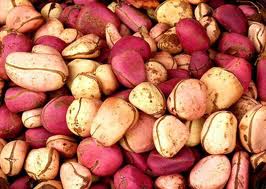
Other trees produce fruits called kola, the size of a pine cone and inside of which are other chestnut-shaped fruits, themselves containing four separate pulps, red and crimson in color. These fruits are kept in the mouth, chewed and eaten to quench thirst and add flavor to the water; they preserve and restore the stomach and are especially effective in liver ailments. Lopes said that a liver of a chicken or other bird, already in putrefaction, sprinkled with the juice of these fruits, became fresh again and almost resumed its previous state. Everyone uses this food commonly, in very large quantities; also it is a good commodity.
We find other wild species of palm trees which bear various edible fruits and whose leaves are used to make mats, to cover houses, to weave baskets, baskets and other objects of the same kind, which we need each day.
Other trees are called ogheghe, the fruits they bear resemble yellow plums, they are excellent to eat and fragrant. We cut branches from these trees, they are planted so closely that they touch each other; they take root and, growing and growing, form palisades and walls around the houses. By then laying mats, we create a fence, a courtyard and these kinds of trellises also serve to provide shade and protect from the heat of the sun.




 African Heritage