
Although 2021 has globally been a tough year, there are still events that lend to celebration. As we turn the page of 2021 and delve into 2022, it is good to note that in 2021, a lot of “firsts” have taken place on the African continent. Below are a few of the events that brought joy. There are many more, of course, but I selected 11. Enjoy, and add in the comments other celebratory events that have marked the continent this year.
-

Professor Hulda Swai Tanzanian professor Hulda Swai wins the 2020 prize of the African Union Kwame Nkrumah Continental Awards for Scientific Excellence in February [Professor Hulda Swai of Tanzania Wins Distinguished Science Award: ‘Women are as good as men’]. This is a highly prestigious scientific award in Africa.
- In May, a Malian woman gives birth to 9 babies (from natural conception). This marks the first single birth and survival of nonuplets in the world. Halima Cisse, a Malian woman, has given birth to nonuplets, 5 girls and 4 boys, in a hospital in Morocco [World Record: Malian Woman gives Birth to Nine Babies].
-
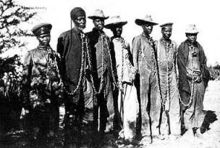
Chained Herero men Germany agrees to pay Namibia €1.1bn over historical Herero-Nama genocide in May of this year. This is historic, late, and probably not enough compared to the loss in human lives… yet it is important! The money will be paid over 30 years in aid programs… (probably a way to siphon money back to Germany, while appearing to be giving something), and pales in comparison to the billions worth of Namibian diamonds and cobalt mine that will profit German companies in fine print [Germany in Namibia: the First Genocide of the 20th Century].
-
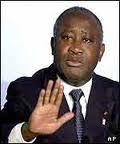
Laurent Gbagbo In June, after 10 years of imprisonment, and over 20 years of persecution, Laurent Gbagbo, the former president of Cote d’Ivoire finally lands home amidst celebrations from his supporters in the country and abroad [Laurent Gbagbo is Back in Cote d’Ivoire]. Although there have been subsequent disappointing actions on his part, it is nonetheless a victory over the International Court of Justice, and all the persecution Blé Goude (How long shall they kill our prophets…?), him, and countless others have gone through, and remains a major cause for celebration, as it shows that, for a just cause, perseverance and determination always bear fruits.
- In June, Petra Diamonds pays Tanzanians for its abuse [Petra Diamonds pays £4.3m to Tanzanians ‘abused’ by its contractors]; this is significant as it shows that it is not impossible to demand reparations from these giant companies that pollute our lands and abuse us. It sets a precedent.
-

Tokyo 2020 Olympics logo (Olympics.com) Late July marks the start of the Tokyo 2020 Olympics after one year of postponement, and Africa wins new victories. Tunisian Ahmed Hafnaoui offers the African continent its first medal of the games, by winning gold in the 400m freestyle swimming; Hugues Zango of Burkina Faso gives his country its first ever medal at the Olympics by winning the bronze medal in the men’s triple jump; while Eliud Kipchoge successfully defends his Olympic title at the marathon becoming the 3rd person in the history of the games to win successive marathons [African Wins at the Tokyo 2020 Olympics].
- In October, Tanzanian writer Abdulrazak Gurnah is awarded the Nobel Prize of Literature, making him the fifth African to win the illustrious prize [Tanzanian Abdulrazak Gurnah awarded Nobel Prize of Literature]. As you can see, the African literary scene is flourishing.
-
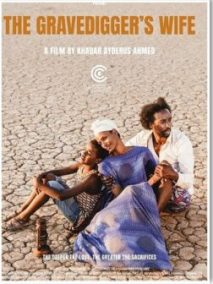
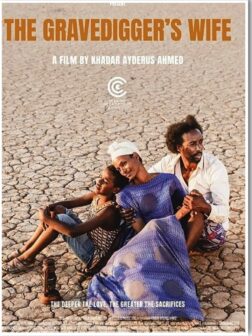
“The Gravedigger’s Wife” by Khadar Ahmed A Somali love story, the Gravediggers’ Wife is this year’s FESPACO winner [Somali Love Story, The Gravedigger’s Wife, is this year’s FESPACO winner]. The FESPACO, which is one of Africa’s biggest film festival, took place this year after the pandemic and lockdowns, and an 8-months delay because of security reasons [FESPACO 2021: One of Africa’s Biggest Film Festival is back!].
- 100 years after René Maran, an African wins the prestigious French Prix Goncourt. The award was given to Senegalese writer Mohamed Mbougar Sarr. This is the first time that a Sub-saharan African person wins the prize, and the third time for a Black person in the almost 120-years history of the title [100 years after René Maran, An African wins the Prestigious Prix Goncourt], even though people of African descent make up so much of the French population over the past century.
-
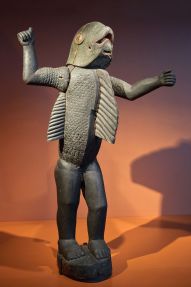
Benin Fon statue symbolizing Behanzin man shark (Musee du quai Branly – Jacques Chirac) In November, France returns some artifacts of the kingdom of Dahomey to the present-day country of Benin; these were looted when the French burnt down the capital of King Behanzin at Abomey over 120 years ago [France returns 26 Artifacts from Behanzin’s Era to Benin]. Similarly, the Benin Bronze cockerel held at the University of Cambridge from the famed Benin Kingdom [Benin City: the Majestic City the British burnt to the ground] has been returned to Nigeria. This is still little, as they should all be returned to their rightful owners; it should not even be up to negotiation.
- Congolese Rumba has been recognized as a UNESCO Intangible World Heritage. Congratulations to both Congos, the Republic of Congo and the Democratic Republic of the Congo (DRC) for working together. We do hope that this is just the first step in a collaboration that will extend to other domains including economic success and beyond [Congolese Rumba Wins UNESCO Protected Status].
Now, there are a lot more such as David Diop winning the International Booker prize for his book “At Night All Blood is Black” which focuses on Tirailleurs Senegalais; or the Senegalese influencer Khaby Lame being ranked number 2 on Tik Tok for his wordless humor which transcends language barriers and cultures (he is the fastest growing Tik Tok influencer with 120 million followers); or even Madagascar’s secretary of police, Serge Gelle, swimming for about 12 hours to reach shore after his helicopter crashed in the Indian Ocean off the northeast coast of the country. When rescued, Gelle said “My turn to die has not yet come, thank God.” So let us all be grateful for this year, and for the people and events who have brought joy to our lives, and let us move forward to a new year.




 African Heritage