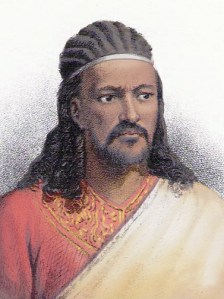
Description of Emperor Tewodros II after He was Crowned

Emperor Tewodros II

When Emperor Tewodros II was crowned King, the British Consul Walter Plowden who knew well the political events of Ethiopia during the 1850s and had foretold the rising star of Kassa, the Emperor’s birth name, the freelance warrior from Qwara, described him as such:

The King Theodorus is young in years, vigorous in all manly exercises, of a striking countenance, peculiarly polite and engaging when pleased, and mostly displaying great tact and delicacy. He is persuaded that he is destined to restore the glories of the Ethiopian Empire and to achieve great conquests: of untiring energy, both mental and bodily, his personal and moral daring is boundless… When aroused his wrath is terrible, and all tremble; but at all moments he possesses a perfect self-control. Indefatigable in business, he takes little repose night or day: his ideas and language are clear and precise; hesitation is not known to him; and has no counsellors or go-between. He is fond of splendour, and received in state even on a campaign. He is unsparing in punishment — necessary in a wilderness as Abyssinia (at that time). He salutes his meanest (poor) subjects with courtesy, is sincerely though often mistakenly religious, and will acknowledge a fault committed to his poorest follower in a moment of compassion with sincerity and grace. He is generous to excess, and free from all cupidity, regarding nothing with pleasure or desire but munitions of war for his soldiers. He has exercised the utmost clemency towards the vanquished, treating them more like friends than enemies. His faith is signal: without Christ I am nothing.”

Description of What Happened to Tewodros II’s Body at Maqdala 1868

From this scene I strolled away to the northern gate, to where the dead body of the late Master of Magdala lay, on his canvas stretcher. I found a mob of officers and men, rudely jostling each other in the endeavour to get possession of a small piece of Theodore’s blood-stained shirt.

No guard was placed over the body until it was naked, nor was the slightest respect shown it. Extended on its hammock, it lay subjected to the taunts and jests of the brutal-minded. An officer, seeing it in this condition, informed Sir Robert Napier of the fact, who at once gave orders that it should be dressed and prepared for interment on the morrow.—Henry M. Stanley [Henry M. Stanley, Magdala: The Story of the Abyssinian Campaign, 1866-67.  Being the Second Part of the Original Volume Entitled “Coomassie and Magdala”, Leopold Classic Library,1896, p. 156.]

UK rejects Calls to Return Ethiopian Prince’s Remains

Prince Alemayehu, son of Emperor Tewodros II, as photographed in 1868 by Julia Cameron

This is a heartbreaking news. Last week, Buckingham Palace, and the UK government refused to return the remains of Prince Alemayehu, son of Emperor Tewodros II, to Ethiopia. Prince Alemayehu’s remains are still in Great Britain 150 years after his death. How preposterous is this! Few years ago, when the Ethiopian government asked, the British said that they could not identify his bones (Ethiopians urge Britain to return bones of ‘stolen’ prince after 150 years). Today, Ethiopians thought that now that there is a new occupant in Buckingham Palace, King Charles III, Prince Alemayehu’s remains will finally return home. However, Buckingham Palace said that returning his remains will not be possible, as it will disturb the resting place of several others in the vicinity. From not being able to identify his bones a few years ago (when in this day and age the remains of King Richard III of England have been identified 500 years after his death), to disturbing others buried there, it makes us wonder if they ever even took the time to look. These are the same people who only returned the hair of Emperor Tewodros II only in 2019. It is so painful to hear… it feels like part of Emperor Tewodros II is still stuck in England. As one looks at pictures of the young orphaned prince who arrived in the UK at the age of 7, and who died at the age of 18, there is so much pain in his face.

Below are snippets of the article; for the full version, go to the BBC.

=====

Emperor Tewodros II

Buckingham Palace has declined a request to return the remains of an Ethiopian prince who came to be buried at Windsor Castle in the 19th Century.

Prince Alemayehu was taken to the UK aged just seven and arrived an orphan after his mother died on the journey. Queen Victoria then took an interest in him and arranged for his education – and ultimately his burial when he died aged just 18.

But his family wants his remains to be sent back to Ethiopia. We want his remains back as a family and as Ethiopians because that is not the country he was born in,” one of the royal descendants Fasil Minas told the BBC. It was not right” for him to be buried in the UK, he added.

… in a statement sent to the BBC, a Buckingham Palace spokesperson said removing his remains could affect others buried in the catacombs of St George’s Chapel in Windsor Castle. It is very unlikely that it would be possible to exhume the remains without disturbing the resting place of a substantial number of others in the vicinity,” the palace said. The statement added that the authorities at the chapel were sensitive to the need to honour Prince Alemayehu’s memory, but that they also had “the responsibility to preserve the dignity of the departed“.

How Prince Alemayehu ended up in the UK at such a young age was the result of imperial action and the failure of diplomacy. In 1862, in an effort to strengthen his empire, the prince’s father Emperor Tewodros II sought an alliance with the UK, but his letters making his case did not get a response from Queen Victoria. Angered by the silence and taking matters into his own hands, the emperor held some Europeans, among them the British consul, hostage. This precipitated a huge military expedition, involving some 13,000 British and Indian troops, to rescue them [no diplomacy, always force and violence].  

British Camp at Zoola, Abyssinia expedition 1868-9 (Source: Victoria and Albert Museum, London)

The force also included an official from the British Museum. In April 1868 they laid siege to Tewodros’ mountain fortress at Maqdala in northern Ethiopia, and in a matter of hours overwhelmed the defences. The emperor decided he would rather take his own life than be a prisoner of the British, an action that turned him into a heroic figure among his people. 

Departure of the British expeditionary forces from Maqdala with the loot – Illustrated London News 1868

After the battle, the British plundered thousands of cultural and religious artefacts. These included gold crowns, manuscripts, necklaces and dresses. Historians say dozens of elephants and hundreds of mules were needed to cart away the treasures, which are today scattered across European museums and libraries, as well as in private collections. [In the case of Maqdala in 1868, it is said that 15 elephants and 200 mules were needed to cart away all the loot from Maqdala. British forces looted the place with no restrain].

The British also took away Prince Alemayehu and his mother, Empress Tiruwork Wube. [The loot was not enough… the young prince and the Empress too].

Ethiopian Emperor Tewodros II’s stolen hair to be returned by UK

Tewodros_II_-_2
Emperor Tewodros II

Last week we talked about Germany returning artifacts stolen from a Namibian freedom fighter back to Namibia. This week, it is the UK which have decided to return the stolen hair of Emperor Tewodros II back to Ethiopia. I hope the Ethiopian government will not just take it at face value, but perform some DNA test of this hair to ensure that it is indeed that of Emperor Tewodros II (Looted Ethiopian Treasures in UK could be returned on Loan). The thing that bothered me about the article below, is that these museums say that they will return stolen artifacts only based on official specific written requests: most of the times when the British looted the different kingdoms, Benin City (Benin City: the Majestic City the British burnt to the ground) in Nigeria or Maqdala in Ethiopia, there were no survivors or very few among the locals. In the case of Maqdala in 1868, it is said that 15 elephants and 200 mules were needed to cart away all the loot from Maqdala.How could anyone have an inventory of all the things they stole? This is just another way of keeping all the loot, and never returning it to their rightful owners. Below are parts of the article; for the full article, go to  The BBC:

======

Ethiopia_Crown looted
A crown from the Maqdala exhibition at the V&A in south-west London – looted in 1868. (Source: V&A Museum)

A British museum [National Army Museum] is to return a lock of hair that the Ethiopian government considers a national treasure.

It was cut from the head of Emperor Tewodros II, who killed himself rather than be taken prisoner by the British during their 1868 invasion of Ethiopia. …

Strands of Emperor Tewodros II’s hair were given to the National Army Museum in London 60 years ago. …

The museum told the BBC it had decided not to make photographs of the hair public out of respect, because the matter was “too sensitive”. The remains are described as two pieces “no bigger than the size of a two-pence coin”.

Tewodros II_Departure of British expeditionary force from Magdala 1868
Departure of the British expeditionary forces from Maqdala with the loot – Illustrated London News 1868

The National Army Museum has now agreed to return the artefact, but says it is not returning any other items of African origin.

It’s definitely not a precedent,” a spokesperson for the museum told the BBC.

That’s the only one that’s been requested. They have to be formal, written requests to the director with a case“. …

The move has reignited demands for the UK to return all the looted artefacts on display in British museums. …