“Femme Noire” de Léopold Sédar Senghor / “Black Woman” by Léopold Sédar Senghor

Léopold Sédar Senghor

I would like to share with you this poem of the late president of Senegal, Léopold Sédar Senghor.  This poem is an ode to the Black woman, but above all, to Senegal his country.  Yes… after reading it several times, one realizes that Senghor was writing an ode to the Black woman, his mother, his sister, his daughter, but above all to Senegal which could be loved just like a woman, and whose “beauty stroke him to the heart like the flash of an eagle”, and whose “Savannah stretch[ed] to clear horizons, savannah shuddering beneath the East Wind’s eager caresses.” This poem was published in ‘Chants d’Ombre’ (1945), English translation by Melvin Dixon (in The Collected Poetry (CARAF books …)).  As you read Senghor’s poem, do you see other meanings? who do you think was the intended audience? Do you feel, like me, that he is praising Senegal, the land of his ancestors? or is he talking about the woman of his dreams? Enjoy!

Femme noire

Femme nue, femme noire
Vétue de ta couleur qui est vie, de ta forme qui est beauté
J’ai grandi à ton ombre; la douceur de tes mains bandait mes yeux
Et voilà qu’au cœur de l’Eté et de Midi,
Je te découvre, Terre promise, du haut d’un haut col calciné
Et ta beauté me foudroie en plein cœur, comme l’éclair d’un aigle

Femme nue, femme obscure
Fruit mûr à la chair ferme, sombres extases du vin noir, bouche qui fais lyrique ma bouche
Savane aux horizons purs, savane qui frémis aux caresses ferventes du Vent d’Est
Tamtam sculpté, tamtam tendu qui gronde sous les doigts du vainqueur
Ta voix grave de contralto est le chant spirituel de l’Aimée

Femme noire, femme obscure
Huile que ne ride nul souffle, huile calme aux flancs de l’athlète, aux   flancs des princes du Mali
Gazelle aux attaches célestes, les perles sont étoiles sur la nuit de ta   peau.

Délices des jeux de l’Esprit, les reflets de l’or ronge ta peau qui se moire

A l’ombre de ta chevelure, s’éclaire mon angoisse aux soleils prochains de   tes yeux.

Femme nue, femme noire
Je chante ta beauté qui passe, forme que je fixe dans l’Eternel
Avant que le destin jaloux ne te réduise en cendres pour nourrir les racines   de la vie.

Black Woman

Naked woman, black woman                              Clothed with your colour which is life, with your form which is beauty
In your shadow I have grown up; the gentleness of your hands was laid over my eyes.                                                                   And now, high up on the sun-baked pass, at the heart of summer, at the heart of noon,
I come upon you, my Promised Land,
And your beauty strikes me to the heart like the flash of an eagle.

Naked woman, dark woman                        Firm-fleshed ripe fruit, sombre raptures of black wine, mouth making lyrical my mouth
Savannah stretching to clear horizons,
savannah shuddering beneath the East Wind’s eager caresses                                                                 Carved tom-tom, taut tom-tom, muttering
under the Conqueror’s fingers                            Your solemn contralto voice is the
spiritual song of the Beloved.

Naked woman, dark woman                                  Oil that no breath ruffles, calm oil on the
athlete’s flanks, on the flanks of the Princes of Mali
Gazelle limbed in Paradise, pearls are stars on the night of your skin

Delights of the mind, the glinting of red gold against your watered skin

Under the shadow of your hair, my care
is lightened by the neighbouring suns of your eyes.

Naked woman, black woman,
I sing your beauty that passes, the form
that I fix in the Eternal,                                        Before jealous fate turn you to ashes to
feed the roots of life.

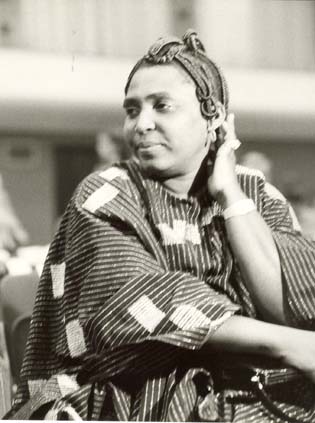
Mariama Bâ: the First African Feminist Writer

Mariama Bâ
Mariama Bâ

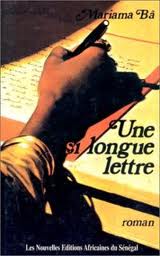
I have wanted to write about Mariama Bâ for the longest time. She is a writer from Senegal… she is the author of “Une Si Longue Lettre” [So Long a Letter], and “Chant Ecarlate[Scarlet Song]. Her book “Une si Longue Lettre” [So Long a Letter] is considered by many as being the first truly African feminist book, as it describes the woman’s condition in an African and Muslim society. It talks about the place of the woman in society, the effect on polygamy on women and society, and the clash between modernism and traditions. It is written as a letter from a widow Ramatoulaye to her best friend Aissatou who left her husband when he decided to marry a second wife. This book really describes the feminine condition in Africa, and was truly the first to address so overtly the woman’s hurdle in African society. Six months after the publication of “Une Si Longue Lettre,” Mariama Ba passed away… and her novel “Chant Ecarlate” was published posthumously.

Une Si Longue lettre

Chant Ecarlate [Scarlet Song] also deals with feminine conditions, but addresses more the clash between two different cultures the European (of the protagonist Mireille), and the African (of Mireille’s husband), and again polygamy. I always felt deeply connected to Bâ’s first book, and always wondered what a great loss African literature suffered when she left. She will always be an inspiration for many: orphan from her mother, raised by her father and grand-parents, mother of nine children, divorcée, professor, highly educated woman, she embodied the strength and determination that can so clearly be seen in African women. Today, “Une Si Longue Lettre” is an African classic, read in all schools across the continent, and translated in numerous languages. We are forever grateful for her work… she opened the door to many bold young African female writers.

Scarlet Song
Scarlet Song

The following is an interview that Mariama Bâ gave to Alioune Toure Dia for the magazine Amina in November 1979: Interview de Mariama Bâ à Amina. Relax and enjoy!