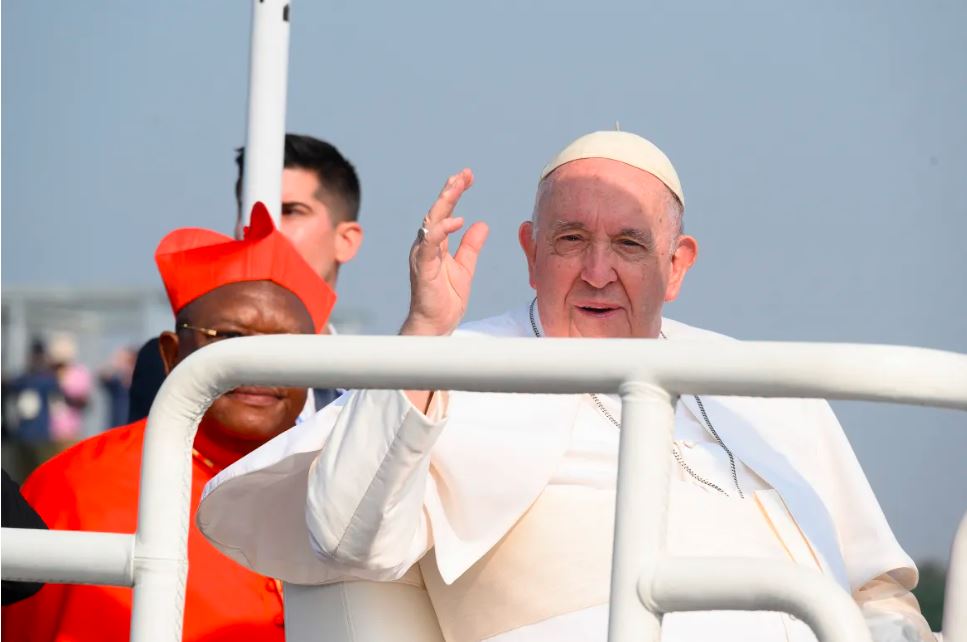
Pope Francis (R) waves as he arrives on the popemobile for the mass at the N’Dolo Airport in Kinshasa. [Source: Arsene Mpiana/AFP – Al Jazeera]
Pope Francis I, the head of the Catholic Church and sovereign of the Vatican City State, passed away this Monday April 21st, on Easter Monday. Jorge Mario Bergoglio was the first Latin American pontiff in world history, the first from the Southern Hemisphere, the first from the Society of Jesus (Jesuit order), and the first born or raised outside of Europe since the 8th century Syrian pope Gregory III. He sat at the realm of the Catholic Church for 12 years, as its 266th pope. His time as pontiff has been seen by many as controversial.
Bergoglio was born in Buenos Aires, Argentina, in 1936. He came from an Italian family, his dad being an Italian immigrant in Argentina, and his mother from a family from northern Italy. He was inspired to join the Jesuits in 1958 after recovering from a severe illness. He was ordained a Catholic priest in 1969. He quickly rose through the ranks to serve as the Jesuit provincial superior in Argentina from 1973 to 1979. He became the archbishop of Buenos Aires in 1998 and was made cardinal in 2001 by Pope John Paul II.
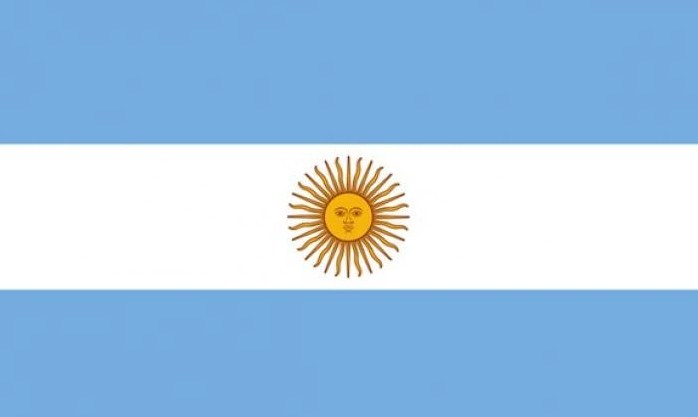
Flag of Argentina
After the resignation of Pope Benedict XVI, Bergoglio was elected at the end of the papal conclave to succeed him on March 13, 2013. He chose Francis as his papal name in honor of Saint Francis of Assisi, the patron saint of the environment, animals and birds.
Throughout his public life, his leadership was defined by his dedication to social justice and support to the marginalized. However, he was accused by some of not doing enough to oppose the generals of the brutal military dictatorship that governed Argentina between 1976 and 1983 – especially after the military kidnapped two priests.
He maintained that the Catholic Church should be more sympathetic toward LGBTQ people, and in 2023, he stated that although blessings of same-sex unions are not permitted, the LGBTQ individuals can be blessed as long as blessings are not given in a liturgical context. This was met by significant criticism from his members. Francis strongly opposed trickle-down economics, consumerism, and excessive development, emphasizing the urgent need for climate action throughout his papacy. However, the greatest challenge to his papacy came from those who accused him of failing to tackle child abuse.
With his election to the pontifical office, there was hope for him to rejuvenate the church, and expand to other parts of the world. As Pope, he appointed more than 140 cardinals from non-European countries – including 15 in December 2024.
Over the years, he visited 68 countries on all continents, including a) Africa: 10 countries, focusing on peace-building, social justice, and interfaith dialogue; b) Asia: 22 countries, emphasizing religious tolerance and environmental concerns; c) Europe: 23 countries, addressing migration, economic inequality, and Catholic unity; d) North & South America: 12 countries, advocating for indigenous rights, poverty alleviation, and climate action.
Early in 2022, Francis expressed “shame and sorrow” for the Catholic Church’s role in abuses against the Indigenous peoples in Canada. He apologized for the church’s role in “projects of cultural destruction” and forced assimilation. Near the former Ermineskin Indian Residential School, the site of a search for unmarked graves, Francis said: “I humbly beg forgiveness for the evil committed by so many Christians against the Indigenous peoples.” Vatican rejects ‘Doctrine of Discovery’ used to Justify Colonial Quest and Theft of Land. We are allergic to words without actions… and as you can see this was just it!
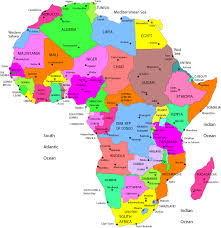
Pope Francis visited Africa 5 times in his 12 years, going to 10 countries. His first visit to the continent took him to Kenya, the Central African Republic (CAR), and South Sudan in November 25 – 30, 2015. His second visit was to Morocco in March 30 – 31, 2019; his third visit was to Mozambique, Madagascar, and Mauritius in September 4 – 9, 2019. His last visit was in February 2 – 5, 2023, to the Democratic Republic of Congo (DRC) and again South Sudan (The Pope Visits the Democratic Republic of Congo and South Sudan). His visits supposedly focused, on paper, on inter-religious dialogue Christian-Muslim as in CAR, peace building as in South Sudan, and social justice. He ‘denounced’ corruption and economic colonialism, and even ‘asked’ colonial powers to let Africa flourish, Pope says Hands off Africa: “Hands off the Democratic Republic of the Congo! Hands off Africa! Stop choking Africa, it is not a mine to be stripped or a terrain to be plundered. In Africa, although pope Francis addressed clerical abuse scandals, many felt that he did not denounce child abuse on the continent as much as he did in other parts of the world.
There was a lot to celebrate in Africa in 2023. Below are just a few in the sea of celebrations.
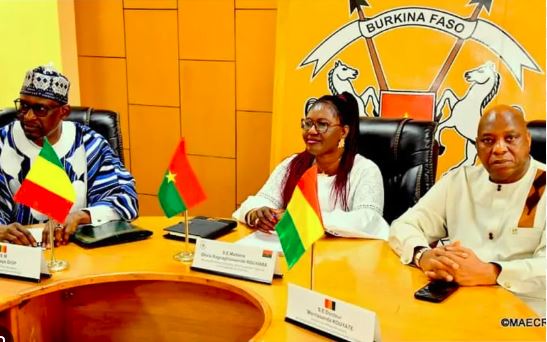
The different ministers of Mali, Guinea and Burkina Faso met to sign the agreement (Source: https://thenews-chronicle.com)
1. In January, Mali, Guinea, and Burkina Faso, three West African countries , all of whom have recently undergone military takeovers amid rising public national anger against France, have agreed to a Bamako-Conakry -Ouagadougou axis, with enhanced cooperation on matters ranging from trade to the fight against insecurity.
FESPACO 2023
2. The biennial African film festival, FESPACO, took place this year from 25 February to March 4. On March4, the winner, Tunisian Youssef Chebbi won the Golden Stallion of Yennenga (Etalon d’or de Yennenga) for his film ‘Ashkal‘ which centres on the investigation into the killing of a caretaker on a construction site in Carthage on the outskirts of his hometown. This year, women directors were celebrated and took home the second and third prizes, with Burkinabe filmwriter Apolline Traore, who picked up the Silver Stallion of Yennenga for the film ‘Sira‘, while the Bronze Stallion was awarded to Kenya’s Angela Wamai for ‘Shimoni.‘ FESPACO 2023: Tunisian Film ‘Ashkal’ Wins the Golden Stallion of Yennenga, and Women Filmmakers are Recognized
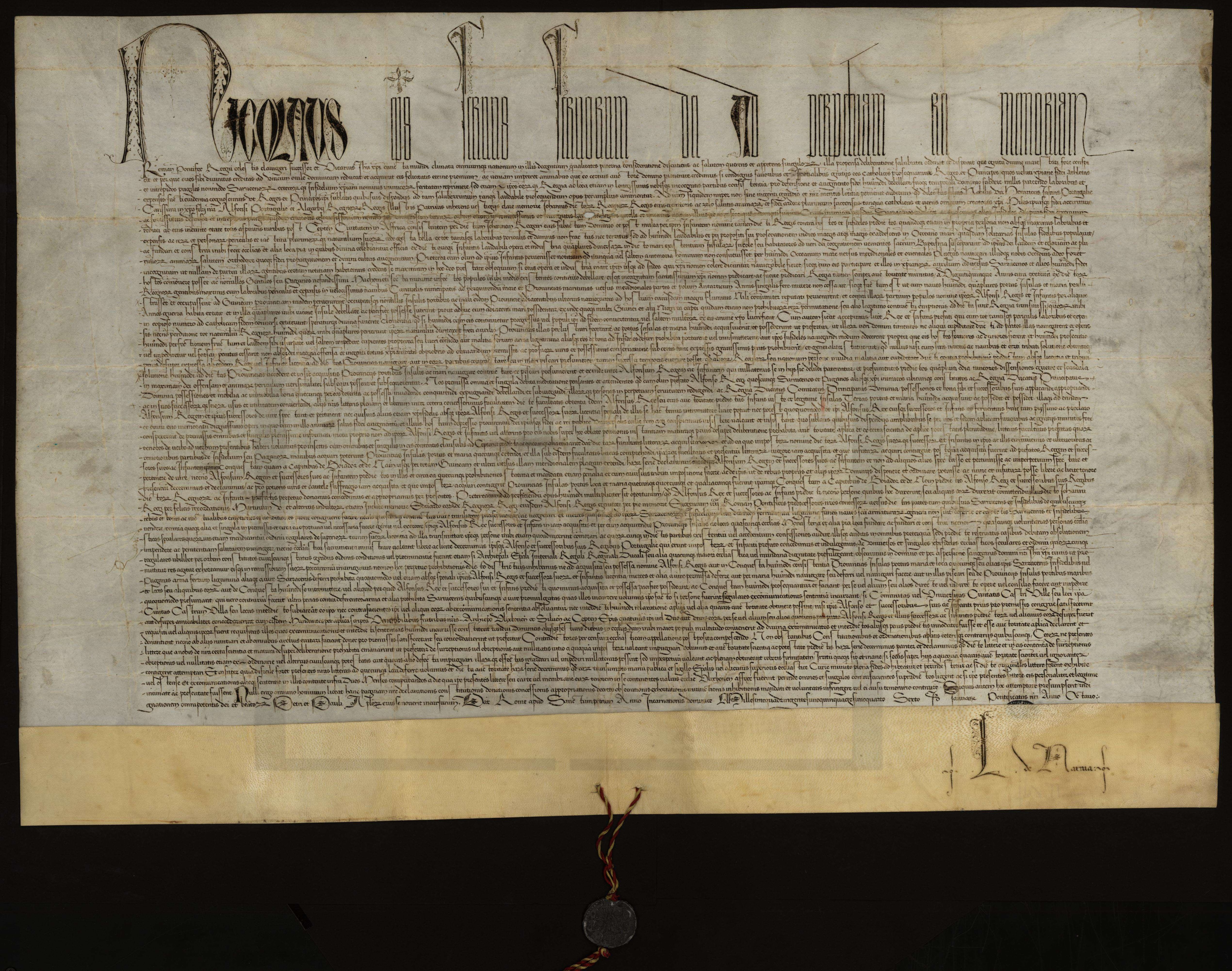
3. In March, the Vatican rejected the ‘Doctrine of Discovery’ used to Justify Colonial Quest and Theft of Land. A Vatican statement said the papal bulls, or decrees, “did not adequately reflect the equal dignity and rights of Indigenous peoples” and “therefore [the Vatican] repudiates those concepts that fail to recognize the inherent human rights of Indigenous peoples, including what has become known as the legal and political ‘doctrine of discovery.’” This is the first official acknowledgment of the Catholic Church for his first place participation in the enslavement of people around the globe, and particularly of Africans. We had published here Dum Diversas or The Vatican’s Authorization of Slavery, which highlighted the major role played by the Vatican in the slave trade of Africans over the centuries.
Inauguration of the Place des Tirailleurs-Sénégalais with Tirailleurs aged over 90-years-old on 10 March 2023 (Source: Sylvie Koffi, RFI)
4. Nine Senegalese tirailleurs, men who served for France for its liberation during the wars, have now won the right to receive their pension while living in Senegal. These men, aged 85 to 96 years, have served in the French army during the wars of Indochina and Algeria, and were forced to live in France at least 6 months per year to get their retirement pension! Can you imagine serving for a country that does not even want to pay you a dime for your services (remember Thiaroye?)? As a result, most of them never returned home. This year, they were able to finally go home. At Last: Senegalese Tirailleurs now allowed to receive their pension while living in Senegal
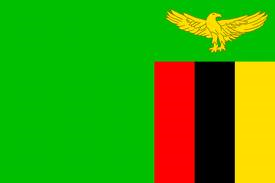
Zambian flag
5. Following months of talks, Zambia successfully agreed new repayment terms with its state creditors on up to $6.3bn (£5bn) debt, including over $4bn owed to China. … Although the details of the deal have not yet been released [as always, populations are kept in the dark, while their future is being signed over], it appears that Zambia will be granted an extended repayment time of over 20 years, including a three-year grace period with interest-only payments. In recent years, the economic debt of Zambia has been making the locals apprehensive; this is a positive step. Zambia breathes a Sigh of Relief after $6bn Debt Deal.
Anatoli Kirigwajjo (Source: 256businessnews.com)
6. Anatoli Kirigwajjo from Uganda, the founder and CEO of Yunga, a local digital security network that enhances neighbor-to-neighbor safety, was awarded “The Africa Prize for Engineering Innovation” dedicated to developing African innovators, an award, founded by the Royal Academy of Engineering in the UK. In a modern world where drums are no longer used to alert communities, it is imperative to find a solution that will be used to alert all neighbors within a community of some impending issue. His innovation is based on the ancestral drum tradition, and the “10,000 household model” – a traditional practice where people use drums to alert their community in case of an emergency. Ugandan Engineer takes Africa’s Top Innovation Award for His Safety Invention.
Faith Kipyegon (Source: WorldAthletics.org)
7. Africans made us Proud at the 2023 World Athletics Championships in Budapest, Hungary. There were so many outstanding contributions, and amazing firsts. Hugues Fabrice Zango of Burkina Faso who took home the gold medal in the men’s triple jump, thereby offering his country its first gold at the World Championships. Letsile Tebogo of Botswana made us proud by becoming the first African to win a silver medal at the World Championships ever in the men’s 100 m, and a bronze medal in the 200 m. Faith Kipyegonof Kenya delivered! There isn’t another athlete as consistently dominant over such a range as Kipyegon, and she was rightfully selected among the best African athlete of the year; at the world championships, she won gold medals in the women’s 1,500 m and 5,000 m in Budapest. Ladies Gudaf Tsegay, Letesenbet Gidey, and Ejgayehu Taye of Ethiopia dominated their events to give us a trio winning gold, silver, and bronze medals respectively in the women’s 10,000 m. Please check out the exhaustive list of winners.
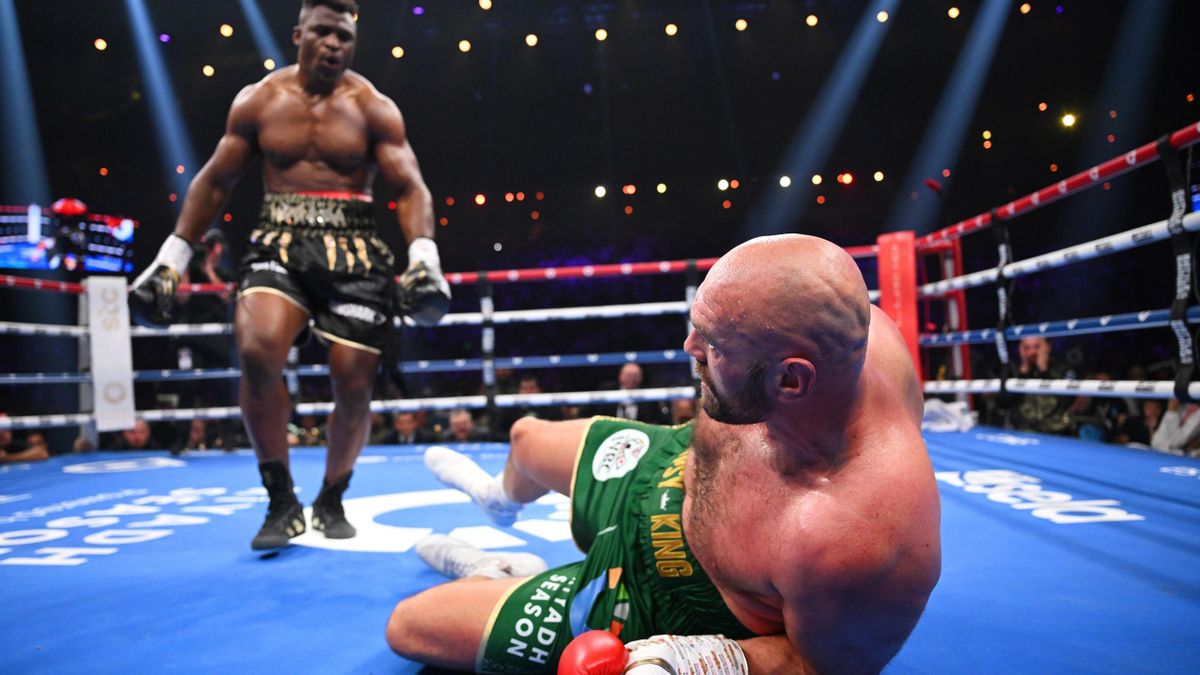
Francis Ngannou knocking down Tyson Fury in the 3rd round (Source: Eurosport)
8. Francis Ngannou, professional mixed martial artist and professional boxer, of Cameroon made us proud in the “Battle of the Baddest” against the undefeated world heavyweight champion Tyson Fury, which place on October 28, 2023, in Riyadh, Saudi Arabia. Ngannou was able to knock down Fury in the third round, taking the fight all the way to the scorecards, in which the judges awarded Fury the victory in a controversial split decision. To many, not just Africans, the real winner was Ngannou.
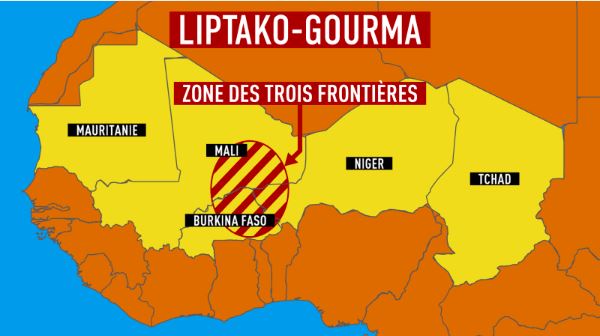
Map of Liptako-Gourma region (Source: aha-international.org)
9. Mali, Burkina Faso, and Niger signed a Mutual Defence Pact called the Liptako-Gourma Charter, to protect their countries, and fight effectively against terrorists which have been occupying the northern parts of their territories. The Liptako-Gourma Charter establishes the Alliance of Sahel States (AES), which aims to “establish an architecture of collective defence and mutual assistance for the benefit of our populations“, Colonel and leader of Mali, Assimi Goïta wrote on X. These countries have shown that we, Africans, can take care of ourselves, without the need of puppet organizations such as ECOWAS.
Ibrahim Traore, President of the Transition, raises the new plate renaming the boulevard after President Thomas Sankara (Source: LeFaso.net)
11. On the 36th anniversary of Thomas Sankara’s assassination, Burkina Faso renamed Boulevard in Honor of Thomas Sankara; the boulevard, one of the main streets of the capital Ouagadougou, was previously known as General Charles de Gaulle Boulevard. Thus, Burkina Faso has replaced the country’s former colonial ruler with its very own leader and inspiration to the nation, Thomas Sankara. We applaud Burkinabes for doing this, and hope to see many African countries follow in their tracks, as many streets and cities still wear the names of European men who wiped out entire peoples (Brazzaville, Port-Gentil, etc).
Woppa Diallo and Mame Bougouma Diene (Source: The Caine Prize/Guardian)
12. Senegalese couple, Mame Bougouma Diene and Woppa Diallo, has made history this week by winning the Caine Prize for African Writing [Senegalese Couple Makes History by Winning Literary Caine Prize for African Writing]. It is the first time in the history of the prize that it is awarded to a couple. Diallo is a lawyer and activist while French-Senegalese American Diene is a humanitarian and a short-story writer. There were also lots of African writers who published acclaimed work this year.
Map of Mali with its capital Bamako
13. Mali military forces succeeded in Kidal where France and Allies could not! The forces were able to liberate the city of Kidal from terrorist groups where France and its allies and the MINUSMA could not. They succeeded in a few days, where it took years for France and co. On November 14 2023, president Assimi Goïta of Mali announced the liberation of Kidal, stronghold of terrorist groups for the past few years. The news was so stunning that even the BBC who has been calling the Mali government, ‘the junta’ and all sorts of names, and always showing ugly pictures of Assimi Goïta, had to, begrudgingly write the article and for once showed him in a decent image :).
A few years ago when we published Dum Diversas or The Vatican’s Authorization of Slavery, many were surprised if not astounded to know that the Catholic Church had authorized and condoned the enslavement of people around the world, the conquest of their lands, the placement of indigenous populations into perpetual servitude, and the genocidal eradication of non Christian populations around the globe. There are still many Catholics today who do not know this! We received quite a few harsh inbox messages about the veracity of our work. Imagine the confirmation we got when last Thursday, March 30, 2023, after decades of indigenous calls, the Vatican itself repudiated the ‘Doctrine of Discovery’ which justified colonialism. A Vatican statement said the papal bulls, or decrees, “did not adequately reflect the equal dignity and rights of Indigenous peoples” and “therefore [the Vatican] repudiates those concepts that fail to recognize the inherent human rights of Indigenous peoples, including what has become known as the legal and political ‘doctrine of discovery.'”
It is not clear what to make out of this “rejection of the ‘Doctrine of Discovery'” by the Vatican. Are we supposed to clap? After centuries of killings, conquistadors killings of indigenous people of Americas, eradication of entire populations, enslavement of African people, land grabs across the globe, resources grab, enrichment, etc. We all know the coffers of the Vatican and European nations are filled with the spoils of these conquests and that their cities and countries were built on the back of all these. We ask again, what are we supposed to do with this “rejection”? Is the Vatican giving back what they took? Will the lands be returned? Words again and again and again… no actions!
The New Scramble for Africa (Source: Source: Dr Jack & Curtis for City Press, National Institute African Studies (NIAS))
As said before, there are no coincidences. There is no coincidence that this comes less than 2 months after the Pope’s visit to Africa, which is said to be the future of the Catholic Church. It is no coincidence that it comes just a few days before the very important Christian celebration of Easter. Could this be linked to the New Scramble for Africa? This New Scramble for Africa needs to be done as before, under the veil of good intentions, purity, and supposed forgiveness; while the impoverished people get ‘honeyed’ out with the ‘rejection’ (just words), the resources get pumped out. Some also think that it is no coincidence that it comes under history’s first Latin American Pope. And You, what do you make of this ‘rejection of the Doctrine of Discovery’ by the Vatican?Excerpts below are from Common Dreams. Please also check out the article in Al Jazeera.
=====
In a historic shift long sought by Indigenous-led activists, the Holy See on Thursday formally repudiated the doctrine of discovery, a dubious legal theory born from a series of 15th-century papal decrees used by colonizers including the United States to legally justify the genocidal conquest of non-Christian peoples and their land.
In a joint statement, the Vatican’s departments of culture and education declared that “the church acknowledges that these papal bulls did not adequately reflectthe equal dignity and rights of Indigenous peoples” and “therefore repudiates those concepts that fail to recognize the inherent human rights of Indigenous peoples, including what has become known as the legal and political ‘doctrine of discovery.'”
Slaves on board a ship
“The church is also aware that the contents of these documents were manipulated for political purposes by competing colonial powers in order to justify immoral acts against Indigenous peoples that were carried out, at times, without opposition from ecclesiastical authorities,” the statement added. “It is only just to recognize these errors, acknowledge the terrible effects of the assimilation policies and the pain experienced by Indigenous peoples, and ask for pardon.”
Indigenous leaders—who for decades demanded the Vatican rescind the discovery doctrine—welcomed the move, while expressing hope that it brings real change.
“On the surface it sounds good, it looks good… but there has to be a fundamental change in attitudes, behavior, laws, and policies from that statement,” Ernie Daniels, the former chief of Long Plain First Nation in Manitoba, Canada, toldCBC Thursday.
“There’s still a mentality out there—they want to assimilate, decimate, terminate, eradicate Indigenous people,” added Daniels, who was part of a delegation that met with Pope Francis last year in Rome and Canada.
… Discovery doctrine is rooted in a trio of papal decrees issued in the second half of the 15th century authorizing the Portuguese and Spanish monarchies to conquer land and enslave people in Africa and the Americas if they were non-Christians and dividing the Americas between the two burgeoning empires.

 Pope Francis visited Africa 5 times in his 12 years, going to 10 countries. His first visit to the continent took him to Kenya, the Central African Republic (CAR), and South Sudan in November 25 – 30, 2015. His second visit was to Morocco in March 30 – 31, 2019; his third visit was to Mozambique, Madagascar, and Mauritius in September 4 – 9, 2019. His last visit was in February 2 – 5, 2023, to the Democratic Republic of Congo (DRC) and again South Sudan (The Pope Visits the Democratic Republic of Congo and South Sudan). His visits supposedly focused, on paper, on inter-religious dialogue Christian-Muslim as in CAR, peace building as in South Sudan, and social justice. He ‘denounced’ corruption and economic colonialism, and even ‘asked’ colonial powers to let Africa flourish, Pope says Hands off Africa: “Hands off the Democratic Republic of the Congo! Hands off Africa! Stop choking Africa, it is not a mine to be stripped or a terrain to be plundered. In Africa, although pope Francis addressed clerical abuse scandals, many felt that he did not denounce child abuse on the continent as much as he did in other parts of the world.







 African Heritage