King Moshoeshoe I: The First King of the Kingdom of Lesotho

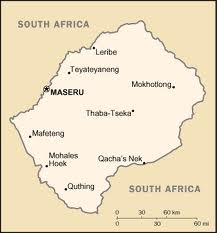
Map of Lesotho

Back in March 2025, the country of Lesotho was suddenly thrown in the spotlight when American President Donald Trump made a dismissive remark during a speech to Congress, saying « nobody has ever heard of » Lesotho while criticizing U.S. foreign aid spending. The comments sparked backlash from Lesotho’s government and prompted many to visit the country, or talk about the country. President Trump was not totally wrong… let’s be honest, before his remark, how many had heard about the country ?… maybe those who visit Afrolegends and who had read about its capital city of Maseru. Unknowingly, President Trump has most likely prompted added tourism to this beautiful landlocked country the size of Belgium entrenched within the country of South Africa.

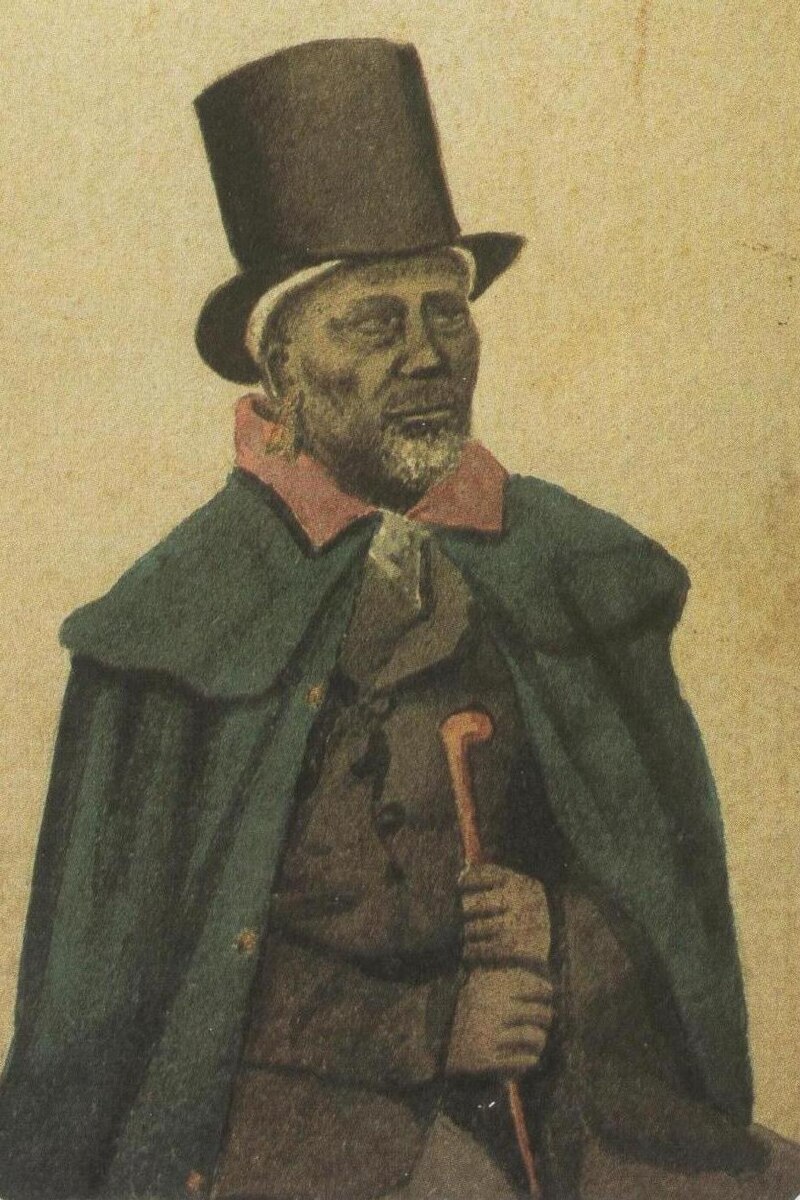
King Moshoeshoe I of Basutoland during a visit to Prince Alfred of England in 1860

Today, we will talk about King Moshoeshoe I, the first king of Lesotho. 

King Moshoeshoe I was the founder and first monarch of Lesotho, known for his diplomatic genius, military leadership, and ability to unite diverse clans into a single nation. He ruled from 1822 until his death in 1870.

King Moshoeshoe I was the first king of Lesotho. At birth, he was named Lepoqo, which means Dispute, because of accusations of witchcraft which were levied on a man in Menkhoaneng around the time of his birth, between 1780 to 1794, where 1786. He was the first son of King Mokhachane, a minor chief of the Bamokoteli sub-clan of the Basotho people and his first wife Kholu, who was the daughter of the Bafokeng clan chief Ntsukunyane. Unlike Shaka Zulu, he had a happy childhood which he always referred to in adult life.

After his initiation ceremony in 1804, he took the name of Letlama, the Binder, and later chose the name Moshoeshoe, a name inspired by the sound of shaving – symbolizing his skill in cattle raids and leadership. It is said that it was chosen after a successful raid in which he had sheared the beards of his victims – the word ‘Moshoeshoe’ representing the sound of the shearing.

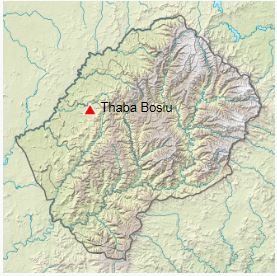
Thaba Bosiu on the map of Lesotho

In 1820, Moshoeshoe succeeded his father and formed his own clan and settled at Butha-Buthe Montain, and later moved to the mountain he named Thaba Bosiu  or “Mountain at Night” because his people arrived at night, a natural fortress that became the heart of the Basotho Kingdom. Thaba Bosiu served as the capital of the new Basotho nation. One can still find ruins from the 19th century of King Moshoeshoe I’s reign at the top of the mountain; it overlooks iconic Mount Qiloane, an enduring symbol of the nation’s Basotho people.

In 1810, Moshoeshoe married Mamabela, daughter of the Bafokeng chief, Seephephe, who was chosen for him by his father. She became his senior wife assuming the name ’MaMohato (Mother of Mohato – name that she took after the birth of her first son Letsie) with whom he had four sons including Letsie, MolapoMasopha and Majara as well as a daughter named Mathe. Their relationship was described by visiting British missionaries as deeply affectionate.  MaMohato died in 1838. Moshoeshoe practiced polygamy and is known to have had 30 wives in 1833 and close to 140 wives by 1865. After MaMohato, Moshoeshoe considered himself to be a widower. Only the children from his marriage to MaMohato constituted the royal line of descent. 

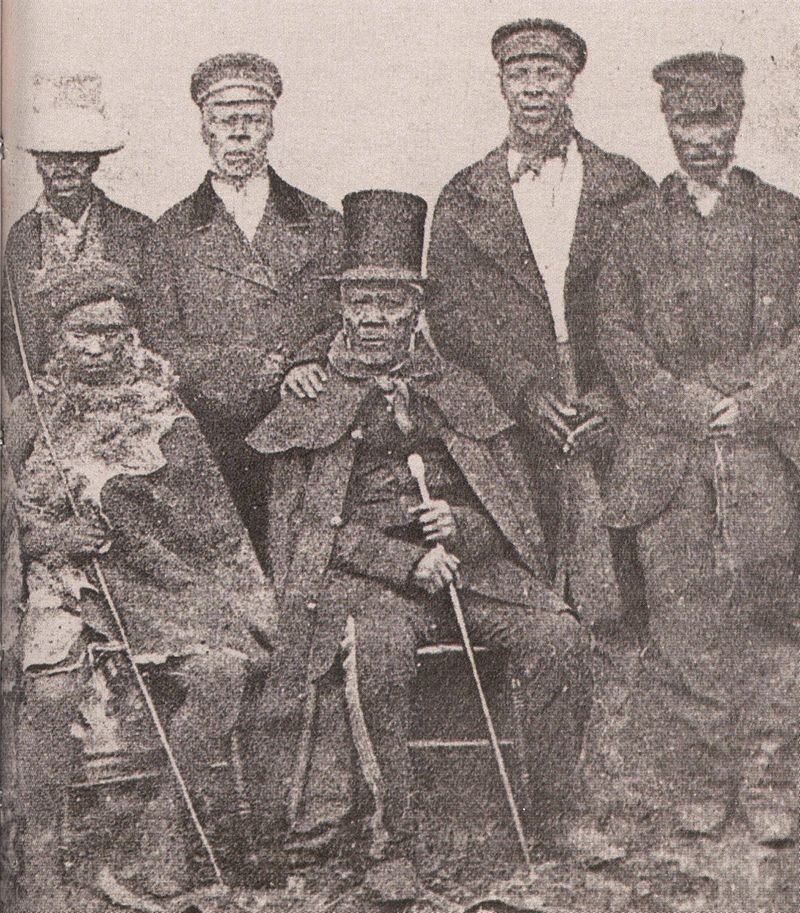
King Moshoeshoe I and his ministers

He was known for his generosity toward enemies, often integrating defeated groups into his kingdom. He united various displaced groups during the Mfecane (a period of widespread chaos and warfare in southern Africa), offering protection and forging a strong, centralized state. He also skillfully navigated threats from the Boers, British, and neighboring African groups, often using diplomacy to preserve his people’s autonomy. Due to constant hostilities and encroachments from Boers and wars, he signed an agreement with Queen Victoria of Great Britain to make Basutoland a British protectorate in 1868; the kingdom then became a crown colony in 1884, achieving independence in 1966 at which point the name was changed to Lesotho. Moshoeshoe died on 11 March 1870 and was succeeded by his oldest son Letsie I.

March 11, the day of his death , is celebrated throughout the kingdom as Moshoeshoe Day, a national holiday in Lesotho. The South African-made shweshwe fabric is named for King Moshoeshoe I who once received a gift of it and then popularized it throughout his realm.

What does Donald Trump’s Victory mean for Africa

Official portrait of President Donald J. Trump, Friday, October 6, 2017. (Official White House photo by Shealah Craighead)

This past Tuesday, November 5 2024, Donald Trump made an amazing and spectacular comeback to the highest office of the American nation, winning both the electoral and popular votes by a landslide, with the Republican party taking both the House and the Senate. In essence, he was given a mandate by the people. His victory, unlike what mainstream media had promised, was a real red tsunami (MMs should be sued for blatantly lying and taking sides in elections). Overall, many Africans rejoice because as it is well-recorded, Trump is the only American president in recent years who has not started a war. In the warmongering climate in which the world currently is, with fears of a third world war, this position offers a great appeal to many Africans. Relationships between countries are not love affairs, but business deals, and Africans need to remember what they stand for and seek benefits for themselves. Congratulations to the new president of the United States, and best wishes. Africans need to take advantage of the upcoming 4 years of a new establishment to enable policies that will strengthen them economically, politically, and socially.

There is no doubt that Donald Trump’s victory will have great impacts on Africa. There are many areas that will be affected by this change; but we will focus on two key ones. 1) The economy: what will happen to the African Growth and Opportunity Act (AGOA), and is it any good? What will happen to the significant American deals in Africa such as the Lobito Railway construction meant to go through Angola, Zambia and the Democratic Republic of Congo (DRC), contract which had been won initially by China? or other deals across the continent?; 2) Geopolitical dynamics: what will be Trump’s take on Africa this time around, particularly as it pertains to the slap taken in recent years by France in the Sahel or the closure of the American base in Niger and the countries of the AES federation, or the wars in Sudan and DRC, or Russia’s growth in Africa, or China’s deals on the continent? Will America continue its expansionist vision? Only time will tell.

Messages have come from all corners of Africa, congratulating Donald Trump for his victory. Excerpts below are from The Africa Report.

=====

Flag of Egypt
Flag of Egypt

… Egypt’s Abdel Fattah el-Sisi, … was quick to congratulate Trump… “Egypt and the US have always presented a model of cooperation and succeeded together in achieving the common interests of the two friendly countries, which we look forward to continuing in these critical circumstances that the world is going through,” said Sisi in a statement early Wednesday.

… The South African president [Cyril Ramaphosa] looks forward to “continuing the close and mutually beneficial partnership between our two nations across all domains of our cooperation.” In the global arena, said: “South Africa looks forward to our presidency of the G20 in 2025, where we will work closely with the US who will succeed us in the G20 presidency in 2026.”

Flag of South Africa

… Earlier, Clayson Monyela, South Africa’s head of public diplomacy, took to X to respond to a user’s assertion that Kamala Harris would be better for South Africa than Trump. “Historically relations between South Africa and the US thrive under a Republican White House,” he wrote, adding that during Trump’s first term, he appointed a woman born in South Africa as the US Ambassador to South Africa. “She was brilliant and helped to enhance the strong and mutually beneficial ties between our two nations.”

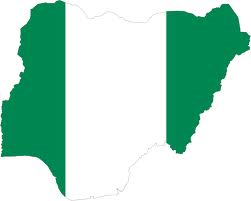
Flag and map of Nigeria

… Nigerian President Bola Tinubu in a statement expressed “heartfelt” congratulations to the US president-elect, seeking to strengthen the ties between the two countries “amid the complex challenges and opportunities of the contemporary world”. Tinubu said: “Together, we can foster economic cooperation, promote peace and address global challenges that affect our citizens.”  “Given his experience as the 45th president of the US from 2017 to 2021, his return to the White House as the 47th president will usher in an era of earnest, beneficial and reciprocal economic and development partnerships between Africa and the US.”

Flag of Kenya

Kenya’s William Ruto has been slower to congratulate Trump than his impeached deputy Rigathi Gachagua, who congratulated the American leader for “one of the greatest political come-backs of our generation”. He wrote on X:Your victory is clear proof that resilience and a never-say-die attitude will always TRUMP obstacles on the path to your destiny.” … President Ruto has since congratulated in a statement, celebrating the “longstanding partnership with the United States spanning over 60 years, grounded in our shared values of democracy, development and mutual respect”.

Flag of Ethiopia

… it was no surprise to see Ethiopian Prime Minister Abiy Ahmed among the first African leaders to congratulate Trump on his victory.

… Zimbabwe’s President Emmerson Mnangagwa congratulated Trump, saying, “The world needs more leaders who speak for the people”.

The DRC’s Félix Tshisekedi, whose controversial first-term victory was waved through by the first Trump administration, congratulated Trump, “in the name of the Congolese people, for his great victory”, saying he was ready to work together.

Mugabe to Trump: “Blow Trumpet of Peace”

Last week at the UN general assembly, President Mugabe of Zimbabwe asked President Trump of the United States to “blow the trumpet of peace.” I liked this, because I believe every leader out there should be blowing the trumpet of peace, and as a matter of fact, everyone of us has the mission to blow the trumpet of peace in our homes, at work, in our cities, in our countries, to make the world a better place for all of us. Enjoy!