

Last October, Ethiopian prime minister Abiy Ahmed declared that having sea access was an existential issue for Ethiopia, which is the largest most populous landlocked country in the world with over 100 million inhabitants. Everyone started fearing, because since Abiy’s arrival, Ethiopia has been in conflict internally in Tigray and Oromia. Everyone started fearing for a renewed conflict with Eritrea, after the peace treaty signed between both nations on 9 July 2018 which formally ended the Eritrean–Ethiopian border conflict. The worries stemmed from the fact that Ethiopia lost its sea access when Eritrea seceded in 1993. The conflict between Ethiopia and Eritrea is like the conflict between China and Taiwan… except it takes on an existential nature in the case of Ethiopia which is landlocked because of it. So when Prime Minister Abiy made his announcement in October, everyone on the horn of Africa started sweating. Ethiopia begged its coastal neighbors, but Djibouti, Eritrea, and Somalia all rejected its pleas for direct access to a port on the Red Sea.
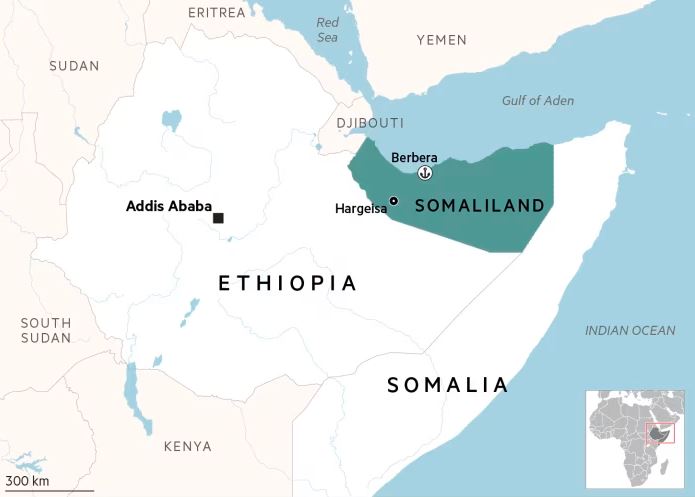
On January 1, 2024, Ethiopia announced an agreement signed with Somaliland to lease the port of Berbera on the Red Sea, and a 20-km stretch of Red Sea coastline for 20 years, in exchange Somaliland will receive shares in its neighbor’s flagship carrier, Ethiopian Airlines, Africa’s most successful airline – and eventual recognition as an independent state. Prime Minister Abiy’s office said the agreement would “pave the way to realize the aspiration of Ethiopia to secure access to the sea.” Somaliland’s foreign ministry said in a statement that the “historic agreement ensures Ethiopia’s access to the sea for their naval forces, reciprocated by formal recognition of the Republic of Somaliland, marking this as a significant diplomatic milestone for our country.” This agreement paves the way for Ethiopia to establish a commercial and military presence on the coast. I breathed a sigh of relief… which I had to take back the following day when Somalia’s President Hassan Sheikh Mohamud called the Ethiopia-Somaliland agreement an act of agression! He sees it as such, because the agreement would seem to imply that Ethiopia will recognize Somaliland as an independent state. Somaliland seceded from Somalia more than 30 years ago, but is not recognized by the African Union (AU) or the UN as an independent state. Quickly, both the US and the African Union have backed the territorial integrity of Somalia and urged all parties to cool tensions.
Ethiopia and Somalia are two states with a lengthy history of military conflict and animosity. Now, the president of Somalia is campaigning up and down the horn of Africa and has gotten the support of Egypt (remember that Egypt is mad at Ethiopia for building the Grand Ethiopian Renaissance Dam on the Nile and getting its proper share of the Nile’s waters – story for another day), Turkey, the puppet organization that is the AU, the European Union (EU), and the US. He stepped up the rhetoric by saying: “We will defend our country, we will defend it by all means necessary and seek the support of any ally willing to help us.” and called on youths “to prepare for the defense of our country“.
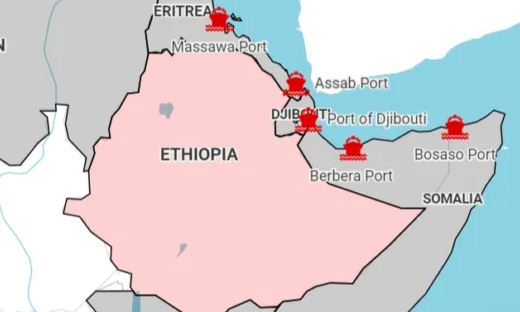
In my simple views, given Ethiopia’s large population, economic weight, and regional cloud (Ethiopia is now a member of the BRICS), any neighboring coastal state would benefit from working with it and developing agreements that will allow the use of its ports; it should be a win-win situation! Thus, it would seem careless for Somalia to want to start war, when all that could be done is get an agreement from Ethiopia to pay Somalia instead or split the proceeds from Somaliland… Ethiopia is definitely not getting access to the port of Berbera for free! Why is Somalia seeing a war threat from Ethiopia and not Somaliland… their issue is with Somaliland, why not deal with that? Neighboring Sudan has been at war since the middle of last year. Conflict would further destabilize the entire region, which is so close to the strategic Gulf of Aden on the Red Sea, one of the world’s largest shipping routes. Could this be a way for the Somalian president to justify his poor internal politics, by diverting his people’s attention towards war? These African countries are always ready and eager to lease their lands, ports, airports, for a specific duration to European or Chinese or even South African companies, why is it so hard to do the same for fellow African neighbors?
To learn more, read this article from the Conversation, Medium, or Modern Diplomacy. Dear reader, do you think this is the beginning of yet another conflict in the Horn of Africa? Do you think this will further play into the New Scramble for Africa?


 African Heritage