The Two Cowards

Tapper harvesting palm wine

Two cowards were banished from their village. They met and walked together into the deepest forest. Once there, they decided to start a home outside of God’s care. They lived there until winter (rainy season from July to October). They then decided to find some handles for their hoes. For that, they walked a long time until they arrived under the shadow of a raat (combretum glutinosum – tree with medicinal properties). One of them said:

  • You will climb on top of the tree to keep an eye out on the forest, while I will dig deep to find some good roots. If you see someone, let me know.
  • Sure, but you too, if you see something, do not forget to let me know.

The watchman climbed up the tree, while the other started digging at once. Soon, he finds two straight and long roots so beautiful that he can’t stop himself from shouting:

  • Ah! Here are two at last!

At these words, the watchman tumbled from the tree and, taking to his heels, dashed as an arrow. The other one, seeing his colleague running, throws away his shovel and runs after him.

running-iconThey run, they run losing their breaths and, when they think themselves safe, they stop. One of them asks:

  • What did you see?
  • No, I should be the one asking you that question, because I started running when I heard your warning!
  • But no, I did not raise the alarm! I was just cutting two beautiful roots that I had dug up. I only made a sigh of joy.
  • It is precisely your sigh that scared me.
  • And I, I ran away as soon as I saw you dash like an arrow!

Which of the two is the most coward?

According to the public, it is the one up in the tree, since the one digging only saw his roots.

Told by Khady Diouf, Contes Wolof du Baol, J. Copans and P. Couty, Ed. Karthala, 1988, p. 79. Translated to English by Dr. Y., Afrolegends.com


Eight Little Girls and Hyena

girls_8
8 little girls

Eight little girls liked to play in the surrounding fields. One day, while out picking flowers, it started to rain. They sought a shelter, and found a cave. They got in. It was the house of Surukuba, the Hyena.

A few moments later, Hyena arrived galloping.

Hyena
Hyene

As soon as she got near the cave, she stopped and exclaimed:

  • Hum ! It smells like a little girl here !

Then she got close to the the cave, and looking inside, exclaimed:

  • How many are you, little girls ?

The eight girls answered with a single voice singing:

  • Eight little girls !
  • We are indeed eight little girls, to fill Hyena’s mouth !

Overjoyed, Hyena jumped up, and galloped away. She wanted to tell another hyena. If she ate them right away, and then told that one day she had found eight little girls in her house, nobody would believe her ! She had to find a witness.

She galloped away, repeating the the little girls’ song:

  • Eight little girls, to fill Hyena’s mouth .

She found a comrade and invited her to come see what she had found in her cave. In her very own house : eight little chubby girls ! But before their arrival, two little girls ran out of the cave and went back to the village.

Girls_6
The remaining 6 little girls

The remaining six answered:

  • Yes, we are really eight little girls to amuse the fangs of eight hyenas !

The two hyenas went away galloping. They needed to find a third one ? Why not a fourth one ? Then a fifth one ? Then … after all, there were really eight little girls.

But when the hyenas got back and asked:

  • How many are you ? Girls ?
Hyena_2
2 hyenas

Only one voice replied. And when the hyenas ran into the cave, they only found a small ring that the oldest of the little girls had put down. It was this little ring which had replied.

Furious, they ran after the little girls. They arrived in the village, as the oldest of the little girls was climbing the fence. A hyena grabbed her foot:

  • I got you, little cunning one. And I am going to eat you !

The oldest of the little girls burst out laughing :

  • Oh! Big moron ! It is not my foot that you hold there, but a wood on the fence .

The hyena let go of the girl’s foot and grabbed the wood. The little girl then jumped into the village and alerted the hunters.

The French original can be found on Ouologuem Blog. Translated to English by Dr. Y., Afrolegends.com
The Story of Three Friends

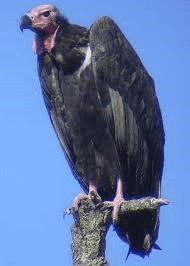
Vulture1
Vulture

A long long time ago, yes it was at the beginning of the world, there were three friends: the vulture, the hornbill, and the hen who became sick. The first one was suffering from baldness, the second from an anomaly on the beak, and the third from cramps on its legs. To make themselves heard, they started singing.

hornbill2
Hornbill feeding another

Adaunia Nomba
Dauni Nomba yôyé
Dauni Nomba
Inden sanga nomba kôyé
Life here
what life here !
Life is in auction !

God did not answer, so they decided to go see Him directly so that He would heal them. The hen challenged:

poule
Hen

My friends let’s not go beyond protocol, God will not delay. By acting as you intend to, we will make Him angry. Why the hurry?

The vulture and the hornbill did not listen to the hen and went up the sky flying as hard as possible. As they rose higher and higher, God arrived and healed the hen. Since then, the vulture has remained bald, and the hornbill has a crooked beak. To this day, they keep hovering in the air in search of God.

The French original can be found on Ouologuem Blog. Translated to English by Dr. Y., Afrolegends.com

Bonnes Fêtes de Fin d’Année

Que de couleurs, que de rires, que d’astuces, que d’intelligence dans ce livre! Le Lièvre, la Princesse, et la marmite de piment est un livre véritablement adapté a toute période enjouée! Je vous garantis qu’il vous fera passer de bons moments. C’est sur Amazon Kindle. Bonnes fêtes de fin d’année!

cover-image

How to Heal Fear

There once was a man who was walking alone in the forest. He walked for so long that he got hungry. He stopped in a village. There, he was given food, ate so well that he renounced to continue on his trip. He took a wife among the young women of the village, started a home, and no longer thought of leaving.

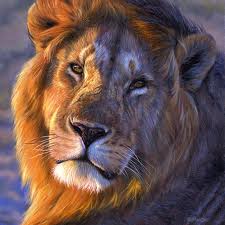
Lion
Lion

One day, after a good meal, the man decided to go to the forest which, unfortunately, was full of beasts, especially lions. The man knew not this.  As soon as he walked in, the king of the jungle came out with a long roar. Scared, the trembling old man peed on himself. The lion got close, and the old man  rushed into a thorny bush. The lion searched in vain; it could not find the man. However, it remained on the lookout for a week, then left disgusted. Then the old man stayed in his bush, completely stunned by his fate. A hunter came around. The man heard his footsteps and called out:

  • Who goes there?
  • It’s me
  • Who are you?
  • I am a hunter looking for game.
  • Hunter friend, could you please get me out of here?
  • But how did you manage to get in there?
  • It is big fear that drove me in here.
  • Then! It is a big fear that will get you out soon!
  • So what will you do?
  • You will know shortly.
feu3
Fire

Then the hunter started collecting firewood under the bush. All of a sudden, he put a fire in several places around the bush. Frightened, the old man rushed out, and with a violent head kick in the thorns, got himself out of danger.

The hunter welcomed him with a large smile. They hugged and became friends.

Told by Amsata Dieye, Contes Wolof du Baol, J. Copans and P. Couty, Ed. Karthala, 1988, p. 81. Translated to English by Dr. Y., Afrolegends.com
The Egg Lover

poule3
La poule / The hen

There once was a man who loved eggs above all. He bought several chickens and went to pay a visit to his fiancée. She was invited to cook rice. He gave her the chickens and a great quantity of rice. Once she was done cooking, all the young girls from the village showed up, responding to her invitation; it was a true feast. After the feast, the young girls all left. From a corner in the bedroom, near a drinking pot, a hen came out, capturing the visitor’s attention. He then thought to himself:

If there is a hen, then there are eggs!

It was then impossible for him to stand still in the room, given that he wanted to take the eggs. He thus decided to leave, and told his beloved, who tried to stop him from leaving. His horse was readied, but before mounting, he told the young girl:

Hold my horse, I will go drink a little before leaving.”

egg
La poule / The hen

He advanced toward the pot, grabbed all the eggs, and put them in his pants. He then went out with his fragile cargo. But just as he climbed on his horse, one egg fell from his pants, then a second one, then a third, and so on.

Oh! What is it? What is coming out of your pants, my honorable host?” says the girl.

It is nothing,” replies the man, “in my country, this is the time of the day when men lay eggs.”

Told by Tamsir Dieye, Contes Wolof du Baol, J. Copans and P. Couty, Ed. Karthala, 1988, p. 64. Translated to English by Dr. Y., Afrolegends.com


L’Araignée et le Caméléon

Un cameleon
Un cameleon

Il était une fois un caméléon très généreux et très charitable.  Il vivait du produit de son travail dans son champ, avait une grande concession sur laquelle il avait construit une belle case spacieuse.

Araignée, le plus grand paresseux de la région, aimait bien vivre d’expédients, sans se fatiguer à travailler, grâce à ses ruses malhonnêtes.  Il entend vanter autour de lui la générosité de caméléon et décide de l’exploiter.  Il se rend jusqu’à l’habitation de celui-ci, suivi de sa femme et de ses enfants couverts de haillons.  « Ayez pitié de pauvres malheureux sans abri ! Se lamente-t-il.  Ayez pitié, Caméléon ! La saison des pluies va commencer ! Nous n’avons pas de maison ! Mes enfants vont mourir de faim et froid, faibles comme ils sont ! »

N’écoutant que son bon cœur, Caméléon invite Araignée et sa famille à s’installer chez lui et met à leur disposition la moitié de sa belle maison.  Un jour, alors que Caméléon est parti aux champs, Araignée tue l’épouse de son bienfaiteur et vole tous ses pagnes et tous ses bijoux.  Au retour de son hôte, il lui raconte que des bandits ont assassiné Madame Caméléon et emporté tout ce qui se trouvait dans la maison.  Araignée ajoute qu’il aurait défendu la malheureuse s’il n’avait été assommé à coups de gourdin.  Caméléon est très fâché car, malgré tous ses mensonges, il a compris ce qui s’est passé.  Il se jure à lui-même qu’il se vengera cruellement et qu’Araignée mourra en châtiment de son crime.

Un plat de Yeke-yeke

Une semaine plus tard, il rapporte à la maison un énorme plat de yéké-yéké (*).  Araignée, son épouse et ses enfants en mangent tant qu’ils peuvent et se régalent.  Lorsque le plat est vide, Araignée demande : « Où avez-vous trouvé cette nourriture succulente, mon frère ? »

Caméléon répond : «  C’est un génie qui me l’a préparée ! Si, toi aussi, tu tues ta mère en sacrifice aux « Togbesikpé » (**), tu recevras le même cadeau. »

Plein de convoitise, Araignée exécute ce nouveau crime affreux.  Mais, contrairement à son attente, il ne reçoit point de yéké-yéké.  Le cœur de Caméléon se réjouit de cette vengeance et il murmure : « Si tu n’avais pas été aussi bête qu’avide, tu n’aurais pas fait cela ! » Continue reading “L’Araignée et le Caméléon”

La queue des animaux

Lion
Lion

Jadis, les animaux n’avaient pas de queue. Le cheval ne pouvait pas chasser les mouches, l’écureuil sans queue avait du mal à sauter de branche en branche, le renard était bien moins beau et ne parlons pas du lion!
Le sage roi des animaux, le lion, prit la décision de remédier à cette situation.  Il réfléchit pendant longtemps à la façon dont il allait s’y prendre et à la fin, il fit appeler le renard pour lui demander conseil.
« Tous les animaux ne peuvent pas avoir la même queue », estima le renard.
« Je sais cela, moi aussi », répondit le lion. « Mais comment départager les animaux sans se montrer injuste ? »
Le renard réfléchit un instant, puis déclara :
« C’est simple. Ceux qui arriveront les premiers recevront les plus belles queues. »
Le lion acquiesça :

Renard
Renard

« C’est une excellente idée. Cours vite dans la forêt et préviens tous les animaux qu’ils doivent se présenter à midi, au bord du ruisseau, pour la distribution des queues. »
Le renard transmit le message et courut vite vers le ruisseau pour arriver le premier.  Il fut suivi de près par le cheval, l’écureuil, le chat et le chien qui arrivent toujours les premiers quand on distribue quelque chose.  Vinrent ensuite les autres animaux : l’éléphant, le cochon et le lièvre se présentèrent les derniers.

Lievre
Lievre

Lorsque tous les animaux furent réunis dans la clairière, le lion se mit à distribuer les queues.  Il se servit d’abord lui-même : ce fut une superbe queue, longue et dorée, terminée par un plumeau.  Ensuite, le lion attribua de très belles queues bien touffues au renard et à l’écureuil. Le cheval opta pour une magnifique queue en crin.  Le chien et le chat reçurent encore des queues fort présentables, mais les animaux qui arrivèrent les derniers, se trouvèrent bien démunis.  L’éléphant eut une maigre cordelette avec quelques soies au bout.  Il en fut si navré qu’il en porte aujourd’hui encore la trompe basse.  La queue du cochon était fine comme un ver de terre.  Il la fit boucler pour la rendre plus jolie.  Le pauvre lièvre resta sans queue.  Le chien et le chat commencèrent à se disputer pour savoir lequel d’entre eux avait la plus belle queue.  À la fin, le chien attrapa le chat et lui arracha d’un coup de dents l’extrémité de la queue.  Le chat s’enfuit dans l’arbre et depuis ce jour, il préfère se sauver devant le chien.  Le lièvre ramassa le bout de la queue du chat et le colla sur son derrière.  Ceci explique pourquoi la queue des lièvres est si petite.

The Jackal and the Wolf

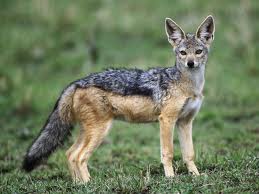
Jackal
Jackal

ONCE upon a time Jackal, who lived on the borders of the colony, saw a wagon returning from the seaside laden with fish; he tried to get into the wagon from behind, but he could not; he then ran on before and lay in the road as if dead.  The wagon came up to him, and the leader cried to the driver, “Here is a fine kaross for your wife!
Throw it into the wagon,” said the driver, and Jackal was thrown in.

The wagon traveled on, through a moonlight night, and all the while Jackal was throwing out the flsh into the road; he then jumped out himself and secured a great prize.  But stupid old Wolf (hyena), coming by, ate more than his share, for which Jackal owed him a grudge, and he said to him, ” You can get plenty of fish, too, if you lie in the way of a wagon as I did, and keep quite still whatever happens.

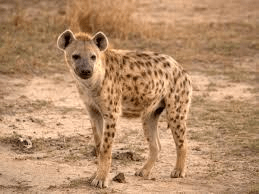
Hyena
Hyena (Wolf)

So!” mumbled Wolf.
Accordingly, when the next wagon came from the sea, Wolf stretched himself out in the road.

What ugly thing is this?” cried the leader, and kicked Wolf.  He then took a stick and thrashed him within an inch of his life.  Wolf, according to the directions of Jackal, lay quiet as long as he could; he then got up and bobbled off to tell his misfortune to Jackal, who pretended to comfort him.
What a pity,” said Wolf, “I have not got such a handsome skin as you have!

South African Folk Tales, by James A. Honey, 1910, Baker & Taylor Company.

The Lion, the Jackal, and the Man

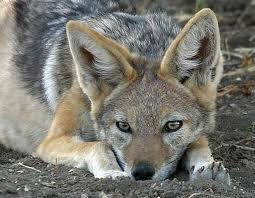
Jackal
Jackal

It so happened one day that Lion and Jackal came together to converse on affairs of land and state.  Jackal, let me say, was the most important adviser to the king of the forest, and after they had spoken about these matters for quite a while, the conversation took a more personal turn.

Lion began to boast and talk big about his strength.  Jackal had, perhaps, given him cause for it, because by nature he was a flatterer.  But now that Lion began to assume so many airs, said he, “See here, Lion, I will show you an animal that is still more powerful than you are.”

They walked along, Jackal leading the way, and met first a little boy.

Is this the strong man?” asked Lion.

No,” answered Jackal, “he must still become a man, O king.”

After a while they found an old man walking with bowed head and supporting his bent figure with a stick.

Is this the wonderful strong man?” asked Lion.

Not yet, O king,” was Jackal’s answer, “he has been a man.”

Lion
Lion

Continuing their walk a short distance farther, they came across a young hunter, in the prime of youth, and accompanied by some of his dogs.

There you have him now, O king,” said Jackal.  “Pit your strength against his, and if you win, then truly you are the strength of the earth.”

Then Jackal made tracks to one side toward a little rocky kopje from which he would be able to see the meeting.  Growling, growling, Lion strode forward to meet the man, but when he came close the dogs beset him.  He, however, paid but little attention to the dogs, pushed and separated them on all sides with a few sweeps of his front paws.  They bowled aloud, beating a hasty retreat toward the man.  Thereupon the man fired a charge of shot, biting him behind the shoulder, but even to this Lion paid but little attention.  Thereupon the hunter pulled out his steel knife, and gave him a few good jabs.  Lion retreated, followed by the flying bullets of the hunter.

Well, are you strongest now?” was Jackal’s first question when Lion arrived at his side.

No, Jackal,” answered Lion, “let that fellow there keep the name and welcome.  Such as he I have never before seen.  In the first place he had about ten of his bodyguard storm me.  I really did not bother myself much about them, but when I attempted to turn him to chaff, he spat and blew fire at me, mostly into my face, that burned just a little but not very badly.  And when I again endeavored to pull him to the ground he jerked out from his body one of his ribs with which he gave me some very ugly wounds, so bad that I had to make chips fly, and as a parting he sent some warm bullets after me.  No, Jackal, give him the name.”

South African Folk Tales, by James A. Honey, 1910, Baker & Taylor Company.