Cameroonian Musical Genius : Ekambi Brillant

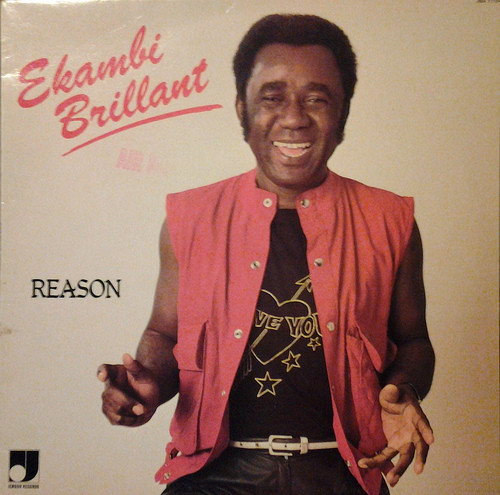
Ekambi Brillant on the cover of his 1987 album Reason (Source: RhythmConnection.Blogspot.com)

Ekambi Brillant was without doubt one of Cameroon’s greatest artists and one of the great African musicians. Originally from Dibombari, a village close to Douala, Brillant spent his youth with his maternal grandparents in Jebale, a suburban island of Douala. Per the words of Cameroonian author Elolongue Epanya Yondo, Jebale is known as the “emerald island, flamboyant jewel” on the Wouri estuary; no wonder, it served as the inspiration to a young Ekambi!  His passion for music was born from ancestral roots and from watching and listening to fishermen singing on their way back home from the sea.

Wouri river and the Djebale island seen on the other side

In 1962, Brillant was admitted to the 6th grade in the prestigious Lycée Général Leclerc (General-Leclerc High School) of Yaoundé. It was there, under the careful attention of Mr. Daniel Zane, his French music teacher, that he learned to play music, particularly the guitar. In 1971, at the age of 23, he stopped his studies and moved to Douala, where he joined the band The Crack’s as a guitarist. He applied for and won the music contest launched by the Office of French Broadcasting Television (ORTF), judged by some of the continent’s great musical personalities such as Manu Dibango and Francis Bebey. Thanks to this prize, he was able to release his first 45 rpm record, Jonguèlè la Ndolo, which sold 20,000 copies.
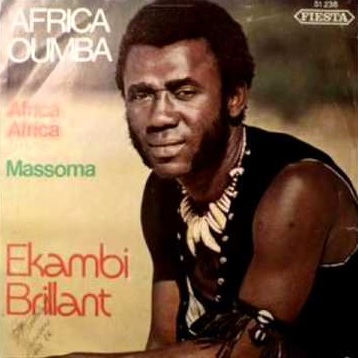
Ekambi Brillant’s album ‘Africa Oumba’

In 1972, he flew to France, where, with the support of Jean Dikoto Mandengue, a Cameroonian bassist, he produced and released his second 45 rpm record with Phonogram. The album was a major success and sold 25,000 copies. As stated before, Ekambi Brillant’s love for his country, his people, and music can be felt in every single note!

In 1975, he ended his deal with Phonogram and began a collaboration with Slim Pezin, with whom he released the album Africa Oumba, which included the major hit song “Elongui.” The song became an incredible source of inspiration for several other artists, both African and European, including the Greek singer Demis Roussos, who sang it as “L.O.V.E. Got a Hold of Me.” Roussos’ version used the exact melody of Ekambi Brillant’s original makossa hit, but he never acknowledged Ekambi Brillant—not even with a tribute. It was only later that African fans (including yours truly) loudly affirmed that this was Brillant’s original work. In the past, African compositions have often been adapted/plagiarized without formal credit, especially when entering European or American markets. Roussos earned millions from Ekambi’s song, without giving him a penny. This is reminiscent of Andre Marie Tala, Cameroon’s Blind Musical Virtuoso, and his song Hot Koki which was plagiarized by  James Brown, or more recently Shakira with “Waka Waka (This Time for Africa)” “adapting” the “Zamina mina (Zangaléwa)” song and claiming in an interview to have gotten inspiration while walking on a beach. The album Africa Oumba reached a record of about 4 million sales (diamond disk). Further collaborations with Slim Pezin as producer yielded titles such as Soul Castel and Musunguédi. In 1976, Ekambi Brillant formed his band known as The Ebis (Ekambi Brillant Show).

Ekambi Brillant ‘Muna Muto’

Over the course of his career, Brillant released nearly 20 albums. Brillant passed away on 12 December 2022 in Douala at the age of 74, after a battle with a long-term illness. Unfortunately, like many in Cameroon, he was a brilliant soul who barely received the recognition his genius deserved. He was from a generation of outstanding Cameroonian artists.

Ekambi Brillant remained an inspiration to generations of artists, propelling several careers and guiding many musicians—both Cameroonian, such as Marthe Zambo, Valery Lobe, and Alhaji Touré, and African, such as Cella Stella and Angelique Kidjo. He was so advanced, brilliant, and inspired … going through his music portfolio is filled with great sounds and a great source of inspiration. Cameroonians should get inspired from his work and celebrate his genius. 

.

Muna Muto (My Love, my Darling) by Ekambi Brillant

Ekambi Brillant on the cover of his 1987 album Reason (Source: RhythmConnection.Blogspot.com)

Today we will celebrate a song, Muna Muto, and particularly a singer who has touched generations of musicians on the African continent, Ekambi Brillant. Brillant is a Cameroonian singer who has contributed to the emergence of outstanding African singers, such as the Beninese-French singer Angelique Kidjo, first African singer to get a Star on the Hollywood walk of fame , Cella Stella, Marthe Zambo, and countless others. To me, just like his name, he is one of the most brilliant Cameroonian singers ever, with a great voice, bass mastery, and a great teacher.

Muna Muto is a love song which focuses on deep affection, longing, and devotion. It is a love so deep that you wonder what life could have been before meeting that special one.

Just with the first note, you can tell that Ekambi is deeply patriotic, and loving of his country. He tells you that he comes from a place of abundant love “O nin mboa su nya bwam wuma ndolo mo nye no.” He further tells you that it is a place where people greet each other with warmth, a place filled with beautiful music, sounds, and dances, where joy and happiness are omnipresent (Wuma mongele mam mese ma nanga no na pi. Na ma senga so bobe mulema mu monya weya. Nyola mabola mongo na londi na isom). That sounds like a description of Africa!

Coeur
Coeur / Heart

He tells his lover that she is his everything, the love they share grows stronger every day. She is his everything and he cannot bear to be without her. “Muna Muto, Na petane nde ndolo po, o bola oa mo … Bo bunya mo bo poï tenge, a makusane mba mo.”

The most touching part is that he has searched far and wide, and found no one like her: he has found his center, his person, his backbone.  “Na si bi ka bo bunya bo mende te nde o po, Na ma nanga nde ndoti, bulu na bulu te … Bwanga to bo bo titi, ye nde welisane” (I have searched far and wide but found no one like you. You are the only one who understands me, heart and soul. … And our love will last forever, as we journey through life together.) So deep! All this on such a deep, dancing tune, and the chorus makes you want to sing “Muna Muto” for the rest of your life!

As you go on to celebrate Valentine’s day, please sing Muna Muto to your special one, that one you have searched far and wide for, the only one, the one who understands your heart and soul, a love that will be immortal. Enjoy Mot’a Muenya love song!

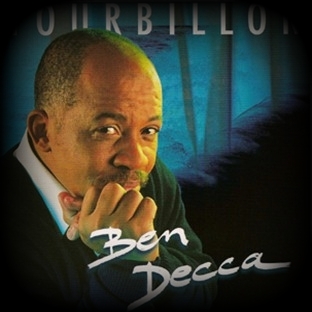
“Souffrance d’Amour” / “Love Suffering” by Ben Decca

Ben Decca (Source: KamerLyrics.net)

For this year’s Valentine, we will introduce you to “Souffrance d’Amour” by the Cameroonian singer Ben Decca. The song, “Souffrance d’Amour” translated as “Love suffering” tells of a love so deep, so strong between two people, but which does not work. So it is, in the words of Ben Decca himself, “proof that two people can go their separate ways and remain in love despite everything. “Souffrance d’Amour” is a shout-out to people who give themselves entirely to the other with sincerity and loyalty, but unfortunately, in general they receive the opposite of what they put in… sad reality…” [“Souffrance d’Amour” est la preuve que deux personnes peuvent se quitter et demeurer amoureuses l’une de l’autre malgré tout. Souffrance d’Amour” est une dédicace aux personnes qui se donnent à l’autre entièrement avec sincérité et loyauté, hélas en général ils reçoivent l’opposé de ce qu’ils ont misé… triste réalité…]. “To love is to forget oneself and to think only of the one we love” [Aimer c’est s’oublier soi-meme, et ne penser qu’a celui qu’on aime…”]

For those who do not know him, Ben Decca, he is the ultimate crooner of Cameroon… You could think of a Luther Vandross type… His career spans over 40 years of constantly amazing music. He is a pure talent, and hails from a family of musicians, with 3 younger siblings who are also renowned singers  Grâce Decca, Dora Decca, and Isaac Decca, and nephew to the great Cameroonian legend Eboa Lotin, and great grandson to Lobe Lobe Rameau one of the pioneers of Makossa in Cameroon. His work has been the legendary, and he has lightened to lives of so many of us lovers of life, given life to our feelings of joy, pain, grace, hurt,…. Kudos to the great, and only Ben Decca.

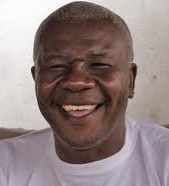
Lapiro de Mbanga in his own words

Lapiro de Mbanga
Lapiro de Mbanga

I decided to make a compilation of some of Lapiro de Mbanga’s words in his interviews.  The full interview to Daniel Brown from Freemuse can be found here; for the interview Lapiro gave to Le Messager, click here; and lastly the interview to Phoenix Gauthier can be found on RFI.  The video below shows Lapiro de Mbanga’s proudly expressing himself at the Oslo Freedom Forum in 2013.  Enjoy!!!

============

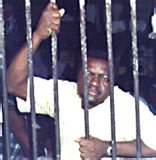
About life in prison: … There is no hygiene here and we must share our most intimate moments with the other cellmates. … I should have been taken to hospital for a consultation but my status as a political prisoner has meant I have not been allowed to go once in these two years. I somehow survived the typhoid attack in December by taking the antibiotics my wife Louisette brought me. It’s fortunate she comes every few days. It’s a five-hour round trip from Mbanga, it’s taking a toll on her, too. …  I wake at 7 to 8 every morning …. I keep informed about the outside world thanks to TV5 [France’s international station] or Radio France International. I eat, chat with the others in the cell, play Ludo, scrabble, draughts. It’s impossible to compose in such an atmosphere. I need calm, serenity. Here, I cannot concentrate and write the thoughtful songs people expect of me.

Pius Njawe in jail
Pius Njawe, a Cameroonian journalist and martyr in jail

We have penal rations twice a day. At 1pm we are given boiled corn and at 5pm there’s rice in some warm water. It’s the same every day. It’s way below minimum requirements. My wife brings me food every two days, I couldn’t survive otherwise. I’ve seen people die of hunger. It happens every day in Cameroonian prisons.

Normally, I should have no contact with the outside world. Telephones are illegal here. I’m speaking to you because we have to scheme like common crooks. In prison there are all kinds of trafficking going on, including this one. You pay guards to turn a blind eye. You know, in Cameroon you can buy everything. This country has been world champion in terms of corruption.  It’s everywhere and filters down to here. (Source: Daniel Brown, Freemuse)

On being scared for his life because of his outspokenness: It’s all part of my struggle. If I was the scared type I would never have started singing in 1985. I’m not going to start getting scared after all these years. My struggle has always been to denounce inequalities and danger is part of that mission. The only thing that has changed for me since 1985 is I’m at the head of a family with six children. I can guarantee my own security, but not theirs. I’m scared for them. But I have no choice. If you start such a struggle, somebody must pay. Still, my family is unhappy with such risk taking. That’s why I think if I don’t go into exile after this prison term, I won’t survive very long out therethey’ll kill me. Because it’s obvious people in charge don’t want to be confronted with somebody who stops them from just getting on with things. (Source: Daniel Brown, Freemuse)

On going to exile: For starters, I am not in exile; I am political refugee in the USA. I needed a social security and an insurance for the future of my children; I refuse to manufacture unemployed people full of diplomas who will retire without ever having worked.  [Pour commencer, je ne suis pas en exil; je suis réfugié politique aux USA. J’avais besoin d’une sécurité sociale et d’une assurance pour le futur de mes enfants; je refuse de fabriquer des chômeurs bardés de diplômes qui vont aller à la retraite sans avoir jamais travaillé.] (Source: Le Messager 04 April 2013)

Flag of Cameroon
Flag of Cameroon

About the way he spends his days now in the US: I dedicate myself to my children’s education. I have, during 3 decades, focused my life on my struggle, the fight against social inequalities, forgetting that I was first a head of family. Despite what the Um [Nyobé], Ouandié, Moumié, and all the known and unknown freedom fighters have done, nobody knows what has become of their offspring. For me, it is very serious. It is as if they had fought for nothing. [Je me consacre à l’éducation de mes enfants qui sont ici avec moi. J’ai pendant 3 décennies focalisé ma vie sur mon combat, à savoir la lutte contre les inégalités sociales oubliant que j’étais d’abord un chef de famille. Malgré tout ce que les Um, Ouandié, Moumié et tous les autres combattants connus et inconnus ont fait, personne aujourd’hui ne sait ce que sont devenues leurs progénitures, Pour moi, c’est très grave. C’est comme s’ils ont combattu pour rien …].  (Source: Le Messager 04 April 2013)

About his rupture with Biya and Fru Ndi: Paul Biya, even if he listens to my songs, does not count on my very short list of friends. So no need to break up with him even though I never voted neither for him, nor for Ahidjo’s party which he hijacked in Bamenda in 1985. Fru Ndi, whom I now call “CHIENMAN” and not Chairman, has ceased to be worthy of my respect, given his multiple reversals and changes. … I cannot be in good terms with an individual who plots against the people, it is as simple as that.  [Paul Biya même s’il écoute mes chansons, ne compte pas sur la liste très restreinte de mes amis. Donc pas besoin de rompre avec lui encore que je n’ai jamais voté ni pour lui-même, ni pour le parti de Ahidjo qu’il a détourné à Bamenda en 1985. Fru Ndi que j’appelle désormais “CHIENMAN” et non Chairman, a cessé depuis bien longtemps d’être une personne ayant droit à mon respect, compte tenu de ses multiples virements, revirements et retournements de veste. … Je ne peux pas être en bon terme avec un individu qui complote contre le peuple, c’est aussi simple que cela]. (Source: Le Messager 04 April 2013)

On his dream for Cameroon? I dream of a Cameroon where the power will belong to the people.  Where the wealthy will not use the misery of the poor by giving them some rice, fish, beer and 1000 FCFA to stay in power and plunder the country’s resources.  [Je rêve d’un Cameroun dont le pouvoir appartiendra au peuple. Où les riches ne vont pas se servir de la misère des pauvres en donnant aux démunis du riz, du poisson, de la bière et 1000f pour aller au pouvoir piller les ressources du pays.] (Source: Le Messager 04 April 2013)

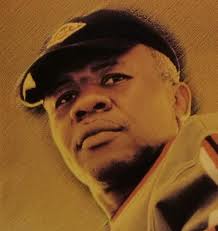
Lapiro de Mbanga
Lapiro de Mbanga

On his struggle: The fight continues. I got out of jail only three months ago. And I need to continue the fight at a greater level. … You have seen my environment. Here in Mbanga, it is 7:30PM and it is already dark everywhere. Without electricity, you can be attacked. Yet, there are people who fight at work all day. And at the end of the day, there is no light, no health, the children cannot go to school. There is no escape. That is my fight, my struggle. It is for that Cameroon that I am fighting. And I want the Americans and Europeans to understand. I come to tell them: thank you for fighting for Lapiro de Mbanga [release] , but there are 20 millions of Lapiro de Mbanga in Cameroon who experience the martyr daily. Wake up and do something. [Le combat continue. Je suis sorti de prison il y a seulement trois mois. Et je dois continuer le combat au niveau des grandes instances. … Vous avez vu mon environnement. Ici à Mbanga il est 19h30 et partout il fait noir. Sans électricité vous pouvez être agressé ici. Pourtant, il y a des gens qui se battent au travail toute la journée. Et, à la fin, il n’y a pas de lumière, ni de santé, les enfants ne peuvent pas aller à l’école. Il n’y a pas d’issue. C’est ça mon combat. C’est pour ce Cameroun-là que je me bats. Et je veux que les Américains et les Européens comprennent. Je viens leur dire par ma voix : merci d’avoir combattu pour Lapiro de Mbanga, mais il y a 20 millions de Lapiro de Mbanga au Cameroun qui subissent le martyr au quotidien. Réveillez-vous et faites quelque chose.] (Source: RFI, P. Gauthier, 12/07/2011)