15 jours et 27 ans, après avoir fait assassiner Thomas Sankara, Blaise Compaoré est à son tour forcé ou plutot jeté dehors. En effet, c’était le 15 Octobre 1987 que Thomas Sankara était assassiné par des hommes de Compaoré. Donc le fameux Compaoré est tombé le 30 Octobre 2014. Comme on le dit si bien, quiconque se sert de l’épée perira par l’épée. Maintenant, notre voeu le plus cher est que cette révolution populaire ne soit pas confisquée par l’armée qui est constituée d’hommes de Compaoré, et des bras de la France. Bye Bye Compaoré.
==========
Flag of Burkina Faso
15 days and 27 years, after having murdered Thomas Sankara, Blaise Compaoré is in his turn forced to resign or rather booted out of office. On 15 Octobre 1987 that Thomas Sankara was murdered by men of Compaoré. Now, Compaoré himself fell on 30 October 2014. As it so well said, anyone who uses the sword, will die by the sword. Now, our hope is that the people’s revolution will not be hijacked by the army who are Compaoré’s men and France’s men. Bye Bye Compaoré.
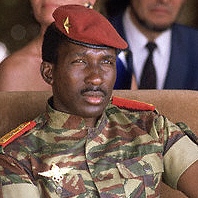
Here is the complete text of a hand-written speech that the revolutionary Burkina Faso President and African statesman Thomas Sankara was set to deliver on the evening of the day he was assassinated, October 15, 1987. Enjoy this rare jewel! The original in French is on ThomasSankara.net, while the translated English version appeared on Pambazuka.
=========
Dear Comrades,
The Revolution’s prestige, and the confidence with which the masses have devoted themselves, has suffered a serious shock. The consequences are a remarkable decline in enthusiasm for the revolution amongst activists, a serious decrease in the commitment, determination, and mobilization of our grassroots base; finally, distrust and suspicion everywhere and factionalism amongst our leadership.
What are the causes of this?
Burkina Faso
There are, on one hand, significant questions which could divide us pertaining to the operating structures and the internal functioning of the CNR based on ideological positions. On the other hand, there are questions regarding the relationships between the principal actors, as each of us is a leader. However, as important as ideological and organisational questions are, they are shown to be less important in our current situation. Indeed, at the soul of any organisation, there is a clash of opposites followed by union of these same opposites. The unity of these opposites is always academic, it is never absolute; it is both relative and temporary. “The unity of opposites is consequently an absolute, exactly as development and motion are absolutes”. This is why balance itself is temporary. It can be questioned at any time. It is our responsibility to preserve it as long as possible, to restore it each time it has been threatened or broken. In the case of organizational and ideological questions, we have benefited each time that someone considered it necessary to raise an opinion different from mine, to defend a position different than mine; you did this with freedom and confidence. These I have adopted and implemented, along with advice, suggestions, and recommendations. Moreover, resolution of disputes between men is always simple when trust exists. This means that as long as the revolution is governed by principles, open debate, criticism and self-criticism, it will succeed in resolving any misunderstandings, provided that trust is maintained. Continue reading “Thomas Sankara: the Speech he would have given on 15 Oct 1987”→



 African Heritage